Oceans

NOAA breaks ground on upgraded port facility in Ketchikan to host research vessel Fairweather

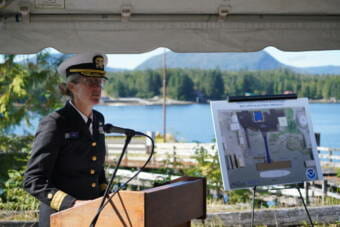
Rear Admiral Nancy Hann, deputy director of NOAA’s Commissioned Officer Corps and its Office of Marine and Aviation Operations, speaks during a groundbreaking ceremony for a port facility in Ketchikan. (Eric Stone/KRBD)

A long-sought revitalization of a National Oceanic and Atmospheric Administration facility in Ketchikan is officially underway. The project aims to give the NOAA ship Fairweather a permanent home.
Local, state and federal officials plunged gold-painted shovels into two long, narrow wooden boxes filled with dirt Tuesday morning.

The ceremonial groundbreaking marks the beginning of work on an $18.7 million project. There’ll be a new office building, utility upgrades and, most importantly, a floating pier to accommodate the NOAA research vessel Fairweather and its 50-plus crew.

NOAA Rear Admiral Nancy Hann says the facility will support fisheries research, hydrographic surveys — and the local economy.

“By revitalizing this facility, we can bring a steady flow of officers, our professional mariners, our logistical support specialists and our scientists to the city, creating a hub for NOAA’s maritime operations in the region,” Hann said.

NOAA Ship Fairweather in the Gulf of Alaska. The Fairweather surveyed Arctic waters in 2012 in preparation for future charting survey expeditions.
NOAA Ship Fairweather in the Gulf of Alaska. (NOAA photo)

The project has long been a priority for local and state officials. As industrial-scale logging slowed around the turn of the 21st century, the late U.S. Sen. Ted Stevens used his position as chairman of the appropriations committee to require NOAA to homeport the Fairweather in Ketchikan.

The agency purchased a dock and some oceanfront property in an industrial area south of downtown Ketchikan. But in 2008, the agency determined the dock couldn’t be repaired, and it was condemned.

Sen. Dan Sullivan, a longtime advocate of the project, credits Ketchikan’s elected leaders with keeping the pressure on. 

“You know, this is a story, what we’re seeing right now, of first, relentless advocacy and a community, Ketchikan — all its leaders, its tribal leaders — who would not take no for an answer, who refused to say, ‘We’re going to give up this ship,’ which by law is supposed to be homeported here,” Sullivan said.

He pointed to the efforts of state Sen. Bert Stedman, who redirected some federal money to Ketchikan’s borough to help pay for the project. The Sitka Republican says he’s pushing for more federal spending in Ketchikan.

“We are actually talking about the second phase of this expansion, right after we get the ribbon cut,” Stedman said with a chuckle. “We’ll be working with Sen. Sullivan and NOAA, hopefully for expanded assets.”

Deputy Secretary of Commerce Don Graves, whose agency oversees NOAA, says discussions aren’t yet underway for a second phase of its Ketchikan port project. But he says he’s open to finding more ways for the Biden administration to grow infrastructure investment in Ketchikan.

“The Commerce Department is focused on finding ways to grow economic development in this community and other parts of the region. So we’re open to having whatever conversations the senator and others would like to have about ways that we can drive that economic opportunity,” he said.

The new NOAA facility will be built by Glennallen-based regional Native corporation Ahtna. Construction is scheduled to wrap up by December, 2022.

Dead seabirds are washing ashore in Western Alaska for the fifth straight summer

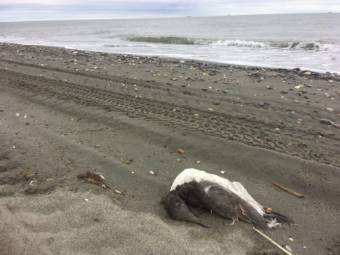
A dead seabird on a Nome beach. (Photo courtesy Gay Sheffield, UAF & Alaska Sea Grant)

Communities all over Western Alaska are finding dead seabirds on their shores for the fifth consecutive summer.

Researchers and federal scientists still have no definitive explanation for the cause.

Gay Sheffield, a wildlife biologist with the University of Alaska Fairbanks and Alaska Sea Grant, collects dead seabird samples each year from communities across the Bering Strait region.

“I would say the scope of this bird die-off is regionwide, and reports have come from Gambell, Savoonga, Koyuk, Shaktoolik, Golovin, the Solomon area, East Beach, West Beach (near Nome), even around Diomede and actually at Shishmaref as well,” said Sheffield.

The numbers total in the hundreds, and that’s only what’s been reported so far.

The National Park Service recently conducted a survey in the Bering Land Bridge Preserve and reported to Sheffield that they found upwards of 100 dead birds every two-and-a-half miles on some stretches of the beach.

According to Kathy Kuletz, seabird section lead for the U.S. Fish & Wildlife Service, the die-off is significant but not as large as the thousands found in Bristol Bay in 2019. Her team is responsible for managing seabirds across Alaska and sending any carcasses onto the appropriate testing labs like the National Wildlife Health Center in Madison, Wisconsin.

And so far in this die-off, Kuletz told KNOM, no infectious diseases or toxins related to harmful algal blooms have been identified in the seabirds’ tissues.

“The last I’ve heard, in most cases, the birds are emaciated, so they’re starved. And so far there’s been no evidence of disease or toxins from harmful algal blooms or anything like saxitoxin,” said Kuletz.

“So if you cross off toxins and you cross off disease, what’s left? And I am left thinking the birds actually cannot find the proper foods,” said Sheffield.

After five years of consistently documenting dead, adult seabirds of multiple species in the Bering Strait region, more and more evidence supports Sheffield’s claim: Seabirds are not eating.

UAF researcher Alexis Will recently released a study that ruled out food shortages as a cause for the 2018 seabird die-off documented on St. Lawrence Island. Since their usual food source — various benthic prey — was available for the birds at the time, Will cited the potential for another unknown factor that was preventing murres, specifically, from catching their prey.

Savoonga residents like Punguk Shoogukwruk have also seen distressed and dying chicks once again this summer. Shoogukwruk has been collecting seabird samples for Will’s research and continues to observe low numbers of nesting birds, similar to what he saw last year.

Meanwhile further south, Will said a major kittiwake die-off is occurring in the Gulf of Alaska but is unrelated to what’s happening in the Bering Strait region this summer.

The unanswered question remains, however: What is causing these seabirds to starve to death?

“The Bering Sea’s ecosystem is in serious, serious trouble, and my fear is that it’s on the verge of collapsing,” said Iyaanga Delbert Pungowiyi.

Pungowiyi, a tribal member of the Native Village of Savoonga, is urging leaders to take action to reduce the effects of climate change in the Arctic. What’s happening to the seabirds cannot be reversed he said, and he wants these die-offs to be taken seriously.

For the U.S. Fish & Wildlife Service’s part, biologist Robb Kaler said its options beyond testing more birds and monitoring the die-offs are limited.

“In terms of what the agency can do about it, is well… remain vigilant, continue asking for community members to share reports and observations and then continue to work with our other colleagues to try to figure out if it’s a food issue?” said Klaer. “Is it food as well as exposure to saxitoxin or a harmful algal bloom event?”

Fish and Wildlife said it does not have plans to conduct a research cruise or do in-person seabird surveys in the Bering Strait region this year.

While more dead birds are studied, and unanswered questions remain, subsistence users across the region are feeling the impacts of the die-off.

In Savoonga, Pungowiyi said, fewer seabirds are nesting, fewer eggs are available and fewer healthy birds are around to eat, which has significant food security implications.

“Since time immemorial,” he said, “over 90% of our food security has been from the Bering Sea itself with the bowhead whales, walrus, seals, seabirds and ducks.”

One Savoonga elder even sent his dinner of seven auklet chicks to Sheffield, wondering if it was safe for him to eat as he normally would. He also reported observing seabirds eating the wrong type of krill based on his own traditional knowledge of seabirds’ diets and behaviors.

Pungowiyi, Sheffield and many others believe the five straight years of seabird die-offs are connected to an ecosystem-wide shift that’s been occurring in the Bering Sea since the cold pool barrier was removed in 2018.

Bottom temperatures in the Bering Sea (NOAA Fisheries)

Keeping with this trend, scientists with NOAA Fisheries documented extremely warm temperatures in the Northern Bering Sea on Aug. 21. According to data from this summer’s bottom trawl survey, sea bottom temperatures in the Eastern Norton Sound and other waters around Nome reached 8 degrees Celsius, or just over 46 degrees Fahrenheit.

According to climatologist Rick Thoman, these significant temperature changes are a sign of what’s yet to come.

“That is undoubtedly going to be important for commercial fisheries,” he said. “And in the long run, that is going to, I’m sure, impact the kinds of fish species that show up and wind up taking residence in the Northern Bering Sea as well.”

But in terms of what caused these significantly warm sea bottom temperatures, Thoman said, he doesn’t have enough information yet to explain that.

Sculpins with eggs on their heads: A sea creature mystery is afoot on Juneau’s sandy beaches

Bob Armstrong is a retired fisheries biologist who still spends a lot of time observing Juneau’s marine life.
Bob Armstrong is a retired fisheries biologist who still spends a lot of time observing Juneau’s marine life. (Photo by Bridget Dowd/KTOO)

Strolling along one of Juneau’s sandy beaches, you might see footprints, remnants of bonfires, or a variety of birds. But what about what’s underneath the sand?

To answer that question, retired fisheries biologist Bob Armstrong frequently makes the trek down a rocky hillside toward Eagle Beach. He left the Alaska Department of Fish and Game in 1984, but at 80 years old, Armstrong still spends a lot of mornings observing local marine life.

“One of my favorite things to do is just sit down here with a chair and a cup of coffee,” he said.

Stepping over layers of blue mussels, Armstrong makes his way toward the shore at low tide. He has a tripod over one shoulder, a shovel in the opposite hand, and a camera bag slung across his chest.

Two years ago, on a day much like this one, Armstrong saw something that surprised him.

Retired fisheries biologist Bob Armstrong wades through water at Eagle Beach, observing critters in the sand.
Retired fisheries biologist Bob Armstrong wades through water at Eagle Beach, observing critters in the sand. (Photo by Bridget Dowd/ KTOO)

“A raven would dig up quite a large [Pacific] Staghorn Sculpin, maybe up to a foot and a half long,” he said.

Often found in shallow seawater, sculpins are scaleless, bottom-dwelling fish with heads much larger than their tapered tails. Pacific Staghorn Sculpins live all along the Pacific Coast from Alaska to Mexico.

Armstrong said this one was buried in about a foot of sand when the raven got to it.

“The sculpin would flip about on top of the sand,” he said. “It was very much alive, which also surprised me because they were living out of water.”

But, the fish, now plucked from its shrouded bed of wet sand, wasn’t what the raven was after. Instead, the bird picked up a nearby clamshell, which was concealing two clusters of sculpin eggs.

“[The raven] would grab the eggs and then fly off probably to its nest to feed its young the sculpin eggs,” Armstrong said. “This happened on three different occasions and I didn’t realize exactly what was going on until I looked at the videos.”

That prompted him to do some research, looking through scientific literature on sculpins, only to find that what he’d seen wasn’t well known or documented.

“With sculpins, it’s usually the male that guards the eggs until they hatch,” he said. “What I suspected happening, was that the female would lay her eggs near or on the head of the male sculpin and then put a horse clamshell on top of it to protect it and this seems extremely bizarre. It just really excited me.”

As Armstrong continued to observe the critters, he ran into his former coworker and fellow retired biologist, John Palmes.

John Palmes is a retired Juneau biologist.
John Palmes is a retired Juneau biologist. (Photo courtesy of John Palmes)

“We’re both naturalists,” Palmes said. “We just really love nature. That’s our joy to go out there and look at that stuff and to understand it and try to figure it out.”

During their conversation, Palmes realized they’d both observed the same spectacle at different times on Eagle Beach: a disturbed area in the sand with a large horse clam shell sitting on top.

“Underneath the edge of the clamshell, I could see eyes,” Palmes said.

Retired biologist John Palmes used a photo of a sculpin in the sand to recreate what he saw when he found a horse clam shell on top of a sculpin's head.
Retired biologist John Palmes used a photo of a sculpin in the sand to recreate what he saw when he found a horse clamshell on top of a sculpin’s head. (Photo by John Palmes)

“So I just flipped the shell over and underneath there was a sculpin with a big mass of eggs on its head,” Palmes said. “They were molded to the shape of the shell.”

Palmes knows a lot about fish, but he’s never seen anything like this.

“This sculpin thing is so cool because it is so weird,” he said.

Retired biologist John Palmes turned a horse clam shell over (A) to reveal a sculpin (B) that was hiding its eggs inside the shell.
Retired biologist John Palmes turned a horse clamshell over (A) to reveal a sculpin (B) that was hiding its eggs inside the shell. (Photo by John Palmes)

After seeing it again at another beach, Palmes started to wonder if the event had something to do with the tides.

Birds fly over the shoreline at low tide on Juneau’s Eagle Beach in July 2021.
Gulls fly over the shoreline at low tide on Juneau’s Eagle Beach in July 2021. (Photo by Bridget Dowd/KTOO)

“I think they lay their eggs and they dig themselves in, so that they’re pretty much free of predation for the time when the beach is nearly exposed,” he said. “The other thing that happens is they’re in warmer water. The sun provides higher temperatures and warmth to incubate the eggs. So I think that’s all part of the plan.”

Palmes said he can’t know for sure yet, but it would make a lot of sense. By sharing his observations, he hopes other beach-goers will keep an eye out for the phenomenon.

“It’s just a wonderful thing to do and it feeds you,” Palmes said. “The Lingít people say ‘when the tide is out, the table is set’ and it’s true.”

Armstrong and Palmes don’t have any plans to formally research this sculpin behavior, but with the help of some citizen science, Palmes said they might be able to solve this sea creature mystery just for fun.


Glacier Bay whales bouncing back after marine heat wave

Whales in Glacier Bay
Whales in Glacier Bay (Wikimedia Commons)

Humpback whales were hit hard by “the blob”—a warm water event that killed off all kinds of sea life in the North Pacific. Researchers at Glacier Bay National Park and Preserve say the humpback population is rebounding.

The reflection of Mt.Wright ripples on the glassy water of Glacier Bay National Park and Preserve until a humpback breaks the surface for a huge mouthful of fish.

Chris Gabriele is a biologist with the park service. She has been observing whales here for over 30 years, but the sight of one of the mammals up so close still wows her. She snaps a few photos and checks them.

“So, that’s identifiable enough for us to tell what individual that is,” she said, looking at the image.

Whales are recognizable by their unique dorsal fins and flukes.

The photos and a log of the whale’s coordinates are the two newest entries in a data set that stretches back to 1973 — it may be the longest-running humpback study in the world. Some whales have returned here for more than 40 years. Some are older than Gabriele.

It’s long-term observational data like this that makes it possible to correlate changes in the ocean with their effects on the species that live there. Researchers could track the severity of a recent marine heat wave because the whale population sank by more than 70%, then stayed low. Lately, there’s a glimmer of hope in the data. The humpback whale population is growing.

“It’s been really encouraging last year, and this year to start to see the number of calves we’ve been seeing after the marine heat wave. And so, it really gives me hope that when the conditions are good, they’re really very resilient,” Gabriele said.

Remember “the blob?” From 2014 to 2016, consistent, record-high ocean temperatures in the northern Pacific decimated the humpback population that visits the preserve. The year before the blob, Gabriele counted an all-time high of more than 160 whales. The next year, only a quarter of them came back.

That two-year heat wave had a three-year hangover: the humpback population stayed low until 2020. This study reveals how deeply the marine ecosystem was affected.

“The whales were kind of a sentinel, that showed us what happened. Otherwise, we would not really have known. And I think it’s important to keep doing this work because we can come back in five years, 10 years, 20 years, and look at what the whales are telling us,” Gabriele said.

The numbers aren’t quite up to where they used to be, but Gabriele expects the population to stay healthy — as long as ocean conditions stay stable.

No guarantees

“It wouldn’t be surprising if there’s another blob event in the next 10 or 20 years,” said John Walsh, the Chief Scientist at the International Arctic Research Center at the University of Alaska Fairbanks.

He’s anticipating another oceanic heat wave because his lab has attributed events like “the blob” to human-caused climate change. He studies the blob through the lens of Arctic sea ice. And he found that, like whales, ice recovered somewhat a few years after the warming.

“We’ll have these modest recoveries after the big events. And then there’ll be another big extreme, somewhere down the road,” he said.

In other words, each time the ecosystem takes a hit, it bounces back. But each time a little less. He says we can count on that for the next few decades.

“The system has inertia in it. It’s like a freight train. You can put on the brakes, but it’s not going to stop on a dime, it might stop at half a mile,” Walsh said. “So I think we basically have to be ready for more of the consequences of what we’ve already done.”

Whales in Glacier Bay. Photographs taken under the authority of scientific research permit #21059 issued by the National Marine Fisheries Service. August 16, 2021. (National Marine Fisheries Service)

Signs of hope

Back on the preserve, a cow-calf pair comes up to breathe together. Their backs are slick, dark arches on the water.

There are eleven calves this year. During the heat wave, there were years without any calves at all.

The pair is a sign of the ecosystem righting itself, for now. Gabriele puts the boat in gear as she jots down the time of their breath; she knows she has 3-5 minutes until the whales surface again.

Correction: A previous version of this article contained a misspelling of Chris Gabriele’s name.


Body of overdue Ketchikan boater recovered near Unuk River

A U.S. Forest Service map of Grant Creek, near the mouth of the Unuk River. (U.S. Forest Service)

The body of a Ketchikan man who was missing over the weekend has been recovered in Misty Fjords National Monument Wilderness.

In an online statement, state troopers say 52-year-old Derek Kelley was reported overdue Saturday from a boating trip to a cabin on the Unuk River. A chartered helicopter assisting the Ketchikan Volunteer Rescue Squad reportedly found Kelley’s body near Grant Creek on Sunday afternoon.

The body will be sent to the state medical examiner’s office for review. Authorities say foul play is not suspected.

Why is Bristol Bay’s sockeye run breaking records while other areas struggle?

Sockeye in a creek in the Wood River watershed. July 28, 2021. (Stephanie Maltarich/KDLG)

This summer, Bristol Bay set a record for the largest sockeye run: 65.86 million salmon returned. That’s much higher than the pre-season forecast of 50 million salmon, and the run hasn’t finished yet.

But why Bristol Bay is such a sockeye hotspot poses a puzzle for scientists.

“The question of why so many sockeye have returned to Bristol Bay the last seven or eight years is a bit of a mystery to I think most people, if not everyone,” said Daniel Schindler, a professor and ecologist in the school of Aquatic and Fishery Sciences at the University of Washington.

Schindler is also the principal investigator at the Alaska Salmon Program — a research project that has documented the watersheds surrounding parts of Bristol Bay since the late 1940s.

This was Schindler’s 25th year exploring and researching the Wood River system, one of the nine rivers feeding into Bristol Bay.

As part of the job, he spends most of his days from mid-June through mid-September walking a couple miles up and down obscure creeks and rivers, counting salmon as they return to their spawning grounds.

This was Dan Schindler’s 25th year researching the Wood River system. July 28, 2021. (Stephanie Maltarich/KDLG)

By the end of July, only a fraction of sockeye have returned to spawn.

“I mean, this looks like a lot of fish, but the peak is still about 10 days away,” Schindler said while tallying sockeye on a July afternoon.

But not every area of Alaska is seeing a lot of fish.

This summer, communities along the Yukon River saw some of the lowest chinook and chum runs on record. Several communities have even appealed for federal aid through fishery disaster declarations.

With access to decades of data, Schindler and his colleagues are trying to make sense of what sets Bristol Bay apart.

One factor, he said, might be water temperature.

Western Alaska is one of the fastest warming places on earth, and scientists have had to re-scale their charts over the last decade to adapt.

“Climate warming seems to have actually benefited Bristol Bay sockeye — warmer temperatures, more food, more growth opportunities, and they are still in the sweet spot of water temperatures that are still profitable,” Schindler said.

Other parts of the state aren’t as lucky. Ocean waters are a few degrees warmer in the Gulf of Alaska, and that slight difference has challenged fish populations south of Bristol Bay.

Schindler said another possibility for Bristol Bay’s success is the area’s large and intact habitat. The surrounding watersheds are uninterrupted by roads, dams and other development.

“That’s one of the reasons Bristol Bay is so unique, is that all of that habitat diversity is still here, and all of that genetic diversity in the salmon and life history diversity is still here,” he said. “And it’s interesting scientifically, but it’s also important for the fishery, because all of that diversity stabilizes how many fish come back from year to year.”

Sockeye carcasses. June 28, 2021. (Stephanie Maltarich/KDLG)

It’s normal for fish populations to fluctuate. And while at some point Bristol Bay will likely see a smaller run, Schindler said he remains optimistic.

“It’s hard to believe the 50 to 60 million fish per year that we’ve been seeing — never mind the 64 million fish that we’ve seen this year — is going to continue at that level forever,” he said. “But if we look into a crystal ball for the next century and look at the fact that the world is warming, there is no reason to believe that Bristol Bay salmon populations won’t continue to flourish even under substantially warmer temperatures.”

But Schindler admits the ocean is a complex place full of many unknowns that scientists still don’t fully understand.

“Really the question is how much more warming these systems can withstand before they get too warm, like California and other places in the Pacific Northwest,” he said.

Schindler plans to return to Bristol Bay each summer to count the salmon and better understand how the warming climate is impacting the world’s largest sockeye salmon fishery.

Site notifications
Update notification options
Subscribe to notifications