Oceans

Yukon subsistence users go to new lengths for food after massive salmon decline

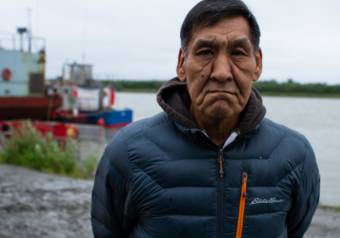
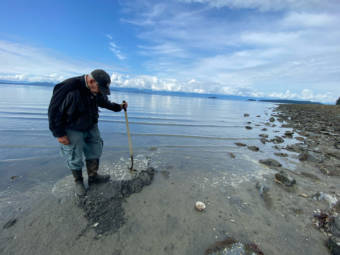
“I had to go 100 miles north up just to get my subsistence needs,” Herman Hootch said. (Olivia Ebertz/KYUK)

This has been the worst salmon fishing season on record for the Yukon River. King salmon, a regional favorite, have returned in low numbers for years, but now a typically stable species, chum salmon, has also collapsed. Subsistence fishing on the lower Yukon River for both species is closed, and residents who usually depend heavily on the fish are pivoting toward other ways to get meat.
“I started fishing on the Yukon when I was six years old. There was one point, me and my grandpa were coming down here for supplies and we had a summer chum jump into the boat. But those days are gone,” Jason Lamont said.

Lamont is from Emmonak and lives off of subsistence food, which in past summers has meant salmon. His family doesn’t buy meat from the store; the salmon caught during the summer will help carry his family through the winter.

“We used to target 300 fish to put away. We’d get that in about two to three hours. Nowadays in our freezer we have only one fish so far, and we’re lucky to have it,” Lamont said.

Elder Herman Hootch also relies on subsistence food. Like Lamont, Hootch is from Emmonak near the Yukon River mouth.

“We learned from our parents that food from the store is not healthy,” Hootch said.

Neither Hootch nor Lamont have been able to subsistence fish for chums or kings on the Yukon this year. Subsistence fishing for the species has been closed all season.

A lone skiff motors up the river past a fish camp. (Olivia Ebertz/KYUK)

In order for the Alaska Department of Fish and Game to open subsistence fishing, over 500,000 summer chum salmon first need to be counted in the river. Five hundred thousand fish is the lower end of the escapement goal.

Normally that number is met without a problem. On average, the run size is 1.7 million summer chum, as counted by a sonar in Pilot Station. But last year the run suddenly dropped to just 700,000 fish. The number dropped to a fraction of the average run size this year: just 153,497 fish.

Hootch and Lamont are missing a big part of their diet. And to make up for the lost protein, they’ve gone to some pretty extreme lengths.

“I had to go 100 miles north up just to get my subsistence needs,” Hootch said.

He traveled to the Norton Sound area to harvest chum this summer, but the numbers weren’t great there either. According to state fisheries biologist Kathrine Howard, chum numbers have been dismal all over the Bering Sea area since last year. Howard theorizes that climate change is responsible for the decline.

But because subsistence fishing was at least open in Norton Sound, Hootch made the journey.

“But that first trip I didn’t have any luck,” Hootch said.

The second time Hootch did have some luck and caught about 100 chums. He estimates that each round trip cost $500. That means with all the expenses added up, each chum cost him about $10. It was expensive, but cheaper than groceries in Emmonak. And he wasn’t the only one trying his luck there.

“What surprised me this year was the whole delta of the Yukon was up in Norton Sound. We saw hundreds of nets up there. And I said, ‘holy cow, that’s the first time that this ever happened,’” Hootch said.

Jason Lamont has been traveling 50 miles out into the Bering Sea on a small skiff to try his hand at ocean fishing. (Olivia Ebertz/KYUK)

Lamont has also ventured into new waters. He’s been taking his river-going skiff out into the testy waves of the Bering Sea.

“There’s a small group of us who are crazy enough to go out there and start harvesting food,” Lamont said.

But they’re not targeting salmon, they’re going for cod and other ocean species and learning in real-time what ocean fishing entails. Lamont said that he takes his boat sometimes as far as 50 miles off the coast. Most boats that go out that far are several times larger than his small skiff.

“And we go out there to the same size ocean, but the storms are the same too,” Lamont said.

But Lamont is determined to not give up on his Yup’ik culture’s subsistence traditions.

“You either gotta adapt, or lose it,” he said.

Three hours upriver by skiff, in the community of St. Mary’s, folks don’t have the same option to travel all the way out to Norton Sound. Instead, they’re supplementing their diet with extra groceries, more whitefish, and they’ll try to bag extra game meat.

Empty skiffs line the shore in St. Mary’s. (Olivia Ebertz/KYUK)

At the St. Mary’s boat harbor, Bay and Walky Johnson are on their way out to pick berries. Theirs is one of the only skiffs leaving the harbor that day. The rest of the boats bob along the shore, empty of fishing gear. I ask the couple how they will fill their pantry this winter.

“We’ll go after other species of fish,” Walky said.

“Definitely more moose,” Bay said. “We hope to get fall chum, but I doubt it. Fall chum are good for canning. Also when making more dry fish. But we didn’t see any last summer, so I doubt we will see any this summer either,” she added.

The state has no plans to open subsistence fishing for fall chum. That’s because an international treaty governs salmon fishing on the river, and not enough fish will pass through to meet treaty numbers.

Bay and Walky Johnson plan to target more moose to supplement their diet for the winter. (Olivia Ebertz/KYUK)

Correction: An earlier version of this story said that the Pacific Salmon Treaty between the U.S. and Canada dictates summer chum subsistence fishing, and that 300,000 summer chum salmon must be counted to open fishing. That is incorrect. It dictates fall chum subsistence fishing. To open summer fishing, 500,000 summer chum salmon must be counted. To open fall fishing, 300,000 fall chum must be counted.

Judge orders EPA to update rules for dispersants used on oil spills

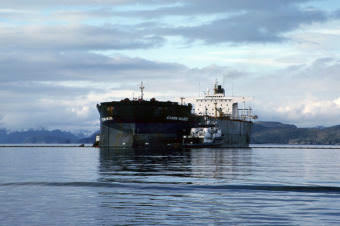
On March 24, 1989, the tanker Exxon Valdez ran aground on Bligh Reef in Prince William Sound, Alaska. Within six hours of the grounding, the Exxon Valdez spilled approximately 10.9 million gallons (259,500 barrels) of its 53 million gallon cargo of Prudhoe Bay crude oil. The oil would eventually impact more than 1,100 miles of non-continuous coastline in Alaska, making the Exxon Valdez the largest oil spill in U.S. waters at the time. (Creative Commons by NOAA Office of Response and Restoration/Wikimedia)
On March 24, 1989, the tanker Exxon Valdez ran aground on Bligh Reef in Prince William Sound, Alaska. The oil would eventually impact more than 1,100 miles of non-continuous coastline in Alaska, making the Exxon Valdez the largest oil spill in U.S. waters at the time. (Creative Commons by NOAA Office of Response and Restoration/Wikimedia)

A federal judge ordered the U.S. Environmental Protection Agency to revise its regulations on oil dispersants, siding with Cook Inletkeeper and other plaintiffs that the current regulations don’t reflect updated research on how toxic those chemicals can be.

Cleanup crews used dispersants in large quantities after the 1989 Exxon-Valdez spill and 2010 BP Deepwater Horizon oil spill in the Gulf of Mexico, but they haven’t been used in U.S. waters in over a decade, according to the National Oceanic and Atmospheric Administration.

Cook Inletkeeper Advocacy Director Bob Shavelson said he’s never seen them used in Cook Inlet. But he said it’s important to make sure it stays that way.

“I think if you have a large oil spill, that’s one of the tools in the tool kit that would come out rather quickly,” he said.

Dispersants break oil down into smaller parts that mix with water, which gets slicks off the surface of the ocean during spills. But research has since shown dispersants to be more damaging to humans and marine species than previously thought.

Meanwhile, the EPA has not updated its regulations on oil dispersants since 1994. U.S. District Judge William Orrick said the EPA’s failure to update that part of its contingency plan in the face of updated science violates the Clean Water Act.

Shavelson said the ruling could be especially significant to communities in the Arctic.

“The concern is that as climate change ensues, as we see more of an ice-free Arctic, we’re going to see more shipping in areas that are dark and rough weather,” Shavelson said. “And it’s going to be very difficult to use traditional tools to clean up spills. So the oil companies and shipping companies are going to prefer to spray dispersants and just disperse it.”

The EPA will have to finalize its new regulations on dispersants by May 31, 2023, per the agency’s own suggestion. The judge asked the EPA to file status reports on the process every 180 days until it is published.

Southeast’s pink salmon catch could beat forecast

Purse seiners enter the Wrangell Narrows near Petersburg in 2018. (Joe Viechnicki/KFSK)

Southeast Alaska’s commercial catch of pink salmon is taking off and could surpass the preseason forecast.

The region’s purse seine fleet netted nearly six million pinks in an opening in early August. That pushed the region’s total catch to around 20 million fish on the season.

“We’re right in the peak of the season, and right now it looks like I project our final harvest if things keep up like this will probably be somewhere near the upper bound of our pre-season forecast,” said Andy Piston, the Alaska Department of Fish and Game’s pink and chum salmon project leader for Southeast. “Our preseason forecast was for a harvest of 28 million with an 80% prediction interval of 19-42 million, and right now it looks like we could get up into that lower 40 million range the way catches are going.”

That would be one of the better catches in the last several years, though far from the record setting run of 2013.

Pink salmon live for two years. The parents of this year’s run spawned in 2019. The catch that year was just over 21 million, and the region saw poor numbers on the inside waters of the northern part of the region.

Piston noted that this year’s returning pinks likely did not experience warm ocean conditions that produced low returns in the past few years.

“You know if you look at the ocean conditions these fish went out into, you know the Gulf (of Alaska) was pretty normal all this last fall winter and spring and so unlike in a lot of recent years the pink salmon that went to sea had pretty average conditions and I think we’re seeing that pay off in some really good survival rates out there,” Piston said.

Catch rates and numbers of fish escaping to spawning streams look to be good throughout most of the region. This year’s pinks are much smaller than average, and the number of male fish is higher than usual for this time of year. Both of those could signal a slightly later and stronger run.

The strong catch is keeping seafood companies busy. OBI Seafoods’ Petersburg plant blew its steam whistle Monday, Aug. 9. That sound means the plant reached 100,000 cases of canned salmon, a mark it hadn’t hit since 2019. Plant manager Nikolai Wendel emailed that they reached that number just before 11 a.m. on Monday. In 2019, OBI canned 140,000 cases. Wendel called this season the best in five years.

‘More hungry mouths’: Bristol Bay sockeye are abundant but getting smaller

Salmon fry swimming through rocks. (Brian Venua, KDLG)

Bristol Bay is home to the largest sockeye run on the planet. But while the size of this year’s run broke records, the fish are getting smaller.

Last year’s average weight for sockeye was 5.1 pounds. But the 2021 average was just 4.5 pounds, according to the McKinley Research Group.

Jon Hickman, the executive vice president of operations for Peter Pan Seafoods, said the smaller fish play a role in how much time processors spend processing.

“Smaller fish are going to take longer to process,” he said. “So you’re handling a 4 pound fish or a 3 pound fish, as opposed to a 5 pound fish, so every time you handle one there’s a two pound difference. There’s more labor going into those smaller fish. You get more labor into them, there’s more costs associated with those smaller fish.”

Hickman said he isn’t worried about how the smaller fish will play in Peter Pan’s markets — demand is good, and he’s comfortable with the market for fish big and small.

But why are Bristol Bay’s salmon shrinking? First, the returning fish are younger than normal.

A salmon’s age is measured by how many years it spends in the ocean. A 2-ocean fish, for example, has spent two years in the ocean before returning to its spawning grounds.

Greg Buck, a biologist for the Alaska Department of Fish and Game, said most fish that returned this year only spent one or two years in the ocean instead of three.

“I’m gonna be gambling like it’s somebody else’s money when it comes to the age of 1-2s in the next year’s forecast,” he said. “I’ve been burned a couple of times. I’m normally kind of conservative when I forecast, but this year I might not be.”

But Dan Schindler, a researcher with the University of Washington’s Alaska salmon program, said fish are also smaller for their age.

“The size of fish has declined for their age,” he said. “So the size of 2-ocean fish has been declining slowly over time, and the size of 3-ocean fish has been slowly declining over time.”

The sheer number of fish can lead to more competition for food in the ocean. Large runs — like this year’s record — tend to have smaller fish.

There were record-high catches of salmon in the North Pacific in recent years, according to the North Pacific Anadromous Fish Commission. Last year was an anomaly in the trend toward larger populations, as catches dropped to the lowest levels in four decades.

Schindler thinks the recent abundance is due to an increase in hatchery pink and chum salmon.

“This declining size at a given age is really a function of more hungry mouths from lots of Bristol Bay fish, but also more hungry mouths that we’re dumping out into the ocean,” Schindler said.

Until recently, scientists and the fishing community didn’t pay much attention to the shrinking salmon trend. That’s because in the 1970s, more salmon started to spend an extra year in the ocean. And older fish usually come in bigger than their younger counterparts. But Schindler says in the last 10 years, more fish have returned after two years.

“So right now, we’re sort of seeing the effect of a double whammy on fish size,” says Schindler. “And the last four or five years — we’ve seen a lot of really small fish in the catches and the escapements,” he said. “That’s because there’s a lot of 2-ocean fish, and those 2-ocean fish are relatively small given the history of Bristol Bay.”

Warming oceans also may play a role. But Schindler said the connection is less direct. Warmer oceans have been correlated with increased survival for Bristol Bay salmon, which means more competition for food.

Correction: This article has been updated to reflect that while there were record harvest numbers for North Pacific salmon in 2018 and 2019, the 2020 catches were the lowest in four decades.

Meet one of the counters who tallied sockeye during Bristol Bay’s record run

Fish counter Sooz Green on her commute. June 2021. (Stephanie Maltarich/KDLG)

This summer, Sooz Green packed her bags to travel north from New Mexico to Bristol Bay, where she became one of three tower counters on the Wood River.

That means she tallied sockeye as they swam upriver to return to their spawning grounds during Bristol Bay’s largest salmon run on record.

The counts help biologists balance conservation and commercial fishing.

Each morning, Green’s day started with a six-minute skiff ride downriver. Then she climbed a four-story tower built from scaffolding.

“I climb up, I start the timer at the top of the hour on the right bank and I count for 10 minutes. Depending on how many fish there are, I might have two clickers,” she said.

After 10 minutes, she would record the total in her notebook.

Then she crossed the river to do the same thing at the second tower. All in all, it’s a lot of climbing.

“So I calculated, if you are climbing up just one during your count, that’s 16,” she said. “At least 16 times a shift up and down.”

A tower counters on the Wood River (Stephanie Maltarich/KDLG)

The Wood River site is one of nine counting stations around Bristol Bay. It has operated since the mid-1950s.

Tower counters like Green send their tallies to the Alaska Department of Fish and Game.

Their numbers inform area managers’ decisions about when to open and close commercial fishing, said Phil Stacey, Fish and Game fishery biologist and west side tower coordinator.

“We know how many are getting into the lake systems to spawn and that will allow us to manage the fishery more accurately because we only need a certain number of escapement to actually be sustainable,” Stacey said.

The Wood River counting tower is especially important in years when there are conservation concerns, he said. The Nushagak’s chinook run started slow this summer, and biologists waited for more than 150,000 sockeye to pass the tower until they let fishermen cast their nets.

For Green, the counting job fits perfectly with her transient lifestyle. When not counting fish in Alaska, Green lives out of a school bus in New Mexico, where she spends a lot of time rock climbing.

Between counts here, she passes the time with workouts. She has also had some tranquil moments.

“I have a couple of bald eagle friends who have been keeping a close eye on me,” she said. “There is a big moose cow and two calves. During my first shift, she was coming out around midnight.”

In addition to nature watching and staying active, Green assists with genetic sampling. Green said her time on the Wood River also made her realize just how important the job is.

“I feel really good about contributing to the system that we have in place and making sure this species doesn’t get overfished,” she said.

Green counted sockeye every day for six weeks this summer before hanging up her clicker on July 24, when the Wood River tower closed up shop for the season. She plans to return next year, with her counter in hand.

To save a huge, 24-armed sea creature, scientists become loving foster parents

On an island off the coast of Washington state, scientists have resorted to breeding sunflower sea stars in a lab. It’s a desperate attempt to save the endangered animals from disappearing completely. (Dennis Wise/University of Washington)

Jason Hodin hauls up a rope that’s hanging from a dock in the waters off San Juan Island in the Pacific Northwest. At the end is a square, sandwich-size Tupperware container, with mesh-covered holes in the sides to let water flow through. Hodin pulls off the lid and peers inside at some crushed bits of shell. He points to some reddish-orange dots.

“See that? That little dot right there in front of my finger?” Hodin says. “That’s a juvenile sea star that’s about a month old.”

It’s only the size of a poppy seed. But when this baby is all grown up, it could be as big as a manhole cover. That’s because this is Pycnopodia helianthoides, aka the sunflower sea star. It’s one of the biggest sea stars in the world, with an arm span that can be more than 3 feet across, and it used to be a common sight in the waters off the West Coast.

Now, though, it’s critically endangered and is being driven toward extinction by a mysterious, devastating disease.

This is why Hodin and his colleagues at the University of Washington’s Friday Harbor Laboratories have spent the last two years figuring out how to raise this species in captivity. It’s an act of desperation born out of the hope that someday, lab-grown sunflower sea stars could be reintroduced into places where this species has disappeared.

Jason Hodin, research scientist at the University of Washington’s Friday Harbor Laboratories, works in the sea star captive rearing lab. The sunflower sea star breeding program is a partnership between the university and the Nature Conservancy. (Dennis Wise/University of Washington)

This voracious predator used to prowl the waters across a nearly 2,000-mile range, from Alaska to Baja California. Their brightly colored bodies — which come in vivid shades of orange, pink, blue and green — would move along the seafloor on as many as 24 arms, gobbling up mussels and scallops and sea urchins. Their consumption of sea urchins, in particular, helped to protect vital forests of kelp, which are home to numerous marine species.

In recent years, however, populations of the sunflower sea star have declined by 80% to 100%. In California, “sunflower sea stars are more than 95% gone,” Hodin says. “Some people think that they are entirely extinct in the wild down there. I’ve heard scattered reports of people maybe seeing a few.”

This species seems particularly susceptible to a wasting disease that’s hit more than 20 sea star species since 2013. Hodin says the sick sea stars are horrible to behold. “I witnessed it, and it’s not pretty,” he says. “They really do kind of like dissolve into a pile of goo.”

In 2019, Hodin says, the Nature Conservancy approached him about the possibility of setting up a program to breed sunflower sea stars. He’d already been interested in the basic science of sea stars because of the way they are able to transform themselves from bilaterally symmetrical larvae to juveniles with five-sided symmetry. He agreed to try raising large numbers of sunflower sea stars to adulthood, even though no one had tried to do anything like this before.

Adult sunflower sea stars feed on mussels at the Friday Harbor Laboratories. Shells from earlier meals collect at the bottom of the tank. The sea star on the bottom, called Charlotte, is the mother of the lab’s 1-year-old juvenile stars. (Dennis Wise/University of Washington)

“For this species in particular, there were very few published efforts to raise them at all, even through embryo or larval stages,” Hodin says.

He didn’t know the answer to some of the most basic questions, such as what did this species eat early on? And how fast could it grow?

“Nobody knows how to age a sea star, so you see something in the wild and you have no idea how old it is,” Hodin says. “It could be 2 years old. It could be 50. It could be 100.”

His team started by taking some sunflower sea stars from the wild. About 30 of these giants now live outside the lab in large, burbling tanks.

“I didn’t really anticipate how exuberant their behaviors are,” Hodin says. “You get to know them, and you get to know them individually. We noticed early on that we could tell them apart by their color patterns. And we gave them names.”

A lot of their names are linked to their colors. Prince, for example, has arms with tips that are purple.

An arm of an adult sunflower sea star has numerous orange and white tube feet that it uses for walking, breathing and sensing. (Dennis Wise/University of Washington)

“This here’s Deep Blue, and she’s our biggest,” researcher Fleur Anteau says as she feeds the sea stars by gently tucking mussels under their arms. “Some of them, when I open the cage, will basically really start moving their arms to the surface, like Olga here. Some of them are a little shyer.”

Even the shy ones suddenly come to life once they clutch a mussel. They hunch over the prey so they can swallow it whole. “When food comes, then you really see the predator come out,” Anteau notes.

Pointing to the red eye spot at the end of each arm, she adds, “They’re looking at you. They don’t have eyes like us, but they can see a light-and-dark kind of vision.”

This lab has figured out how to get sperm and eggs from the wild-caught adults and grow up their offspring. The oldest sea stars they’ve produced are now nearly a year and a half, and they are about 3 inches across.

The lab only has about a dozen young sea stars that have reached this stage. But considering how little was known at the start — and the fact that they had to work out their techniques during a pandemic that restricted who could go to the lab — Hodin says he feels lucky to have gotten that many.

“We’re assuming that by next year, they might be reproductive, based on ones that we’ve seen in the field,” Hodin says. “It’s good news that they can grow relatively quickly.”

Left: Hodin, the research scientist who is leading the captive rearing program, prepares to view sea star larvae under a microscope. Right: Sunflower sea star larvae, born in mid-January, are seen under a microscope. The dark oval shapes are stomachs. (Dennis Wise/University of Washington)

Having learned the tricks needed to raise these sea stars, the research team’s new goal is to produce up to 1,000 more young stars. The lab is full of glass pickle jars that contain larvae, and food containers that hold the poppy seed-size juveniles.

Hodin says that first, lab-grown sea stars could be put into the local waters, where their parents came from, to test how well they fare in the wild. If that goes well, it might be possible in the coming years to try to restore populations off the California coast.

But the danger of sea star wasting disease could still be out there.

“I would say at the outset that it’s critical to understand more about what’s killing them before trying to put them back,” says Drew Harvell, a professor emeritus with Cornell University who is also a researcher at the Friday Harbor Laboratories.

Currently, she says, scientists disagree on the nature of the killer. Some blame an infectious agent, such as a virus, while others point to warming oceans or other environmental changes.

“It’s extremely controversial,” says Harvell, author of a book called “Ocean Outbreak: Confronting the Rising Tide of Marine Disease.” She believes there’s a lot of evidence that sea star wasting disease is infectious.

This month, she and her colleagues are starting new lab experiments to test that idea. In a fish pathogen lab, extracts from sick sea stars will be injected into seemingly healthy ones. She’ll be using sunflower sea stars since they are so susceptible.

“These are difficult experiments to get to run consistently, and so if you try to do them with a species that is somewhat resistant, sometimes just nothing happens,” Harvell says.

Even if scientists never are able to figure out what causes this illness, she says, eventually it could still be worth trying some kind of reintroduction of captive-bred sea stars to the wild.

“At some point we would just have to probably go forward,” Harvell says, “even though scientifically that wouldn’t be the very best plan.”

Sunflower sea stars — voracious predators that feed on mussels and sea urchins — are succumbing to a strange wasting disease that has devastated populations of sea stars along the West Coast. (Dennis Wise/University of Washington)

Hodin wishes he knew whether the sea stars his lab is raising are susceptible to the disease. He’s constantly on the lookout for any signs that his beloved animals are falling ill. “We hope they don’t get it obviously,” he says.

He uses a pair of tweezers to tenderly feed a tiny mussel to one of the young sea stars. It curls its arm around the treat.

“Their adult-like behaviors are starting to emerge at these small sizes, and that’s been really fascinating to watch,” says Hodin, who adds he feels a deep attachment to all of the animals that he’s raised. “I think of myself as their foster parent. I’m caring for them and trying to optimize their growth and watching them grow.”

He says he even dreams about them. Just the night before, he’d dreamed of being surrounded by water in a house-size version of one of their tanks.

Copyright 2021 NPR. To see more, visit https://www.npr.org.

Site notifications
Update notification options
Subscribe to notifications