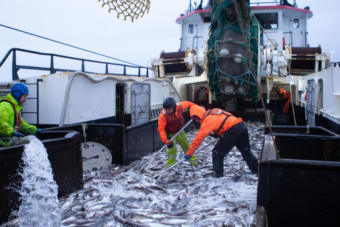
Crew members shovel pollock on the deck of a Bering Sea trawler last year. (Nathaniel Herz/Alaska’s Energy Desk)
A key Democrat in the U.S. House introduced a bill Monday to renew the Magnuson Stevens Act. Magnuson Stevens is the primary law that covers fishing in federal waters. Past bills have languished in Congress in part because many in the industry were generally happy with the law as it is.
But Jared Huffman, D-Calif., included a few provisions in his bill that certain Alaska groups have been requesting for a long time. Huffman chairs the oceans subcommittee of the House Resources Committee.
The bill emphasizes the need to consider the impacts of climate change on marine resources. It would, for the first time, recognize the importance of subsistence fishing. It would also put two tribal representatives on the North Pacific Fisheries Management Council — the committee responsible for fisheries in the Bering Sea and Gulf of Alaska.
The bill won praise from environmental advocates and groups representing Alaska’s small-boat fishermen, as well as several tribal organizations.
Seafood Harvesters of America said it has a few issues it hopes to work out with the bill’s sponsors.
Alaska Republican Congressman Don Young also said he has concerns and recommendations to discuss.
Fisheries are central to Alaska’s culture, way of life, and economy. To secure a sustainable future, we must reauthorize MSA. I welcome @RepHuffman's bill, and I look forward to working with him on my concerns and recommendations. https://t.co/qDFCBNMvQj
Mabel Baldwin-Schaeffer, the National Oceanic and Atmospheric Administration’s first tribal coordinator. (Photo courtesy of Mabel Baldwin-Schaeffer)
For the first time, the federal National Oceanic and Atmospheric Administration has a tribal research coordinator. NOAA is a key federal leader of environmental research. Those involved say the new position is a step toward better representation for Alaska’s Indigenous communities.
Mabel Baldwin-Schaeffer is the first tribal coordinator for the Alaska Fisheries Science Center’s communications program.
She was born and raised in Kiana, a small Iñupiaq village on the Kobuk River in northwest Alaska, and said she will bring that perspective with her.
“Near and dear to my heart has always been to improve local participation and to engage rural communities and research development,” she said. “I am most excited to work with elders and local people in the community.”
Mabel Baldwin-Schaeffer winter crabbing in Norton Sound. (Photo courtesy of Adem Boeckmann)
As a tribal coordinator, Baldwin-Schaeffer will facilitate existing communication and outreach efforts to communities. She will also act as a liaison between NOAA and communities that rely on subsistence when scientific research takes place in the future.
“My job is to help enhance and strengthen research networks in order to build effective and helpful collaborative partnerships with Alaskan Indigenous communities,” she said.
Baldwin-Schaeffer received her bachelor’s degree in sustainability studies and a master’s in environmental science from Alaska Pacific University.
She previously led a collaborative study on offshore gold mining and its effects on the environment — specifically, on young red king crabs in the Norton Sound. The study aimed to understand the effects of the Kuskokwim Bay’s water temperatures on crabs and strengthen communications between Alaska Native communities and the commercial fishing industry.
Bob Foy, NOAA’s science and research director, said that the partnership with Baldwin-Schaeffer will benefit the organization and Indigenous communities across the state.
“Our goal with that position is to bring information into our fisheries and marine mammal management process that includes Indigenous knowledge,” he said.
Baldwin-Schaeffer started in her new position as coordinator a couple of months ago. She says she is working to establish contacts and recruit participants from diverse backgrounds and viewpoints to engage with NOAA’s projects.
A kelp harvest in Kodiak. Tamsen Peeples is at far right. (Kayla Desroches/KMXT)
Representatives from the Alaska Fisheries Development Foundation visited Unalaska last week as part of its push to expand the state’s mariculture industry.
Gov. Bill Walker created the Alaska Mariculture Task Force in 2016. Since then, the organization has been focused on developing the state’s mariculture industry to meet its long-term goal of $100 million by 2038.
Mariculture refers specifically to farming and enhancing shellfish and seaweeds. The state’s mariculture industry was valued at approximately $1 million in 2018.
Julie Decker, executive director of the Alaska Fisheries Development Foundation, sees opportunities in the shorelines and beaches of the Aleutian coast.
“You have lots of water, so you have lots of space. Relatively little population, which means relatively little conflict,” Decker said. “The people that do live here are used to working on the water. There’s North America’s largest processing port. These are some pretty significant assets.”
Oyster and kelp farms have been springing up in Alaska’s coastal communities from Southeast Alaska to the Kenai Peninsula and Kodiak Island, but there’s only been one permit so far in the Aleutians.
Decker says that a lot of the infrastructure from the fishing industry could be used to expand mariculture in the Aleutians and that people could reconfigure much of their fishing equipment. And while shellfish could do well in the Aleutians, Decker says seaweed offers an easier point-of-entry.
Seaweed provides a quicker return than most shellfish because it is an annual crop, unlike oysters, for example, which can take about three years to harvest. That’s not to say mussels, oysters or sea cucumbers wouldn’t thrive here, but kelp happens to time well with the fisheries already in place.
Industry experts say the timing for kelp farming fits well between pollock or salmon seasons.
“You want to have your kelp out of the water by the beginning of June,” said Tamsen Peeples, a commercial seaweed mariculture specialist whose job is to counsel businesses and investors interested in mariculture. “And guess what else happens at the beginning of June: the salmon come back.”
Peeples says growing kelp also offers environmental benefits.
“Seaweeds are carbon negative because they do draw carbon out of the ecosystem. And if you’re familiar with ocean acidification, that can have huge ramifications and benefits for the ocean, as well as just the entire global environment,” she said.
It also provides economic opportunities for kelp farmers to sell carbon credits.
Peeples says countries like Norway, France and Chile are competing with Asian nations for the seaweed market while the United States largely sits on the sidelines.
“We’re one of the only large countries in the world that’s not producing or harvesting wild seaweeds,” she said, “so we’re a little bit behind the curve.”
A United Nations report valued the global seaweed industry at over $6 billion in 2018. And while Alaska may be a global leader in fishing, the state falls behind in mariculture.
By comparison, aquaculture in New Zealand — which does include finfish farms — generated over $450 million in 2020.
Decker says growing Alaska’s mariculture into an operation on a competitive scale won’t be easy.
“I want to be clear with people that when you’re developing something new, there’s always challenges,” she said.
For new farmers, those difficulties may include picking farm sites and navigating the application process. But Peeples says that she is available specifically for those purposes.
“I would be assisting with site selection, as well as business planning and the permit process and then application assistance,” she said.
Decker and Peeples also say there are various funding opportunities available, including the Mariculture Revolving Loan Fund.
Alaska Fisheries Development Foundation’s website has more information about mariculture training and funding opportunities. There are also pamphlets and other materials available at the Unalaska Visitors Bureau.
Homes and streets near the coastline are seen flooded with seawater in Newport Beach, Calif., Friday, July 3, 2020. The combination of surf and high tides could produce minor coastal flooding at the lowest coastal locations in the evenings during high tide this holiday weekend, according to the National Weather Service. (AP Photo/Matt Hartman)
Coastal neighborhoods around the U.S. are seeing a steady increase in high tide flooding, as sea level rise accelerates and sends seawater into homes, sewers and streets. The problem is expected to get worse in the coming years, federal scientists warn.
In 2021, 14 coastal locations broke or tied records for the number of so-called sunny day floods, when water infiltrated neighborhoods even though there was no storm, according to the annual high tide flooding report from the National Oceanic and Atmospheric Administration.
That includes Galveston and Corpus Christi, Texas, which each set records of more than 20 days of high tide flooding in 2021. Residents of Pensacola, Fla., and Charleston, S.C., each experienced 14 days of high tide flooding in 2021.
That’s a huge increase over just two decades ago: all four cities saw two days of tidal flooding or less in the year 2000.
“Damaging floods that decades ago happened only during a storm are now happening more regularly, even without severe weather,” says Nicole LeBoeuf, the director of NOAA’s National Ocean Service.
The cause of the flooding is clear: human-driven climate change. People are burning fossil fuels that release enormous quantities of greenhouse gases into the atmosphere. That’s causing the Earth to heat up rapidly, which melts ice and causes the water in the oceans to expand, both of which drive sea level rise.
“Sea levels are going up quicker than anticipated and the number of flood days are following suit,” says William Sweet, an oceanographer at NOAA’s National Ocean Service. “There’s a lot of heat and there’s a lot of warm water.”
In some areas, the land is also sinking. That includes the Chesapeake Bay region, where the land is naturally subsiding, and parts of the Gulf Coast where fossil fuel and drinking water extraction are hastening land loss. When the land sinks while the water rises, flooding is even more severe.
Scientists expect high tide flooding will continue to accelerate in the coming years. Long-term projections for the U.S. suggest that the average number of days with high tide floods could double by the end of the decade.
Beginning in the mid-2030s, a change in the lunar cycle will amplify climate-driven tidal flooding, a recent study by NASA scientists warned. The moon’s orbit has a natural wobble, and when the moon is slightly closer to the Earth, tides are a little higher.
Local governments in coastal areas are increasingly reliant on official predictions about tidal flooding. Floods can affect emergency services and schools, and local planning departments must decide where to build new buildings in light of increased flood risk.
NOAA’s ocean scientists continuously monitor tides around the U.S., and release seasonal predictions for each U.S. region. Those predictions include specific dates that residents in each region of the country can expect to see high tide flooding, such as water running in the streets or bubbling up through storm drains.
Copyright 2021 NPR. To see more, visit https://www.npr.org.
A purse seiner fishes for salmon in Southeast Alaska in 2010. (KFSK file photo)
Commercial net fishing for salmon in Southeast is off to a poor start in much of the region. Returns for most species are not meeting forecasts, which weren’t very high in the first place.
With some exceptions, it hasn’t been a very encouraging start to the salmon season.
“I guess for both net fisheries, gillnet and seine, we’re looking at poor chum salmon catches and poor sockeye catches and yet to be determined for pink salmon,” said Troy Thynes, the Alaska Department of Fish and Game’s management coordinator for commercial fisheries in the region.
By the middle of July, the region’s pink salmon catch neared 600,000 fish, still a far cry from the pre-season forecast of 28 million humpies, with the bulk of the season still to come. Thynes explained indicators have been mixed on whether returns later this summer will meet that, with some up and down fishing in southern Southeast near Ketchikan.
“There was some good pink catches that showed up in lower Clarence (Strait) a couple weeks ago, and then the pink catches kind of fell off,” he said. “And then they picked up again here this last opening in districts one and two. We are seeing a higher percent males than what we normally see this time of year, which is generally indicates that the run is coming in a little bit later than normal, and we have been seeing a low average weight on the pink salmon as well.”
Smaller sizes for individual fish can sometimes signal a larger overall return, and managers are hopeful the 28 million harvest forecast for the region is still a possibility. They’ll know more in the next few weeks, heading into what’s normally the peak of the pink season.
Pinks are targeted by the region’s purse seine fleet, which is having 15-hour openings on Thursdays and Sundays in the early season. Most of the focus is around Ketchikan and Prince of Wales Island, with many permit holders not out fishing.
In the past, hatchery chum salmon have filled in a gap for seiners and taken pressure off wild pink stocks. But in recent years that hasn’t been the case. The Northern Southeast Regional Aquaculture Association produces some of those chums around Sitka, Kake and Petersburg.
Association general manager Scott Wagner called chum salmon returns miserable.
“Well it’s just a continuation of last year and the terrible return last year. Whatever widespread issue out in the Gulf (of Alaska) is causing all species of salmon but particularly chum to do very poorly,” Wagner said.
There’s been no fishing this season around the Hidden Falls Hatchery on Baranof Island because of a low forecast. There have been openings at Southeast Cove near Kake and Thomas Bay near Petersburg, but catches have been poor.
Wagner said chum are smaller than normal this year, and he does not expect early summer chum will hit the low end of forecasts at any of NSRAA’s sites.
“We’re about halfway through the return, and particularly Thomas Bay and Southeast Cove are performing very poorly,” he said. “Gunnuk Creek, it’s our first return to the hatchery there with four year olds and it’s looking better. You know we’re seeing about half of our broodstock needs right now, about 10,000 fish which is encouraging but not what we forecasted. Same thing at Hidden Falls.”
Gunnuk Creek is NSRAA’s chum hatchery in Kake. The region-wide chum catch topped 700,000 by the middle of July. All of Southeast’s hatcheries combined forecast a total of 9.5 million chum for 2021.
There have been some better catches of chum for gillnetters closer to Juneau and in Lynn Canal.
In the central part of the region, the drift gillnet fleet has seen one area remain closed for the first part of the season. Fish and Game’s Thynes explained managers have kept district 8 around the Stikine River near Petersburg and Wrangell closed for multiple species.
“It was closed initially for chinook salmon conservation, but it’s also been closed for sockeye salmon,” Thynes said. “We weren’t expecting a large return of Stikine River sockeye this year and as a result district 8 has kept closed because of that. So we haven’t had any indications in our district 6 drift gillnet fishery that the Stikine run is coming in larger than forecasted, so district 8 has remained closed.”
District 6 near Zarembo and northern Prince of Wales Island has seen openings for gillnetters. The Stikine River forecast going into the season was 56,000 sockeye, well below average and similar to what came back in 2020. This year the run may not even meet that poor forecast.
There are a few better showings of sockeye numbers elsewhere in the region, at Redoubt Bay near Sitka and on the Situk River in Yakutat. Thynes says it’s still too early to know the strength of sockeye on the Taku, Chilkat and Chilkoot rivers. Some of those saw high water levels from a big snow pack to start off the summer.
“I would say it slowed at least the chinook and sockeye heading up the big mainland rivers,” Thynes said.
Gillnetters are having openings from two to four days depending on the area with the bulk of the fleet focusing on district 11 near Juneau and district 15 in Lynn Canal.
Thomas Olsen-Phillips and Sunny Rice check traps at Sandy Beach. (Katie Anastas/KFSK)
The European green crab might be small, but it can destroy vital habitats for animals all along the food chain. It’s already costing New England shellfisheries million of dollars.
In July 2020, green crab were found in Haida Gwaii, the closest they’ve ever been to Alaska. With the help of volunteers, the Alaska Department of Fish and Game hopes to stay one step ahead of the invasive species.
At low tide at Sandy Beach in Petersburg, Sunny Rice and a group of volunteers walked toward a crab trap — on the lookout for European green crab.
Green crab are small but mighty, measuring around 3 or 4 inches wide. Their shells are a dark, greenish-brown shell with yellow spots, with five triangular points on either side of the eyes.
To check whether the crabs have made it this far north, the Alaska Department of Fish and Game has asked volunteer groups to set up traps all over Southeast. Rice is with the Alaska Sea Grant Marine Advisory Program and wanted to get involved. She and a group of high school students with the Petersburg Indian Association’s natural resource management program set six traps at Sandy Beach and two at Hammer Slough.
So far, they’ve found no green crabs.
“Unfortunately, you guys, this is sometimes what monitoring is about,” Rice told the students. “And as we know, we don’t really want to find a green crab anyway.”
Juvenile Dungeness crabs like this one could be threatened by green crab if they come to Southeast Alaska. (Katie Anastas/KFSK)
Getting a group of kids — or anyone — excited about not finding something is a bit of a challenge, says Tammy Davis. She’s the invasive species program coordinator for the Alaska Department of Fish and Game.
“In this case, you’re hoping to get zeros across the board, which, you know, as a citizen monitor may be somewhat of a deterrent because getting zeros isn’t as exhilarating as finding that thing that you’re looking for,” Davis says.
But citizen monitors are a vital part of the search for green crab in Alaska because of the large size of the geographic area.
Alyssa Guthrie checks a crab trap at Sandy Beach. (Katie Anastas/KFSK)
Green crab could be a serious threat to juvenile salmon, Dungeness crab and other wildlife vital to Southeast ecosystems and industries.
Davis said the big problem is habitat destruction. Green crab like to get into eelgrass beds while they search for clams, mussels and other invertebrates. When they do, they clip the leaves or uproot the eelgrass entirely. That leaves other animals, like juvenile salmon, without a habitat.
“That whole food chain gets disrupted when green crab move in,” Davis says. “It’s sort of a cascading impact, both destruction of the habitat and altering the food chain.”
It’s happening on the East Coast, too. In New England, green crab are uprooting eelgrass and eating soft-shell clams. East Coast shellfisheries have lost an estimated 14 to 18 million dollars annually because of green crab, according to Environmental Protection Agency research. Green crab populations there continue to grow because of rising sea temperatures.
As sea temperatures rise here, Davis said, Alaska could face a similar economic and ecological threat as New England.
“Alaskans love their seafood. We love both commercially and recreationally catching fish. Aquatic invasive species put those things at risk, either through predation or habitat destruction. So it matters to all of us whether invasive species get introduced and then spread.
So what can you do if you see a green crab? Davis says pick it up, take it home, and get a good photo of it, especially the top of the shell. You can call the invasive species hotline or upload the photo online to the department’s invasive species reporter.
Fish and Game is always looking for volunteer groups to help set traps, too. But even if you can’t commit to setting traps each month, you can still play a part.
“Next time you’re walking on the beach, look down,” Davis said. “And if you find a shell that doesn’t quite look like a Dungey or doesn’t quite look like whatever crab is native in your area, that could be really important. You could be the person who finds the first green crab.”
The invasive species hotline is 1-877-INVASIV (1-877-468-2748), and you can find the Invasive Species Reporter at adfg.alaska.gov.
Close
Update notification options
Subscribe to notifications
Subscribe
Get notifications about news related to the topics you care about. You can unsubscribe anytime.