Oceans

Rapid erosion threatens set net fishery in Southwest Alaska village

A truck bed equipped to chill a set-netter’s catch. In Ekuk, fishers are able to set nets by truck, and the local processor collects catches from truck beds. (Brian Venua/KDLG)

It’s midmorning in Ekuk, as people get ready to pull nets from the beach and pick fish. Kay Andrews, an Aleknagik resident, is cutting a Chinook salmon for dinner later.

“I think what makes us unique is, we have Ekuk fisheries,” Andrews said. “They support their fishermen by providing eyes and we deliver by vehicles, trucks.”

Kay Andrews with a Chinook salmon. (Brian Venua/KDLG)

Ekuk is different from many other beaches in Bristol Bay. Fishers are able to set nets by truck, and the local processor collects catches from truck beds rather than a tender collecting fish from skiffs. The beach acts as natural infrastructure for the fishery. But the rapidly eroding coastline takes away a top layer of gravel. That causes weight issues for the trucks delivering large catches to the processor about a mile away.


The village is southeast of Dillingham, and two winter watchmen live there year-round. Andrews and her family have a long history of set netting in the village. Her grandfather ran Columbia Ward Fisheries for over 20 years, and her grandmother has sites along the bluff where her cousin fishes. She says set netting by truck gives Ekuk fishers a slight advantage over those that transport their catch by boat.

“I think we can get our fish processed quicker versus getting it into a holding cell, in a processor, then getting it barged to the cannery sight,” Andrews said. “So we pick the fish out of the net, place it in the slush water or ice water, then we deliver it to the cannery.”

That advantage has waned in recent years, with the introduction of ice and refrigerated seawater systems to chill fish on boats.

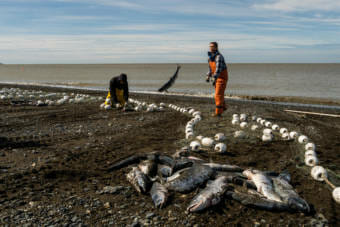
A truck pulls a net from the beach, while boats in the distance fish from the sea. (Brian Venua/KDLG)

“You know, I think days are different now, compared to what my grandfather used to do,” she said. “They used to pick fish one by one with a pick on the beach. With no ice, but that was all canned back then.”

Further down the beach, another set netter, Julie Wiss, is picking fish with her son Ryan. Wiss grew up fishing in Ekuk and each season they return to work on the family site. She says some of that change is due to a demand for higher-quality salmon.

“Now there’s a lot of fillets and people want pretty stuff and everyone’s aware of it,” Wiss said. “You know people pick their nets and clean them, much more — the ropes, the nets, the lead lines — all much better. So in that way, it’s changed a lot but same concept.”

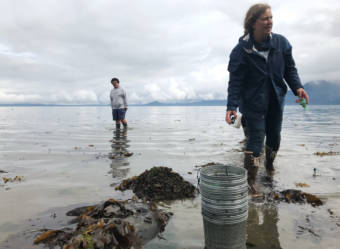
Julie Wiss (right) and son Ryan (left) pick fish at their site in Ekuk. Wiss grew up fishing in the village and returns each summer. (Brian Venua/KDLG)

Beyond new tech and products, the rapidly eroding coastline looms over the fishers. The village is losing about 5 feet of coastline per year, a rate that’s doubled over the last century. Set-netter Jamie O’Connor grew up in Ekuk. As a kid, O’Connor would play and climb the bluffs.


Jamie O’Connor outside a cabin in Ekuk. (Brian Venua/KDLG)

“It’s been really interesting to look at it through that lens and see how the changing shore ice conditions in the winter are impacting how quickly the bluff is eroding,” O’Connor said. “It’s made of silt and composite rock that is vulnerable to the ocean.”


Weather events like severe wind storms rip away large chunks of the coastline.

Each season, Fish and Game sets regulations for how big or wide a site can be. O’Connor says they have to make constant adjustments to their sites.

“We’re happy to do that, but it makes you a little more aware of how the coast is changing,” she said. “But at the same time, it’s been changing my whole life and my great-grandparents’. I mean my great-great-grandmother had a wall tent at first creek and she would stay there and watch the net. That’s the site people in our family still fish but it looks very, very different.”

Researchers from the University of Alaska Fairbanks traveled to the region this summer to install new erosion monitoring equipment. Ekuk’s Village Council also recently applied for a climate change and resiliency grant.

Kay Andrews hopes to see a long-term solution for the village.

“I could tell this year the tides, are a lot higher. I’ve never really witnessed 24-foot tides as much as we have this season,” Andrews said. “And I think it’s our grandmother’s prayers that are still being answered, that our cabin is still up cause we’re right on the beach here. I think, in all, we need to have a sea wall that starts at the cannery.”

Despite the threat of rapid erosion, optimism thrives in Ekuk.

People are happy to return to their sites with family and friends, like the Andrews, Wiss and O’Connor families. And a surge of salmon is providing hope for a bountiful season.hat morning was the start of a record-setting push of sockeye up the Nushagak. While some people said it was a slow morning for most camps, the trucks never stopped hauling fish.

New smartphone app helps fishermen track ocean conditions in real time

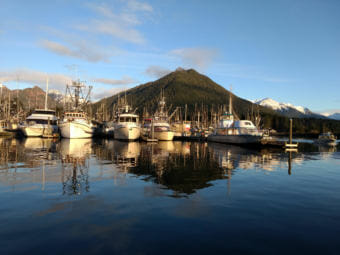
Sitka fishing vessels in harbor on Jan. 18, 2018. (Photo by Jacob Resneck/KTOO)
Sitka fishing boats in harbor on Jan. 18, 2018. (Jacob Resneck/KTOO)

A new smartphone app hit the market last week, with the potential to transform the debate over Alaska’s ocean resources.

The Skipper Science app will allow users along Alaska’s entire coastline to contribute observations about changes in fish and animal populations, which can then be collected and quantified as data for Alaska’s science-based resource management.

Anywhere the Alaska Board of Fisheries meets, there is always a certain amount of frustration among some who testify because their years of experience — sometimes over many generations — don’t seem to carry much weight in data-driven management decisions.

In Sitka this is particularly acute around herring season, where subsistence harvesters have noted drastic declines in the abundance of the species over many decades, while 40-odd years of data collection by the Alaska Department of Fish & Game suggests everything is okay.

“I wonder if all the scientists that are here can figure out what’s going to happen when the herring’s gone,” said Coho clan leader and elder Herman Davis when he testified before the Board of Fisheries in Sitka in 2015.

Skipper Science was created for exactly this purpose. Developed by the Aleut Community of St. Paul Island, it’s a way for Alaska’s harvesters and managers to at least speak the same language.

“How do we take what has historically been called anecdotal and create some structure around it that is rigorous, has scientific repeatability?” asks Lauren Divine, Director of Ecosystem Conservation for the tribal government of St. Paul Island in the Bering Sea.

Divine and a team of collaborators have built the Skipper Science app in an attempt to convert the thousands of informal-yet-meaningful environmental observations by fishermen and others into hard numbers that can be brought to the Board of Fish, the North Pacific Fisheries Management Council or any other agency that makes decisions that impact fisheries.

The idea is that, scaled up over many harvesters, the observations of someone like Herman Davis can carry the weight of scientific data.

“This is the way that, you know, an Indigenous person takes on life and living and engaging in traditional harvests and relationships with the ecosystem. It is very non-quantitative,” she says. “And so we’re very far behind the times really, but yet there’s no weight that’s historically been given and the respect given to the more social science on, and you know, non-western scientific side of things. And so we were really working to, to shift that paradigm.”

Divine and the Aleut Community of St. Paul are not new to this. About 15 years ago the tribal government established the Indigenous Sentinels Network to monitor changes in animal populations and the environment in the Bering Sea. They’ve since developed a half-dozen apps and utilities, one of which is called Citizen Science.

Skipper Science is built on the Citizen Science platform, but the goal is to make it coastwide, “From the Beaufort to Baja,” as Divine says.

To extend their reach, the Aleut Community of St. Paul needed a partner. Enter Lindsey Bloom, who works with the Juneau non-profit, SalmonState.

Bloom works within SalmonState’s Salmon Habitat Information Program — or SHIP. A coastwide advocacy organization, SalmonState and the Aleut Community of St. Paul have similar goals: quantifying informal observations.

“We’ve been working through the SHIP program for many years now to help bring fishermen’s voices and perspective and knowledge and information to the table when it comes to decision making around not only policy and habitat related policy, but we think the information from fishermen can be really helpful in a number of ways to fisheries managers, whether they’re at the state or federal level,” she says.

Bloom and her husband are drift gillnetters. She’s been using the beta version of Skipper Science. The way she explains it, the app takes something that in the past might just have been a few minutes of dock talk after a fishing trip and compiles it into a database.

“It could be a marine mammal sighting, it could be a change in water temperature, that’s unusual. It could be algae blooms. You know, there’s many, many sorts of categories of data that could be observed or reported,” she said. “You’ll just pull up your app, you’ll hit a button that says ‘record an observation.’ In my phone, in my case, it actually just loads in my GPS coordinates right then and there. And I can describe what I’m seeing and how it’s different from what I’ve seen in the past, and perhaps take a picture and upload that as well and send it in.”

The Skipper Science app works anywhere, whether or not it’s connected to the internet. Observations will be cached until users are back in range. Individual observations are also private and password protected, so users can go back in and review past observations. The overall dataset, however, is the property of what Lauren Divine is calling the Skipper Science community. Divine and other researchers will compile it and prepare reports as needed based on the information.

The app is free. Divine has considered the possibility that it will gain traction and explode into an enormous amount of work. She says she’d welcome that event.

“That would be such a dream of mine,” she said. “This is honestly such an untapped area of really rich information that could totally change the way you know that we approach fisheries management from subsistence to personal use to recreational to commercial and it has such amazing potential.”

The Skipper Science app is available for download for both iPhone and Android.

Observers count over 200 Cook Inlet belugas in rivers this spring

Cook Inlet belugas have been declining as a population for over two decades. Researchers hope to learn more about why through studies and observations like the ones made this spring. (NOAA photo)

Those who live close to the Kenai and Kasilof rivers know belugas sometimes feed there. But it’s been a mystery how many whales actually travel through those waterways, particularly in the spring.

This year, a large team of volunteer observers counted for the first time how many Cook Inlet belugas passed through the rivers between March and May. They counted just over 220 belugas.

“They are absolutely amazing. Absolutely amazing,” said Teresa Becher, a coordinator for the Alaska Beluga Monitoring Partnership. She was among a team of nearly 30 observers that scanned the Kenai and Kasilof rivers this spring for Cook Inlet belugas — a population that’s considered critically endangered and has been declining for over two decades.

Researchers are tracking Cook Inlet belugas to learn more about why they aren’t rebounding.

They’ve relied in part on volunteers like Becher who count and report beluga sightings in Cook Inlet and its watershed. For a few years, they’ve watched whales in the fall, when they come into the rivers for silvers.

But they haven’t been tracking as closely what happens when belugas return to the rivers in the spring, until this year.

“One of the biggest things that we learned is that the belugas use the Kenai River in particular much more often than even NOAA understood in terms of coming in and foraging for food in the spring,” Becher said.

She said they saw the first belugas in the rivers on March 25 and the last on April 30.

“And to discover that they use the Kenai River so much during the spring is very important information,” she said. “It just means that we really have to pay attention to what’s going on in the river and kind of find out what it is they’re eating.”

Becher counted from the river bluff in Kenai. Up at Turnagain Arm, Suzanne Steinert was counting by the Twentymile River and near the Mile 95 pullout in Girdwood.

“We call that stretch there Beluga Alley,” she said.

Monitors in the inlet saw fewer whales than in the rivers. But Steinert said they got to observe some interesting beluga behaviors — like when a pod of belugas swam up to a stranded humpback whale in Turnagain Arm.

“It was really fascinating. Personally, I had never seen belugas interacting with a whale like that in Turnagain Arm,” Steinert said.

Monitors at all the locations submitted their observations electronically and they’ll be compiled by a coordinator. That data is cross-referenced with data from aerial surveys from the National Oceanic and Atmospheric Administration.

It’s one part of a large puzzle about the endangered animals. And there are still lots of pieces researchers don’t know, like why the belugas travel through the rivers in the spring. They’re trying to learn more about the belugas’ food sources through an environmental DNA project this year.

Becher said she wants to learn more about what’s threatening the beluga population as a whole.

“One of the big problems that NOAA talks about is they have not been able to pinpoint why they aren’t coming back,” she said. “Is it pollution? Is it warming temperatures? No one seems to know.”

Belugas do sometimes come into contact with boats and fishermen — something Becher said they can better avoid if they know where belugas are. The Alaska Wildlife Alliance has a text alert system so people know when there’s been a sighting.

“That’s probably the single most important, immediate thing that everyone can help with,” she said.

It’s hard to say if the large number of whales in the rivers are a sign that the population is rebounding, since there’s little data for comparison. It’s also possible observers counted some whales twice. Scientists know of about 280 Cook Inlet belugas in existence.

But Becher said they’ll use this year’s counts as a benchmark going forward.

To get text alerts about belugas in the Kenai and Kasilof Rivers text BELUGA to 833-541-0408.

With a haul of 11 whales this season, Point Hope gears up for Qaġruq festival

Guy Omnik stands with the baleen from Russell and Andrea Lane’s whale. (Photo courtesy of Guy Omnik for the Alaska Arctic Observatory and Knowledge Hub)

This weekend kicks off the Qaġruq Whaling Festival in Point Hope. Every year, people come from around the region for a three-day feast to celebrate the annual subsistence haul of the whaling season.

Rex Rock Sr. says he’s been whaling his whole life. The 60-year-old Point Hope captain says this year’s whaling season kicked off in early spring.

“Early April we went out,” Rock said. “The lead was further out this year.”

Rock explained the lead is the term for the crack in the sea ice that hunters follow to track the whales. He says this year’s lead was about seven miles outside town.

“We were able to get there,” Rock said. “I was happy that Russell and JJ Lane were able to land the first whale. They always say once you strike and land the first whale, everything else is going to fall into place.”

Point Hope whaling captains ended up landing 11 bowheads this year, a great year in Rock’s book.

With the hauling period over, Point Hope is preparing for the three-day Qaġruq Whaling Festival. Rock says over the first two days, captains will haul the whaling boats up and show off their crews flags before cutting up the whale for the large communal feast.

“First is what we call qalgi, the second day the avarriqirut, and then the third day we have an all-day cookout,” Rock said. “So we invite everybody to come up and sample all the food that we’ve been blessed with this spring.”

For many Inupiaq residents of Northwest Alaska, this year’s Qaġruq will be the first major community event since the COVID-19 pandemic began.

“I don’t think it feels much different,” Rock said. “Because we feel blessed when we go out to whale and provide for our community. Not only our community, but cousins in the outlying villages. Definitely we share the whale with everyone, everyone that wants a taste.”

Qaġruq begins on Sunday and will conclude Tuesday evening.


Bioengineered salmon available for the the first time in US

A genetically modified salmon dwarfs a non-modified salmon of the same age in an undated handout photo distributed in 2010. (Photo via AquaBounty Technologies)

A Massachusetts company is sending genetically modified salmon to dinner tables in the U.S. for the first time. AquaBounty Technologies said it’s shipping five tons of bioengineered salmon to distributors this month.

It’s marketed as a sustainable alternative to other kinds of salmon. But AquaBounty’s fish hasn’t received the warmest reception in Alaska, where it’s often called “Frankenfish.”

Tim Bristol of Homer is the director of Salmon State, an Alaska organization defending wild salmon populations.

“It’s going to be a real challenge for us moving forward to make sure we do everything we possibly can to educate the American and the international consumer that if you want the salmon that’s best for you and supports communities and small family businesses, you need to choose wild Alaska salmon,” he said.

AquaBounty’s salmon is a genetic mixture of three different fish — Atlantic salmon, chinook salmon and the eel-like ocean pout. It grows twice as fast as its non-engineered counterparts, reaching full market size in 18 months.

This is the first time a company has sold genetically engineered salmon in the U.S.

Federal regulators ruled the salmon safe to eat and sell in 2015. But for a while, AquaBounty still didn’t have permission to grow its salmon in the U.S. Instead, it was working out of facilities in Canada and Panama.

That was until 2019. The latest batch of salmon headed to market in the U.S. comes from a facility in Albany, Indiana.

The Food and Drug Administration said AquaBounty’s fish are similar nutritionally to non-engineered, farm-raised Atlantic salmon. AquaBounty says their fish could help mitigate overfishing and create less pollution than farmed fish.

Not everyone’s convinced.

“It’s just a faster way of doing business and making money,” said Sara Erickson, who owns AlaSkins in Soldotna. She’s a vocal opponent of fish farming and a former commercial fisherman.

“They have a picture of a regular farmed salmon and their farmed salmon. And it looks just like a giant. I mean, what’s the point of that?” she said.

A big concern for environmental groups has been whether fish can escape from the facility and mate with wild salmon. Late last year, a federal judge ordered the FDA to look into what would happen if that occurred.

AquaBounty said there’s no risk of that happening, since it grows sterile salmon in inland-based tanks, with multiple barriers to prevent fish and eggs from escaping.

Erickson said that’s one good thing that sets AquaBounty’s salmon apart from other farmed salmon.

“And I appreciate that. In fact, all fish farming should really go to that place. But it’s a lot more expensive to do,” she said.

Erickson said salmon should be clearly labeled in stores so people know what they’re buying.

Federal law currently requires GMOs to be labeled as such. But that doesn’t just have to be through wording — a QR code, scanned with a smartphone, also suffices.

There are some exceptions to the Department of Agriculture’s current labeling law. Food served in restaurants, for example, doesn’t have to be labeled.

Labeling is voluntary in Canada, where AquaBounty previously sold its salmon.

Sen. Lisa Murkowski has been a vocal opponent of genetically engineered salmon. Legislation she introduced this month would require the words “genetically engineered” to appear on bioengineered salmon in stores.

It’s called the Genetically Engineered Salmon Labeling Act. Sen. Dan Sullivan is a co-sponsor.

“It would be a level of consumer awareness,” Murkowski told KDLG Friday. “Because it is only when we are aware of what is being sold, what is being put in front of us, that we can say firmly and clearly, ‘Nope. Don’t want this on my table.’”

A spokesperson from AquaBounty said the company will use the phrase “genetically engineered” on grocery store packaging.

Several grocery chains have pledged not to sell genetically modified salmon, including Safeway and Kroger, which owns Fred Meyer.

Bristol said he hasn’t heard of any Alaska businesses interested in buying the product.

“We have seen Alaskan stores carry farm-raised Atlantic salmon in the past, and usually the blowback is pretty significant and comes pretty quickly,” he said.

An AquaBounty spokesperson said the company isn’t shipping any salmon to Alaska yet.

Izzy Ross in Dillingham contributed reporting to this story.

Tongass and Bristol Bay protection can help Biden meet new climate goal, fishing and conservation advocates say

Habitat for sockeye salmon is vulnerable to climate change. (U.S. Fish and Wildlife Service)

The Biden administration issued a conservation plan Thursday called “America the Beautiful.”

At 22 pages, it’s more of a statement of principles. The centerpiece is a goal of conserving 30% of the nation’s lands and waters by 2030, in part to combat climate change.

Republicans in Congress immediately criticized it as vague and an attempt to lock up natural resources.

Meanwhile, conservation groups are eyeing parts of Alaska they’d like to see protected. Their eyes are on salmon.

“It’s hard to think of two better candidates than the Tongass in Southeast Alaska and Bristol Bay in Southwest Alaska,” said Tim Bristol, executive director of Salmon State.

He said conservation measures in the Tongass and Bristol Bay would protect fish, wildlife and save thousands of jobs which depend on renewable resources.

“It just seems like they’re no-brainers. They’re places where you could make the 30-by-30 concept real and also have a real positive impact on many people’s lives,” he said.

Bristol’s group is among those campaigning to have the Roadless Rule reinstated for the Tongass. They also want the EPA to reapply Clean Water Act protection to the Bristol Bay watershed, to preclude a new permit application for the proposed Pebble Mine.

The Alaska Longline Fishermen’s Association and other groups that advocate for small-scale commercial fishermen are also joining the call to protect Bristol Bay and the Tongass.

Kelly Harrell is chief fisheries officer at Sitka Salmon Shares, a processor and direct marketer which buys from small-boat fishermen. She said Biden’s goal caused some apprehension at first.

“Initially, we and many other Alaskans and fishermen were concerned that the 30 by 30 efforts could mean no-take marine areas and marine reserves that would exclude small boat fishermen,” she said.

But the plan shows the administration sees fishermen as stewards of the resource, she said. Harrell wants to see the administration succeed in reducing carbon emissions, in part because climate change is a threat to healthy fisheries.

“Ocean acidification, we know, is having impacts on things like our food webs in the Gulf of Alaska and the Bering Sea,” she said. “It’s a huge concern. And we need action.”

Alaska’s congressional delegation opposed the Roadless Rule and the EPA’s so-called “pre-emptive veto” when they were imposed during prior Democratic administrations.

Site notifications
Update notification options
Subscribe to notifications