U.S. Rep. Don Young, R-Alaska, talks during a Juneau Chamber of Commerce lunch on June 10, 2021, at the Elizabeth Peratrovich Hall in Juneau, Alaska. It is the chamber’s first in-person lunch in about 15 months. (Rashah McChesney/KTOO)
Chinook salmon runs are in decline across Alaska, and research suggests a host of factors are to blame, from ocean predators to warmer streams to excess rain. Alaska Congressman Don Young added a novel suspect to the list: nuclear submarines.
“We have to figure this out. Have to work on it and make sure there’s not something going on,” he said of the poor runs. “Is it climate change? Are they moving north? Is there a nuclear sub stuck out there somewhere?”
Young spoke at a subcommittee hearing Thursday, and he acknowledged that his theory sounds unusual.
“Everybody laughs at me, but at one time I counted 64 nuclear subs from Russia,” he said. “We kept track of them as they came off the coast of California.”
A spokesman said Young was referring to matters like those described in a 2020 BBC article on radioactive submarine wrecks.
Young’s comments came after he testified in favor of bills he sponsored to protect Alaska’s salmon from farmed and genetically engineered fish. Subcommittee Chairman Jared Huffman, D-Calif., noted that Young had only used about half of his allotted five minutes. So Young detoured into the chinook mystery and his nuclear theory.
“See, I knew if we drew you out a little we’d get something interesting and colorful,” Huffman said. “So thank you for that, Don, and for your leadership on these bills.”
Research on the chinook problem has not focused on nuclear pollution.
A study published last year identified multiple climate and habitat changes that are suppressing chinook runs in Southcentral Alaska but found no single factor that can fully explain the declines.
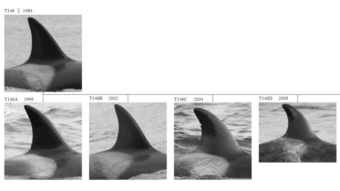
A page from the killer whale photo-identification catalog shows T146D’s dorsal fin. This fin helped a researcher identify Thursday’s beached orca. (Graphic: Fisheries and Oceans Canada).
Researchers have identified the killer whale that beached on Prince of Wales Island last week and then freed itself when the tide came in.
Its name is T146D. It may not roll off the tongue, but killer whale researcher Jared Towers says the name is important.
“It allows us to keep track of the whale after the stranding,” he said. “And that may be among the most important parts of identifying animals like this.”
The orca hasn’t been spotted since it freed itself on Thursday. Or at least, no one has seen it and identified it as T146D again. But Towers said the documentation matters.
He works for Canada’s Department of Fisheries and Oceans and is part of a team of researchers called Bay Cetology. He led a team that compiled a photo-identification catalog of West Coast transient orcas, also known as Bigg’s killer whales.
“There’s over 300 of them,” he said. “They’re the ones that are typically seen from Alaska and further south, down to the Lower 48 off the west coast of North America.”
The man who identified the beached orca is Towers’ colleague, Gary Sutton. Sutton says the eye patch of the orca was fairly distinctive, alerting him that it might be T146D.
“It’s got a big kind of hook on the front and comes in,” he said. “It sets her apart from a lot of the rest (of the whales).”
But to be sure, he said he checked multiple photos of the orca against the catalog. Though he used feminine pronouns to refer to T146D, he said that the killer whale’s gender isn’t confirmed — it’s mostly a guess based on body shape. But he said they do know it’s 13 years old.
The killer whale later identified as T146D stranded on shore rocks in the vicinity of Prince of Wales Island, Alaska in this drone image provided by NOAA Fisheries. (Photo courtesy of Captain Chance Strickland and Crew of M/V Steadfast)
As for whether it will survive in the long-term, there are some good signs pointing that direction, said Sutton.
“I was fairly optimistic, because of the way it looked and the fact that there wasn’t a significant amount of blood and the tide pool below it,” he said. “…(It) seemed to be in good health.”
But contrary to some posts on social media, NOAA Fisheries spokesperson Julie Fair said they have not confirmed if T146D has rejoined its pod. But Towers said there’s a good track record of this species surviving such strandings.
He said strandings of five killer whales from this population had been documented over the 20 years before T146D ran aground. All of them survived their initial strandings, he said, and four are still alive, as far as they know.
“They’ve all rejoined their families after stranding, and they’ve all gone on to survive and live normal, healthy lives,” he said. “And the only reason we know that is because their identities were documented when they were stranded, and their identities were further documented.”
Towers said there are several kinds of killer whales along the West Coast. But all the documented live-stranding events were Bigg’s killer whales, which he said like to hunt harbor seals in shallow waters.
“I don’t think anyone knows exactly when this whale stranded, or what the circumstances were,” he said. “But I would make a wager that there was harbor seal hunting as the motivating factor.”
Still, there’s a lot unknown about T146D — including exactly why it stranded. But because it’s been identified, there’s a good chance that the killer whale could be documented again, and researchers will know if it survived in the long-term, too.
Lab technician Elsie Herman holds an endangered Sunflower Sea Star (Tash Kimmell/KCAW)
Set to a soundtrack of humming water pumps and bubbling sea water, Dr. Sarah Gravem’s research comes alive. But it’s not the high-tech science lab you might imagine. In the basement of the Sitka Sound Science Center, a collection of plastic tubs and barrels serve as control tanks, and researchers collect data by hand every few hours.
It’s within these unassuming tubs that our main character, the sea star, sheds light on the world of underwater forests.
Gravem, a postdoctoral scholar and marine ecologist from Oregon State University, is one of six researchers from Santa Cruz and Oregon working to understand the recent decline of Pacific kelp forests. She walks through the lab, exposing tiny underwater worlds.
“What we’re looking at right now is a bunch of laboratory experiments that we have running, looking at, for example, how fast the sunflower sea stars eat urchins and eat snails,” she said. “And then how fast the urchins and the snails eat kelp. And then over here is when you put them all together — how does the presence of the sea star benefit the kelp? And how does that change their behavior?”
The office in the basement lab of the Sika Sound Science Center. (Tash Kimmell/KCAW)
From the coast of Mexico to the Gulf of Alaska, ocean habitats have seen a startling change over the last four years. Invisible from land, beneath the waves of the Pacific, kelp forests have been fighting a losing battle.
Scientists have taken notice as the once-thriving kelp forests and the ecosystems they support have become rocky wastelands.
“The Santa Cruz lab over the last few years has noticed that big, lush kelp forests full of kelp, full of other critters, fish, abalone, et cetera are disappearing and transitioning into urchin barrens, which are more bare rock,” Gravem said. “And a lot of sea urchins just cruising around and grazing all the algae down and preventing other things from using that algae as a place to live or thing to eat.”
Control tanks in the basement lab of the Sitka Sound Science Center (Tash Kimmell/KCAW)
Like their terrestrial counterparts, kelp forests rely on an intricate web of predators and prey: sea otters, urchins and starfish. On remote shores, that web remains intact. Closer to cities and towns, the system has been thrown out of balance. And kelp forests suffer.
“In Oregon, we’re just now seeing kelp starting to collapse,” Gravem said. “And we’re seeing inklings of it here up in Alaska, and we are hoping it’s not on its way.”
Gravem says the decline of sea stars could be one of the reasons it’s happening.
“They’ve been wiped out in Oregon, California, most of Washington, and they’re here in Sitka,” she said.
The sunflower sea star, an echinoderm known for its excessive size and numerous limbs, has been making a slow recovery in Sitka.
“They got wiped out pretty badly, but they’re starting to come back a bit. And so the sunflower sea stars are the top predator. And they eat sea urchins, and sea urchins eat kelp,” Gravem said.
But even as the population rebuilds, years of damage has already been done. Sea stars were wiped out by sea star wasting disease, a plague-like sickness causing lesions, body fragmentation and eventually death. It’s when these sea stars, who once played the top predators, died that scientists saw the biggest transitions in the kelp.
Lab tech Elsie Herman measures and records the mass of dead urchins to better understand sea star eating patters. (KCAW/Tash Kimmell)
By observing the ways kelp, urchins and sunflower sea stars interact, Gravem and her colleagues hope to unravel the kelp’s decline.
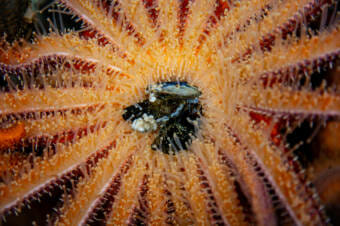
Gravem lifts a sea star out of its mini habitat, a bright orange mass of spiny arms. I balk at the size of it, but she assures me this star, an adolescent by her account, is on the smaller end.
“We actually had to go all the way across Chatham Strait to get big ones,” she said, holding the glistening invertebrate up to the light. “They’re not close to town. And so these ones are medium size, and they can get like the size of an extra-large pizza. They can get really, really big.”
Gravem says humans have long stewarded our terrestrial habitat but have failed to notice subtle changes in the ocean. Losing kelp forests could have potentially devastating implications for coastal communities.
But for Gravem, the buckets and barrels in this dark basement lab hold hope for the future.
Sunset on the Stikine River. Canada’s government closed transboundary fisheries on the Canadian side of the Stikine in late June. (Sage Smiley/KSTK)
This summer, Canada closed most of British Columbia’s commercial salmon fisheries. Declining stocks were to blame for the drastic conservation measures. Southeast Alaska shares coastline and transboundary rivers with B.C. — so what could this mean for the region?
The Department of Fisheries and Oceans Canada — the federal agency that manages Canada’s fisheries — effectively ended the 2021 commercial salmon season on the West Coast in late June.
Seafood Alliance Executive Director Christina Burridge says Canada’s fishing industry was stunned.
“First Nations have harvested salmon forever. And post-contact, salmon canneries are what in the sense built this province. To be now in this situation seems really tragic to me,” she said.
The closure came just weeks after Canada announced a $535 million plan to revitalize its flagging Pacific salmon stocks in B.C. and Yukon Territory.
But Burridge says the closure erased most of the Canadian fleet’s entire year.
“The minister’s announcement and most subsequent media coverage has said that it’s 60% [of B.C.’s commercial fisheries closed],” she explains. “In terms of the number of actual fisheries, that is correct. In terms of landed volume, it is 80%. And for gillnet fisheries, it’s about 95%.”
Canadian government officials say this has been a long time coming.
“I know it was a bit of a surprise to some — to many — but those that have been close to the industry and close to Pacific salmon fisheries here, at least and [along] the B.C. coast recognize that the overall level of catch has been dropping significantly for some time,” Sarah Murdoch said. She’s the senior director of Canada’s Pacific Salmon Strategy Initiative, which aims to shape Canadian fisheries policy moving forward.
So what does Canada’s salmon shutdown mean for its Alaska neighbors?
From a market standpoint, not much, says McKinley Research analyst Dan Lesh in Juneau.
“Alaska dwarfs B.C.,” Lesh explains, “And so anything that happens in those markets is not going to be a big impact on our fisheries. For instance, Canada produces only about .017%, so less than .1%, of sockeye globally — that’s as of 2019.”
B.C.’s largest wild salmon market is chinook: about 14% of the global market in recent years. But its shares of the other four salmon species represent less than 2% of worldwide production.
So, while the closures are devastating for B.C., they shouldn’t move world markets.
Still, Lesh says the shutdown isn’t good for the perception of wild salmon as a sustainable product. Concerns about declining food sources for killer whales have prompted some in the Pacific Northwest to avoid chinook salmon.
“Of course, that doesn’t make sense for protecting the orcas,” Lesh said. “The salmon are coming from a different area and a different stock. But so that’s my broader concern with some of these declining stocks on Alaska’s market.”
State fisheries managers say B.C.’s experience isn’t likely to be repeated in Alaska. Southeast management biologist Troy Thynes says Alaska has safeguards in place to keep salmon runs from dropping too far, allowing spawning fish to keep moving up rivers and streams. Drastic measures like widespread closures aren’t in the nature of Alaska’s dynamic management, where biologists can time openings at will.
“When Fish & Game is concerned about stocks — if a stock is not making escapement after a number of years, those types can be listed or recommended to the Board of Fisheries as a stock of concern. And we do have several stocks of concern that are in Southeast Alaska right now,” Thynes said.
The chinook on the transboundary rivers Unuk and Chilkat are among the current Southeast stocks of concern. Stikine and Taku kings — both also transboundary rivers — are proposed to be added to the list.
Burridge, with the B.C. Seafood Alliance, says she admires Alaska’s proactive strategies, which involve long-range management plans and a lot of public input.
“Basic things like stock assessments in Canada have been starved for at least two decades,” Burridge said. “And I think that’s one of the reasons why we’re looking at these closures is that the work simply hasn’t been done. I suspect most Alaskans would agree with me that the foundation of good fisheries management is good stock assessment.”
Burridge says the sacrifice being made by B.C. fishermen will only be worthwhile if there’s more investment in research and restoration of fish habitat.
“Salmon, as you know, are doubly vulnerable because they depend both on the marine environment and the freshwater environment,” she said. “And we have certainly compromised the freshwater environment here and particularly in southern B.C.”
But about a third of Canada’s $500 million salmon rescue plan will likely be spent buying out permit holders.
“I’m not for a moment saying that we should go fishing because people need to go fishing,” Burridge said. “We have to be extremely careful and cautious, but this is very, very devastating. And I think while some of the closures were probably necessary, many it seems to me are just putting the burden on the commercial sector rather than putting it on other sectors.”
U.S. states and Canadian provinces work cooperatively to co-manage transboundary salmon runs through the Pacific Salmon Treaty. But the Canadian government says the shutdown on their end likely won’t affect current allocations, as the treaty won’t be renegotiated until 2028.
Kuskokwim king salmon caught near Bethel, Alaska on June 12, 2018. (Katie Basile/KYUK)
Throughout Southeast Alaska, non-resident sport anglers will not be allowed to keep king salmon they catch this August.
It’s the latest change aimed at keeping the region’s sport harvest of chinook within a target allocation of 37,900 fish.
“As the season goes along, we’re monitoring how many fish have been harvested, kind of what we project the total for the season is going to be. And we’re getting towards the end of the season now, and it looked like we’re going to exceed our allocation and had to take more restrictive action in order to keep the sport fishery within its allocation,” said Patrick Fowler, the Alaska Department of Fish and Game’s area management biologist for Petersburg and Wrangell.
In June, the department announced reduced bag limits. This is an additional step to slow the harvest. Fish and Game says the number of people out fishing is lower than average, but catch rates are higher than expected this year.
The closure for non-residents also applies to special hatchery areas, like the salt water of the Wrangell Narrows near Petersburg. But it doesn’t apply to Alaskans.
Residents will see a change in king salmon bag limits in August, though. On the outer coast, residents are limited to one fish. On the inside waters, including around Petersburg and Wrangell, residents can keep two kings. Those inside waters are closed in the spring to avoid harvest of kings returning to Southeast’s river systems, and the higher bag limit is meant to make up for some of that reduction later in the season.
Fowler said the harvest of Crystal Lake king salmon in the Wrangell Narrows near Petersburg has been better than average.
“We saw some pretty good catch rates coming out of there and some healthy numbers of king salmon returning to that area, consistent with what we forecasted for the area,” Fowler said. “But that was definitely the highlight for the Petersburg area, especially with so much of our waters being closed in the early season.”
King salmon return to spawn in the spring and early summer. As the numbers of those fish dwindle, anglers may be turning their focus to coho salmon or halibut at this time of year anyway.
USGS wildlife biologist Sarah Schoen surveys the water for fish samples to test for saxitoxin. (Courtesy of Elizabeth Mears)
Paralytic shellfish poisoning, caused by eating seafood contaminated with toxins from harmful algal blooms, can be deadly to humans. Now, using marine samples from Unalaska, scientists are trying to understand if those harmful algal blooms could also be responsible for seabird die-offs.
There’s not much data on how saxitoxin — a harmful compound produced by algal blooms that cause PSP — spreads through the larger food web. But in July, a group of biologists with the United States Geological Survey visited Unalaska to collect samples of plants and animals in hopes of learning more about how saxitoxin levels magnify and diminish as they move through the food chain, from phytoplankton to mussels and up to seabirds.
“We don’t really know how this toxin moves through the food web,” said Sarah Schoen, a USGS wildlife biologist that recently collected marine samples in Unalaska. “There’s still a lot of unknowns, but the more information we can collect about it, the more we’ll understand it.”
“When we picked up some of the carcasses, the birds were all starving; they were emaciated,” she said. “But we weren’t sure if there was another factor that was contributing to their deaths. So we became interested in knowing if something like toxins — biotoxins — could have contributed to their deaths.”
Schoen and other researchers collected tissue from the dead birds to test for saxitoxin and found some lower levels of toxins in about a third of the birds, but she said they weren’t sure what that meant for their overall health.
“It was still unclear if algal blooms — toxins — could have played a part in their death,” Schoen said. “The project has kind of expanded from there.”
Since then, she said they’ve also looked at tissues from live murres in breeding colonies and found that a similar proportion of birds had toxins, but the levels were lower.
Very little work has actually been done to look at the saxitoxin levels in seabirds, according to Schoen. Most people focus on intertidal invertebrates like mussels or clams and how those affect humans.
The extremely high toxin levels recently found in Unalaska make the island a good place for studying how the toxins travel up the food chain, specifically for learning when the levels may become deadly for animals that are further up that chain, like seabirds, Schoen said.
In July, a group of UGS biologists visited Unalaska to collect samples of plants and animals in hopes of learning more about how saxitoxin levels magnify and diminish as they move through the food chain. (Courtesy of Elizabeth Mears)
The U.S. Food and Drug Administration says it is safe for humans to consume meat with up to 80 micrograms of toxin per 100 grams of tissue. Around the beginning of July last year, some samples of blue mussels collected in Unalaska showed toxin levels that were more than 100 times higher than that. And in June of this year, some sampling showed toxin levels of more than 6,000 micrograms per 100 grams of tissue.
“Those are levels that make us interested in what’s going on with the whole food web,” Schoen said.
Schoen and her team want to discover if these toxins play a role in the recent record-breaking bird deaths and to see whether they transfer to seabirds in higher levels or not.
Sometimes it can be tricky to trace samples back to a singular, specific algal bloom, but she said it was easy to make those connections in this recent sampling in Unalaska.
“In this case, everything looks to be super connected,” Schoen said. “The mussels are filtering in the plankton that we’re collecting right offshore. Fish are eating the plankton. The birds are eating the fish, and they’re all in the same system.”
Schoen and her colleague Daniel Donnelly — another biologist on the team — collected samples of various fish including sand lance, Pacific sandfish, cod and halibut, as well as species of seabirds like horned puffins and black-legged kittiwakes.
They only had about a day to collect the samples, and Donnelly said finding all of the animals, coordinating and setting the different gear and properly recording everything made for a hectic day.
“We got samples from different trophic levels, meaning all the way from zooplankton to small plankton, foraging fish to predator fish, to birds — so a whole bunch of different levels in the ecosystem,” he said.
Donnelly is an avid hunter and shot some of the live birds to bring back to the lab to study. Others were collected from local fishermen who found and froze a dead puffin, for example, after a recent die-off.
Schoen said collecting and tracking data in a place like the Aleutians where there are few scientists can be tricky. But getting help from locals is a useful way to keep track of marine behavior and things like strange die-offs.