Federal managers are warning that there may not be enough sockeye salmon to allow a full season of subsistence fishing on the Stikine River. That could lead to a premature closure of an important source of food in the Wrangell area.
Federal fisheries biologist Rob Cross manages the districts near Petersburg and Wrangell. He says the U.S. Forest Service doesn’t take these decisions lightly.
“Our goal certainly isn’t to close the subsistence fishery,” Cross said. “This year, we have a below average preseason forecast for sockeye. So basically, we just want to give harvesters a heads up and let them make an informed decision about where they’re going to focus their efforts this year.”
The preseason forecast for Stikine sockeye is 56,000 fish. That’s less than half of the 10-year average.
Cross says managing the subsistence fishery is a balancing act.
“Our primary goal is to maximize subsistence opportunity for these communities, because they really depend on the Stikine fishery,” he said. “But at the same time, we need to make sure that there’s a healthy stock for fish as well. So we’re basically just letting people know that there’s a possibility of a closure throughout the season.”
An early closure isn’t guaranteed. The Forest Service says it will be working with Wrangell’s tribe, the Wrangell Cooperative Association, to conduct harvest surveys throughout the summer.
This isn’t the first time in recent years that a low pre-season forecast has led the Forest Service to warn subsistence fishermen of a possible closure for sockeye harvest. In 2019, Wrangell District Ranger Clint Kolarich closed the subsistence sockeye fishery nine days before the set close date because of low escapement.
Cross says that possible closures to the sockeye subsistence fishery up the Stikine would not affect the coho subsistence fishery in the area.
The federal subsistence fishery for chinook salmon has been closed since 2017 due to low return numbers and mature fish being smaller than average.
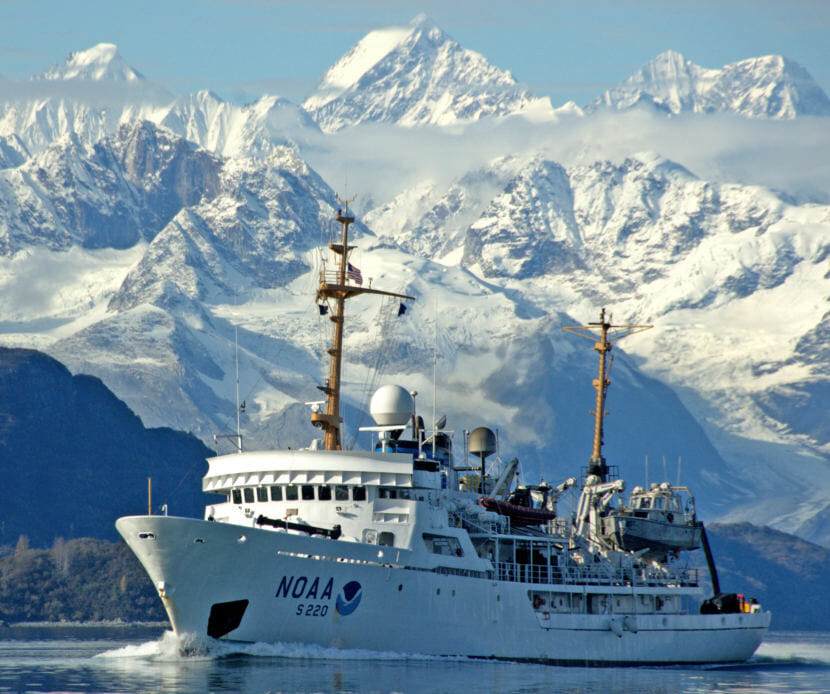
The NOAA Ship Fairweather regularly conducts reconnaissance missions to help NOAA prioritize its efforts to update navigational charts in the Arctic. NOAA and other private companies in Alaska are participating in the global Seabed 2030 project which aims to map the seafloor. (Photo courtesy the National Ocean Service Image Gallery)
The National Oceanic and Atmospheric Administration says work will begin soon on a new office building and pier in Ketchikan. The agency says the project will allow it to bring the research ship Fairweather to its official home port in the southern panhandle.
While the Fairweather spends much of its time at sea mapping the seafloor, studying fisheries and searching for shipwrecks in Alaska, the research vessel hasn’t had a home in the state since at least 2008.
Alaska’s junior Republican senator, Dan Sullivan, says he has been pushing to base the Fairweather in Ketchikan for years.
“It’s good to finally get an important win. It’s going to be important for science, important for our economy, research. But also, I think (it) signifies more opportunities for Coast Guard, Navy and other research vessels to come to Southeast and make an impact for our state and our country,” Sullivan said in a phone interview.
Sullivan says moving the Fairweather to Ketchikan would bring about 50 jobs to the area, though a NOAA spokesman says it’s too soon to know for sure. The project includes a new NOAA office, a floating pier and upgrades to power and water systems for visiting ships.
A conceptual drawing shows the design for a new NOAA office building in Ketchikan. (Ahtna Infrastructure & Technologies via NOAA)
The late Sen. Ted Stevens inserted language in a 2002 bill that moved the Fairweather’s official home port to Ketchikan. But the ship hasn’t had an Alaska home since 2008, when NOAA’s Stedman Street dock was condemned as unsafe. It’s spent the intervening years based out of the Lower 48 with occasional calls at Ketchikan’s Coast Guard base.
“Most of its research missions are in Alaska, about Alaska, whether it’s the oceans, environment, fisheries, surveys, and to me, it just makes complete sense,” Sullivan said. “That’s where the mission is. And that’s where the ship should be homeported.”
Sullivan says he pressed Biden administration Commerce Secretary Gina Raimondo, whose agency includes NOAA, to keep a promise Sullivan extracted from the Trump administration in 2019 to bring the Fairweather to Ketchikan.
“This was the No. 1 issue I raised with Secretary Raimondo when she was going through her confirmation process — the No. 1 issue. And you know, I also let her know that her predecessor, Wilbur Ross, made this commitment,” he said.
Raimondo said in a statement that the project “will enable the agency to support safe navigation and commerce in Alaska and the region more effectively than ever.”
Sullivan credits Sitka state Sen. Bert Stedman for coming up with a novel approach to fund the project. Alaska pitched in about $7 million for the federal facility through a grant to Ketchikan’s borough, which was later transferred to NOAA.
Stedman says he’d like to see more resources moved to Alaska — like an expansion of the naval test facility on Back Island just north of Ketchikan.
“There’s no reason for Alaska to be treated like a territory or a third-world country and everything based out of Washington State. Ships and facilities should be in Alaska, where they belong,” Stedman said.
Ketchikan Borough Mayor Rodney Dial calls it an “amazing win” for Ketchikan.
“This represents hundreds of thousands, if not millions, into our economy every year for many different sectors,” Dial said. “A vessel this size requires expensive maintenance — we’re going to argue that that should be done at our shipyard. There’ll be fuel that will be sold, supplies, employee payroll, and all of that will circulate through our economy.”
He says he hopes the federal spending will help the area reduce its reliance on tourism as an economic driver.
Alaska Gov. Mike Dunleavy thanked NOAA for its commitment and said moving the survey ship to Ketchikan would enhance U.S. national security amid rising tension in the Arctic. He said the move was “long overdue.”
The $18.7 million construction contract was awarded to a subsidiary of Ahtna, the Alaska Native regional corporation based in Glennallen. The company will start by removing the existing pier.
NOAA expects to finish the project by December of 2022.
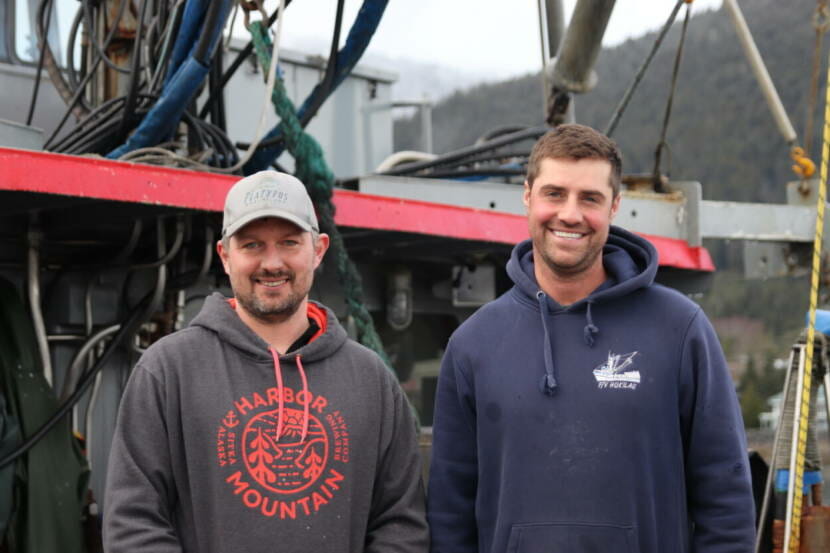
Justin Peeler and Matt Kinney stand aboard Peeler’s boat the F/V Defiant in late March, several days before the Sitka Sound Sac Roe Herring Fishery opened. (KCAW/Rose)
The Sitka Sound sac roe herring fishery opened in late March after a two-year hiatus. Less than half the fleet is fishing this spring, but the seiners who have stuck around have hauled in catches every day over the last week and a half.
KCAW spoke with two commercial fishermen shortly before the fishery opened about the importance of herring to their businesses and lives.
Justin Peeler is standing on the deck of his boat, the F/V Defiant, moored in Eliason Harbor. He’s explaining how the rigging works and why exactly they call it “purse seining.” “So on our boom is the power block,” he points upwards toward the rigging. “It pulls the net evenly. We try to pull it in evenly and, like I said, shrink that bowl up or shrink that purse up, until we’re just to the fish and then we bring them on board.” Below the rigging is a massive black net that will make up the purse when Peeler and his crew of four haul in a set of herring. Piled high, it’s taller than me and as wide as the boat.
“When it’s wet it’s pretty heavy, but I would guess that it weighs, oh wet, I would say 8000 pounds or something like that,” says Peeler.
The Sitkan has fished in the Sac Roe Herring Fishery with his family for over two decades, and the Defiant hasn’t missed the fishery since it was built 42 years ago. It’s one of around 20 vessels participating this year. And it’s an unusual time in its history.
The fishery didn’t open last year or the year before, largely because fish have been too young and small for their eggs to be marketable abroad. But this year, the state is predicting a record-breaking biomass, which they say should be closer to marketable size.
Matt Kinney runs the F/V Hukilau. He says the state’s forecast lines up with what he’s seeing out on the water– very large schools of fish, some in deep waters, 50 to 60 fathoms below the surface, made visible with sounding and sonar equipment.
“We’re doing our best as fishermen to document and take pictures and try to show the public what’s out there. Because unlike the other species we fish, if you weren’t out there looking at them through electronics, you wouldn’t know that they’re there,” Kinney says.
The large anticipated biomass has led state biologists to set a ‘guideline harvest level” or GHL of over 33,000 tons of herring. Peeler says the fleet likely won’t catch that much. He says the GHL isn’t the same as a “quota,” and they don’t have the processing capacity to reach that mark.
“It takes freezers to freeze these things. And there is only a window of six to seven days a week–ten days if we’re lucky–that the herring are marketable, that the roe reaches the quality that they are,” he says. “It’s not that we can’t fish them and we can’t catch them and they’re not there,” he continues. “We’re not going to harvest something that’s not marketable.”
Peeler says this year, seiners are working together a little more closely. Though state biologists consider the fishery competitive, groups of fishermen are partnering with specific processors to harvest what they need.
“Is it a co-op in the word that we’ve used co-op before in this fishery? No. Are the fishermen working together to do this as efficiently as possible? Yes,” he says. “So we’re not going to see a lot of the YouTube video highlights,” he laughs, “but we’re still out there to catch what our companies need.”
Cooperative or competitive, no herring fishery for two years has been a huge strain on the fleet and Peeler and Kinney’s businesses.
“It’s forced me to change my business,” Peeler says. “Sure I do multiple fisheries in Southeast Alaska. But I bought into the Defiant 7 years ago…With that comes a big bill. Every fishery counts. I wouldn’t buy this boat just to fish salmon; I wouldn’t buy this boat just to fish herring. It’s all those things put together that makes a fishing business.”
“Permits can be anywhere, right now, from $190,000 to $250,000 dollars over the last six years. The payments don’t go away,” says Kinney. “Of course we love this fishery, and we’ve kind of based a big plan on it that it’s going to be here for a long time. It’s in our best interest to keep it going.” Both Peeler and Kinney participate in other fisheries, and those fisheries have helped their businesses weather the off-years for herring. But only with the combination of several fisheries can most fishing businesses sustain themselves long-term. And he says the absence of a herring fishery doesn’t just affect the fleet’s bottom line– it has ripple effects throughout economies in coastal Alaska.
State management of the herring fishery has been the subject of ongoing litigation in the courts for two years now, with the Sitka Tribe arguing that subsistence harvests of herring roe are not being properly addressed. Both Kinney andPeeler say they want the stocks to survive and subsistence harvesters to meet their needs. But they also want the fishery to continue– the permits and the equipment are meant to be lasting, not temporary.
“Matt’s a little younger than me and we have, you know, 20 to 30 more years of this ahead of us, and our boats, our gear, our permits and all that stuff is made to go on,” Peeler says. “It’s not made to be here for once or twice, and talk about our big catch. We want these biomasses of herring or salmon or black cod or whatever we’re fishing to keep going.”
Kinney says that’s the biggest misconception about seiners. That they’re not concerned about the longevity of the herring. He says they do care, they just trust that the state is regulating the fishery responsibly.
“People just feel like, we have one thing on the brain, and that’s harvesting, harvesting, harvesting, and that’s just not the case,” he says.
“We’re harvesting what we think the stock can handle. And all that is set by Alaska Department of Fish and Game, you know, they put those quotas out there to harvest what the fishery can handle,” he continues. “They’re not affiliated with processors or fishermen. And it feels like people are undermining science, which is truly the last thing that we have.”
And biology will determine when the herring fishery ends as well. Regardless of how much of this year’s record guideline harvest level of 33,000 tons is landed over the next few days, once the herring begin to spawn along the coastline of Sitka Sound, it’s game over, even for this year’s small-but-determined herring seine fleet.
Editor’s Note: This story is part of a series sharing different perspectives on the commercial herring fishery.
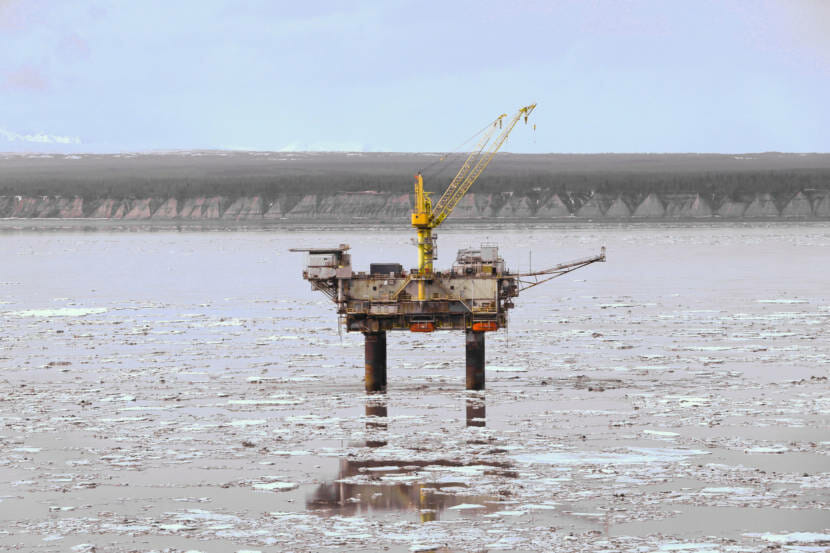
Hilcorp’s Anna Platform in Upper Cook Inlet. The company is looking to further expand its operations in the Inlet after buying up additional acreage at federal and state lease sales. (Photo courtesy Cook Inletkeeper)
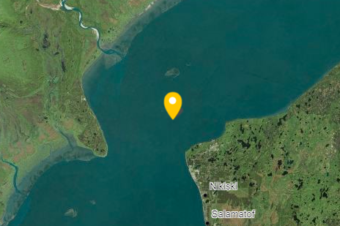
Oil company Hilcorp is reporting another undersea natural gas leak near one of its platforms in Cook Inlet, about six miles offshore from Nikiski.
Authorities said they don’t yet know how much gas has leaked into the ocean or what caused the leak from the eight-inch-wide pipeline, located 80 feet underwater. Hilcorp said the leak was first reported Thursday evening by a company helicopter pilot who spotted bubbles on the water’s surface.
Hilcorp reported the leak to state and federal authorities an hour later and immediately reduced pressure on the line, according to a report issued late this afternoon by the Alaska Department of Environmental Conservation.
A map of the spill site, near Nikiski in Cook Inlet. (Alaska Department of Environmental Conservation)
It said Hilcorp activated valves to control the leak on Saturday afternoon, and officials said there’s no longer gas running through it.
This is not the first time the same pipeline has sprung a leak, according to local watchdogs. Four years ago, a rock on the ocean floor punctured the line and caused the loss of as much as 310,000 cubic feet of natural gas per day.
The pipe also leaked twice in 2014, according to Bob Shavelson, the advocacy director of Homer-based watchdog group Cook Inletkeeper.
Ice in the inlet blocked Hilcorp from repairing the 2017 leak for three months. Cook Inletkeeper threatened to sue the privately owned company over damage to the environment and local marine life.
The leaking pipeline is more than 55 years old, according to Cook Inletkeeper. Hilcorp is known for buying and reinvigorating old infrastructure and is currently Cook Inlet’s biggest oil and gas producer.
The gas that leaked isn’t produced from the platform. Instead, it’s dry natural gas that fuels nearby Hilcorp platforms. It’s almost entirely composed of methane.
Hilcorp will assess damage when ice conditions allow, the company said. A representative from the company also said divers will install a temporary clamp on the pipeline later this week.
The spill area is within the designated habitat for endangered Cook Inlet belugas. It’s also an essential fish habitat for several Pacific salmon species.
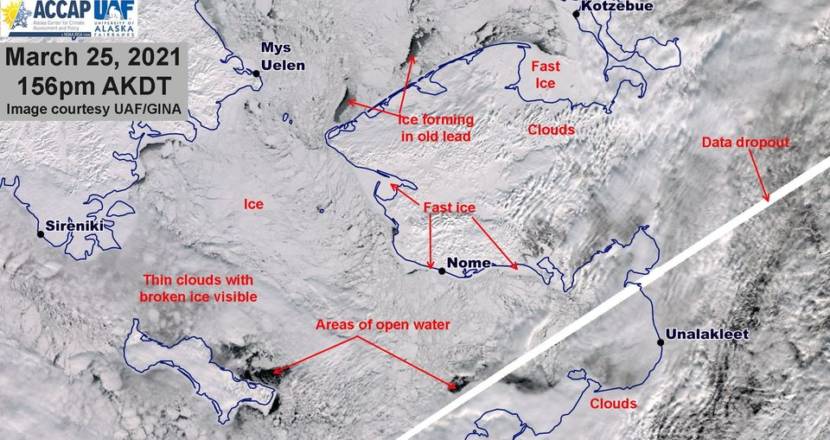
This satellite shot is from March 25th after a winter storm. The most prominent leads can be seen near St. Lawrence Island and in parts of the Norton Sound. (courtesy Alaska Center for Climate Assessment and Policy)
Blizzards and winter storms battered the Seward Peninsula and surrounding region throughout the month of March, but the sea ice has proved more resilient than in recent years.
Rick Thoman is a climatologist with the Alaska Center for Climate Assessment and Policy. He said these March storms have been known for tearing the ice apart.
“We have not seen the dramatic collapse of sea ice like we saw in several previous years, including last year, when the ice extended significantly farther south than it does this year,” Thoman said. “During the stormy spell last March, the ice retreated quite a bit. We have seen some decrease this season, but it’s been much less.”
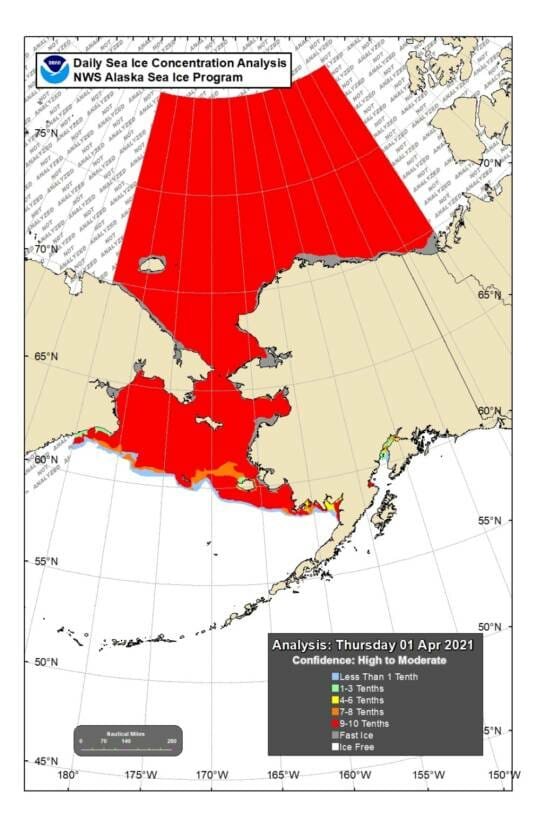
Thoman thinks the sea ice held better this year because the most southern part of the ice edge down near St. Matthew Island has been much thicker and more stationary than in recent years. That ice can hold up better against the recent batch of storms.
The most recent sea ice model from the National Weather Service. Image from the NWS, 2021.
Some of the worst ice retreat was off Savoonga, but that’s unsurprising for Delbert Pungowiyi, a lifelong resident of Savoonga and former tribal president. He said that for about ten years now, the island has only had sikuliaq — that’s the word in St. Lawrence Island Yup’ik for young and brittle shorefast ice.
“Before the storms hit us you see on a satellite [that] it looks like a good winter,” Pungowiyi said. The north side of our island is all locked up [with ice] and the south side of our island. [But] any given storm from the east or south, it just breaks it up and opens it up.”
Recent storms have continued to push the ice off the northern parts of St. Lawrence Island.
Even when the sikuliaq is there, it is difficult to use for hunting. Pungowiyi recounted that recently a group of hunters fell through the young ice attempting to get to walrus. The hunters were fine, but the hunt was unsuccessful and Pungowiyi estimates that Native food from the ocean makes up as much as 90% of the community’s food security.
Wind speeds in the Nome-census area averaged around 43 mph with easterly winds on Sunday, based off data recorded from regional airports collected by mesowest.edu, with wind in Golovin reaching as high as 56 mph.
Thoman says that historically, these storms haven’t been typical for March.
“Typically this time of year, we’re not seeing storms track through the northwestern Bering Sea, across Chukotka and into the Chukchi Sea. That’s very common in the fall. But this time of year, quite unusual. But it’s been an unusual run of marches,” he said.
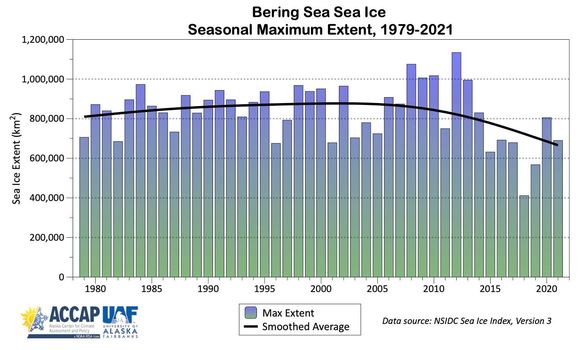
Weather patterns suggest that rather than having a storm season, the climate is just becoming stormier and less predictable. Thoman said that 2021 is also the seventh year in a row that the maximum ice extent is less than the 1981-2010 average.
“When we get these storms with less ice cover, that means, of course, that there’s more water exposed south of the ice edge, which means that water is available to evaporate and be incorporated into these storms,” Thoman said. “So when these storms come along, they have the potential to hold more moisture than they would have if say the ice extended all the way to St. Paul. And that certainly is directly attributable to the low sea ice, which is part and parcel with our changing environment.”
Graphic courtesy of the Alaska Center for Climate Assessment and Policy
And that likely means more snow and rain for Western Alaska.
At this point, Thoman predicts that melt-out for most of the Western Bering Sea and Gulf of Anadyr will likely occur in early to mid-May for parts of the Norton Sound. But these abnormally late winter storms may not be over yet. The National Weather Service is predicting heavy snowfall for Friday evening and the weekend in many parts of Western Alaska, including 5-10 inches for areas near Unalakleet and across the Eastern Norton Sound.
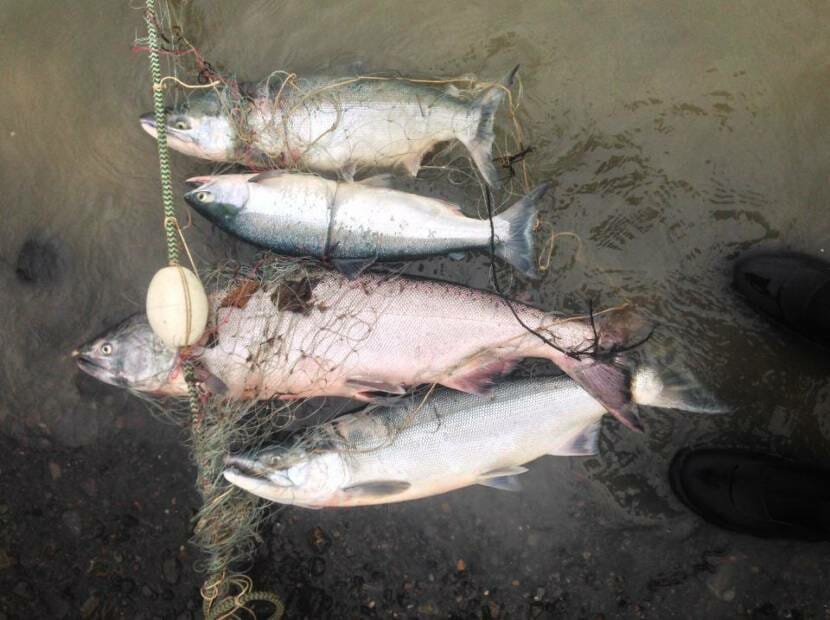
A chinook and sockeye in a net. June 24, 2016. (KDLG file photo)
Fifty-one million sockeye are forecast to return to Bristol Bay this summer.
If that holds, commercial fishermen will be able to harvest around 37 million reds. That’s 13% more than the average harvest of the past decade.
But concerns remain about the numbers of chinook salmon in the Nushagak District on the west side of Bristol Bay — which leaves the biologists who manage the fishery with a complicated balancing act.
Faced with another huge sockeye run this summer, managers in the Nushagak District say they will try to allow fishermen to harvest the sockeye and also conserve chinook.
Tim Sands, the district’s area management biologist, describes the job as trying to walk a fine line between “getting as many kings up the river as we can, but still provide opportunity to harvest sockeye salmon.”
For years, biologists around the state have wrestled with declining numbers of chinook, fish that are central to subsistence ways of life across Alaska, and also targeted by sport fishermen. Since 2007, the state’s chinook runs have consistently declined, forcing managers to restrict or close fishing in certain areas.
A stark example: the chinook run to the Chignik River. Last year, just under 1,300 fish returned, which is below the minimum escapement. Both state and federal managers restricted subsistence fishing for chinook in July, and residents struggled to get enough fish.
In the Nushagak District, managing harvest is tough because chinook and sockeye runs overlap, so when the sockeye harvests increase, so does incidental chinook bycatch.
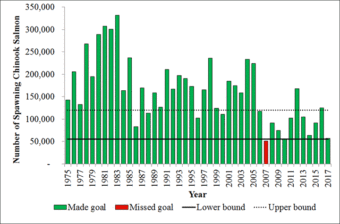
Chinook escapements up the Nushagak River, 1975-2017. (ADF&G)
The Nushagak is the only commercial fishing district in Bristol Bay that still counts the chinook runs, which can vary widely from year to year. For the past two years, the run hasn’t met its minimum escapement of 55,000. That means too few fish have reached the spawning grounds for the run to be sustainable. In 2019, escapement was roughly 47,880. Last year, it was just over 43,000.
Fish and Game has acknowledged that its counting methods are designed to count sockeye, not chinook, so it likely isn’t providing an accurate estimate of the king run. The department counts fish with sonar, which is designed to cover the areas closer to shore, where sockeye swim. chinook tend to swim in deeper water toward the center of the river.
Last June, managers postponed commercial fishing in the Nushagak District for days to allow more kings to escape upriver. In doing so, they let hundreds of thousands of sockeye swim through the district unharvested. This summer, the commercial and sport fish divisions will work to conserve as many chinook as possible, according to Sands, the management biologist.
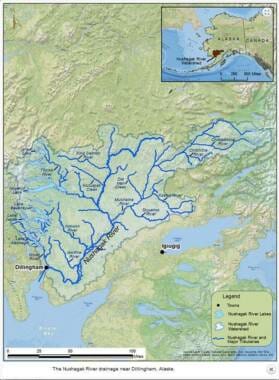
A map of the Nushagak River drainage. (ADF&G)
“Hopefully more than the minimum of kings up the river,” he said. “So it’s going to be one of those day-by-day, looking at things, evaluating the information we have and trying to make the best decision we can with the information we have.”
In other areas of the bay, managers don’t count chinook escapement anymore, but they do count incidental harvest. Last summer, the chinook harvest across the bay was the lowest on record, at 10,000 fish.
It’s not just the chinook runs that are declining, but the size of the fish is also shrinking.
A study in the journal Nature Communications shows their body length has declined by 8% over the past six decades.
Daniel Schindler is a professor at the University of Washington who has researched salmon in Bristol Bay for decades. He said chinook are returning to spawn at younger ages, particularly in western Alaska rivers.
“What we’re seeing is that the oldest, biggest fish are disappearing, or their body sizes are getting smaller at an accelerating rate,” he said. “Particularly during the last 10 or 15 years, when fishery pressure has been relatively low compared to where it was 20, 30 years ago.”
Schindler said climate change in the Pacific Ocean may slow their growth. But he said research indicates that if fish grow more slowly in the ocean, they return to freshwater later.
“That’s not what we’re seeing,” he said. “We’re seeing them come back to spawn at earlier ages. So that does suggest that there’s increased mortality on the oldest, biggest fish.”
A lot of factors can affect salmon survival. The state has said the overall declines are likely due to more fish dying out in the ocean. The decline in bigger fish could also be due to more predators targeting them.
Still, Schindler said, salmon are resilient. Chinook can rebound if their habitat quality remains intact, and if enough fish are allowed to pass through fisheries to spawn during years of low returns.
Close
Update notification options
Subscribe to notifications
Subscribe
Get notifications about news related to the topics you care about. You can unsubscribe anytime.