Oceans

Warming Pacific waters likely adding to Arctic sea ice loss, study finds

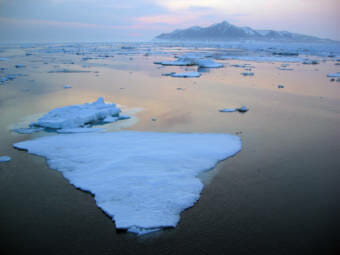
Sea ice floats in the Bering Strait off Cape Prince of Wales. (UAF photo by Gay Sheffield)

For the past decade, scientists have observed several years of abnormally low sea ice extent. While most of the cause has been attributed to a warming Arctic climate, a new study from the University of Alaska Fairbanks has found evidence that warming waters outside of the Arctic are impacting sea ice as well.
In the summer, there is a warm water mass that flows up from the Pacific Ocean through the Bering Strait across the Chukchi Sea. UAF marine science professor Harper Simmons says this transfer of warm water up into colder seas is normal.

“That flow is a natural state of the system,” Simmons said. “Unless things were really rearranged in the distant past.”

The water ends up resting in a layer just below the surface of the Arctic Ocean. Simmons says it stays there until the fall when colder water starts to form ice on the surface.

“That warm water makes its way slowly out of that layer and affects the ultimate amount of sea ice that forms in the Arctic,” Simmons said.

While that flow is normal, Simmons says there is emerging evidence that the warm water coming up from the Pacific is getting even warmer.

“Since the 90s, the temperature of that water has been observed to have a pretty significant warming trend,” Simmons said.

That trend translates to about half a degree Fahrenheit per decade. While that may not seem like a lot, Simmons says because it’s such a sudden change from years of stable sea ice conditions, it can be jarring to the system.

“If there was, in the past, kind of an expected sea ice formation of two meters of sea ice over the Beaufort,” Simmons said. “And this heat becomes part of that, then you would expect that instead of getting two meters of sea ice, you would only get a meter and a half of sea ice.”

R/V Sikuliaq docks in Nome (File photo by Emily Russell/KNOM).
The UAF-University of California San Diego study on warming Pacific waters was conducted on the R/V Sikuliaq, seen here docked in Nome. (Emily Russell/KNOM)

These observations were made as part of a study conducted by the University of Alaska Fairbanks and the University of California San Diego’s Scripps Institute of Oceanography. Simmons says the major change between this study and studies in the past was the introduction of new CTD, or conductivity, temperature and depth, technology.

The process works the same as how scientists had done it in the past. Basically, researchers lower a package into the ocean to monitor conditions in the water.

However, Simmons says the new custom-made CTD technology from the Scripps Institute exponentially increases the amount of data that researchers can gather.

“In a traditional cruise, you could make hundreds of profiles, and with a package like this, you could make thousands,” Simmons said.

Satellite imagery (upper figure) shows a warm jet of salty water flowing past Point Barrow then disappearing. Ship-based measurements (lower figures) show that the warm water subducts and continues below the surface. Lines A and B in the upper figure correlate with the ship-based data in the lower left and right figures, respectively. (Harper Simmons/UAF)

As scientists continue to monitor changes in sea ice, the impacts to the region continue to grow.

Diminishing ice has the potential to disrupt everything from marine mammal migration to the travel patterns of people who use the sea ice. Additionally, it could make travel across the Northwest Passage easier for shipping companies. Simmons says the diminishing sea ice could also impact the rate of coastal erosion.

“The more open water that you have for longer periods of time gives you more opportunities for storms to create large waves that increase coastal erosion.”

In the end, Simmons says that the findings of the study show that it isn’t just a warming Arctic that is leading to less sea ice.

“It’s not warmer temperatures locally,” Simmons said. “There’s this kind of global connection where warm water in the Pacific makes a difference.”

The study was published last month in the outlet Nature Communications.

Alaska House passes bill to allow bolstering wild shellfish populations with hatchery stock

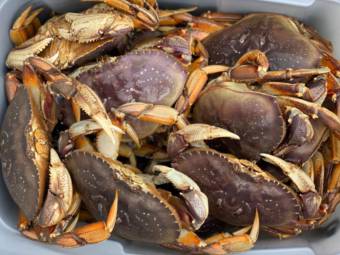
Dungeness crab in Southeast, Alaska. (Photo by Angela Denning/KFSK)

House lawmakers have passed a bill that, for the first time in Alaska, would allow shellfish like crab to be grown in hatcheries and released into the wild to bolster commercial fisheries.

Rep. Dan Ortiz (I-Ketchikan) sponsored HB-41, which would put shellfish on the same footing as salmon species that are bred in hatcheries across the state.

“The bill gives Fish and Game a solution to potentially help address declining stocks of shellfish like stocks of crab out west or abalone in the Southeast which have suffered from overfishing and predation, instead of relying only on conservative management,” Ortiz said.

The mariculture bill found bipartisan support. Rep. Sarah Vance  (R-Homer) told legislators she sees benefits for coastal communities throughout the state.

“I didn’t think that I was that old to say, ‘Hey, back in the day, we had razor clams this big, and now they’re small, and they can no longer make that available to the public,’” Vance said. “This is an area that we need the enhancement, we need these nonprofits to come in and say we’re going to help rehabilitate the shellfish to make it available for common use.”

Some Alaska biologists have voiced concern that an influx of hatchery shellfish could do more harm than good to what remains of the state’s wild stocks. They’re particularly concerned about crabs, one of the more mobile species of shellfish.

Only two lawmakers opposed the legislation, but not on environmental grounds. Rep. David Eastman (R-Wasilla) said there should be a cap on permit fees. He also took issue with the fact that the bill allows the Department of Fish and Game to penalize people, saying he thought it was backwards to allow penalties when the regulations still need to be written.

“If we are going to be in a sense creating new crimes,” Eastman said, “I think that the legislature ought to know what it is that the regulations are, that are going to attach to these stiff penalties. And have the ability as legislators — as elected representatives of the people — to make sure that those regulations are in fact, what the people want to attach to such penalties.”

Eastman and fellow Wasilla Republican Christopher Kurka were the only no votes.

The bill also allows the Alaska Seafood Marketing Institute to promote hatchery-born, wild-caught shellfish in the same way they market hatchery-bred salmon. A companion bill in the Senate has yet to be heard. It will require passage by state senators and the governor’s signature to become law.

Dunleavy proposes opening part of Kachemak Bay to subsurface gas leasing

Kachemak Bay in 2014 (courtesy Ian Dickson)

Oil and gas leasing isn’t allowed in Kachemak Bay. The state blocked development there after an oil rig got stuck and leaked oil into the bay in 1976.

But legislation proposed by Gov. Mike Dunleavy would allow the state to sell subsurface gas-only leases in part of Kachemak Bay so oil and gas companies could drill into undersea reservoirs from miles away.

More broadly, the bill would permit subsurface leasing and drilling where surface drilling is currently prohibited. And the bill’s opponents say that would unravel state restrictions meant to protect wildlife.

Haley Paine, deputy director of the Alaska Division of Oil and Gas, told the House Fisheries Committee the point of the legislation is to capture royalties for the state.

“The primary benefit of this bill would be increased revenue,” she said.

Traditionally, oil and gas companies have reached undersea gas reserves with vertical wells from platforms on the ocean’s surface. But recent drilling technology allows companies to tap into reservoirs in the ocean floor from onshore pads, miles away. Locally, it’s a method BlueCrest Energy already practices to reach offshore oil reservoirs from its Cosmopolitan Unit.

But the state can’t currently profit off subsurface leases in Kachemak Bay, where leasing is prohibited.

The area in blue is where the state proposes a program for subsurface leases. The red shaded area is where the bay is currently closed to oil and gas leasing. (Alaska Department of Natural Resources Division of Oil and Gas)

The legislation allows for subsurface leasing on a chunk of the bay near Anchor Point. It’s adjacent to the Seaview Unit, where oil company Hilcorp has prospects.

Hilcorp hasn’t yet made plans for any subsea expansion there. But the state wants to establish a lease program to collect royalties in the event that they do, said Sean Clifton from the Alaska Division of Oil and Gas. In Cook Inlet, those royalties hover around 12.5%.

“We’ve seen a lot of new lease activity in this area as Hilcorp has been looking for new places to develop gas in order to keep our homes warm and the electricity running,” Clifton said.

The area was closed to drilling in the first place in part because of fears about harming local fish and fishermen. The state says subsurface drilling won’t hurt local fisheries and that surface development will still be prohibited.

But Penelope Haas, a member of the Kachemak Bay Conservation Society’s board, worries activity in the bay could still adversely impact local wildlife.

“This lateral drilling technology and the fracking that goes along with it can go six miles or more into areas that are currently closed,” she said.

Not all directional drilling is fracking. But the two often go hand and hand.

Haas said that brings concerns about large-scale water withdrawals, impact to local watershed and potential flowback at fracking sites. The state, for its part, said fracking can be done safely and is already practiced in Cook Inlet, with oversight from the Oil and Gas Conservation Commission.

Haas is also concerned about the larger-scale impacts of the legislation.

“We on the second level are very much concerned about an effort by the Dunleavy administration to rewrite the playbook on areas protected from oil and gas drilling around the state,” she said.

Beyond its impact on Kachemak Bay, the legislation allows for subsurface drilling around the state where surface drilling is restricted. Clifton, with the state, said he doesn’t have other examples in mind of where it might apply. But he said the state wants to be ready in case a situation like the one in Kachemak Bay arises elsewhere.

The legislation is among a slate of bills from the governor’s office allowing the Department of Natural Resources to lease and sell land for development. Committees in both the House and Senate are reviewing versions of the bill.

Feds designate critical whale habitat areas in Alaska and the West Coast

Humpback whale entangled in commercial lobster gear, sighted off San Diego in 2015 (photographed under NOAA permit #: 18786) (Photo courtesy NOAA Fisheries)
Humpback whale entangled in commercial lobster gear, sighted off San Diego in 2015. The main threats identified for the whales were ship strikes and fishing gear entanglements. (Courtesy of NOAA, photographed under NOAA permit #: 18786)

The National Marine Fisheries Service published a final rule on April 21 designating critical habitat for three populations of humpback whales, including some areas in Alaska. The federal ruling affects the eastern Aleutians, Kodiak and Prince Williams Sound as well as the coastlines of Washington, Oregon and California.

The ruling excludes Bristol Bay and Southeast Alaska.

The rule establishes about 116,000 square nautical miles of protected area for the endangered Western North Pacific and Central American populations of humpback whales and the threatened Mexico population.

Critical habitat for three populations of humpback whales in Alaska and the West Coast/NOAA

These whales winter in warm, southern waters but travel north for seasonal feeding on krill, herring and other small species. In Alaska, critical habitat has been identified near the eastern Aleutian Islands, Kodiak, and Prince William Sound areas.

The Endangered Species Act mandates that the federal government create critical habitat for endangered species. Lisa Manning with NMFS says the 238-page ruling came after careful consideration of public comments.

“The goal is to identify everything the species really needs to get to recovery,” she said.

Some areas in Alaska were excluded in the designation, like Bristol Bay and Southeast Alaska, because the federal agency determined the economic impacts and national security concerns in those areas outweigh the potential protection of the whales.

Manning says NMFS decided to exclude Southeast because it’s considered one of the least important areas for conservation of these whale groups.

“Out of all the other areas considered, it is the one they’re using the least,” Manning said. “Most of the whales there are from the unlisted Hawaii population.”

This image indicates critical habitat near the Aleutians and Kodiak/NOAA

Dozens of Southeast fishermen from different gear groups spoke out against the designation in a public hearing in Petersburg last January.

Amy Daugherty was one of them. She’s the executive director of the Alaska Trollers Association.

“We were a little bit concerned about having some lines drawn over our grounds that could potentially impact us,” Daugherty said. “So we’re glad that the agency is bypassing Southeast Alaska.”

Other fishing groups said they are still reviewing the recent ruling, as is Alaska Fish and Game commissioner Doug Vincent-Lang.

The main threats identified for the whales were ship strikes and fishing gear entanglements, specifically pots and traps that have vertical lines such as for black cod fishing or crabbing. The habitat designation can only affect federal commercial fisheries, not state-managed ones. The ruling could also impact federal activities like Coast Guard operations, oil spill response, seismic surveys and permitting for Army Corps in-water construction.

The Center for Biological Diversity believes this will be enough to help protect the whales. Catherine Kilduff is an attorney with the center.

“We’re excited, this was a huge win for humpback whales,” she said.

The center was one of three environmental groups that had sued the federal government to force the designation required by law. Kilduff says that now the whales’ prey species can be protected, and hopefully the whales can be delisted in the future like the Hawaii population was.

“Animals with critical habitat designated are twice as likely to be recovering as those without them,” Kilduff said. “So, we know that having these areas drawn on a map increases awareness about where the animals are and what kind of protections they need.”

The National Marine Fisheries Service began considering the critical habitat ruling in the spring of 2018 but things became delayed with a government shutdown and then the pandemic.

The rule goes into effect May 21, 30 days after its publication.

A decade after Fukushima nuclear disaster, Alaska expands seafood monitoring

The Sitka sac roe herring fishery in 2018. In Southeast, the state screens herring, pink salmon and halibut for gamma radiation looking for the signatures most commonly associated with Fukushima radioactivity. (Heather Bauscher/KCAW)

State environmental regulators announced Monday they’re expanding radiation testing of commercially harvested Alaska seafood, including crab, using a gamma radiation detector at a state laboratory in Anchorage. That’s thanks to continued federal funding from the Food and Drug Administration.

A devastating earthquake and tsunami off the coast of Japan in 2011 killed tens of thousands and crippled the Fukushima Dai-ichi nuclear plant, which released radioactive material into the air and ocean.

That led to global concern about the safety of Pacific seafood. Alaska began screening fish samples in 2014. It now routinely tests prime export products, including Bristol Bay salmon and Bering Sea pollock, to reassure consumers that Alaska seafood is safe.

State Department of Environmental Conservation chief veterinarian Bob Gerlach told CoastAlaska that the screening has “not detected any elevated levels that are deemed harmful for consumption or for the health of the animal.”

Gerlach runs Alaska’s seafood monitoring program. He says the agency is now finalizing plans to begin testing several species of crab to capture more of the complex marine food web.

“What we’re hoping to do now with the other species is look at not just maybe these top predatory feeders, but actually some lower levels of fish in the bottom of the food chain,” Gerlach said.

He says the goal is to make sure the state is “evaluating the entire ecosystem of the North Pacific and Bering Sea.”

Environmental concern continues from the fallout of Japan’s worst commercial nuclear disaster. The Japanese government announced plans this month to release 1.25 million tons of stored radioactive seawater in the next two years.

Alaska seafood is a multibillion dollar industry. The Alaska Seafood Marketing Institute says two-thirds of the nation’s seafood is landed in Alaska ports.

Pacific heat wave had lasting impacts on Gulf of Alaska marine species

John Moran of NOAA and Jan Straley of the University of Alaska Southeast study whales in Prince William Sound. (courtesy Rob Suryan)

When a heat wave swept through the northeast Pacific Ocean between 2014 and 2016, it changed the marine makeup of the Gulf of Alaska. The warm water decimated some commercial fish populations.

Some species bounced back right away. But a recent study from NOAA finds others are rebounding more slowly.

NOAA’s study charted the impacts of the heat wave — also known as “the blob” —  on gulf marine species over time, through 2019.

Some of the blob’s impacts on local marine life were immediate. Rob Suryan is a program manager for NOAA in Juneau and the lead author on the study. He said in 2015 and 2016, thousands of common murres were found dead.

“Especially noticeable in the Prince William Sound, near Whittier, actually, a beach was just littered with thousands of carcasses,” he said.

NOAA focused on longer-term trends in this study using data from Gulf Watch Alaska, a group that monitors species recovery in Alaska waters and is funded by the Exxon-Valdez Oil Spill Trustee Council.

Suryan said there were three different types of long-term impacts on the abundance of those species they observed. Some species did well.

Those tended to be the species that do better in warmer water, like sablefish and some varieties of zooplankton.

Other species saw no change, or change that only lasted a year.

“And then a negative response, of course, is something that declines and is persistently in a lower state than what it was before the heat wave,” Suryan said.

Among those species are several popular varieties of fish, like sockeye salmon and Pacific cod.

Suryan said it’s important information to have, and continue to study, because scientists are anticipating more heat waves in the future.

“Part of it has to do with feedback loops as the conditions that are causing these warming events begin to magnify and build and are additive over time,” he said.

The data isn’t uniform across species or geography. Some fish, like certain populations of herring, are rebounding more rapidly. But taken altogether, the data paints the picture of an ecosystem that is still reeling from a warming ocean.

Suryan said the study will be included in an assessment sent from NOAA Fisheries to the North Pacific Fisheries Management Council, the agency that sets policy in Alaska’s federal waters.

Declines in cod population already prompted the council to close Alaska’s cod fishery in 2020.

Site notifications
Update notification options
Subscribe to notifications