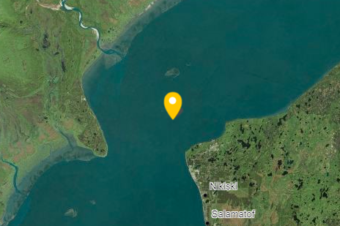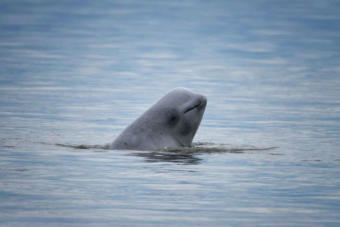
Cook Inlet belugas are the smallest of five beluga stocks in Alaska. The population has been declining for over two decades. (NOAA photo)
A federal permit allowing Hilcorp to drill in Cook Inlet does not account for the harm vessel noise could pose to endangered belugas there, according to a decision yesterday from a District Court judge.
Cook Inletkeeper and the Center for Biological Diversity challenged the permit in a 2019 lawsuit. This week, Judge Sharon Gleason sided with them, ruling NOAA Fisheries did not account for how noise from Hilcorp’s tug boats would cause harm to belugas when it authorized the company to work there.
Bob Shavelson, advocacy director at Cook Inletkeeper, said the decision touches on one of many impacts Hilcorp’s activities have on local wildlife.
“This decision clearly shows that the National Marine Fisheries Service is not doing an adequate job at protecting our marine resources,” he said.
The Marine Mammal Protection Act requires those involved in offshore oil and gas production to obtain special authorization for harming local marine life, known as “incidental take,” as long as its impact on wildlife is negligible.
Hilcorp received that authorization from NOAA Fisheries in 2019 for its five-year plan to explore and develop Cook Inlet.
But in its own recovery plan for the endangered species, NOAA says noise from tug boats is a threat to beluga whales. That’s partly because belugas rely on echolocation to find food and communicate with each other. Whale researchers have also previously voiced concern over Hilcorp’s use of air guns in Cook Inlet when exploring there.
The judge’s decision requires the parties involved to propose remedies to the noise problem from tug boats within 14 days of the March 30 order. Shavelson said Inletleeper will be in touch with its lawyers to decide what to propose.
“There’s so many different impacts affecting the Cook Inlet beluga whale,” he said. “It really is that death by a thousand cuts. And some things, like climate change, are a lot more difficult to get a handle on. But we know that pervasive ship noise, seismic air guns, toxic dumping — we know those things are having a negative effect on beluga whales, so we should reduce and eliminate them where we can.”
The court did uphold part of NOAA’s ruling, regarding mitigation measures for seismic surveying around belugas.
Representatives from NOAA Fisheries and Hilcorp declined requests for comment.
Hilcorp is currently the biggest producer of oil and gas in Cook Inlet. The Texas-based company owns several federal lease blocks in the inlet and is planning for a geohazard survey on some of those tracts this summer.
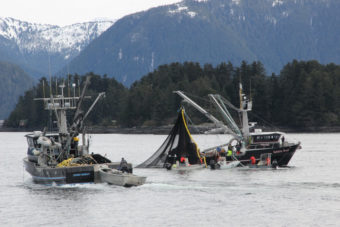
The seiner Infinite Grace pursing up during the third opening in the Sitka Sound sac roe herring fishery, on Wednesday, March 26, 2014. (Photo by Rachel Waldholz/KCAW)
According to a release from the Alaska Department of Fish and Game, the fishery opened for 8 hours on Saturday. It re-opened on Sunday morning at 10:45 and closed at 6 p.m.
Area management biologist Aaron Dupuis said seiners caught around 2,300 tons on Saturday, but he didn’t have data from Sunday’s harvest yet. He said the fleet is smaller this year, with around 20 seiners and four processors are participating.
“It’s been pretty relaxed,” he said. “Just the size of the fleet. Everything is really tightly controlled. So it’s not the usual bumper boats, wild, shoot-out fishery a lot of people are accustomed to. It’s pretty relaxed out there.”
Historically, the fishery has been fast and competitive. But due to a smaller fleet and a limited number of processors, Dupuis thinks daily harvests will be lower than usual, and it will take the fleet longer to reach its quota.
Even with a more relaxed fishery, there was one accident on the water over the weekend when a seine boat capsized during Saturday’s opener. “We looked over and saw that fishing vessel rolled over pretty hard and he was starting to take on water,” Dupuis said. “Good Samaritan vessels were able to get over there and keep the boat from going down. It doesn’t sound like any diesel fuel or any other pollutants got released from that boat.”
Dupuis said good Samaritan vessels helped bring the boat back to town. He was not aware of any injuries associated with the accident.
It’s the first time the fishery has opened in two years, and its return has been met with some resistance. A group of local activists known as the Herring Protectors have gathered outside of ADF&G offices to protest the fishery several times since the fishery went on two-hour notice.
Crew from the Silver Spray empty snow crab pots while fishing in the Bering Sea. (Courtesy of Bill Prout)
A group of Bering Sea crabbers say the pandemic has slowed their fishing season, and they want more time to catch their quota before the state shuts down their season next week.
But the Alaska Department of Fish and Game has denied their request for an extension, citing low population numbers and an upcoming mating season.
For the few boats fishing bairdi crab this year, there could be a lot at stake if they don’t have time to catch their full quota.
“I’m thinking they don’t quite understand what we’re going through out here,” said Oystein Lone, captain of the 98-foot crab boat Pacific Sounder, which is based out of Dutch Harbor.
Until recently, Lone has been fishing in the Bering Sea for snow crab, also known as opilio. But right now, he and his five-person crew have switched to fishing for a different type of crab called bairdi, which is also known as tanner crab.
Both bairdi and snow crab seasons open in October. But Lone recently switched to fishing for bairdi because that season is nearly over — even though as of Wednesday, only 46% of the total quota had been caught.
“The closure is looming on us here,” he said. “So my rationale was to try to get fish and game to give us a month extension to help us out here and keep us from switching back and forth in the middle of the season.”
The department quickly denied formal requests by Lone and two other boats to extend the season, but Lone said he hasn’t given up. He’s still pushing for an extension to catch his full quota before switching back to snow crab.
Going back and forth between the fisheries has added stress, safety risks, extra fuel burn and gear work on top of an already long and difficult season amid the COVID-19 pandemic, Lone said.
“We have changed the way we do business,” Lone said. “And I think the whole industry has changed to adapt to this. But saying that, things are taking a lot longer to get done out here. And we’re going to be pushing right up against the closure to get our business done.”
Because of bad weather, a fuel shortage in the Bering Sea community of St. Paul that’s forced him to travel hundreds of extra miles to fill up, and pandemic-related plant closures and delays, Lone is left with a lot of bairdi quota that he likely won’t be able to catch.
“Traditionally, right now, a lot of vessels would be heading to port and tying up and be done for the season,” he said. “But most of us are still fishing here.”
According to Lone, this year’s pandemic-related complications will add as much as a month and a half to his fishing season.
Bill Prout, who owns and operates the 116-foot crab boat Silver Spray out of Kodiak, is in a similar situation. He and his six-man crew, which includes three of his sons, are wrapping up fishing for snow crab before making a last-ditch effort at catching some of their bairdi quota.
“We’re probably only going to end up getting maybe four or five days of actual fishing time for the bairdi,” Prout said.
Extra wait time for crab deliveries, parts and supplies, and crew changes have roughly tripled Prout’s time to catch crab this season, he added.
And what makes the looming closure especially stressful for some fishermen is that they have payments to make on quota they either own or lease from others — and they might not have the money if the quota isn’t caught, Prout said.
“I have a couple of people that I’ve leased from for a long time who will be fairly understanding of the situation,” Prout said. “But they still might say, ‘Well, an agreement’s an agreement,’ and we could have to pay for crab that we didn’t even catch.”
While the crabbers are still pushing fish and game for an extension, it doesn’t look like they’ll get one.
After talking to industry groups and boat captains, the agency decided not to extend the fishing season for several reasons, said Miranda Westphal, a fisheries biologist with the local fish and game office in Unalaska.
The primary one is biological.
Some crab species mate all year when they come across each other on the seafloor. But bairdi gather together to molt and mate only during the early spring.
“This is the time of year that’s really critical for the future of the stock,” Westphal said. “So it would have to be a pretty large emergency for us to justify fishing into that season.”
There also haven’t been many harvest-size bairdi crab in recent years. While they were unable to survey the size of the bairdi population last year because of the pandemic, Westphal said that in 2019, the agency saw some of its lowest numbers in nearly 15 years.
Because abundance is low and fishing is slow, Westphal said, just six crab boats are currently fishing for bairdi in the western Bering Sea. The rest of the fleet is focused on catching snow crab further north.
“Boats are struggling, people are struggling due to COVID, and also abundance levels are low in the fishery,” she said. “It’s this really unfortunate coinciding of events right now. And we feel for our fishermen — we wish things could be better. But we’re very cautious about not sacrificing the future fisheries for current times.”
Despite Fish and Game’s rejection, Lone — the captain on the Pacific Sounder — said that with just six days left of the season, he’s still pushing.
“I’m going to fight to the last hour of the season to try to get an extension,” he said. “I know they said no. But no means just another way to get a yes out of them for me. So, we just have to keep fighting here and hope for the best.”
Cook Inlet oil platforms are visible from shore near Kenai, Alaska. (Photo by Rashah McChesney/Alaska’s Energy Desk)
Oil and gas leasing on federal lands and waters is on pause. That includes a sale in Alaska’s Cook Inlet that was originally slated for later this year and is now suspended indefinitely.
At the same time, the federal government is reviewing its energy program and gathering input from industry experts, environmental advocates and tribal leaders across the country. Several representatives from those groups, including two from Alaska, weighed in on the program at an Interior Department forum Thursday.
Nicole Borromeo, executive vice president and general counsel of the Alaska Federation of Natives, said that while Alaska Native communities are on the front lines of climate change, the federation also acknowledges the oil and gas industry is a boon for the Alaska Native workers it employs.
“Alaska natives do not operate in an either/or space when it comes to the nation’s energy policy,” Borromeo said. “We favor both traditional and emerging forms because a combination of both best serves our state and our people.”
In Alaska, the National Petroleum Reserve and a large swath of Cook Inlet are both part of the federal oil and gas program.
Earlier this year, the federal government halted an upcoming lease sale in the inlet in response to an executive order from the Biden administration, geared toward addressing climate change. Alaska and 12 other states are suing the Biden administration for that decision, while some environmental advocates are petitioning the government to block offshore leasing for five years.
Interior Secretary Deb Haaland said the government needs to take a long view at its management of public lands and waters.
“The pause on new oil and gas lease sales give us space to look at the federal fossil fuel programs that haven’t been meaningfully examined or modernized in decades,” she said.
Michael LeVine is a Juneau-based Arctic fellow with Ocean Conservancy, an environmental advocacy nonprofit. He said the pause was a good first step but further reforms and legislation are needed.
“If we could make one change in the legislation about offshore oil and gas, it would be to prioritize the health and viability of ocean ecosystems, rather than the way it’s stated now, a priority for extraction,” LeVine said.
He said offshore leasing in Alaska jeopardizes ocean ecosystems and the people who rely on them, including coastal communities and members of the fishing industry.
Representatives from trade unions and oil and gas industry associations said cutting federal oil and gas production would be bad for jobs.
Borromeo said AFN is also concerned about maintaining energy jobs for Alaska Native people. She said the department should actively consult Native communities in its decision-making on energy policy.
“Let us show you our lands,” she said. “Don’t necessarily just rely on what private industry or environmental groups are saying. We want to be the ones to take you and to show you.”
She encouraged Interior Department officials to visit Alaska to see it for themselves.
“That means you’re going to have to stay probably a week or so,” she said. “Because it’s going to take you a day to get here, a day to adjust up in Anchorage, and then we’ve gotta get out to the bush. We need to travel.”
The Interior Department said it will complete an interim report on its federal conventional energy programs this summer. It’s soliciting additional feedback until April 15.
Boats in Wrangell’s Heritage Harbor.(Sage Smiley / KSTK)
A special report released in March paints a stark picture of 2020’s salmon harvest in Southeast Alaska.
“Overall, it was one of the lowest harvests we’d seen, I think since the 70s,” says Lowell Fair, the Southeast regional supervisor for the state Fish and Game department’s commercial fisheries division.
It was already clear from preliminary reports that last year’s salmon season was a rough one. But just how rough?
For sockeye, the harvest was the second lowest since 1962 — that’s just a couple of years after Fish and Game was formed and started collecting data.
The king harvest was among the bottom five harvests since the early 1960s as well.
Coho and pink harvests came in stronger than kings and sockeye, but were still among the lowest years in recent memory, ranking 48th and 53rd since 1962, respectively.
Fair says Fish and Game doesn’t have an answer for the almost 60% drop in salmon harvest between 2019 and 2020. It could be any number of factors, at any part of a salmon’s life cycle.
“Marine survival [issues] is what our biggest guess would be,” Fair explains, “But that’s always hard to pinpoint, because we just don’t have the funding to do the research to really look at those kinds of studies.”
If there’s a silver lining, it might be the department’s forecast for 2021 pink harvest, which is projected to be average. In its report, Fish and Game doesn’t forecast salmon returns to the region for any species besides pinks.
That’s because pinks are the only species Fish and Game has enough data on to make a forecast.
“There’s just so much uncertainty already in survival, then when you have uncertainty in the data, that makes it just problematic to begin with,” Fair says.
He adds that Fish and Game manages all five species based on what comes back.
“We just don’t have the money to research why that amount came back,” Fair said.
But the numbers Fish and Game does have say pinks should come in a bit better than last year.
“Overall, we’re expecting a better return — better run next year to just Southeast,” Fair explains.
With some digging, putting together forecasts from hatcheries, sport fisheries, and intergovernmental partnerships with Canada, he adds that 2021 might just be better for all five species.
“I mean, it was one of the lowest overall salmon salmon harvests we had seen since I think the early 70s,” Fair said. “So I would hope so. And not only was that the case, but prices were down. And so it was really tough on fishermen.”
Drone footage of the dead humpback whale shortly after the Coast Guard spotted it and reported it to NOAA. (Photo by Joshua Houston, provided by NOAA)
Sitka’s marine mammal stranding network headed to Kruzof Island on March 18 to conduct its first necropsy on a dead humpback whale in five years. They wanted to learn more about why the whale died.
The Coast Guard reported the dead 47-foot female humpback to NOAA on Sunday evening. It had washed ashore on the south end of Kruzof Island.
Bad weather delayed the team until Thursday, and when they finally arrived, they found the whale in a different position.
“When we got out there, the whale had rotated 180 degrees and then rotated onto its stomach from all the surf and swell out there,” University of Alaska Southeast researcher Lauren Wild said. Wild is also the volunteer coordinator for Sitka’s stranding network.
Volunteers and UAS researchers conduct a necropsy on a 47-foot female humpback west of Shoals Point on the south end of Kruzof Island. (Photo provided by Lauren Wild/NOAA Alaska Marine Mammal Stranding Network)
She said that the whale had already started to decompose when they arrived. It’s a smell that she’s gotten used to over the years, but for newbies, it can be shocking.
“It’s funny to watch people’s facial expressions change as they move towards this whale, and they just kind of have this look of horror like ‘Do I have to keep walking forward, or can I stop now?’” she said.
Despite the smell, the team of UAS researchers and local volunteers from the city, school district and Sitka Tribe of Alaska got to work cutting the whale open. It took five and a half hours and 10 people to take photos and notes, collect tissue samples and examine the whale for signs of trauma.
“It takes a while and a lot of muscle power to cut through the blubber and then flense that back and peel it back and then cut through the muscle to access the inner organs,” Wild said.
Conducting a necropsy can be dangerous. If the whale is bloated, responders have to take care that it doesn’t explode when they cut it open, although that’s rare and easy to avoid, Wild said. Carcasses can also attract bears. And the scenes can be hectic, with lots of people working quickly with sharp tools. All of the responders have received specialized training from NOAA.
“You just have to be really careful especially because whales are really oily; the blubber is just really oily,” Wild said. “So as you start cutting, the animal’s just oozing oils, and so that makes things really slippery.”
The team cuts away pieces of whale blubber to take tissue samples and examine the whale for signs of blunt trauma. “We’ll wear disposable rain gear because after getting that on you for five hours, there’s really no way you can wear that clothing again,” Wild said. (Photo provided by Lauren Wild/NOAA Alaska Marine Mammal Stranding Network)
Wild said whale necropsies in Sitka Sound are fairly uncommon. When they receive a notice of a dead whale, they can’t always get to it, or sometimes it’s washed away by the time they do. But conducting necropsies is important because it can teach researchers about whales and any changes that might be happening in their environments.
“I like to think of a dead whale as kind of like a goldmine of opportunity, and there’s always information that can be gleaned from it,” Wild said. “It’s just a matter of trying to get as many people to help figure that out in the short amount of time that you have.”
As far as what killed this humpback, Wild said they didn’t find a smoking gun. The whale looked healthy and its belly was full of fish — most likely herring. But they did find some evidence of blunt trauma. They sent samples off to the lab, and they’ll have to wait for the results to find out more.
A U.S. Coast Guard helicopter flies over the deflated humpback. The helicopter dropped off six members of the team, and two boats brought the rest of the crew. (Photo provided by Lauren Wild/NOAA Alaska Marine Mammal Stranding Network)
To report a marine mammal stranding, you can call NOAA Fisheries Alaska marine mammal stranding hotline at 877-925-7773.
Close
Update notification options
Subscribe to notifications
Subscribe
Get notifications about news related to the topics you care about. You can unsubscribe anytime.