Oceans

Low sea ice and warmer oceans impact seabird migration in Western Alaska, research suggests

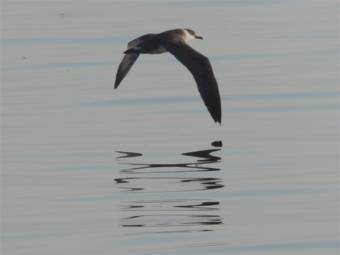
A shearwater in flight. (Photo from National Oceanic and Atmospheric Administration)

Coastal seabirds have experienced die-offs in Western Alaska the past few years. But recent results from over a decade of research suggest that offshore birds are also feeling the impact of low ice and warming ocean temperatures in the Bering Sea.
Kathy Kuletz is the lead seabird biologist for Migratory Bird Management with U.S. Fish and Wildlife Service. In a Strait Science presentation on Feb. 11, she shared research findings on birds that spend a majority of their lives at sea.

“During this warm period, there was low abundance of birds, or they shifted their distribution,” Kuletz said. “Overall, there was little reproductive success for seabirds, particularly in the northern Bering Sea.”

From 2015 to 2019, Kuletz said that bird species that feed off the surface of the water fared a little better than birds that dive for their food. However, in the northern Bering Sea, groups of murres and other surface-feeding birds overall seemed to decrease, while more of the diving birds increased.

“With the fish-eating birds, the eastern murres, puffins, murres, guillemots, all combined, they show quite a dramatic shift towards lower abundance after 2014 and 2015,” she said. “On the other hand, the plankton-eaters, which are three species of auklets, in this case, have increased during that period, from 2015-2019 in the northern Bering Sea.”

There have also been numerous changes in distribution. Thick-billed murres, for instance, decreased in the northern Bering and southern Chukchi seas, yet increased in the central and northern Chukchi Sea. Meanwhile, auklets did the opposite — they decreased in the north and increased in the south.

Overall, Kuletz said that every bird species responded differently to warming waters and a lack of sea ice in recent years.

“So we have some species that have declined like the common murres, some that have shifted their distribution a little bit north like the thick-billed murres,” she said. “And then [some species], like the short-tailed shearwaters here, have gone dramatically further north and concentrated in the Chukchi during these warm years.”

More long-term research is needed to understand why these changes in distribution and abundance are happening in seabirds. One potential cause is food scarcity. Quoting research done by National Oceanic and Atmospheric Administration Dave Kimmel, Ph.D., Kuletz said that the zooplankton community in the northern Bering Sea was significantly lower in 2019 than in 2017 and that a majority of the community was small copepods. Seabirds like auklets rely on large copepods to feed their young.

Kuletz speculates that the lower abundance and quality of prey has to do with the diminishing cold pool in the Bering Sea.

“Without the ice in the Bering Sea, there was no cold pool, for the first time ever in 2018, no thermal barrier. And this resulted in a lot of very large, predatory fish coming up into the northern Bering Sea and even into the Chukchi,” she said. “This was potential competition for forage fish and zooplankton, we don’t know for sure. But there was definitely some impact.”

Looking to the near future for studying offshore birds and the permanence of these changes, Kuletz says that Fish and Wildlife has partnered with United States Geological Survey for a new risk assessment. They plan on purchasing automatic identification system data from large vessels that traverse the Bering Sea.

With this data, researchers can overlay the ships’ track lines with seabird migration patterns and colonies, and ultimately understand species and areas of risk. This could also help shipping traffic in these lanes avoiding high-risk areas.

Warm, wet February in the Aleutians linked to warming ocean temperatures

In Unalaska, it’s also been the rainiest start to February since 2004. So far, the island has recorded more than eight inches of rain this month, with more than a week left to go. The normal February precipitation for Unalaska is six and a half inches. (courtesy of Tacho)

While much of Alaska has been bitterly cold this month, the Aleutian Islands and Alaska Peninsula have been extraordinarily mild.

It’s part of the recent warming pattern in the Bering Sea, and communities along the Aleutian Chain can expect a similar trend moving forward, says Rick Thoman, a climate specialist with the University of Alaska Fairbanks.

“Because the oceans are warming, and the climate of the Aleutians is so dominated by the oceans — unless the atmosphere does something particularly unusual, we’re aiming for a warmer than what used to be considered normal February,” Thoman said.

Much of Interior Alaska has been cooler than normal this month because of cold air coming out of Northwest Canada or down from the high Arctic, he said. But the lower Alaska Peninsula and Aleutians Islands haven’t seen a similar trend, and it’s shaping up to be one of the mildest Februaries on record for the region.

“There really hasn’t been a push of colder air from Siberia across the Bering Sea,” Thoman said. “That’s how the Aleutians can get their cold weather, and that just has been completely lacking so far in February.”

At Unalaska’s Tom Madsen Airport, temperatures haven’t dropped below freezing yet this month. And in Cold Bay, the average temperature is running more than eight degrees Fahrenheit above normal, making this the second warmest start to February since World War II.

“The only warmer start to February was in 2019,” he said. “And the third warmest is 2018. So three of the last four years in Cold Bay have been exceptionally mild — far above normal. And that is undoubtedly related to the large scale warming of the oceans that we’ve seen in recent years.”

In Unalaska, it’s also been the rainiest start to February since 2004. So far, the island has recorded more than eight inches of rain this month, with more than a week left to go. The normal February precipitation for Unalaska is 6.5 inches.

Dunleavy taps real estate executive for fisheries commission

Purse seiners fish a commercial herring opening in Sitka Sound in 2014. (Photo by Rachel Waldholz/KCAW)

The Commercial Fisheries Entry Commission is obscure to many Alaskans. But for those whose livelihoods are tied to fish, it’s a household name.

The agency was created in the 1970s after Alaska voters amended the state constitution to allow limits on the number of people allowed to fish — all for the sake of conservation. Fishermen had to show a history of their catch in a particular area to get rights to fish.

“The commission spent many, many years going through those applications, sorting through the permits,” said Juneau attorney and former lobbyist Vance Fate Putman, who former Gov. Bill Walker appointed to the two-person commission in 2017.

Vance Fate Putman was appointed by Gov. Walker to service on the Commercial Fisheries Entry Commission in 2017. The attorney and former lobbyist’s term expires in March 2021. (File photo from Governor’s Office)

That work of documenting who did and didn’t get fishing rights took decades, but it’s finally done. Over the past few years, the commission has resolved all but one dispute: an excess of eligible permit holders for a single shrimp pot fishery in Southeast.

The commission hasn’t created a new limited entry fishery since 2004. But Putman says there’s still work to be done: namely facing what he calls “the optimal number question.” And that’s because the number of permits was largely based on historic participation.

But that isn’t necessarily the optimum number,” Putman said. “That’s the maximum number. The optimum number may be lower or higher than that.”

His term expires in March. And so his successor Melvin Smith will likely take up that question. Until recently Smith worked for the Anchorage real estate office of a regional Native corporation.

He’s a low-key appointment — industry representatives say they don’t know him. He didn’t respond to requests for comments sent through the governor’s advisors.

Records show Smith has lived in False Pass, Wasilla and most recently Anchorage. His most recent commercial fishing permit was active in 2004. He’s also held permits for land-based set nets in the Alaska Peninsula, purse seining and some longlining. His work email at Aleut Corporation bounced back saying he’d left the Native corporation last Friday.

The Governor’s office didn’t announce the appointment. Nor was the vacancy advertised. His name only surfaced after it was transmitted on February 3 to the state Senate for consideration. Appointments to the commission require a confirmation vote by lawmakers.

Asked about his qualifications, the governor’s spokesman released a one-sentence statement.

“Gov. Dunleavy selected Mr. Smith because he believes he is the best candidate for the seat on the CFEC,” wrote spokesman Jeff Turner in an email.

Fish politicos like former fisheries lobbyist Bob Thorstenson say it’s longtime practice for someone close or loyal to the governor’s inner circle to be tapped for the commissioner jobs, which come with six-figure salaries.

“Whoever gets that job is usually a pretty good friend of the governor’s people,” Thorstenson told CoastAlaska. “Because it’s a choice job.”

Thorstenson agrees with Putman that the commission’s next task is to right-size the number of permits in limited entry fisheries. And create new ones.

“There’s going to be a lot of buybacks and a lot of different types of moves,” Thorstenson said. “And there’s moves that need to be made for commercial fisheries.”

CFEC has been under pressure since a scathing 2015 audit that found inefficiencies, and Thorstenson says he takes exception to critics who argue that the commission has worked itself out of a job.

“Those people just don’t have a lot of breadth or vision or depth,” he said, “because CFEC’s job is far from done.”

Lawmakers proposed a bill in 2015 to merge the commission into the Department of Fish and Game. An executive compromise reduced the number of commissioners and cut salaries.

Melvin Smith may be unknown in fishing circles. But industry figures will soon be putting a face to the name. He’ll be addressing the United Fishermen of Alaska during this week’s annual meeting.

Genetic technique brings biologists closer to solving beluga mystery

Cook Inlet belugas are the smallest of five beluga stocks in Alaska. The population has been declining for over two decades. (NOAA photo)

The beluga population in Cook Inlet is not bouncing back, and scientists are trying to figure out why. First, they need to know more about the population. A key part of that is knowing how old the whales are.

“Up until this point, the only way we’ve been able to age animals is through their teeth,” said Verena Gill, a branch chief with NOAA Fisheries.

“You count the rings in your teeth, kind of like you count tree rings,” she said. “We can’t exactly go run around the inlet, jump on top of a beluga, yank one of its teeth out and count the rings on the living animal and go, ‘OK, well, Betty Beluga out there is 10.’ So the only way we’ve been able to get teeth are from animals that have died.”

But now, researchers have found a way to determine the ages of living Cook Inlet belugas using skin samples. That technique is outlined in a paper published last month by researchers from NOAA Fisheries, Oregon State University and University of California Los Angeles.

It’s a big deal for researchers who study these whales. NOAA lists Cook Inlet belugas as one of its nine “Species in the Spotlight,” meaning they’re at high risk for extinction.

The technique relies on epigenetics. While genetics concerns DNA, epigenetics is about how that DNA is modified.

“So the term itself is a little bit of a catchall, because it actually includes a lot of different processes,” said Ellie Bors, a postdoctoral researcher on the study. “But I like to think of epigenetics as all these other ways that DNA is modified or packaged within a cell that affects the way DNA turns into genes and proteins.”

In particular, researchers looked at a specific epigenetic process called DNA methylation. That means organic compounds, called methyl groups, are being added to DNA.

“And it turns out that as a lot of mammals age, the way that DNA is methylated changes, or the amount of methylation changes with age,” Bors said.

Scientists can tell how old a beluga is based on how its DNA is methylated. And they can get that DNA through tiny skin samples of living whales.

Other species, like humpbacks, have patterns on their bodies that indicate age. Not belugas.

Paul Wade works for NOAA Fisheries’ Alaska Fisheries Science Center and was a co-author of the paper.

“Being able to estimate the age of a living animal just can be so important for us,” he said. “I’ve always been jealous of colleagues that study different species where they can know the age of their animals just ’cause they know so much about their population.”

He said this technique will help with a lot of research in the works about Cook Inlet belugas.

A lab in San Diego is studying pregnancy rates in belugas using hormones found in their blubber. Researchers knew what percentage of these whales were getting pregnant, but they couldn’t tell the age of the pregnant whales.

“But as soon as we got the ages and plotted pregnancy or not versus age, we noticed that it was only the older whales in our study that showed a fairly high pregnancy rate,” he said.

It was a small sample size, Wade said. But when scientists compare those findings with that of healthy beluga populations, they show reproduction among Cook Inlet belugas could be delayed. That might be a sign the population is struggling due to external factors, like a lack of food.

Findings are preliminary. But Wade said scientists feel they’re getting closer to knowing why Cook Inlet belugas aren’t rebounding.

Kenai Peninsula residents who are excited about beluga research can participate in local efforts, like the Cook Inlet Belugas Count, a one-day event that uses volunteers in Homer and Kenai to count whales.

There’s also the Alaska Beluga Monitoring Partnership, a program that takes place in the spring and involves training. Visit akbmp.org for more information.

Study connects physical decline of Alaska seals to warming Arctic

Spotted seal mother and pup in the Bering Sea. (NOAA Fisheries photo)

As global temperatures rise and warm the coldest parts of the world, scientists are watching for changes to species that live there. A new study has found evidence connecting the rapid warming of the region with a physical decline in three species of Alaska seals.

For 12 years, researcher Peter Boveng with the National Oceanic and Atmospheric Administration led a team that monitored ribbon and spotted seals in the Bering Sea. They were specifically monitoring body condition, or how fat the seals were. Boveng says what they found was the youngest seals were getting smaller.

“The fatness of the pups, the young of the year, declined on average over that time period,” Boveng said.

Boveng says this is one of the first major studies that shows evidence of a noticeable change in the seals’ body condition related to global warming.

“There hadn’t been, up until now, really much of any documentation of impacts that we think are climate related,” Boveng said.

Both of these species of seal tend to gather on the edge of the sea ice to hunt for food and raise their young. However, sea ice extent has drastically diminished over the past decade, with an average loss of just over 18,000 square miles a year. Boveng says that could impact how much seal mothers are able to forage.

“The mothers, maybe, were not finding as much food in the period prior to the birth of their pups, when they were pregnant,” Boveng said. “And also maybe not having as much fat or finding as much food during the nursing period.”

NOAA Fisheries scientists approach a ribbon seal. (NOAA Fisheries photo)

Between 2007 and 2018, the time period of the study, Boveng says that the two species of seals experienced two unusual mortality events, or an unexpected rapid decline in population. During the first event, the seals acted more lazy, with many showing sores on their bodies and loss of hair. Boveng says there was no evidence linking those things to a loss of food or a warming climate. He says the second however, saw more evidence that the decline was food-related.

“So this second UME which occurred right in the years of record low ice extent in the Bering Sea, really seemed to line up with the things we were seeing,” Boveng said.

A related study of harbor seals in the Aleutians found a similar decline over a three-year period, with an average decrease of 13 pounds per year — that’s about 10% of their weight. Boveng says that decrease is tied to a heat wave in Southwest Alaska between 2014 and 2016. He says it’s clear the dramatic decline in weight hadn’t been going on for long.

“The decline in harbor seal body condition over that period was pretty rapid,” Boveng said. “Something like that wouldn’t be something that had been going on for a long time, because they would’ve just wasted away.”

Looking to the future, Boveng says that scientists forecast warmer Arctic conditions will become more normal, and he anticipates that changes to seal bodies will be much clearer as time goes on.

US and Russia update plan to address marine pollution in Bering, Chukchi seas

The U.S. Coast Guard Cutter Healy, a 420 ft. icebreaker homeported in Seattle, Wash., breaks ice in support of scientific research in the Arctic Ocean.
The U.S. Coast Guard Cutter Healy, a 420-foot icebreaker homeported in Seattle, Washington, breaks ice in support of scientific research in the Arctic Ocean. (Public domain photo by Petty Officer Prentice Danner/U.S. Coast Guard)

The United States and Russia have updated their plan for addressing pollutants across national boundaries in the Bering and Chukchi seas.

The agreement between the United States and Russia, known as the Joint Contingency Plan, has been in effect since 1989. The U.S. Coast Guard is the federal agency that does most of this work, working with counterparts at Russia’s Marine Rescue Service.

Coast Guard incident management official Mark Everett said the plan lays out protocols for pollution that spreads from one nation’s waters to the other’s.

“This agreement says, essentially, we will agree to notify you. We will agree to request assistance in the response if needed,” Everett said.

Everett said to date, there have been no joint responses to pollution like oil or marine debris along that boundary with Russia. However, he said the two entities regularly conduct exercises and share information on pollution within their boundaries.

“There was one recently in Kamchatka, on the Russian side, that the Russian Federation government shared information with the United States,” Everett said. “We offered assistance. They didn’t accept the offer of assistance, but that is part of the bilateral agreement — to share information about other incidents, even though they may not affect the other party.”

Everett said one of the major new features of the latest Joint Contingency Plan is the addition of what’s called an international coordination officer.

“Someone potentially from the U.S. Coast Guard, in the event of a joint response, could go over to the Russian side,” Everett said. “A Russian representative could come over to the U.S. side, and then we have embedded liaison officers.”

Everett said he’s hopeful that having the new positions will make it easier and more efficient for either nation to share information. He said U.S. and Russia officials plan to meet in the fall to discuss their next exercises related to marine pollution response across national boundaries.

Site notifications
Update notification options
Subscribe to notifications