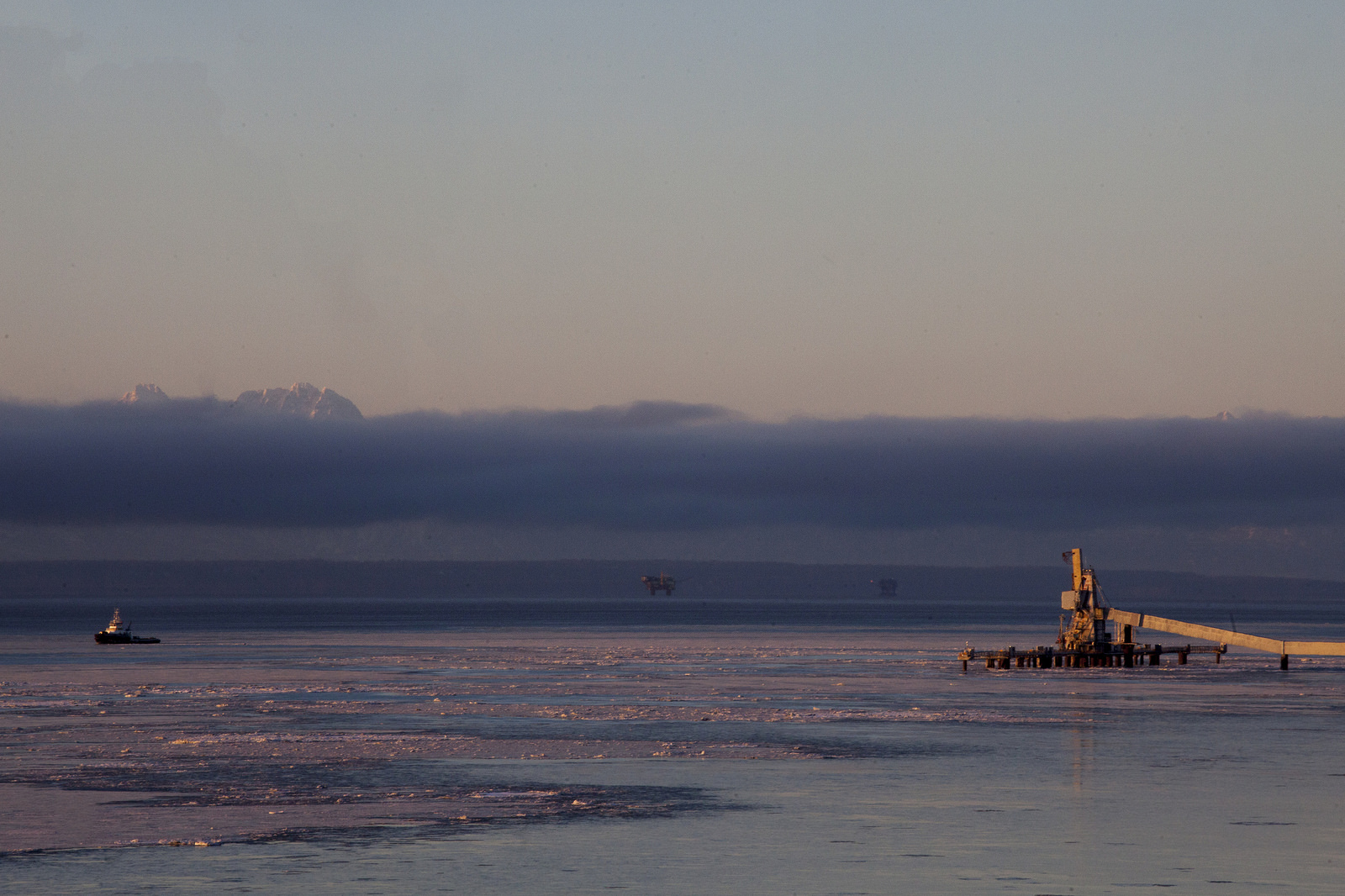
Cook Inlet oil platforms are visible from shore near Kenai, Alaska. (Photo by Rashah McChesney/Alaska’s Energy Desk)
The federal government has hit pause on preparations for an oil lease sale in Cook Inlet after President Joe Biden signed an executive order indefinitely halting new leases.
The Bureau of Ocean Energy Management was gearing up to solicit bids on 1 million acres in Cook Inlet’s federal waters later this year. But Biden said on Jan. 27 his administration wants to review the federal leasing program — one part of a broader order geared at combating climate change.
Before the lease sale stalled, the bureau had already released a draft environmental impact statement. The comment period for that impact statement and all February meetings are now canceled.
Kara Moriarty is the president and CEO of Alaska Oil and Gas Association. She said it wasn’t surprising that the Cook Inlet lease sale was paused after Biden’s order.
“What we don’t know is, is this indicative of all lease sales into the future? I mean, we certainly would hope not,” she said.
Even without presidential intervention, it’s not clear that the federal bureau would have held the lease sale. The agency canceled lease sales in 2006, 2008 and 2010 due to lack of industry interest. Hilcorp was the only bidder in state and federal lease sales in Cook Inlet for several years.
Environmental groups say the moratorium is a good thing. Cook Inletkeeper Advocacy Director Bob Shavelson said it’s refreshing to see the new administration take action.
“And there has been strong opposition over the decades to industrializing lower Cook Inlet, and we’ve got strong commercial fishing and sport fishing and tourism and subsistence economies here that would directly conflict with heavy industry and oil and gas development,” he said. “So it doesn’t make sense to throw all that away so Hilcorp can make a few more dollars.”
Tim Dillon is the executive director of the Kenai Peninsula Economic Development District. He said even without widespread industry interest, it’s important for Alaska that the opportunity is there.
“Our governor has said over and over again that here in Alaska, we do it the safest way possible,” he said. “And people know that. And to just put a stop on everything, really hurts an industry in a big, big way.”
If the Biden administration does let leasing proceed, the federal government will open a new comment period.
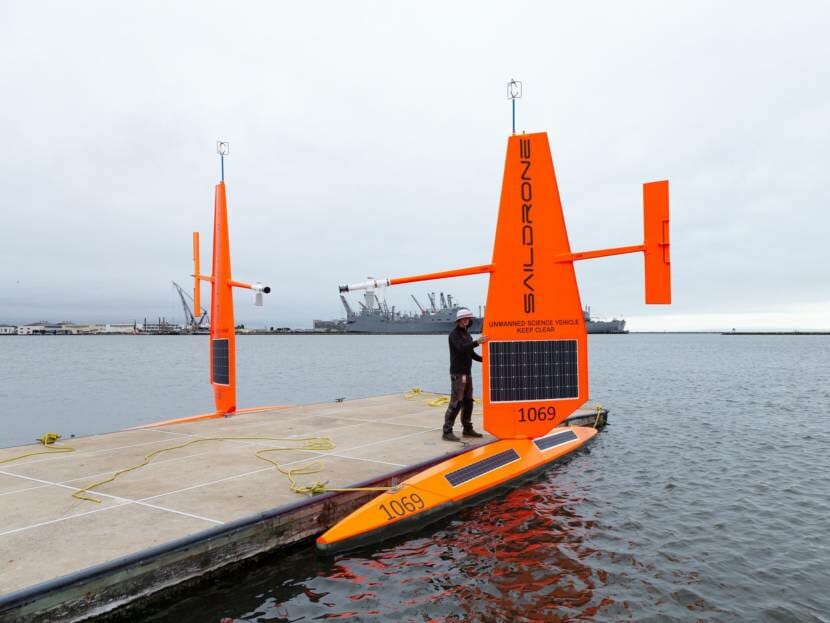
A Saildrone employee wearing a mask for COVID-19 inspects an uncrewed surface vehicle at the dock in Alameda before deploying it the Arctic. (Photo by Saildrone)
Seafloor mapping continues to utilize unmanned technologies. The data updates and charts areas of the Bering Sea and oceans where there is little to no information, potentially making nautical travel safer and more efficient in Western Alaska.
The National Oceanic and Atmospheric Administration’s Office of Coast Survey maps nautical charts to help with safe shipping, national defense and maritime boundaries. The coast survey office has contracted with TerraSond, a geospatial services company that specializes in seafloor mapping, since 1998 to chart Alaska waters. However, ocean floor mapping dates back to 1807 when President Thomas Jefferson created the U.S. Coast Survey Office.
Andrew Orthman, a charting program manager at TerraSond references lead lines, one of the very first nautical survey technologies.
“Of course you got lead lines, lowering a weight on a rope and physically measuring how deep it is. What’s funny is we still do this, but not for charting anymore,” Orthman said. “We do it as a great quality control tool. We love to take a lead line and lower it next to our fancy multi-beam sounders and make sure we are getting the same thing.”
In recent history, there has been a shift to drone technology. During a recent Strait Science presentation, hosted by the University of Alaska Fairbanks Northwest Campus in Nome, Orthman noted many benefits from these innovations.
“They’re entirely wind-driven sailboats, no engine or props, they are entirely at the mercy of the wind and current. As a result, they’re slow, normally only 2 to 3 knots, but they are incessive. They go for 24/7, weeks or months at a time. It’s amazing what you can accomplish at 2 or 3 knots if you never stop. Solar panels to power their electronics, of course, zero emissions.”
Orthman also recognizes how unmanned vessels keep people safe. When one begins to chart the uncharted, there are many risks that go into navigating seas. However, no one is put in harm’s way when autonomous boats begin to collect the data in the risky areas. Recently, Orthman said drones returned from a five-month mission to map the 20 meter and 50-meter isobaths, or depth line, off Alaska’s North Slope. The drones also had some additional surveying in the Norton Sound and Kuskokwim Bay.
In late May 2020 TerraSond, working to chart more Arctic waters, had planned on using the drones for this project. The initial plan was to have the drones shipped up to Dutch Harbor, but COVID-19 travel restrictions made things difficult. The plan had to be changed.
“Saildrone released these things on May 28 from San Francisco Bay, they towed them out of the Bay and waved goodbye. Off they went,” Orthman said. “They took a little over two months to arrive off of Point Hope. They began to trickle in there in early August after about a 3,000 nautical mile transit. It was very successful, no major issues on the transit up.”
The journey back is still underway, three of the four boats made it back to Almeda, California, where Saildrone headquarters are located. The fourth drone was caught in a big storm in the North Pacific in late November. The boat’s sail was damaged but is still being tracked.
“And the last word is that that one is in Queen Charlotte Sound, in Canadian waters, north of Vancouver Island,” Orthman said. “So, we’re thinking we are going to get the data from that boat in the next couple weeks or so. Depending on who they can round up to pick that boat up.”
Looking ahead for the year to come, TerraSond is collaborating with NOAA to chart waters in Bristol Bay, but nothing has been confirmed yet.
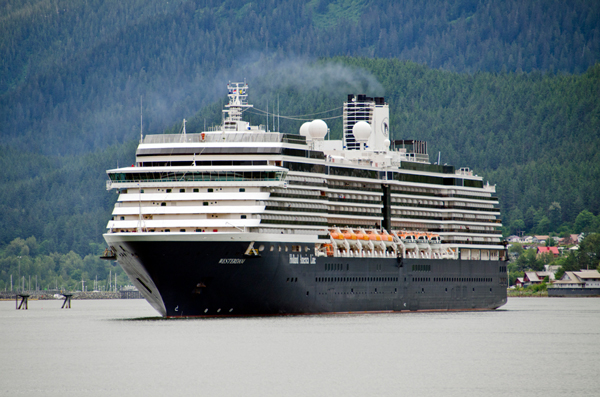
The Holland America Cruise Ship Westerdam prepares to dock in Juneau July 16, 2012. The ship was fined $250 by the National Park Service for illegally discharging grey water last year in Glacier Bay National Park. (Photo by Heather Bryant/KTOO)
The state Department of Environmental Conservation is looking to hire environmental monitors to inspect cruise ships over a six-week period in May and June. It comes via a recent contract proposal to field marine engineers on commercial passenger vessels during the early part of the cruise season.
“We’re going to get onboard 100% of the cruise vessels that are coming in the state,” DEC water division director Randy Bates told CoastAlaska on Tuesday.
The proposal would include the megaships with thousands of passengers and crew. But unlike the Ocean Ranger program, it would also cover smaller, high-end 60-person cruises operated by boutique lines like National Geographic Expeditions and UnCruise.
“DEC is committed to environmental oversight of cruise ships, and we expect the cruise ships to comply with our existing laws while they’re in Alaska waters,” Bates said.
The agency is offering up to $400,000 annually for marine engineers to inspect 30 to 40 ships. The money would come from a head tax paid by cruise ship passengers.
But it’s a fraction of the $3.4 million Ocean Ranger program that was funded out of that same head tax money. That program had marine engineers on more than half of all voyages by large cruise ships.
Gov. Mike Dunleavy has twice defunded the Ocean Rangers through line item vetoes over the objections of state lawmakers. His administration’s legislative proposal to repeal and replace the program has stalled in the legislature.
Rep. Zack Fields (D-Anchorage) says blocking that program goes against the will of voters who approved the Ocean Rangers program in 2006.
“What I’ve heard is very strong support for the Ocean Ranger program, both from the public and for members of the legislature,” Fields said Tuesday. “Because the cruise industry is an important part of our economy. And it’s important that the public have confidence that there aren’t going to be illegal discharges.”
Fields says lawmakers support modernizing the Ocean Rangers program but want to see widespread coverage on large ships.
“We were actually working on legislation to update the Ocean Ranger program to include the capacity for remote monitoring, that is electronic monitoring, complementing in-person inspections,” Fields said. “So I would like to return to that legislation when we get organized.”
The DEC contract also makes allowances for monitors to ride along but prevents them from booking berths on what are often overnight trips.
One of the authors of the original 2006 ballot measure says that violates the spirit of the original law which seeks to maximize coverage of cruise ships.
“This seems to be yet another example of the Department of Environmental Conservation’s lackadaisical approach towards enforcement of Alaska’s laws designed to protect the water,” Juneau attorney Joe Geldhof said.
Cruise Lines International Association Alaska‘s Mike Tibbles released a brief statement on the proposal.
“The industry is committed to meet or exceed environmental regulations and is continuously investing in new technology to further reduce environmental impacts,” Tibbles wrote late Tuesday. “As new technology and compliance systems evolve, we appreciate the state’s effort to consider more effective and modern ways to monitor and ensure compliance with state environmental laws.”
Industry veterans say a mix of qualified engineers and electronic monitoring could probably be an efficient way to police cruise ship pollution.
“I was in the Coast Guard when we first came up with the oversight when they discovered they were doing overboard discharges,” Ed Page, executive director of the Marine Exchange of Alaska. He’s referring to the 1990s when cruise lines were accused of illegally dumping in Alaska waters.
“I look at it 20 years later, I’m going, ‘There’s some pretty good technology that could be coming into play,’” he said. “I still think you need a human, though.”
Ed White helped develop and run the Ocean Rangers program as head of DEC’s cruise ship program. He left the agency in 2019 after more than a decade.
“The proposal in some ways reminds me of 2007 when there was a partial Ocean Ranger program immediately after the ballot measure when there wasn’t much time to prepare the contract or to hire,” he wrote in an email to CoastAlaska. “It was difficult to hire, train, and transport Ocean Rangers each year, but a lot of hard work by contractors and staff made the program possible.”
It remains unclear how many cruise ships will return to Alaska in 2021. The pandemic erased last year’s season and so far cruise lines have announced early cancellations suggesting that if cruises do resume they’ll be later in the season.
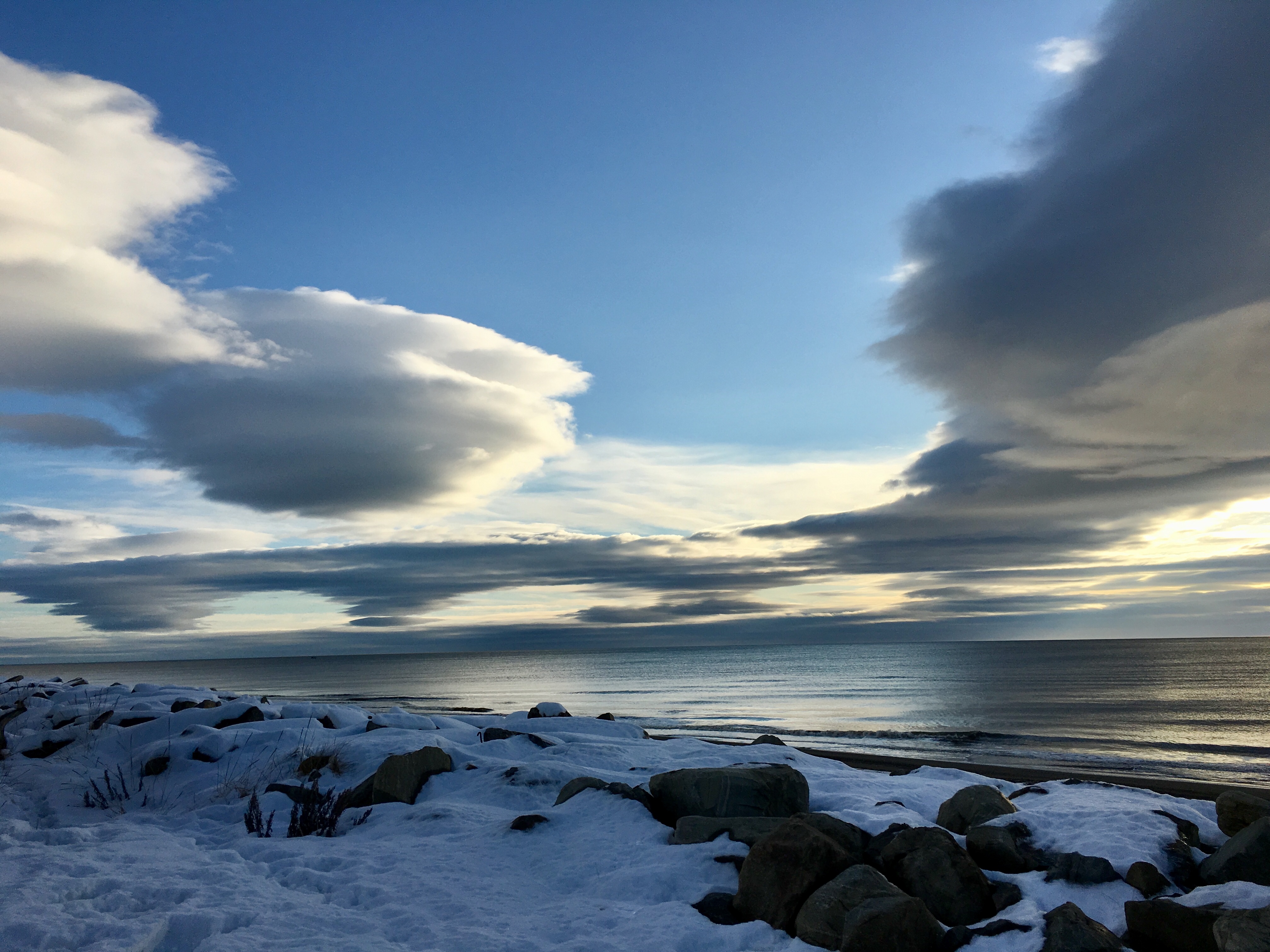
Bering Sea coastline near Nome, October 2017. (Photo by Zoe Grueskin/KNOM.)
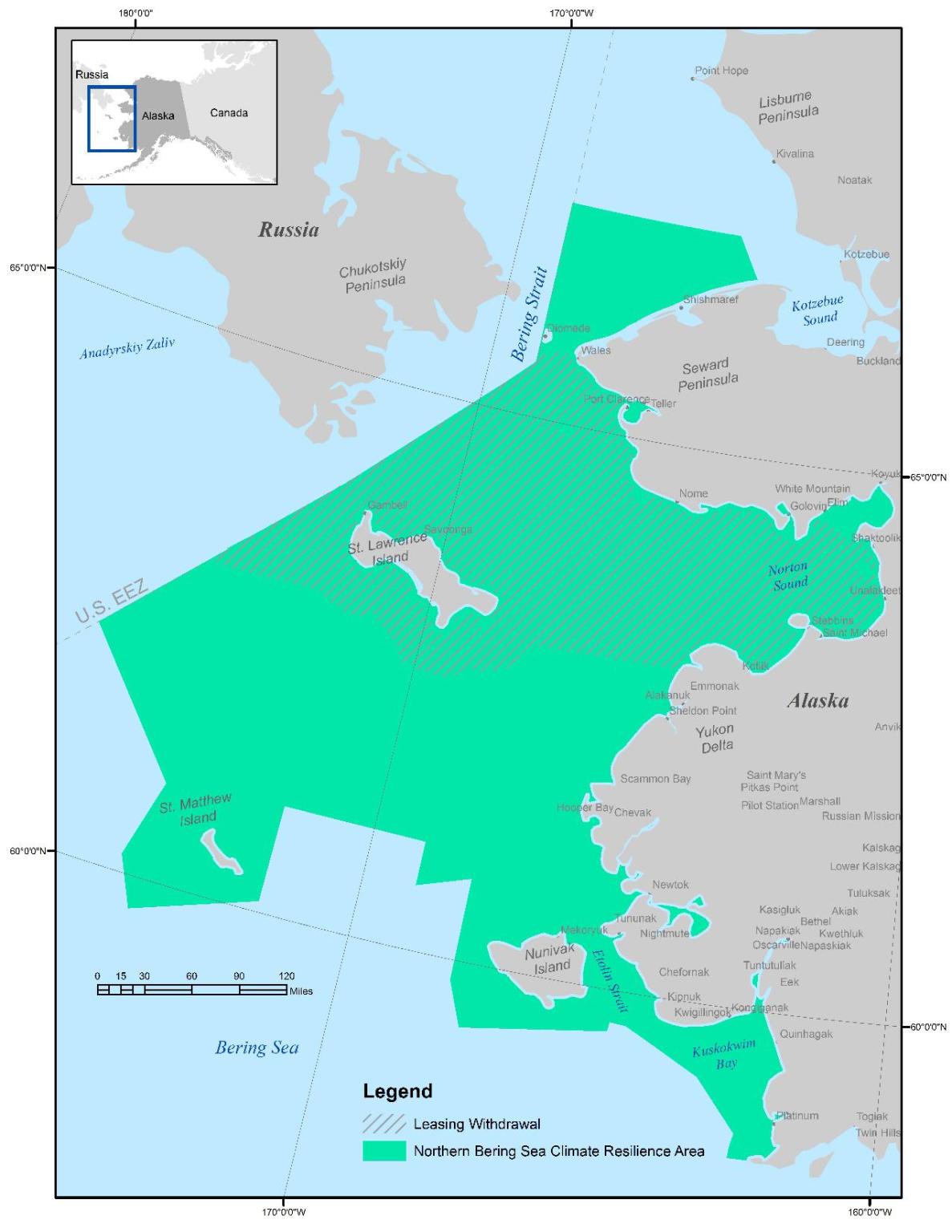
President Joe Biden signed several climate-related executive orders on his first day in office. One of them reinstates the Northern Bering Sea Climate Resilience Area, an Obama-era executive order that includes protections from offshore oil and gas leasing in the Norton Sound as well as waters around St. Lawrence Island.
The original order was revoked during former President Donald Trump’s early months in office.
The reinstated order outlines policies on marine shipping, pollution, marine debris and oil spills, among other Arctic marine-related issues. The entire “resilience area” stretches over 112,300 square miles, from the Kuskokwim Bay to the southern border of the Chukchi Sea.
But for groups in Western Alaska, one of the most significant things about the order is that it acknowledges the importance of using local Indigenous knowledge. The federal task force responsible for the Northern Bering Sea Climate Resilience Area would include an intergovernmental tribal advisory council. The council has not yet been formed but would include between nine and eleven elected representatives from tribal governments.
Melissa Johnson, executive director of the Bering Sea Elders Group, called it a “milestone” for incorporating Indigenous people into federal conversations and policy on climate change.
“That council focuses on the matters that affect us as Indigenous people who live along the Bering Sea coast, who rely on the Bering Sea coast and who pass that knowledge on to future generations,” Johnson said.
Johnson and others emphasize that anything addressing climate change and activities in the Bering Sea should include local tribes. In 2016, the Elders group and 39 Tribes reportedly petitioned the Obama administration for additional marine protections. One of their primary concerns was that increased Arctic shipping could impact marine mammal migrations and subsistence hunting.
In a joint press-release from several Tribal groups, the Bering Sea Elders Group said the order “elevates” tribal roles in Bering Sea management and “provides a pathway for our Tribes to exercise self-determination.”
The “resilience area” stretches over 112,300 square miles, from the Kuskokwim Bay to the southern border of the Chukchi Sea. (map from the executive order)
Kawerak, Inc. marine advocate Austin Ahmasuk welcomed the new order after years of Arctic policy that he said has not adequately included the people most affected.
“A lot of Arctic policy is being proposed, decided upon, even written, by people who are not from this region,” Ahmasuk said. “We’re glad that it’s prohibited oil and gas leasing in those planning basins. We are of course glad about the prohibition of bottom trawling into the northern Bering Sea. And then we look very much forward to how communities will be involved as advisors in Northern Bering Sea management.”
The original 2016 executive order drew sharp criticism from the Alaska congressional delegation. Senator Dan Sullivan called it a “unilateral plan to harm Alaskans.” The delegation has not yet issued a statement or responded to requests for comment on Biden’s decision to reinstate the 2016 executive order.
The Dunleavy administration would not comment specifically on the reinstatement of the Northern Bering Sea Climate Resilience Area.
In a statement from the Alaska Department of Law, Assistant Attorney General Maria Bahr wrote that Biden’s executive orders are still being reviewed for their impacts on state agencies.
“These are complicated and evolving issues and will take some time to fully analyze,” Bahr wrote in a statement.
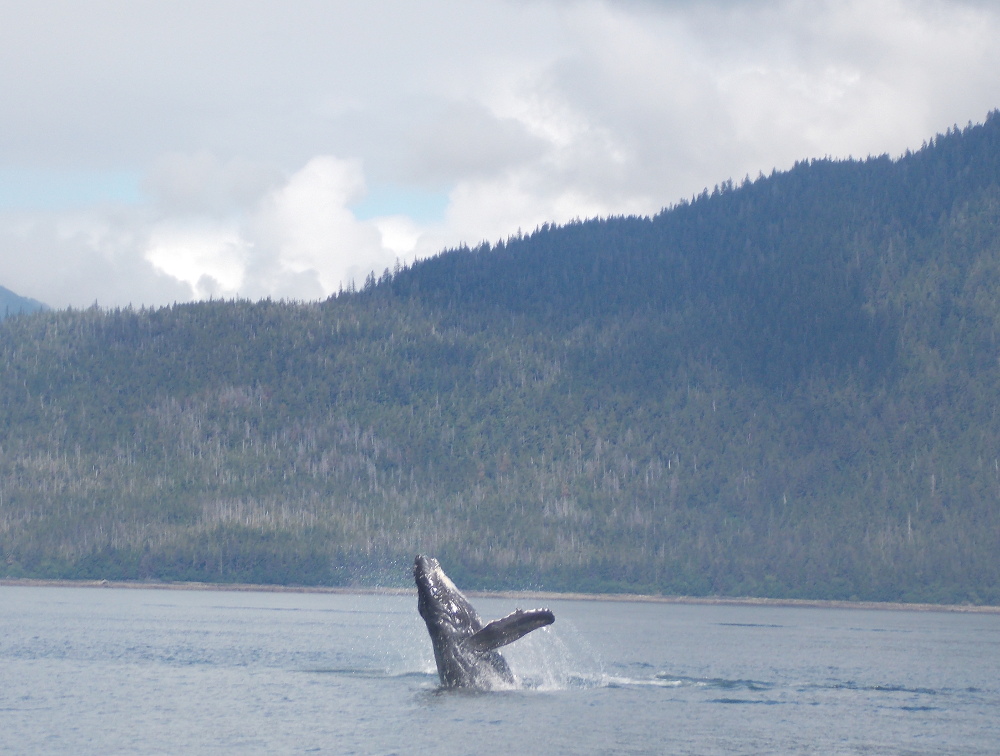
A humpback whale breaches in Frederick Sound in 2015. (Joe Sykes/KFSK)
A judge has agreed to another extension for a final rule on designating critical habitat for endangered and threatened humpback whales in the Pacific Ocean.
Wildlife conservation groups including the Center for Biological Diversity, Turtle Island Restoration Network and Wishtoyo Foundation sued the National Marine Fisheries Service in 2018, seeking to force designation of waters important to three different populations of whales. The habitat ruling is a requirement of the Endangered Species Act.
The groups hope it will help the whales rebound that range into the waters off Mexico, Central America and into the western North Pacific Ocean. The numbers for these populations remain low, while humpbacks that frequent other parts of the Pacific are flourishing and have been removed from ESA listing.
The agency issued a proposed rule in 2019 to designate thousands of square miles off the coast of Alaska, Washington, Oregon and California. And it identified some of the threats to these whales, including fishing gear entanglement.
In 2019 and 2020, the Marine Fisheries Service held hearings from California to Alaska on the proposed rule and received thousands of comments. Habitat designation requires the federal government to show its decisions are not destroying waters important to survival of those humpbacks.
Commercial fishermen, the state of Alaska and municipalities in Southeast Alaska opposed the proposed rule and want Alaskan waters left out of the final decision.
Based on a court agreement, the deadline for the final rule was Jan. 15, 2021. However, the federal government asked for additional time to review its final decision before releasing it and the plaintiffs in the lawsuit agreed.
On Jan. 19, U.S. District Judge Haywood Gilliam Jr. granted an additional 90 days. That puts the new deadline for the final rule at April 15.
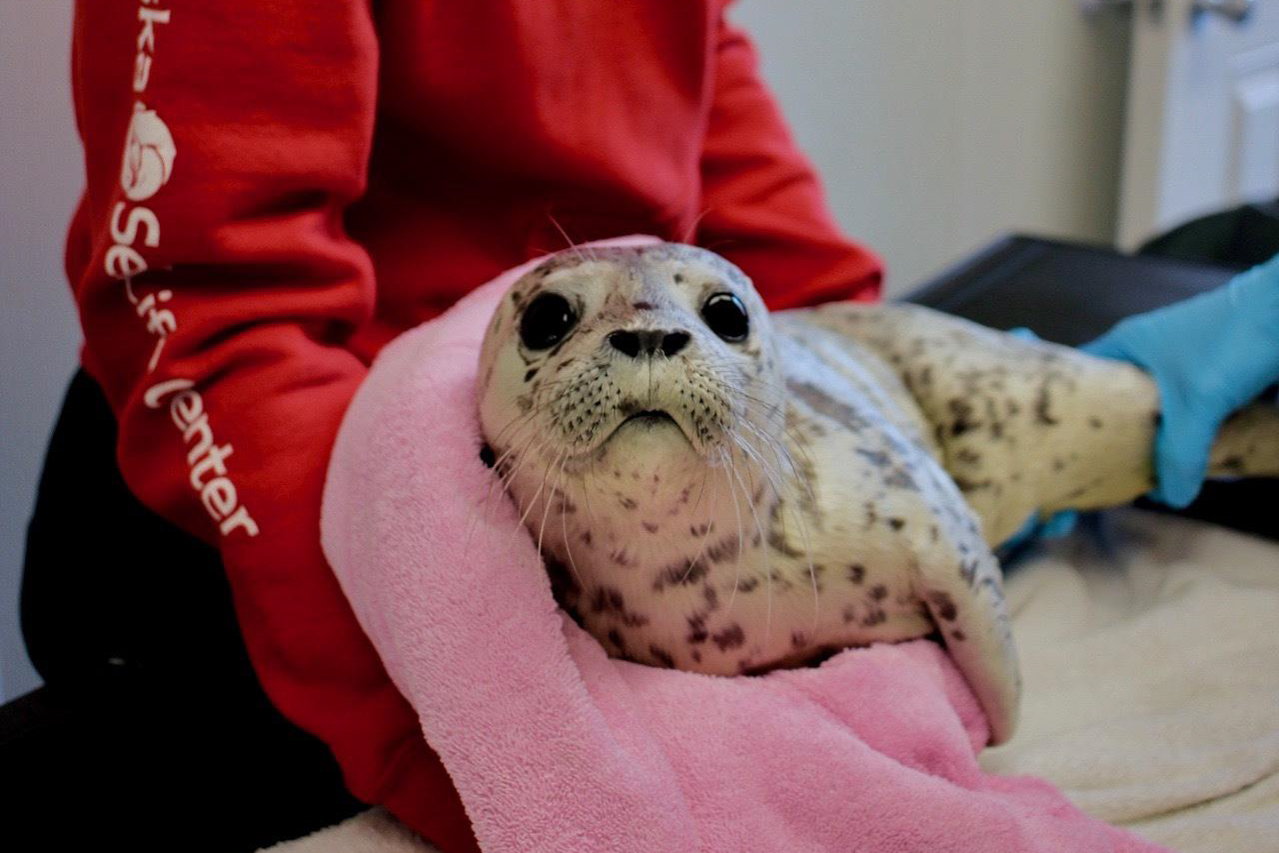
The new program will send SeaLife Center staff to oil spill sites in western Alaska. (courtesy Alaska SeaLife Center)
The Alaska SeaLife Center in Seward is partnering with an oil spill response organization to rehabilitate oiled marine mammals in Western Alaska.
Through an agreement with nonprofit Alaska Chadux̂ Network, the center will treat marine mammals affected by spill pollution in a large chunk of Alaska waters.
The idea is to get wildlife experts to the scene of a spill as quickly as possible — like an oiled wildlife SWAT team, said Chip Arnold, chief operating officer for the SeaLife Center.
“The exciting thing about the contract with Chadux̂ is that their whole paradigm of oiled wildlife response is rapid response,” he said.
Locals know the Alaska SeaLife Center as an aquarium. But it’s also the state’s only permanent rescue and rehabilitation facility for marine mammals.
Arnold said they never intended to get involved in oil spill response. But a decade ago, the center decided to build up its capacity.
“We knew that if some big spill, some spill of national significance happened again in Alaska, we are the marine mammal stranding center for the entire state,” he said. “And we are going to be called. And we’re also animal lovers, and so we are going to respond.”
The center is on contract with two other oil spill response organizations, including Cook Inlet Spill Response and Prevention in Nikiski. But this is the first time it will be available as a first responder, Arnold said.
It’s a first for Chadux̂, too. The organization also partners with a bird rescue group, but has never teamed up with marine mammal experts before.
When there’s a spill, Chadux̂ will first send in its team.
“Once we’ve discerned that wildlife has been impacted, or wildlife may be impacted, we would then reach out to the Alaska SeaLife Center and ask them to deploy immediately,” said Chadux̂ general manager Buddy Custard.
The center has a team of 23 animal care professionals, along with mobile vet clinics, staff support units, and other infrastructure and supplies. That way, teams can rehabilitate affected animals on-site, without taking them out of their habitats.
The SeaLife Center has also trained volunteers from the Lower 48 to staff the center while its own employees are in the field.
Chadux̂’s oil response programs are funded by the industry. To be part of the Chadux̂ Network, companies pay dues to the nonprofit in exchange for services.
“Everybody that’s enrolled in our program gets this service, if they need it,” Custard said.
Chadux̂ covers a large part of Alaska’s waters, from the North Slope down to the Aleutian Islands, and throughout Prince William Sound.
But Arnold said the development of this infrastructure will also allow the center to respond to spills closer to home. If there’s a spill in Resurrection Bay, for example, it can set up units in the center’s parking lot.
It wouldn’t be the first time the site is used to rehabilitate oiled wildlife. Arnold said after the Exxon Valdez spill, nearly 10 years before the SeaLife Center opened its doors, the property on which the center sits was used to house a temporary sea otter treatment facility.
Close
Update notification options
Subscribe to notifications
Subscribe
Get notifications about news related to the topics you care about. You can unsubscribe anytime.