Oceans

Scientists look for invasive crab ‘fingerprint’ in Alaska waters

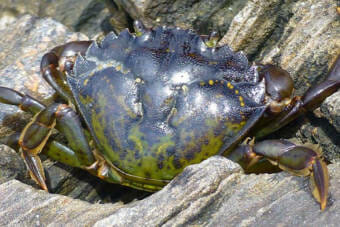
A European green crab. (Photo by Emily Grason/Washington Sea Grant)

Scientists are on the lookout for an invasive crab species expected to move north into Alaskan waters. This year in Southeast Alaska, they added a new tool to the monitoring effort for European green crab, which is a threat to the state’s shellfish and salmon.

European green crab or shore crab have been expanding their range north along the Pacific coast. But this year they were discovered just south of the Alaskan border.

“This Haida Gwaii occurrence last summer puts them very close to us,” said Linda Shaw, invasive species coordinator for the Alaska regional office of NOAA Fisheries. “I really wish I could say we don’t expect them, but prudence dictates that we say, yes, we think it’s a matter of when, not if.”

In July, natural resources managers found male and female adult green crab in Haida Gwaii, formerly called the Queen Charlotte Islands.

The species is native to northern Europe but has expanded its range to North and South America, Africa, Asia and Australia. The crab species was first found on the east coast of the U.S. in 1817 and the west coast in in San Francisco in the 1980s. Initially they may have been transported in ship ballast or by other human means. But some of the northward expansion in the Pacific may be drifting young crab on oceans currents.

Shaw said this animal ranks highly on the list of invasive threats for Alaska.

“They’re one of the top, at least marine, invasive species that we’re concerned about, and we’ve been tracking them for many years because they’ve been on the west coast already. They’re in Oregon and Washington and have been moving up the coast of British Columbia,” Shaw said.

On the east coast, these hardy crustaceans are known as aggressive eaters and have meant millions of dollars lost in fisheries for clams, mussels and scallops. The crab are destructive to eelgrass beds, which are important to young fish. They’re also known to eat juvenile salmon and could compete with native Dungeness crab.
Charlie Waters prepares eDNA samples for transport to Auke Bay Laboratory. (Photo courtesy of NOAA Fisheries/Dave Nicolls)

These green crab have expanded their range northward during times of warmer water conditions from El Nino events. Scientific models predict warmer water from climate change could also help the spread of the species.

The typical way to monitor for this invader is using fish traps in targeted spots. But this past year Shaw and Alaska Sea Grant fellow Meredith Pochardt came up with a plan to combine trapping and water sampling in multiple spots. The water testing could produce environmental DNA, left behind by the crab in skin, shell or excrement. Scientists describe this eDNA, as its called, like a biological fingerprint. Shaw said this is a relatively new method that seems well suited to monitoring for invasive species.

“So maybe we have a broader net to cast,” she said. “Just collecting the water samples, which are filtered down, and then the eDNA is analyzed for the potential presence of that organism.”

That wider net helps on Alaska’s expansive coastline. But the plans for the expanded monitoring were derailed by travel restrictions from the global pandemic. Instead other scientists working at Little Port Walter on southern Baranof Island south of Sitka obtained the testing equipment and took the first water samples for green crab. Results aren’t back yet from that testing. Shaw cautioned that even if DNA is detected, follow up trapping is still needed to confirm the presence of that species in Alaska.

The scientists also secured funding to work with the Metlakatla Indian Community to join the monitoring effort.

“They are positioned ideally down there on Annette Island close to our southern Southeast Alaska border to be able to intercept green crab that might be coming north towards Alaska. And they were very interested in this project.”

The Alaska Department of Fish and Game provided fish traps that were sent to Metlakatla and set in several spots. No crab turned up there, or in traps set at Little Port Walter. The eDNA water sampling could start up in Metlakatla in 2021 and scientists may look to add other spots. They plan a full sampling season next April through September.

Nearly 8,000 gallons of ‘slop oil’ spilled at onshore Hilcorp facility near Cook Inlet

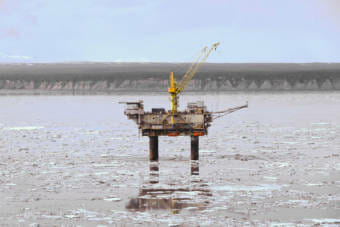
Hilcorp’s Anna Platform in Upper Cook Inlet. The state says nearly 8,000 gallons of oil leaked out of an underground line at Hilcorp’s onshore Trading Bay facility near Cook Inlet. (Photo courtesy Cook Inletkeeper)

Oil and gas company Hilcorp is cleaning up an oil spill on the western side of the Cook Inlet, about 20 miles northwest of Kenai.

That’s according to a report Wednesday from the Alaska Department of Environmental Conservation. The state says nearly 8,000 gallons of “slop oil” leaked out of an underground line at Hilcorp’s onshore Trading Bay production facility.

The slop oil is about 80% crude and 20% water. It’s considered waste and can’t be sold down the pipeline, said the state’s report.

The oil mix pooled in the soil and on top of it but did not go into the Cook Inlet waters, according to Crystal Smith, central region manager for the environmental conservation department.

An operator first noticed the leak Tuesday afternoon.

In a statement Wednesday, Hilcorp spokesman Luke Miller said the underground line was “immediately isolated” and the spilled oil remained within a tank containment wall.

Nine Hilcorp employees on site recovered about 630 gallons of the spilled oil Tuesday, according to the state’s report. More workers were headed to the area to help with cleanup. Also, Hilcorp said, environmental specialists were traveling to the scene.

The state says it has received no reports of impacts to wildlife so far.

The cause of the leak remains under investigation.

Worry for commercial fishermen and Kenai Peninsula communities after Cook Inlet fishery closure

The 10-0 vote shuts down drift gillnet fishing in waters farther than three miles offshore, from the southern tip of Kalgin Island to Anchor Point. (courtesy Redoubt Reporter)

Federal managers voted Monday to close a huge swath of Upper Cook Inlet to commercial salmon fishing, capping a two-year fight over the fate of the fishery and its 500 permit-holders.

Those fishermen and representatives from the Kenai Peninsula turned out in droves to the North Pacific Fisheries Management Council meeting to oppose the closure and advocate for lighter conservation measures.

But when representatives from Alaska Gov. Mike Dunleavy’s administration said the state was unwilling to manage the area alongside the federal government, the council voted unanimously for the closure.

The 10-0 vote shuts down drift gillnet fishing in waters farther than three miles offshore, from the southern tip of Kalgin Island to Anchor Point. Fishermen like Georgie Heaverly, of Anchorage, said the area is a crucial fishing ground and that the closure will reverberate across industries.

“Fishermen have been leaving the fishery already for the last several years,” she said. “It’s hardly economically viable, and this really is the nail in the coffin.”

For years, fisheries management of Upper Cook Inlet’s federal waters was under state jurisdiction. But in 2013, United Cook Inlet Drift Association, advocating for the commercial industry, filed a lawsuit in an effort to revert management to the federal government.

The courts sided with UCIDA in 2017, and the council was tasked with drafting a new salmon management plan. This fall, two years into a process that involved collaboration from groups of stakeholders, Dunleavy’s administration introduced the option of closing the federal waters to commercial salmon fishing completely — a proposal known as “Alternative 4.”

It was a controversial idea. In the weeks leading up to the meeting, hundreds submitted comments in opposition, including the Kenai Peninsula Borough Assembly, the cities of Kenai and Homer, Rep. Ben Carpenter, R-Nikiski, and Sen. Peter Micciche R-Soldotna.

Micciche now says he thinks the council’s decision will be challenged in court.

Rather than an outright closure of the federal waters of Upper Cook Inlet, opponents of Alternative 4 asked the council to turn management over to the state, with federal oversight.

Council members rejected fishermen’s plea for state management after hearing from the Dunleavy administration. Rachel Baker, the deputy Fish and Game commissioner who represents Dunleavy’s administration on the council, said the state does not want to take on the burden of managing fishing in Upper Cook Inlet’s federal waters.

Andy Mezirow, who runs a charter fishing business in Seward, is the one council member who lives on the Kenai Peninsula.

He said he was worried about the impacts of the decision on his neighbors. But he added that if the state would not agree to joint management, he would reluctantly support the closure.

“I’m not an expert on states’ rights, but it seems like almost everyone agrees that the state should be the one that’s ultimately managing this fishery,” he said.

A big concern among opponents is that the closure will make matters worse for seafood processors, who are already strained by poor fishing seasons the last couple of years. And it’s hard for drift and set-net fisheries to stay open if processors are closing, says Robert Ruffner, a former member of the Alaska Board of Fisheries and a resident of Soldotna.

“Our communities are going to suffer pretty heavily, probably more than the numbers reflect in terms of the harvest that occurs out there, because our processors are rapidly becoming the limiting factor in what they can continue to stay open and operate under those environments,” he said.

Homer, in particular, would be hard hit by the decision, according to the council’s report.

The area in red is Cook Inlet’s exclusive economic zone. The pending fishery management plan will apply to that stretch of water.
(NOAA)

At least one group of fishermen supported the action. The Kenai River Sportfishing Association, which has close ties to Dunleavy’s administration, submitted the lone comment in support of closing the federal waters to fishing.

Executive Director Ben Mohr said he would prefer state management of the fishery than total closure. But after the court’s decision in the UCIDA lawsuit, he saw the closure as the best path forward.

“We weren’t seeking to shut down the commercial fishery or anything like that, that’s not what we’re about,” he said. “It was solely about who manages those fish and defending the state’s primacy to manage our fish and wildlife resources for the benefit of all Alaskans.”

Most other waters in Alaska under federal jurisdiction are closed to commercial salmon fishing.

Baker said at the meeting that benefits to other groups might balance out its negative effects. Smaller harvests in the federal waters could lead to better harvests in other parts of the inlet, like for sportfishing groups, commercial set-netters and northern inlet drift fishermen.

The closure will not go into effect before the upcoming 2021 season, since it still needs to be approved by the secretary of the Department of Commerce and the National Marine Fisheries Service.

Jim Balsiger, the service’s regional administrator, was the one member of the council to abstain from voting Monday.

Once again, Arctic Report Card shows the abnormal is now normal

Sea ice floats in the Bering Strait off Cape Prince of Wales. (UAF photo by Gay Sheffield)

The 2020 Arctic Report Card is out, and the results show the Arctic continues to warm at an accelerated rate. This year was the second warmest on record in the Arctic, with impacts to sea ice, erosion and marine ecosystems.

In 2006, the National Oceanic and Atmospheric Administration released its first Arctic Report Card, laying out a timely snapshot of what the coldest parts of the world looked like as the climate warmed.

Rick Thoman is a climate specialist with the University of Alaska Fairbanks.

“Things were starting to change rapidly enough that folks were interested in this near-real time update of a variety of the different parts of the Arctic system,” Thoman said.

Fifteen years later, Thoman is the lead editor of the 2020 Arctic Report Card. He says even though Alaska didn’t have very extreme weather patterns, the Arctic as a whole was impacted.

“Some place in the Arctic every year has some extreme. It varies place to place,” Thoman said. “This year, Siberia, especially Western Siberia was the focus of the warmth, the very early snow melt, the wildfires, some of which were overwinter fires, zombie fires. Last year was Alaska. A couple years ago it was Greenland.”

Thoman says even though Alaska was impacted a little less this year by the warming climate, it still follows the recent trend.

“Whatever the trend is, there’s always going to be years above and years below that,” Thoman said. “We’re at the point now though, for instance with erosion, it wasn’t as much as last year, but it’s always going to be more than it was in the 1950s.”

One of the facets of the Arctic most impacted by a warming climate is sea ice. Thoman says this year followed a trend of shrinking sea ice in the Arctic.

“The lowest it got at any point was the second lowest [on record]. Only the 2012 minimum extent was lower,” Thoman said. “And in the winter, the maximum extent it got on any one day was the 12th lowest.”

Low sea ice extent impacts much of the arctic ecosystem, forcing marine mammals like walruses and seals to haul out on tiny patches of land rather than the thick rich sea ice they’d been accustomed to. Thoman says that bowhead whales in Alaska waters are in a slightly better position than other marine mammals, due to their ability to swim much farther to get to the zooplankton that they eat.

“If their food supply is very far north one year because that’s where the ice is, they have the ability to go and get that food, unlike other species which have a much shorter range,” Thoman said.

While that works well for the whales, Thoman says new feeding routes have the potential to upset subsistence whale harvests from Alaska’s northernmost Indigenous populations.

“From a whale perspective, if they have to go 600 miles of the Alaska coast to find food, for a bowhead that’s not a problem,” Thoman said. “At what point it becomes the whales are there but they’re not accessible for Alaskans, that’s a different question.”

Basically, Thoman says what was once abnormal or unusual in terms of Arctic climate is now normal. The Arctic is transforming, and populations will have to adapt.

Relief and disappointment as Bristol Bay reacts to Army Corps’ Pebble permit denial

Two attendees at a public hearing on the draft environmental review of Pebble, which the U.S. Army Corps of Engineers held in Newhalen in March 2019. (Izzy Ross/KDLG)

When the U.S. Army Corps of Engineers last week denied the Pebble Limited Partnership a federal permit to develop a mine under Section 404 of the Clean Water Act, it surprised people on both sides of the issue.

“I was ecstatic. I was elated. I was so happy to hear that it was finally over,” said Billy Trefon, Jr. from Nondalton, one of the villages closest to where the mine would have been built.

To the south, in Iliamna, Iliamna Development Corporation CEO Lisa Reimers said people feel hopeless.

“Well, we feel like it was — we were lied to by the Army Corps because they said politics wouldn’t be involved. And it ended up being politics,” she said. “The Army stated they’d recommend to build a mine, then out of nowhere they changed their minds.”

Pebble would have been one of the largest gold mines in the world. The Army Corps said last week that the mine proposal didn’t follow Clean Water Act guidelines.

For Trefon, in Nondalton, the project also went against the traditional teachings of elders.

“I was raised up listening to elders telling me that, if you take care of the land, the land will take care of you,” he said. “And it has been doing that for centuries, milleniums. So to us this land is important. The water is important.”

People around Bristol Bay, including Trefon, have focused on Pebble to the point of exhaustion, investing years to understand the issues around the project and its potential impacts.

Many were resigned, and for opponents of the project, the Army Corps’ decision released a wave of relief. Lindsay Layland is the deputy director of United Tribes of Bristol Bay, one of the regional groups opposing the mine. She’s also a commercial fisherman.

“As a fisherman, I’m just… I’m so happy, you know, I’m so proud of the effort that folks in the bay and beyond have put forward, and come together on,” she said.

Opposition to Pebble has been a unifying issue for the three major sectors of Bristol Bay’s fishery. Much of the advocacy over the past decade and a half has been centered on protecting Bristol Bay’s sockeye salmon run — the largest wild salmon run in the world.

“It really comes down to this amazing coalition, this amazing, diverse group of people — from commercial fishermen, to tribes, to sport fishermen, to subsistence fishermen, to hunters and anglers,” Layland said.

The debate has influenced people of all ages. Hailey Carty is a 13-year-old from Dillingham who’s in eighth grade. Pebble has always been a topic close to home.

“This has been something I’ve been protesting against for a few years now, and for it to finally be denied is really, really exciting,” she said.

Many of the people who live in the region and opposed the project also see this as a win in a fight to prioritize and protect subsistence practices.

“This is our land, our food sources, our animals, everything kind of runs off the water,” Carty said. “And for something to be taken away, can affect so many different things. It can just destroy many, many things.”

But for those who backed the project, the decision comes as a harsh blow. The mine proposal had recently seemed poised to succeed.

Sue Anelon works for the Iliamna Development Corporation. Iliamna is another community close to where the mine would have been. Anelon says the area is economically depressed. She sees the Army Corps’ denial as a bad decision for the state as well as the Lake Iliamna region.

“I’m very worried right now, because there’s a lot of people without jobs — they’re depending on the government,” she said.

Anelon said people have to wake up to the economic reality in the state. She pointed out that when Pebble was operating in the area several years ago, it provided jobs. That meant they were able to more fully participate in a cash economy.

“I’ve seen the good and the bad,” she said. “When Pebble was here and a lot of people were working, they were paying for their own groceries, they were paying their own fuel. They were buying trucks, they were buying Hondas. People were paying for things. Now they can’t do that. They have to rely on the government.”

Reimers, the CEO of Iliamna Development Corporation and a board member for Iliamna Natives Limited, has supported the project for years. She disagrees with the Army Corps determination that it was “contrary to the public interest.”

Reimers believes that regional entities like the Bristol Bay Native Corporation have not provided viable economic opportunities for communities like Iliamna, and she said that people who live near the proposed mine site and wanted the project are deeply disappointed.

The Pebble partnership said in a statement that the Army Corps’ decision is a “lost opportunity” for the region, and that it plans to appeal the denial.

No 2021 rebound projected for Taku and Stikine kings

King salmon are by far the most lucrative salmon species for trollers. (Photo courtesy of Matt Lichtenstein)

State biologists have again predicted underperforming king salmon runs in the Taku and Stikine river systems. That means Southeast Alaska’s troll and gillnet fleets can expect restrictions for sockeye and king salmon harvests in areas around Juneau and Wrangell.

“We’ll be going along in this same conservation mode that we’ve had,” state Area Management Biologist Dave Harris told CoastAlaska. “We’ll probably do very, very similar fisheries management regimes that we have in the last several years.”

Both rivers have been historically below the lower limits of the state’s escapement targets that biologists say are needed to keep the king runs healthy.

Harris says there are a number of theories to explain low king returns. They’re not fully understood, though a blob of warm water offshore is one of the most well-documented causes. For whatever reason, there have been poor survival rates of king salmon in the open ocean.

“Our freshwater production has been dropping off now because the returns have been so small,” Harris said. “But we don’t believe there’s a fundamental ecological problem in freshwater at this point.”

The 2021 preseason forecast released Monday by the Alaska Department of Fish and Game predicts 9,900 fish on the Stikine River. The Stikine River’s escapement goal is between 14,000 and 28,000 king salmon. Some 10,300 king salmon are projected to return to the Taku River. The escapement goal on the Taku is between 19,000 and 36,000 kings.

In other words, both forecasts are well below the minimum number fish biologists say should return to freshwater to spawn in each river.

That means fisheries managers will close areas to trollers targeting lucrative king salmon. And Harris says there may be less opportunity for the gillnet fleet to fish sockeye salmon when the kings are returning.

The Taku and Stikine river forecasts for 2021 are lower than the previous year’s. Harvest restrictions banning night fishing and large mesh gear that target kings have been in place for several years. Trollers have also seen more areas placed off-limits as an effort to conserve kings.

Alaska Trollers Association Executive Director Amy Daugherty says the poor forecast is not unexpected.

“These river systems have been coming in low for a series of years,” Daugherty said Monday. “It’s not ideal but we’re going to follow our managers and try and help these rivers recover.”

The Stikine and the Taku are Southeast Alaska’s most productive salmon fishing systems.

The largest king salmon run on record for the Stikine River was in 2006, which saw 90,000 kings. The Taku’s record year was 1997, at nearly 115,000 fish.

Both runs are on transboundary rivers that flow downstream from British Columbia. The U.S. and Canada are treaty-bound to limit their catches to keep the cross-border salmon runs sustainable.

Site notifications
Update notification options
Subscribe to notifications