Oceans

After 2020’s dismal catch, next year’s Southeast pink salmon harvest could be close to average

Ava Daugherty, of Juneau, grabs a chum salmon from Sara Gering, of Juneau, as the two work to offload more than 40,000 pounds of salmon from the fishing tender San Juan on July 19, 2018, in Juneau, Alaska. (Photo by Rashah McChesney/Alaska’s Energy Desk)

Next year’s catch of pink salmon in Southeast Alaska could come in a little below average, although that would be an improvement following several years of weak returns.

The Alaska Department of Fish and Game is forecasting a harvest of 28 million pinks in the region next summer. Andy Piston, the department’s pink and chum salmon project leader for Southeast, said that would still put the catch a little below the recent 10-year average.

“That forecast for 28 million harvest for 2021, that’s actually for an odd year that’s quite a bit below what we’ve seen in most recent years with the exception of 2019,” Piston said. “And in 2019, the parent year for 2021’s return, that was the first year in a long time where we saw a really poor odd-year harvest.”

Pink salmon spawn two years after they’re born. Southeast has been in a cycle of weak returns for even years but better numbers in the odd years. This year’s catch wound up at 8.1 million pinks, roughly the same harvest from two years ago. The region hasn’t seen catches that low since 1976.

Fish and Game’s forecast is based in part on trawl surveys that catch young pinks heading to sea each year. Those are conducted in partnership with NOAA Fisheries researchers in the northern panhandle.

Piston notes that the forecasts for five of the past six years have overshot the actual catches.

“What we’re doing with these trawl surveys is we’re basically measuring what survived all that fresh water and early marine mortality,” Piston explained. “So we’re just measuring the survivors that are making it out to the ocean. But once they’re past that, if you have factors out in the open ocean, you know once these fish got offshore, that increases mortality, that could result in us over forecasting.”

Unknown factors could include unusually warm waters the Gulf of Alaska has seen in recent years that have coincided with low returns. However, water temperatures this year have been closer to normal for the pinks heading to out sea this past spring.

“Right now if you look at sea surface temperatures in the Gulf, they’re pretty close to normal all through, off Southeast Alaska and through a lot of the northern Gulf, they’re within a half a degree or so of normal and there’s even a few patches of below normal water temperatures,” Piston said. “So hopefully, that gives me some hope that these fish are experiencing something a little more closer to average out there and hopefully we’ll see some improvements in marine survival with these fish.”

Inside waters in the northern panhandle especially have had poor returns for many recent even years as well as the parent year in 2019. The forecast assumes that won’t continue into next year. The parent year harvest in 2019 was 21.2 million fish.

Pinks are targeted by the region’s purse seine fleet, and many are canned or frozen. The value of this year’s catch was the lowest in decades, fetching just over six million dollars at the docks. Communities have asked the state to seek a disaster declaration for low salmon returns and low prices paid for those fish.

Correction: The caption of this photos has been updated to label the salmon being lifted out of the hold correctly, they are chum. 
Russian and American Scientists say warming water is pushing Bering Sea pollock into new territory

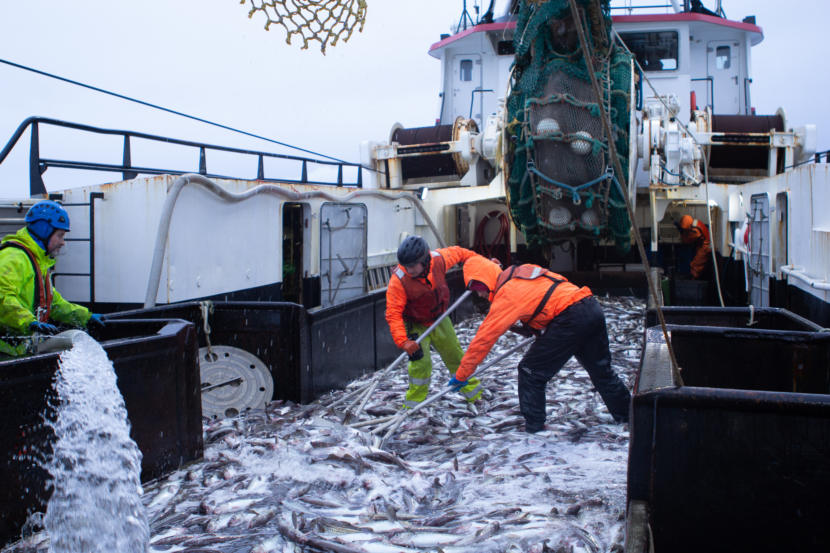
Crew members shovel pollock on the deck of a Bering Sea trawler last year. (Nathaniel Herz/Alaska’s Energy Desk)

In a new study, scientists have linked warming Arctic temperatures, changing wind patterns and shifting currents to movement of commercially valuable Alaska pollock in the Bering Sea.

The Bering Sea has seen the loss of a summer cold water barrier in recent years, which used to keep pollock from spreading out and moving north.

But while scientists are seeing drastic shifts in pollock movement patterns, further research needs to be conducted to know what the changes mean for communities like Unalaska and Dutch Harbor and the billion-dollar pollock industry.

“This research is really critical because pollock are a key ecological component of the Bering Sea shelf food web supporting the largest commercial fishery in the U.S. by biomass,” said Robert Foy, NOAA’s Alaska Fisheries Science Center director. “To get an accurate assessment of pollock abundance so that resource managers can set sustainable catch limits, we have to be able to understand pollock distribution, which certainly looks different under a warm water regime.”

While the implications of changing pollock distributions in the Bering Sea are not yet known, this study marks the first time American and Russian scientists have been able to work together to look at why the groundfish species has shown up in new places in recent years.

By looking at historical and recent data, they’ve been able to confirm both a northward shift of the species and a long-suspected movement of fish between U.S. and Russian waters.

“We were trying to compare what was driving those changes,” said Lisa Eisner, a NOAA Fisheries oceanographer and lead author of the study. “And also if it was possible for some of the fish from the eastern shelf to mix with the fish on the western side of the Bering Sea.”

While scientists have been surveying Bering Sea fisheries for nearly four decades, Eisner said this specific study was born out of the unusual warming events they’ve seen in recent years, and it also drew on historical datasets from both the U.S. and Russia.

According to Stan Kotwicki, program manager for NOAA’s Groundfish Assessment Program, pollock generally have a north-south migration. Typically, as ice comes down from the Arctic over the course of the winter, it pushes fish south to feed in warmer areas.

“And, of course, then during the spring, summer and fall, when the ice is melting, pollock move back north,” he said.

But as winters warm and sea ice melts, Kotwicki said the pollock can migrate much further north and stay there for longer. That’s in part because of a shrinking cold pool — an area of frigid water left behind by melted ice that fish don’t like to swim through. According to the study, with declines in the cold pool, there appears to be more intensive mixing between the Russian stock as it moves north and eastward and the U.S. stock as it moves north and westward.

Lyle Britt leads a team of NOAA Fisheries scientists who do yearly surveys of the eastern Bering Sea shelf and northern Bering Sea to track fish stocks.

Britt said studies like this one often worry people in communities like Unalaska and Dutch Harbor, where the economy is dependent on the commercial fishing industry. He said people can interpret these studies as saying that all pollock are moving north and to Russia.

But, he said, that’s not the message here. It’s much more about understanding pollock movements and behavior than it is an alarm bell that all the pollock are swimming out of reach of fishing boats.

“We are now just starting to fully understand really what their migration pattern is and how they interact with going into Russian waters, or staying in U.S. waters, being constrained by a cold pool or less constrained when there’s a limited or even no cold pool,” Britt said.

The change in temperatures and shifting sea life has happened very rapidly in recent years throughout the eastern Bering Sea ecosystem, according to Britt. And for him and fellow scientists, the big question is how these environmental changes will affect pollock over the long term.

“Science for us is only as good as the number of observations we have,” he said. “And in this case of unprecedented warming, and we really only have a couple of years [of data], it’s really hard to draw really large scale conclusions at this point.”

But he said scientists are planning an array of studies on how whole ecosystems are changing. Not just on pollock movements, but on how they follow prey like plankton or smaller fish and how they interact with bird and marine mammal migrations.

“All of these are questions that are ramping up within our research community,” Britt said. “And we realize it has to ramp up very quickly because of the amount of change we’re seeing.”

Environmental groups say Pebble could threaten the endangered Cook Inlet beluga whale

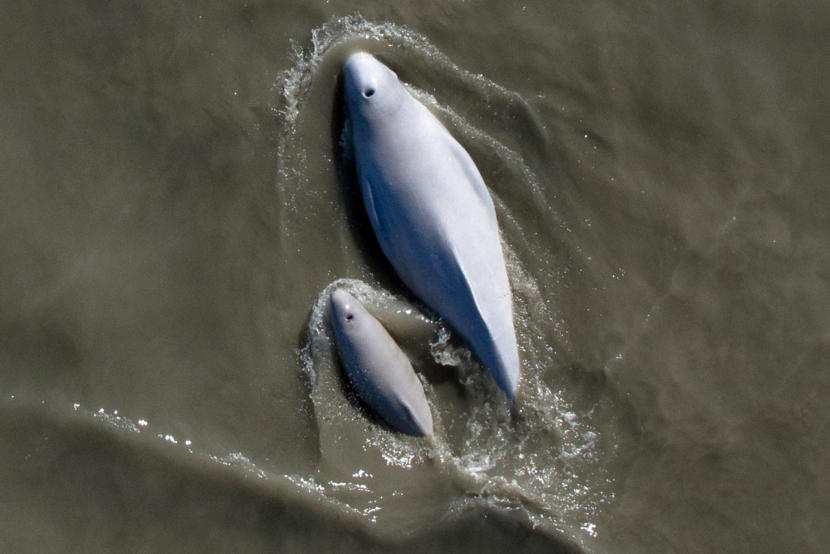
A Cook Inlet beluga whale mother and neonatal calf swim together. (Public domain photo by Hollis Europe and Jacob Barbaro/NOAA Fisheries)

Beluga whales in the Cook Inlet are nearing extinction as an accumulation of threats endanger the whales’ habitat. Now conservationists in the region are raising concerns about adding yet another stressor to a disappearing whale population — the proposed Pebble Mine.

A new documentary provides a brief look at how the mine would operate in the area and what that could do to the belugas.

“Is it possible that the Pebble Project activities could lead to these threats against Cook Inlet belugas? Yes,” said Mandy Migura, a wildlife biologist speaking at a panel hosted by the Environmental Investigation Agency last month.

The environmental group recently released “White Whale, Gold Mine,” a short documentary about how the mine could affect belugas.

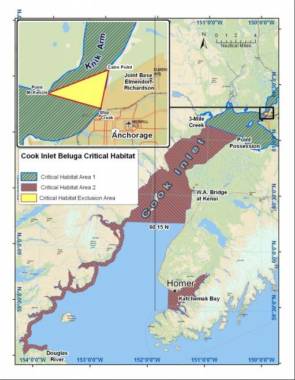
All 3,013 nautical miles designated as critical beluga whale habitat. (Courtesy NOAA Fisheries)

NOAA Fisheries has ruled that Cook Inlet’s beluga whales are endangered. The belugas are unique to the region because the Aleutian chain acts as a barrier, so the whales never travel in or out.

In 2011, NOAA designated 3,000 nautical miles of the Cook Inlet as critical beluga whale habitat. Migura says that a portion of Pebble’s developments cut through that area.

“Part of that includes the western shoreline of lower Cook Inlet,” Migura says. “And they have said that it includes two nautical miles seaward of the high-water mark.”

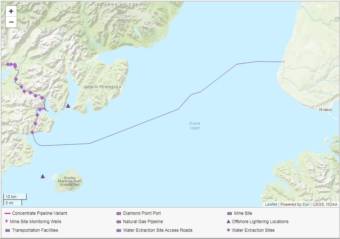
The Pebble Limited Partnership is planning to build a port on the shore of Diamond Point in the Iliamna Bay, with a dredged navigation channel. It would also run a 74-mile natural gas pipeline and fiber optic cable across the water basin.

The Marine Mammal Commission is an independent government conservation agency. It estimated that 1,300 belugas were in Cook Inlet in 1972. Now there are fewer than 269 whales left. The population is decreasing at a rate of 2.3% per year.

NOAA’s recovery plan, the Critical Habitat for the Cook Inlet Beluga Whale, lists 10 potential threats to the population, which the plan classifies as high, medium and low concerns. The top concerns are catastrophic events like oil and gas spills, noise from on and offshore activities and the combined effects of all individual threats.

Bob Shavelson is the advocacy director for Cook Inlet Keeper, a non-profit focused on protecting the watershed. He said a combination of threats could be behind the population’s decline.

“So when you look at all those things: the oil and gas dumping, the seismic testing, the regular spills from pipelines and leaks — the beluga whale faces a myriad of threats,” Schavelson said. “We’ve gotta do a better job of looking at these things. And the Pebble Mine is one more risk, one more stress that we don’t need for this declining population.”

According to the state Division of Water, there are over 100 facilities that have permits to discharge wastewater into the Cook Inlet area. The region’s primary oil company, Hilcorp, uses mixing zones authorized by the state for its nine offshore platforms. Those zones are meant to dilute oil and gas waste when it’s released. There are 17 oil and gas platforms in the basin.

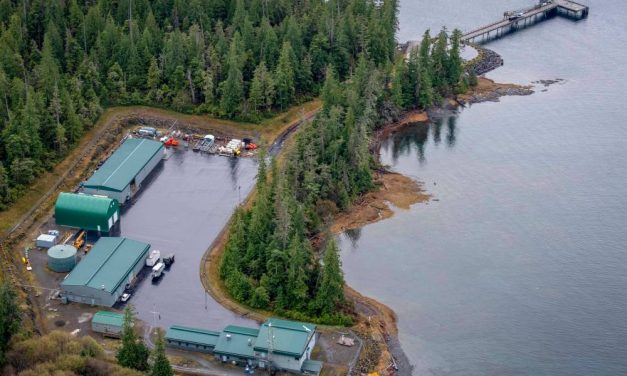
Diamond Point port in Cottonwood Bay and Iliamna Bay, adjacent to the Iniskin Peninsula. The purple line running across Cook Inlet represents the concentrate pipeline and fiber optic cable.
(Pebble Project EIS)

The state Department of Environmental Conservation has said that Cook Inlet’s currents are strong enough to meet federal water standards. But Hilcorp has a troubled history of waste discharge in the watershed. Three years ago, the company had to halt production at two platforms due to an oil spill and gas leaks. 

The U.S Army Corps of Engineers’ final environmental review of the Pebble Mine concludes that the impacts of the project in critical beluga habitat would be minor but permanent. 

In an email, Pebble spokesperson Mike Heatwole said, “as our port will operate in Cook Inlet, we will utilize best management practices to ensure no negative impacts to Cook Inlet belugas.”

Pebble says it will work with the U.S Fish and Wildlife Service and other relevant agencies to finalize its mitigation efforts.

But Mandy Migura, the wildlife biologist, is worried that the mine may be a tipping point for the whales’ survival.

“It kind of does beg the question at one point are we getting to the threshold,” she said. “Right now there’s not a whole lot going on in the lower Cook Inlet. If that area is able to be somewhat of a refuge of the other threats, we’re now adding stressors into an area that had relatively low stressors.”

Migura said that if the population is depleted, those whales will be lost forever.

Permit for Navy activities allows over 16,000 ‘behavioral disturbances’ to Southeast marine mammals

The Southeast Alaska Acoustic Measurement Facility in the Behm Canal, near Ketchikan. (Photo courtesy Jennifer Kelso via KRBD)

The U.S. Navy has received a green light from federal agencies for seven more years of training and testing up and down the West Coast.

NOAA Fisheries published a final permit Nov. 12 for the Navy’s testing and maneuvers from northern California to Southeast Alaska. In Alaska, the permit includes permission to behaviorally harass marine mammals more than 16,000 times over the next seven years.

Naval operations in Southeast Alaska consist mostly of acoustic measurement activities at the Southeast Alaska Acoustic Measurement Facility in the Behm Canal near Ketchikan.

Environmental groups have expressed concern that the Navy does not do enough to mitigate its impact on marine life — from larger marine mammals like whales and porpoises, down to fisheries and zooplankton.

Under the Marine Mammal Protection Act, the Navy must submit an environmental impact statement for its Northwest Training and Testing Area. The EIS includes projected impacts to marine life and some mitigation efforts. The Navy released the final supplement to its EIS in late September.

The federal agencies tasked with protecting marine mammals then evaluate the EIS and approve a permit for harm. The Navy is not permitted to physically harm or kill any marine mammals in Southeast Alaska over the next seven years, but is permitted thousands of what it calls behavioral disturbances. This can include disruption to feeding, interacting or traveling from place to place.

Calculation of disturbances to marine mammals and other ocean-dwellers is theoretical. The Navy does not keep track of actual harm done to marine mammals during the course of training exercises, instead using the number of training and testing activities as a proxy to estimate marine impacts.

Both the Marine Mammal Commission and NOAA Fisheries declined to comment, directing questions back to the Navy.

In Southeast, this year’s salmon harvest fell by more than half

Boats in Reliance Harbor, Wrangell. 2020. (Sage Smiley / KSTK)

Southeast Alaska’s salmon harvest was less than half of last year’s haul. That’s according to a preliminary report from the Alaska Department of Fish and Game released on Monday.

Commercial fishermen in Southeast harvested just over 14.3 million salmon across the five species this year: almost 5 million chum salmon, 1.1 million coho, 8 million pinks, 373,000 sockeye and 200,000 chinook.

That’s a drop in harvest for every species except chinook, which increased by a few thousand fish this year. In other words, Southeast’s total salmon harvest was 19 million fewer fish than last year.

The preliminary ex-vessel value of Southeast’s 2020 salmon fishery was just over $50 million dollars. That’s less than half of 2019’s estimated value, and the third consecutive year that Southeast’s value paid to fishermen has dropped.

It wasn’t all doom and gloom. That’s because salmon prices paid to fishermen rose slightly for chinook, sockeye and coho compared to the year before. But prices dipped for pinks and chum salmon. Other areas in Alaska had similar slight shifts in per-pound preliminary prices, with the exception of Bristol Bay, which saw prices fall by nearly 50% compared to last year.

Fish and Game reports that 2020’s statewide salmon harvest was the 13th lowest on record. Adjusted for inflation, the initial salmon fishery value for 2020 is the lowest since 2006.

Warming rivers are melting Arctic sea ice, new study shows

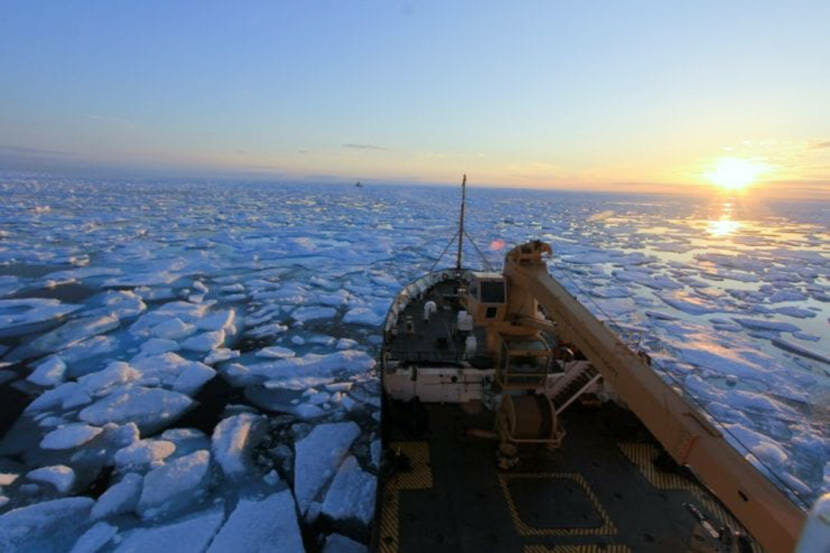
(Photo provided by Lisa Hatland/USCG)

Warming rivers play an increasingly important role in melting sea ice and rising air temperatures in the Arctic, according to a new study published Nov. 6 in the journal Science Advances.

Using complex modeling techniques, a team of international researchers found that heat from rivers melted as much as 10% of Arctic sea ice between 1980 and 2015.

University of Alaska Fairbanks researcher Igor Polyakov is one of the study’s authors.

“Because of increase of surface area temperature over continents, the riverine water becomes warmer. This warmth is carried by river water into the Arctic,” he said.

The warmer river water then flows beneath sea ice, causing it to melt. That triggers a cycle where newly open ocean absorbs heat from the atmosphere, warming the ocean temperature even more and melting sea ice further.

“What we showed is that this positive feedback mechanism almost doubles the effect of original heat carried by rivers. So it’s multiplication of causes and effect in this system,” Polyakov said.

The Arctic is warming at almost twice the rate of the global average, and the impact of climate change there is well-documented. But the impact of river heat on sea ice loss and ocean and atmospheric temperatures is not. Polyakov said their research identified a previously overlooked piece.

“Our study is just one element of a big puzzle of Arctic or global climate change, but it’s an important element,” he said. “It creates a more complete, more interesting picture of multi-disciplinary changes in the Arctic in general.”

The effect is especially pronounced in places with larger rivers like Siberia and Canada’s Mackenzie River, but smaller rivers in Alaska play a role, too.

Site notifications
Update notification options
Subscribe to notifications