Oceans

Weekend storms pummel Arctic coastal villages

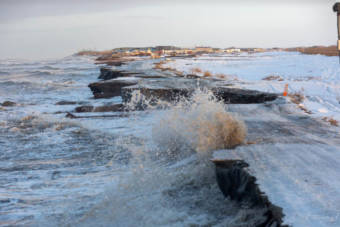
Shishmaref coastal erosion after a storm in November 2020. (Dennis Davis)

Over the weekend, much of the state saw snowfall, icy roads and the first wintry conditions. Photos from Shishmaref, a small village along the Chukchi Sea coast, show a large swath of road that leads from the community to the sewage lagoon has been completely washed away by waves. A number of other villages were also battered by high seas and gusting winds.

Meteorologist Jonathan Chriest said the National Weather Service office in Fairbanks had received a number of reports from communities along Alaska’s west coast. He said villages from the Yukon River Delta north to Kivalina reported severe weather, including high seas.
“Sections of the road between Nome and Council were washed out,” said Chriest. “Golovin reported some erosion. At Unalakleet, water was estimated at about eight feet above the normal high tide line, it approached the Alaska Commercial store there, but it did not flood and we heard that the community was prepared and there were no major impacts and the same was true at Shaktoolik,” he said.

“One of our residents locally has said that the storm on Friday was so powerful that an estimated 20-40 feet of infrastructure was lost,” said Twyla Thurmond.

She’s the local coordinator for the Native village of Shishmaref. She works on community expansion and protection efforts.

“Another local resident had commented that it was the worst that they had seen in the past 20 years,” said Thurmond.

The infrastructure she mentioned is actually a road that connects Shishmaref with its dump and sewage lagoon and the state estimates that the loss more likely totals a quarter to half a mile.

Thurmond said winter weather means residents may be able to find a temporary work-around, by breaking a trail with snow machines and ATVs, but she said that’s not a permanent fix.

“Without having access to the dump, the community would be overloaded with garbage and human waste, so it creates a really big sanitation hazard overall,” said Thurmond.

Residents in Shishmaref voted to relocate due to severe coastal erosion back in 2016. On Monday, Shishmaref’s Mayor was working on a disaster declaration with the hope of freeing up emergency funds from the state for assistance. A spokesman with the state Division of Homeland Security and Emergency Management said it’s unlikely the road will be rebuilt this winter, so they are exploring alternate means of transportation for residents.

Further north, winds gusted up to 50 miles an hour at times, battering the tiny village of Kivalina. The community sits on a barrier island along the Chukchi sea coast. With no shore-fast sea ice yet formed to protect the coastline this fall, every storm that pummels Kivalina’s west-facing beach could be the island’s last. Climate change driven sea level rise and coastal erosion may eventually wash this island away, entirely.

“Well, I’ve been documenting because it was pretty — the storm surge was pretty bad and the water was very high,” said Janet Mitchell. She grew up in Kivalina.

She spent much of the weekend driving around the island on her four-wheeler documenting the storm. Her short video clips show fierce and giant waves slamming against a rock revetment built a decade ago by the U.S. Army Corps of Engineers to protect the island. Kivalina is one of nearly three dozen communities deemed in imminent danger of complete destruction due to climate change according to a 2009 report from the government accountability office.

Mitchell also captured a video of her Aunt, Lucy Adams, an 87-year-old elder in the village. The video shows Lucy, walking with a cane, in her handmade mukluks, out to the rock revetment.

Mitchell said her Aunt looked concerned, so she decided to stay nearby. “I asked her if she was ok,” said Mitchell. “She said, ‘oh yeah I’m ok, I’m just walking.’”

In the video, the elder woman stops when she gets to the pile of dark gray rocks and then she just stands there, looking out over the angry, roiling Chukchi sea.

“She’s like the stronghold of Kivalina,” said Janet Mitchell. “She’s very faithful and she prays a lot and it’s like you feel safe knowing she’s praying for Kivalina, for our safety.”

Nearly every day, Lucy Adams sends a prayer out to her village over the local VHF radio. Mitchell said her Aunt Lucy also said her radio prayers this weekend.

By Sunday, skies over Kivalina had cleared, but only briefly. Winter weather and high surf advisories are in effect for the region until Tuesday.

Correction: A previous version of this story stated Shishmaref is located in the Bering Sea. It is in the Chukchi Sea.

Judge orders FDA to study dangers of wild release of genetically engineered salmon

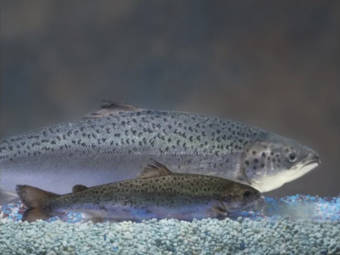
A genetically modified salmon dwarfs a non-modified salmon of the same age in an undated handout photo distributed in 2010. (Photo via AquaBounty Technologies)

A federal judge in San Francisco has ordered federal regulators to re-evaluate the safety of genetically modified salmon. But the court is still allowing thousands of engineered fish raised in tanks in the Midwest to reach American consumers by the end of the year.

The Food and Drug Administration in 2019 approved the farming and growing in land-based pens of an engineered fish that splices genes from Atlantic salmon, Pacific Chinook and an eel-like species called ocean pout.

Marketed as AquAdvantage Salmon, it’s designed to grow about twice as fast as regular farmed salmon.

Environmental lawyers say scientists have urged the FDA to fully consider the ecological risks that could occur if a man-made salmon species became established in the wild.

That is not what the FDA did,” Earthjustice attorney Steve Mashuda told CoastAlaska. “The FDA decided that it would stop its analysis at the assumption that the fish would never get out.”

And that’s where the federal agency erred, U.S. District Court of Northern California Judge Vince Chhabria ruled Thursday in his 16-page decision.

“Obviously, as the company’s operations grow, so too does the risk of engineered salmon escaping,” the judge wrote.

He ordered the FDA to study the issue further and consult with other federal resource agencies over potential risks to wild salmon.

Sending FDA back to the drawing board to take a look at all of the effects of genetically engineered salmon is step one,” Mashuda said by phone from Seattle. “We think when FDA does that, and if they do that in consultation with the expert biologists and listen to outside scientists, they’re going to have to do far more to ensure that these fish are environmentally safe, before they can be continued to be approved.”

AquaBounty Technologies recently announced plans for a Kentucky facility it says would be eight times larger than its existing plant in Indiana.

But Judge Chhabria’s decision effectively blocks AquAdvantage fish from being grown or harvested anywhere but existing facilities until the FDA complies with the court’s ruling.

AquaBounty Technologies President and CEO Sylvia Wulf released a statement on Thursday saying the company is “disappointed” by the ruling. But she says it won’t impact operations at its Canadian egg-growing facility on Prince Edward Island or its Indiana fish farm.

Wild salmon is one of Alaska’s top exports. The engineered Atlantic salmon product has been viewed as a threat, to both the worldwide salmon market and the environment.

The Alaska Seafood Marketing Institute isn’t sounding the alarm over any competitive threat from genetically modified fish. ASMI Executive Director Jeremy Woodrow said by email that consumers are more savvy about the origin of their food.

“Clear labeling and transparency in our food systems is becoming more important every day,” Woodrow’s statement said. “This is just one reason why customers worldwide trust wild, sustainable and natural Alaska seafood.”

The company confirmed the first AquaAdvantage fish grown in Indiana is still slated to hit the U.S. market by the end of the year.

“AquaBounty is excited about the future, and takes seriously the unwavering leadership that is required to offer a safe, secure and sustainable source of Atlantic Salmon that is raised right here in the U.S. heartland for U.S consumers,” Wulf’s statement added.


Fall storms set back Bering and Chukchi sea ice formation in already delayed season

Scattered sea ice near Nome, Alaska, March 15, 2019. (Photo courtesy David Dodman via KNOM)

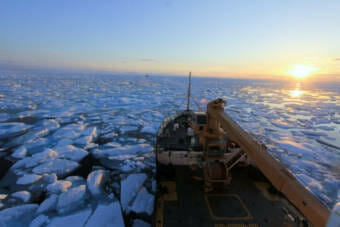
As of Nov. 3, sea ice in the Bering and Chukchi Seas is the lowest on record for the last five years, even with tiny bits of ice starting to form in Norton Bay and Kotzebue Sound. One climatologist forecasts that sea ice will form late, the extent will be below average, and it will be similar to last year’s.

The Bering Strait region is on track to have the lowest sea ice extent on record for early November, based on a 15-year dataset.

It started this summer, when May through September again featured some of the warmest ocean temperatures on record. Climate specialist Rick Thoman, with the Alaska Center for Climate Assessment and Policy (ACCAP), said the good news is that summer 2019 was still significantly warmer than this summer.

“In Eastern Norton Sound, in Kotzebue Sound, those are temperatures that are seven degrees Fahrenheit or more above average for that entire five months. And you can see the entire Chukchi Sea, almost all of the Bering Sea in 2019 was significantly warmer than normal. That’s not the case this year, well actually it kind of is, in that most of the Bering Sea for those five months, did end up warmer than normal,” Thoman said.

Thoman points out that in the northern Bering Sea, sea surface temperatures have gone from 42 degrees in the early 1900s up to about 45 degrees today.

“That doesn’t sound like much to most folks, but three-to-four degrees warming of a five-month average, in the ocean…is really just incredible,” he said.

As the average temperature in the Bering and Chukchi Seas continues to climb, and with the La Niña conditions this year, sea ice extent is expected to remain below the historical average. However, Thoman says sea ice in the Bering Strait region most likely won’t be as poor as last year. Nome didn’t see sea ice offshore until late November 2019, and even then the quality was poor.

“It’s still below the recent years’ average, but not as low as last year, but that is a bad comparison for our part of the world,” Thoman said. “Even though the Arctic-wide sea ice extent average for September was the second-lowest on record, the Beaufort Sea kept our area from being as low in sea ice as we saw in 2019.”

Thoman warns that from January to March, if there are strong swings of weather patterns across the Bering Sea, those will absolutely affect sea ice growth.

“This really seems like the kind of situation where we might get three weeks of really cold weather and then the pattern changes and boom — it’s storm after storm after storm. With water temperatures above normal, if ice extent is not much better than normal, then these storms could produce a lot of precipitation,” he said.

Today, according to the National Weather Service and Thoman, a “big Bering Sea storm and associated fronts” are expected to bring a mess of snow and rain along with winds up to 40 mph to the Bering Strait region.

This storm could also raise water levels in the Norton Sound, setting sea ice development back a week or more in the Bering and southern Chukchi seas.

High school hatchery revitalizes Unalaska silver salmon population

Students in Steven Gregory’s fisheries class stretched a seine net from bank to bank of the Iliuliuk River, while another group waded upstream, slapping large dip nets on the surface of the water. (Maggie Nelson/KUCB)

Around October every year for the last 19 years, Unalaska High School students have been wading into the Iliuliuk River, under science teacher Steven Gregory’s guidance, to collect pairs of spawning salmon.

Last week, students in Gregory’s fisheries class stretched a seine net from bank to bank, while another group waded upstream, rhythmically slapping large dip nets on the surface of the water.

“Two people go down and they scare the fish into the net and then a bunch of people stand on the net so the fish can’t escape,” said Natalie Buttner, a junior at Unalaska High School. “And then as the people come down, scaring [the fish] in, the net comes all the way around and catches the fish, hopefully males and females.”

Buttner said she’s excited to be in Gregory’s class, and that it’s something that seems unique to the region. As the course has progressed, she said she’s gained more interest in the subject, as she’s been able to observe the salmon daily, from counting silvers from the banks of the river to assisting with the fertilization process.

While the class struck out last Tuesday — only catching a single male silver — they caught two spawning pairs the day before.

After they catch the spawning pairs, Gregory said they collect the eggs in a bucket and fertilize them. They then add salt to water from the Iliuliuk River, which is added to the eggs. Gregory said his class started adding the extra salt about four years ago, and it has increased their fertilization success rate to about 90 percent — a percentage that he said is comparable to professional hatcheries.

Gregory encourages the students to actively participate, but he said the beginning of the harvesting process requires a delicate and experienced approach.

“What I do is I express the eggs from the female. I usually do that because it takes a certain amount of experience to be able to squeeze the eggs out,” said Gregory. “You don’t want to break the eggs, it’s very bad if you break the eggs because the contents of a broken egg will interfere with the fertilization of the healthy eggs.”

After fertilizing the eggs, they place them into incubation trays with running water to simulate the undergravel nest in the river — also known as a redd.

Gregory very carefully pulled out an incubation tray filled with about a thousand salmon eggs, directing pairs of students to gather around to get a closer look.

“The eggs can be exposed to the air for a short period of time,” Gregory explained to the students. “You don’t want them to be exposed to the air for too long because the mold spores will land on them and a fungus will start to grow on the eggs. The dead eggs will appear white. So anything that is white was not fertilized.”

Unalaska Senior Landen Shaishnikoff holds a fertilized silver salmon egg. (Maggie Nelson/KUCB)

Gregory said the fisheries course covers a number of topics, ranging from basic biology to commercial fishing and salmon hatchery operation.

He tells the students that they are “the stewards of the river.” And as part of their current unit, they’ve performed a salmon census. The eggs that they are now collecting will ultimately develop into young salmon and will be released into the Iliuliuk River.

Gregory and his students monitor the eggs until they become fry, which are small salmon that no longer have a yolk sac attached to them. Most of the fry are released into the river, but some, Gregory said, are kept longer in the hatchery.

“Once the alevins have turned into fry, we put them in the other part of the hatchery — it’s called the raceway,” said Gregory. “And the raceway simulates the flowing water part of the river. And so that’s where the salmon go when they’re fry and then they turn into what are called ‘smolt’.”

Gregory said they will keep 50 fry in the raceway and feed them and chart their growth.

“And this spring, May of 2021, [the smolt] will be about as long as your hand,” said Gregory. “And we will let them go along with the fry from the eggs that we captured last week.”

Along with some of the elementary students, Gregory’s class will release last year’s smolt into the river in the spring and will nurture another group of salmon for next year’s class to observe and then release.

In the meantime, Gregory uses the fish to teach students about a number of subjects, from the salmon life-cycle to analyzing and protecting the watershed.

Rodrey Sebastian, a senior in the class held up a murky vile of water and explained that they monitor the water in the raceway to ensure it has the correct amount of dissolved oxygen in it.

“So this right here is sodium thiosulfate,” said Sebastian. “This is what we use to determine how much dissolved oxygen there is in the water. So right now the water is just super mucky. After we add this chemical, we have to mix it up and then after that we transfer it into this little tube, and then put it in this mixing jar. And what we’ll do once this is a little bit mixed up and settled, is we’ll drop as many drops of sodium thiosulfate that we need to make the water clear again.”

Sebastian said the number of drops of sodium thiosulfate will tell them the number of units of dissolved oxygen in the water. He said they are aiming for about 9 to 11 drops.

Gregory and his students place the salmon eggs into incubation trays with running water to simulate the undergravel nest in the river — also known as a redd. (Maggie Nelson/KUCB)

And as Gregory discussed aspects of the course and detailed the life-cycle of a salmon, it was easy to see where that enthusiasm originated.

“Do not take the salmon that run in our river for granted,” said Gregory. “The amount of urbanization that has taken place in this town — it’s obvious that [it has] negatively impacted our watershed. And I’m very passionate about that.”

While Gregory remains frustrated with some of the ways local streams and water quality are neglected, he said he’s noticed a significant increase in the silver salmon population in the river since they began regularly offering the course and releasing salmon into the stream.

“Our operations here at the hatchery have done nothing but increase the silver salmon population,” said Gregory. “It’s been amazing to see that come back. When I was a kid here, there were hardly any of them spawning out there. And today, you can go out there for two or three straight weeks and see 100, at least, actively spawning at any one time. So it’s been a success.”

Gregory said the class will try again this week — weather permitting — to catch another spawning pair of silvers.

There’s more sea ice in the Chukchi Sea than last fall, but it’s still historically low

Snow piles on sea ice in the Kotzebue Sound. (Wesley Early/KOTZ)

Researchers track the extent of Arctic sea ice every year — essentially, how far it extends from the North Pole. The Arctic sea ice pack is smallest in the fall, after melting and receding all summer and right before it starts growing again through the winter.

There’s more sea ice this fall in the Chukchi Sea than there was at this time last year. But the ice closer to Alaska’s shores is lagging behind.

Rick Thoman, a climatologist with the International Arctic Research Center in Fairbanks, broke the news about the amount of ice in the waters off the coast of Northwest Alaska this year.

“We have much more, about three times more ice in the Chukchi Sea than we did last year,” Thoman said.

Last year saw the lowest fall sea ice extent in the Chukchi Sea on record. Thoman says this year’s sea ice extent is still way below the historical average, and most of this year’s ice is in waters north of Alaska.

(Courtesy of Rick Thoma/International Arctic Research Center)

“When we talk about the Chukchi Sea here, we’re talking basically to about 78 North,” Thoman said, “so that’s hundreds of miles north of Utqiagvik.”

In the southern Chukchi Sea, Thoman says there’s still a lot of open water. In fact, even though there’s more ice across the entire Chukchi, the ice near Kotzebue and Point Hope is actually weaker than last year.

“Kotzebue Sound is mostly open water at this point,” Thoman said. “So especially on the Russian side, we have even less ice than we had last year at this time.”

Thoman says this year’s forecast calls for storms throughout the coast of Northwest Alaska. Stormy seas make it difficult for sea ice to form.

“We’re going to have a turn towards warmer stormier weather in the Bering and Southern Chukchi Sea,” Thoman said. “We’re going to be very late with starting to form ice south of Point Hope. And we could easily be looking at no ice in the open Chukchi Sea, north of the Bering Strait, well into December.”

Thoman says historically, that ice was formed by mid-November or even as early as October.

Plan approved to sink the Lumberman, Juneau’s troublesome tug

The tugboat Lumberman sitting in Gastineau Channel at low tide on June 15, 2018. It’s since been moved to a city-owned vacant cruise ship dock. (Photo by David Purdy/KTOO)

Juneau’s harbor officials have received the all-clear to scuttle the Lumberman, a derelict tugboat, offshore and in deep water.

The World War II-vintage tugboat has been a fixture on Gastineau Channel.  And it became a jurisdictional tug-of-war between city, state and Coast Guard officials after it broke its anchor line on state tidelands more than two years ago.

It’s now moored to a city-owned cruise dock.  Juneau Port Director Carl Uchytil says permit from the U.S. Environmental Protection Agency gives the city permission to flood the 192-ton steel hulled boat and sink it in 8,400 feet of water.

“If we open this six inch valve, the vessel should sink in 22 minutes,” Uchytil said.

But first, port officials will need to find a way to tow the tug about 50 miles west of Icy Point. How that works, what it would cost and whether it’ll happen this year or next spring is still being worked out.

“It’ll be a very good day when we can put the Lumberman in our in our wake and move on to something else,” he said.

The EPA gave the green light to sink the vessel after it was thoroughly cleaned, first by the Coast Guard in 2018 and more recently by contractors who removed garbage and oily waste from the ship.

The 107-foot tugboat was last used as a makeshift live-aboard anchored outside of Juneau’s Aurora Harbor. Tragedy struck in 2017 when a skiff with five people heading to the tug overturned. Two men on the skiff were never found.

Derelict vessels are a problem across coastal Alaska and Gastineau Channel in particular. As recently as 2015, another derelict tug — the Challenger — sank near Juneau.

It was ultimately refloated, cleaned and dismantled. That cost the public upwards of $2 million.  The state Legislature has since tightened up vessel registration rules in an effort to strengthen the law over the liability of derelict vessels.

Site notifications
Update notification options
Subscribe to notifications