Oceans

Federal government moves toward Cook Inlet oil lease sale

Cook Inlet oil platforms are visible from shore near Kenai, Alaska. (Photo by Rashah McChesney/Alaska’s Energy Desk)

The federal government has released a draft environmental impact statement on an oil and gas lease sale in Cook Inlet, tentatively scheduled for late 2021.

The Bureau of Ocean Energy Management is planning to solicit bids on over 1 million acres in the inlet’s federal waters, which includes anything more than three miles offshore. The agency first published its notice of intent in September and released the EIS draft Wednesday.
Some fishermen and conservationists say that wasn’t enough time.

“We’ve never before seen an environmental impact statement rammed through in such a short time,” said Bob Shavelson, advocacy director of Cook Inletkeeper. “When you look at something like a three month time period, it’s not going to be adequate to understand really what the impacts are.”

The area of the proposed Cook Inlet sale, covering just over 1 million acres, is outlined in yellow. Blocks outlined in green were purchased by Hilcorp Alaska LLC in the last sale. (via Bureau of Ocean Energy Management)

The bureau spent almost two years drafting a statement prior to the last federal lease sale, in 2017.

But since that sale, the Trump administration has set both time and page limits on federal environmental impact statements. An August 2017 order from the Secretary of the Interior requires bureaus to complete final statements within a year of issuing a notice of intent.

Still, Alaska Region spokesperson John Callahan said the bureau completed the draft EIS with due diligence.

“Of course we’re always hoping for input, that’s the whole purpose for producing a draft,” he said. “And we’d like to have the Cook Inlet communities look at it, or view it, and let us know what they think.”

Callahan said the process could also move faster because the bureau was able to work off of the 2017 draft. While each environmental impact statement is different, he said it helped to have that framework.

The bureau hasn’t decided for certain whether it will hold the sale. It canceled lease sales in 2006, 2008 and 2010 due to lack of interest. Hilcorp Alaska LLC has been the sole bidder in both state and federal lease sales in the inlet for several years, including in 2017, when the company picked up 14 tracts for over $3 million. The company currently owns all the federal leases in the inlet.

The bureau will hold public hearings in February before drawing up the final environmental impact statement. To submit public comments, visit boem.gov/CookInlet2021.

Editor’s note: This story has been corrected to fix a transcription error in a quote from John Callahan.

State predicts commercial herring harvest will fall short of annual limit

The herring fishery didn’t happen in 2020, but the state continued to survey and map herring spawn. (ADF&G photo)

In an unusual move, the Alaska Department of Fish & Game has set a large guideline harvest level for the commercial herring fishing in Sitka this spring, on the understanding that the fleet is not likely to hit that mark.

In a news release Monday, ADF&G announced a guideline harvest level — or GHL — of just over 33,000 tons for the upcoming Sitka sac roe herring fishery.

But that much probably won’t be harvested. In the same news release, Fish and Game predicts that the commercial harvest will likely not exceed 20,000 tons. Area Management Biologist Aaron Dupuis says the state arrived at that number after speaking to processors about the potential market demands.

“Just from our conversations, like what the individual markets want in terms of herring,” he said. “Part of the reason why we put that in the announcement was, I guess just to temper people’s’ expectations for what will likely get harvested in the fishery. “

Dupuis says 33,000 is already a conservative estimate. The GHL is reduced by 20% of what the state would typically allow from the forecasted population of fish, a mature biomass of 210,453 tons. Even so, he says the state is gearing up as usual for a fishery this year.

“We’re gonna be getting ready for a fishery like we normally do,” he said. “It’s been two years since we’ve had a successful fishery, but we plan on managing it like we normally do.”

But in recent years the fishery has been far from usual. The annual fishery didn’t happen at all in 2019 and 2020. Most of the herring were young and too small to meet international market demands. And the coronavirus added some additional challenges in 2020. Dupuis says he doesn’t expect the pandemic to get in the way of the fishery happening this year.

“Everybody had all of last year to kind of figure out what works on the processing side with the salmon season and with other species, so I think they’ll be able to come up with something,” he said. “For the state, we have standard COVID protocols, especially with the state vessels that were in place last year for the dive surveys. We’ll be able to adequately manage the fishery given those COVID guidelines.”

This year, herring managers believe that most of the available herring stock consists of 5-year-olds (around 86%), which are closer to marketable size than in recent years. Nevertheless, the five-year-olds will be just on the cusp of being large enough to sell. Last year, the marketable size was estimated at around 110 grams. The state estimates age-five fish to weigh in at around 109, with an average weight of the entire herring population estimated to be around 112.

The fishery has continued to see pushback from subsistence harvesters who argue the management of the commercial fishery has harmed the fish population over the last few decades. Herring eggs are highly valued as a traditional food and resource among Indigenous communities in Southeast.

The Sitka Tribe of Alaska brought a suit against the state in 2018, challenging its management of the commercial fishery. The fight continues, with a superior court judge hearing oral arguments this Thursday on whether the state has upheld its constitutional obligation to meet reasonable subsistence needs.

Ask a Climatologist: An Alaska-sized storm sets a record

The Dec. 31, 2020 “bomb” cyclone over Shemya Island. (Earth.nullschool.net)

A massive storm way out in the Aleutian Islands at the end of the year set a record for the lowest atmospheric pressure ever recorded in the North Pacific — but you’ve probably never heard of it.

That’s because the 60-foot seas and 80 mph winds were hundreds of miles from most Alaskans.

But what does it actually mean for there to be an area of extreme low pressure?

National Weather Service climate researcher Brian Brettschneider spoke with Alaska Public Media’s Casey Grove to explain.

Listen here:

Closures send clamdiggers across Cook Inlet

A charter boat in front of Chisik Island on the west side of Cook Inlet. (courtesy Bottom Line Charters)

Scientists are still digging for answers about the low abundance of adult razor clams on the east side of Cook Inlet. Meantime, charter companies are taking passengers over to the west side, where razors abound.

“The west side is like Deep Creek and Clam Gulch were 20, 24 years ago,” asid Ernie Kerby. He’s owned Bottom Line Charters, in Ninilchik, for almost three decades.

In response to the crash of clam populations, the Alaska Department of Fish and Game closed east side beaches to personal and sport-use clamming in 2014. It announced last week it will close those beaches again in 2021.

At one time, the 80 miles of shoreline from the mouth of the Kenai River to the Homer Spit was home to the most popular clam fishery in Cook Inlet. That includes the beaches of Clam Gulch, a town named for its abundance of razor clams.

Scientists aren’t sure why the crash initially happened, about a decade ago. What they do know is that stocks aren’t rebounding, said Mike Booz, the Lower Cook Inlet sportfish area manager for Fish and Game.

He said the department has successfully incorporated new juvenile clams into the area, a process known as “recruitment.” But as they reach adulthood — between three and five years old — they’re dying off.

“Unfortunately, it’s not a perfect recovery,” he said. “During that time, or transitioning through that time, growth has been really poor for razor clams, particularly in 2017 and 2018. The adult survival of razor clams through that time hasn’t been very good. So, yes, you’re getting new clams, but they’re not growing and they’re not surviving for the population to rebuild to what it was, historically.”

This high rate of mortality among adult clams is likely due to a confluence of factors, including environmental stressors and changes in habitat. The instability of ocean water temperatures could be part of the equation.

“Overall, climate change, that’s only one component of it,” Booz said. “Climate change doesn’t cause clams to leave the beach. It definitely influences their growth rate or the primary productivity of plankton in Cook Inlet and how that likely affects razor clam abundances on these beaches.”

The closures have driven more people to the beaches on the west side. Off the road system, those shores are only accessible via boat or plane.

Kirby does the 30-mile ride to the Crescent River drainage, south of Polly Creek, with his passengers. It takes about an hour and fifteen minutes from Ninilchik.

He’s always taken his passengers to the west side. But since the closure on the east side, many others are, too.

“A lot more of the guys in Ninilchik are starting to go over there,” he said.

That’s also where the commercial clammers, like Nikiski’s Pacific Alaska Shellfish, get their stock.

There are no harvest limits on the west side. Kirby said he’s not worried about the area getting overfished because there are enough clams to go around.

Again, it’s not completely clear to Fish and Game why the west side seems to be doing much better than its neighbor. And more generally, it’s hard to know how the dwindling numbers on the shore of the peninsula stack up with their counterparts on other Pacific shores. Razor clams in the east part of Cook Inlet are more studied than others, due partly to the robustness of the fishery.

“Further south, in Oregon and Washington would probably be the next place where razor clams are really studied well enough to make a comparison between east Cook Inlet,” Booz said. “And razor clams in Oregon and Washington right now are doing great.”

The department continues to monitor clam stocks on both shores and submitted a proposal this year to develop a management plan for east Cook Inlet razor clams. Currently, there’s no management plan that would regulate harvests in the case of a reopening.

Kirby says he trusts the department to protect the east side fishery.

“I would want them to show at least two years, two consecutive years of growth,” he said. “Good, sustained growth. I’m losing business if they keep it closed but in the long run, it’s going to be better for everybody.”

That department’s proposal will be discussed at the board’s scheduled meeting in March.

Sen. Dan Sullivan highlights final passage of second ocean cleanup bill

Trash on the shoreline of Kuiu Island in Southeast Alaska in 2017 (Courtesy U.S. Forest Service)

Alaska Republican Sen. Dan Sullivan is highlighting the passage of his bipartisan legislation aimed at cleaning up plastic in the ocean and reducing sources of plastic pollution.

The bill, called Save Our Seas 2.0, builds on the first version of the bill, which was approved in 2018. This update was introduced by Sullivan and Democratic Sens. Sheldon Whitehouse of Rhode Island and Bob Menendez of New Jersey.

Congress finalized the bill this fall, and President Trump signed it on Dec. 18.

“It’s an issue that everybody cares about, cleaning up the oceans,” Sullivan said during a recent teleconference with reporters. “It’s going to be huge for Alaska and our fisheries but really important for America. It puts our country in the lead again on this issue, and it’s a solvable issue. Ten rivers in Asia and Africa are estimated to be responsible for up to 80% of all the plastic pollution in the world, and this targets that.”

The bill aims to reduce the supply of plastic waste entering the ocean with grants for study of waste management and mitigation in the U.S. It also formalizes U.S. policy on international agreements and aims to improve outreach to other countries about the problem.

The bill creates a marine debris response trust fund for cleanup. Sullivan said the bill also focuses on research in that area.

“That has a congressionally chartered ocean debris foundation that will be headquartered somewhere,” he explained. “We think it should be headquartered in Alaska. And I think that’s going to be an important aspect of that bill keeping us on the lead for ocean clean up, the research that needs to go into that and so that’s something we’re going to be following up on.”

Sullivan said a third version of the bill is already in the works.

US Congress sets aside $3.6 million for transboundary watersheds

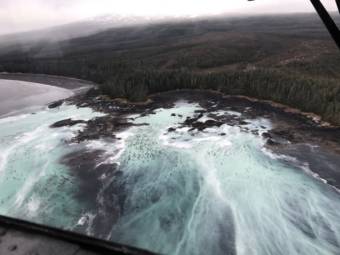
The Stikine River Delta, as seen from the air. The chinook subsistence fishery on the river has been closed. Photo by Ed Schoenfeld, CoastAlaska News.
The Stikine River Delta. (Ed Schoenfeld/CoastAlaska)

The U.S. Congress has appropriated more than $3.6 million to monitor transboundary watersheds and for diplomatic efforts in cross-border negotiations with Canada.

The lion’s share will go to the U.S. Geological Survey for pollution monitoring and cleanup projects. The money is not exclusive to Alaska transboundary watersheds or mining concerns but is spent at the discretion of the federal agency.

The funding also stipulates greater coordination with Native tribes in Southeast Alaska and northern Montana, where most transboundary watersheds lie. The Central Council of Tlingit and Haida has been collecting baseline water quality data since 2015 on the Taku and Stikine rivers, as well as sampling of other Southeast rivers that are downstream from mines in British Columbia.

Appropriations for water quality monitoring have been a regular feature of Congressional appropriations bills since 2016, when Congress set aside $120,000 for water quality monitoring on the Unuk River.

New to the 2021 appropriations bill is $500,000 for the U.S. State Department to address outstanding transboundary watershed and mining concerns. Environmental groups have been pushing for federal involvement in international transboundary watershed negotiations and monitoring.

The funding was approved as a part of the larger appropriations bill passed by Congress on Dec. 21. It awaits President Trump’s signature.

Site notifications
Update notification options
Subscribe to notifications