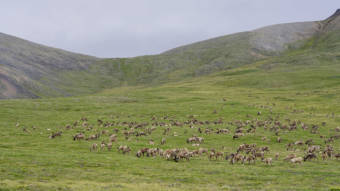
The Porcupine Caribou Herd in the Arctic National Wildlife Refuge on July 3, 2019. (Danielle Brigida via Creative Commons)
The Biden administration Tuesday took its first steps toward reversing the opening of the Arctic National Wildlife Refuge’s coastal plain to oil drilling, by suspending leases issued in the final days of the Trump administration.
The suspension comes as no surprise: Biden, on the campaign trail, vowed to adopt permanent protections for the refuge. And on his first day in office, on Jan. 20, he directed the Interior Department to put a “temporary mortarium” on all oil and gas leasing activities in the refuge and to review the environmental impacts of the Trump administration’s oil and gas program for the area.
Now his Interior Department saysit’s doing just that. It announced in a written statement Tuesday that it’s conducting a new environmental review of the Trump administration’s oil and gas leasing program for the refuge’s coastal plain while addressing what it called “legal deficiencies.”
All activities related to the program — including the current leases — are suspended until the review is complete. The department will then decide whether the leases should be “reaffirmed, voided, or subject to additional mitigation measures,” the statement said.
The refuge’s coastal plain — the area Congress opened to drilling in 2017 — is the northernmost slice of the Arctic refuge.
It’s home to migrating caribou, polar bears, birds and other wildlife. It also potentially sits atop billions of barrels of oil, according to federal estimates. Some Indigenous Iñupiat leaders in the village of Kaktovik, which sits within the coastal plain, support oil exploration, while the Gwich’in, who live to the south and subsist on caribou, are opposed.
The Arctic National Wildlife Refuge’s coastal plain is shown in orange. The area covers about 1.6 million area, roughly the size of Delaware, and makes up about 8% of the refuge. (USGS map)
After a decades-long fight over whether to drill for oil in the coastal plain, the Trump administration held the refuge’s first-ever lease sale Jan. 6.
It was a controversial sale, snarled in lawsuits and opposition.
Critics said it was rushed, sloppy and a threat to animals and the environment. But supporters said drilling in the refuge is good for jobs and the country’s energy independence.
The sale ended up drawing little interest; no major oil companies bid on the leases. Instead, two smaller ones each picked up a single lease, and the state-owned Alaska Industrial Development and Export Authority picked up seven. The leases last for 10 years.
An Alaska-based spokesperson with the Bureau of Land Management said she had not been given any information on a suspension by late Tuesday morning.
An AIDEA spokesperson did not immediately respond to a request for comment.
Meanwhile, environmental groups and a Gwich’in organization cheered the news of suspended leases.
“The Gwich’in Nation is grateful and heartened by the news that the Biden administration has acted again on its commitment to protecting sacred lands and the Gwich’in way of life,” said a statement from Bernadette Demientieff, executive director of the Gwich’in Steering Committee.
Demientieff said she hopes the Biden administration goes a step farther soon and cancels the existing oil and gas leases and bans drilling in the refuge’s coastal plain.
This is a developing story. Check back for updates.
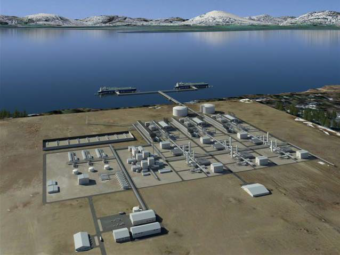
This illustration shows a rendition of what the liquefaction plant in Nikiski could look like if the Alaska LNG project is completed as planned. (Courtesy Alaska LNG project.)
A state corporation is in the middle of making another big push to try to get an 800-mile-long natural gas pipeline built from the North Slope to the Kenai Peninsula.
It’s a massive and complicated project that’s been talked about for decades.
Supporters say it will be good for the state’s economy and for energy costs. But critics argue that it’s way too expensive, and it’s time to give up on the pipe dream.
“There’s just no money in it. It’s never worked out. It’s never gotten built,” said Larry Persily, who was tasked under former President Obama with trying to get an Alaska gas line constructed.
Frank Richards, president of the Alaska Gasline Development Corporation, sees it differently. Richards’ job is to develop the long-talked-about liquefied natural gas project on the state’s behalf.
“I’ve been sitting in numerous and daily Zoom and Teams meetings, presenting the project and talking to potential investors, keeping people informed,” he said.
The project, Alaska LNG, involves building three big parts: A gas treatment plant on the North Slope, a pipeline down to Cook Inlet and a giant plant in Nikiski, where the gas would be liquified so it could be shipped out and sold.
Richards said the pipe would move the gas that’s already being pumped out of the ground on the North Slope, but is — as he puts it — stranded there.
“That natural gas comes up with the oil every day and must then be recycled back down into the reservoir,” he said.
If the gas can be piped out, some could stay in the state to generate electricity and heat homes, while some could go to the liquefaction plant on the Kenai Peninsula, he said.
“We would have energy delivered to Alaska, but also be able to have the financial reward of selling those natural resources to markets where they’re needed,” Richards said.
It’s not a new idea.
People started talking about building a gas pipeline soon after natural gas was discovered at Prudhoe Bay in the late 1960s.
But it never worked out. It’s expensive to build, and that’s still a major issue today. The Alaska LNG project is estimated to cost $38.7 billion.
Richards’ next steps include finding companies to take over pieces of the project. He also hopes to secure more funding. The corporation is asking the federal government for almost $6 billion to pay for the project’s first phase: A roughly 500-mile pipe that would run from the North Slope to Fairbanks, where the gas could be used locally.
Persily said there’s no way.
“The notion of the federal government spending billions of dollars to underwrite, to subsidize a fossil fuel pipeline to the Arctic is preposterous,” he said.
Persily worked as the federal coordinator of the Alaska Natural Gas Transportation Projects from 2010 to 2015, trying to get a gas pipe built from Alaska’s North Slope to the Lower 48.
He said the economics just don’t make sense. Companies will always invest in projects with the least amount of risk and best potential for profit, he said, and Alaska’s LNG project doesn’t stack up.
“I do feel bad for the people who are working on it and want it,” Persily said. “It’s just, you know, I wanted to be a pitcher in baseball. At some point I realized I’m 70 years old and I’m probably not going to be a major league pitcher. I need to move on.”
Persily argues that it’s time for the state to let go of the natural gas line,and stop funneling money into it. Since 2010, the corporation has received roughly $630 million in state funding.
“Every governor, every candidate for half a century has told people it’s coming,” Persily said about the gas line project. “And of course, we want it to come: It’s revenue, it’s jobs, it’s more royalties and tax dollars, and our life can go on happily ever after. So there’s no reason not to want it. But it’s time just to wake up.”
Richards, with the state corporation, strongly disagrees. He believes now is the time to build the gas pipeline.
The project, he said, will mean lower energy costs for Alaskans and thousands of jobs, plus more revenue for the state government. Also, he said the corporation has the environmental permits it needs to get building.
“We had received in 2020 literally all of our federal authorizations and permits necessary to construct the Alaska LNG project,” he said.
Even if Congress doesn’t add the funding, he said, the project is not dead.
“The project is not contingent on receiving those funds,” he said. “That was just an option that we represented, that would benefit the state and would ultimately help the project in terms of its economics, should there be that infrastructure funding.”
Without the federal help, private companies would have to foot more of the bill. The idea is that the corporation would hand over the gas line project to the private sector.
Richards said he’s talking to companies that want to take over different pieces of the project.
“They would not continue if they thought this was not a viable project,” he said.
Who those companies are is still a secret. The corporation said it won’t reveal their names yet because negotiations are ongoing and confidential.
The goal is to announce the companies later this year, said Richards. He said the state will also have to decide what stake it wants to keep in the project, if any.
An oil rig in Cook Inlet, Feb. 22, 2009. (Creative Commons photo by hig314)
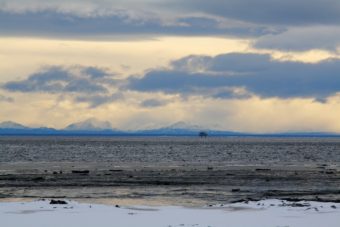
Alaska and a dozen other Republican-leaning states are taking the Biden administration to court over its suspension of new federal oil and gas leases.
The states filed the lawsuit Wednesday, led by Louisiana’s attorney general.
It comes about two months after Democratic President Joe Biden hit pause on any new leases for oil and gas development on federal lands and waters including Alaska’s Cook Inlet and National Petroleum Reserve.
The move was part of a series of executive orders Biden signed soon after taking office, to address global warming.
Cori Mills, an attorney with the Alaska Department of Law, argues the suspension isn’t in line with federal laws.
She said Alaska joined the lawsuit because oil and gas development is critical for the state.
“We still see most of our revenues, most of our economy, our jobs, are based on oil and gas development, responsible and environmentally conscious oil and gas development,” Mills said. “And we feel that’s really important and vital to the state. And this lawsuit seeks to really, you know, tell the Biden administration this isn’t okay.”
While the majority of Alaska’s oil production is currently on state lands, some industry leaders say the future is in federal lands.
The Department of the Interior declined to comment on the lawsuit Wednesday.
The Biden administration has said it’s reviewing the current leasing program but has not said how long the suspension will last.
The administration has also highlighted that oil and gas companies hold leases to millions of acres that have yet to be developed. And, the suspension does not stop work on those existing leases.
Today’s lawsuit asks the court to order the Biden administration to end the suspension, and to move forward with lease sales, including in Alaska’s Cook Inlet.
Meanwhile, conservation and some Indigenous groups are petitioning the Interior Department to block offshore leasing for five years, citing concerns about climate change and threats to coastal communities.
Other states joining Alaska in the lawsuit include Alabama, Texas and West Virginia. Also, Wyoming filed a separate but similar lawsuit Wednesday.
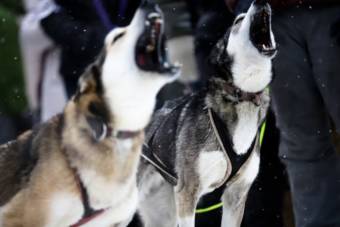
Sled dogs competing in the 2020 Iditarod Trail Sled Dog Race. (Joey Mendolia/Alaska Public Media)
The 2021 Iditarod Trail Sled Dog Race kicks off Sunday in Willow.
But concerns about COVID-19 have made for a drastically different competition this year. There’s required testing and face masks, plus a shorter trail and a smaller group of mushers signed up to compete.
It’s set to be an Iditarod like no other.
Here’s what to know about the 2021 race.
When will the Iditarod start?
At 2 p.m. on Sunday, March 7, at Deshka Landing in Willow, about 90 minutes north of Anchorage.
Iditarod officials say spectators can’t watch from Deshka Landing, because of COVID-19 concerns. But people can still snowmachine out to see teams go by farther down the trail.
Anna Berington and her sled dog team take off from Willow for the 2016 Iditarod Trail Sled Dog Race. Race officials don’t want spectators at this year’s starting line because of the coronavirus. (Ben Matheson/Alaska Public Media.)
As for the ceremonial start in Anchorage? That’s canceled. So are the many other in-person events usually held in the lead-up to the race, like the musher banquet.
What’s different about the race trail this year?
It’s shorter, it doesn’t end in Nome and it passes through fewer Alaska communities.
The 850-mile route goes from Willow, out to the ghost town of Flat and then back to Willow.
That means teams will cross the Alaska Range twice this year but will avoid the windy Bering Sea coast.
A map from the Iditarod Trail Sled Dog Race shows the approximate 2021 route in red. Race officials say the trail will start and end in Willow, near Wasilla. (Iditarod)
Iditarod race director Mark Nordman described trail conditions as snowy.
“We’ve got really good snow,” he said last week. “Lots of snow.”
What about the race checkpoints? Where are mushers stopping to rest?
The race wants to keep interaction between mushers and local residents “to an absolute minimum,” said Nordman.
Already, the new out-and-back trail means more race checkpoints will be located near remote lodges and in ghost towns.
Nordman said the race will set up large tents big enough for multiple mushers to rest in some locations. That includes in the village of Nikolai, where mushers can sleep in the tents instead of inside the village’s school, like they normally would.
Joar Leifseth Ulsom and his sled dogs wear matching neon orange jackets as they glide into Nikolai around 11:30 a.m. (Photo by Zachariah Hughes/Alaska Public Media)
Nordman said he expects many mushers will opt to rest away from others during the race, and near their dog teams.
“I think you’ll see a lot of people camping out,” he said. “If you’re in a tent with four or five different mushers, why not just sleep out with your dogs?”
In McGrath, the most populated community along this year’s trail, there will be a non-tent option: Mushers can stay in an airplane hangar.
Will mushers get tested for COVID-19 during the race?
Yes, several times.
According to the Iditarod’s coronavirus prevention plan, mushers must get tested for COVID-19 two weeks before the race.
Then, they’ll get tested at least four more times: On Thursday in Anchorage, at the race start in Willow, when they get to McGrath and at the race finish.
Race staff and volunteers will go through a similar series of tests and screenings.
The race can do more than 5,000 tests, said Iditarod chief executive Rob Urbach.
What happens if mushers test positive?
If mushers get a positive result on a rapid test, they’ll be given a molecular test.
If they’re positive on that test too, they’re out of the race and must isolate.
According to the Iditarod’s plan, staff will sanitize the area and test anyone who has been in close contact with the infected person.
What other COVID-19 protocols are in place?
The Iditarod has strict limitations on who can go into checkpoints this year.
Normally, many checkpoint areas are often brimming with reporters, race staff, vets and others following the trail. Local residents also often gather at the checkpoint buildings, and bring food to share.
But this year, Urbach said, “we’ve got down to just mission-critical folks.”
Jessie Royer, left, eats in Takotna with Mark Sass, Brent Sass’s father, as well as Richie Diehl and Pete Kaiser during the 2016 Iditarod Trail Sled Dog Race. Takotna is a popular resting spot for mushers, but the race will bypass the community this year because of the pandemic. (Zachariah Hughes/ Alaska Public Media)
The race is creating a “checkpoint bubble” for staff, volunteers and some media, such as the Iditarod Insider, Urbach said.
Those in the bubble must go through the COVID-19 testing protocols and follow other social-distancing and sanitation rules.
The idea, Urbach said, is to ensure everyone in the bubble has tested negative for COVID-19 before the race begins, and then to keep them isolated from others.
“We’re doing as much as we can to protect our traveling ecosystem along the way,” Urbach said.
Jessie Royer mushing into Nikolai on Tuesday, March 10, 2020. The village serves as a race checkpoint about 260 miles into the trail. (Zachariah Hughes/Alaska Public Media)
The race will also have more than a dozen EMTs on the trail this year.
“They’ll essentially serve as our COVID testers, our COVID police, our COVID techs,” said Urbach. “They’re responsible for ensuring that we’re eating and sleeping in a hygienic way. Everybody’s under daily surveillance and there’s daily testing going on.”
The staff and volunteers, as well as mushers, must also wear face masks at the checkpoints.
Who’s competing in this year’s race?
Just 47 mushers — all but 12 of them are race veterans.
They include former Iditarod champions Pete Kaiser, Joar Leifseth Ulsom, Dallas Seavey and Martin Buser.
Richie Diehl pets his dog during a walk during his 24-hour rest in Takotna on Wednesday, March 11, 2020. Takotna is about 330 miles into the 2020 Iditarod Trail Sled Dog Race. (Zachariah Hughes/Alaska Public Media)
Three-time Iditarod runner-up Aliy Zirkle, who has also won the Quest, is hoping to win this year’s Iditarod too, which she says will be her last.
(Here’s the starting order for all of this year’s mushers.)
Aliy Zirkle at the Rainy Pass checkpoint during the 2019 Iditarod Trail Sled Dog Race. (Zachariah Hughes/Alaska Public Media)
What do mushers have to say about the COVID-19 rules?
Several mushers interviewed said they feel pretty good about the precautions in place.
“Bottom line is, I’m not really an expert on COVID. Like, I’m just out here living in the middle of nowhere, picking up dog poop, you know,” the 29-year-old said.
He said he trusts that the Iditarod and infectious disease experts have come up with the best plan, and he will abide by its rules.
Sean Underwood loads dogs from Jeff King’s kennel into a truck for transport to the Tustamena 200 sled-dog race. (Photo by Zachariah Hughes/Alaska Public Media)
Four-time Iditarod champion Martin Buser, 62, said he’s vaccinated, but even if he wasn’t, mushing through Alaska wilderness with his dogs feels like a safe pandemic activity.
“Where better to be if you’re into self-isolating anyway?” he said. “The answer would be somewhere on the Iditarod Trail.”
Even before the coronavirus, Buser usually brought his own small tent on the Iditarod Trail to rest in, instead of sleeping in checkpoint buildings with fellow mushers.
He’ll continue the routine this year.
Four-time Iditarod champion Martin Buser rests in a yellow pop-up tent in Shageluk during the 2018 Iditarod. (Alaska Public Media)
Other mushers are also hopping on the trend, including 37-year-old twin sisters Anna and Kristy Berington.
Anna said she knows everyone will be tested, but the thought of sharing a tent with others still feels too risky.
“So we did go out and buy little pop-up tents and we’ve practiced with those, so we can have our own little bubble in the bubble,” she said.
The Beringtons said while they’re already not seeing many people this winter, they’re being extra cautious in the lead-up to the race.
Underwood said he is too, and plans to keep to himself at the race start.
“I’m not going to be hugging random strangers,” he said. “This is high stakes. And that could cost you dearly, you know, down the line.”
Underwood is competing with Dallas Seavey’s “B-team” as a race rookie, after he and two other mushers got rescued from the trail last year.
What about this year’s race trail? What do mushers think?
Depending on who you talk to, some mushers say the idea of going over the Alaska Range twice is very exciting — or very daunting.
Buser, perhaps, falls somewhere in the middle.
“The range is always a challenge, whether you only do it once, with a fresh team in the northerly direction, or now we’re doing it twice,” he said. “It’s going to be a substantial challenge.”
Diehl, 35, said he’s curious to see what the trail looks like when teams race back down it, on their way to the finish.
“Some of those bridges that we go over, can kind of break apart afterward,” he said. “So I’m interested to see how some of these little creeks and stuff that we cross going out will be when we come back.”
One of Matthew Failor’s sleepy dogs under an Ohio State blanket, Failor’s alma mater, in Takotna on Wednesday, March 11, 2020. Takotna is about 330 miles into the 2020 Iditarod Trail Sled Dog Race. (Zachariah Hughes/Alaska Public Media)
Matthew Failor, 38, said he’s looking forward to seeing more dog teams an out-and-back trail as they pass one another.
“It’ll be fun to get a high-five from the mushers on the way and I think that’ll give the dogs a little, you know, just like a little pick-me-up,” he said.
Some mushers say they’re also packing differently this year because of the trail and checkpoint set up.
Aside from bringing a pop-up tent, Failor said he’s sending extra socks and toe warmers to checkpoints to try to keep his feet warm, knowing it’s unlikely there will be indoor space to dry gear.
It’s also unlikely mushers will be able to charge electronics along much — if not all — of the trail.
That means Kristy Berington is bringing a small battery-powered camera to document the race, instead of using her phone.
“We had to dig it out of the archives,” she said.
Underwood said he bought a new, battery-powered headlamp to replace the more powerful, rechargeable one he normally uses, and would plug in at schools.
It’s not ideal, he said, but it’ll work.
“I’m sending out like hundreds of AA batteries for my little little weenie of a headlamp,” he said, laughing. “I’m going to be changing batteries every three or four hours.”
How can I follow the 2021 Iditarod?
The 2020 Iditarod Trail Sled Dog Race held its ceremonial start in Anchorage on Saturday, March 7, 2020. (Tegan Hanlon/Alaska Public Media)
Alaska Public Media isn’t sending any reporters on the trail this year because of race restrictions and COVID-19 concerns.
But we’ll be reporting on the race start and finish, as well as other breaking news, at alaskapublic.org and on 91.1 FM.
Also, keep an eye out for some episodes of the Iditapod podcast to drop over the next couple weeks, where we’ll talk Iditarod happenings.
Other local news outlets will also be following the race, and there’s coverage provided by the Iditarod itself on iditarod.com.
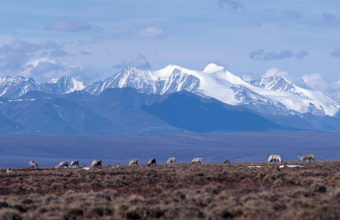
Caribou graze on the coastal plain of the Arctic National Wildlife Refuge, with the Brooks Range as a backdrop. (Creative Commons photo by USFWS)
Last weekend, officials from the U.S. Interior Department said there would be no searching for oil in the Arctic National Wildlife Refuge this winter.
The reason: The Alaska Native corporation proposing to do it failed to meet a key deadline to identify polar bear dens in the area, which could be threatened by the trucks used to detect underground oil formations.
“It was the agency that ran the time out, not KIC,” said Nathan Gordon Sr., the corporation’s chairman.
KIC said it was blocked from making the flights to search for polar bear dens by a Feb. 13 deadline because it never got approval from the U.S. Fish and Wildlife Service, an Interior Department agency.
It blamed Fish and Wildlife’s “negligence, irresponsibility and failure to do its job” for thwarting its plans to search for oil this winter, which were largely targeting corporate-owned lands within the Arctic refuge’s boundaries.
“They held all the cards,” said Matthew Rexford, president of KIC, “and then we saw a lot of delays and excuses from them.”
Rexford, in a news release and six-page letter to Fish and Wildlife, is demanding an apology and correction from federal officials, saying they harmed KIC’s reputation and caused significant economic loss to the corporation and the village of Kaktovik — the only community within the Arctic refuge’s boundaries.
An Interior Department official said the agency had no comment on KIC’s statement.
What KIC wanted to do this winter was bring the big trucks and dozens of workers onto a piece of the Arctic refuge’s coastal plain to search for pockets of oil using seismic technology.
Much of the surface area it wanted to assess is owned by the corporation, with an affiliated regional Native corporation, Arctic Slope Regional Corp., holding rights to any oil under the ground.
But for the seismic testing to move forward, KIC needed approvals from the federal government, including an authorization for “incidental harassment” of polar bears in case the work disturbed any dens.
KIC originally applied to do the work under the Trump administration, which pushed for oil development in the Arctic refuge. But the administration didn’t take action on the request before Trump left office — leaving decisions to the anti-drilling administration of Joe Biden.
Federal officials’ correspondence with KIC suggests that one reason the review took as long as it did was a campaign opposing the seismic exploration that popped up on the popular video-sharing app TikTok.
Video creators called on people to submit comments opposing KIC’s proposal to explore for oil this winter — their messages often playing over montages of polar bears and caribou. One activist even created an “influencer kit” to help other social media users promote the campaign.
In a letter Sunday to KIC, a Fish and Wildlife official pointed out that the agency received more than six million public comments. He said the agency could not review and consider all of the comments tied to the corporation’s request by the Feb. 13 flight deadline, despite taking “extraordinary measures.”
“These efforts included hiring a contractor to process and sort the comments, assembling a team of approximately 40 service staff members to review unique comments and working nights, weekends and holidays to ensure that all substantive comments were appropriately addressed,” the letter said.
KIC says that’s no excuse.
In a response letter, Rexford, with KIC, said the corporation expected approval by late January, which would have left more than enough time for the aerial surveys.
When that deadline seemed no longer possible, Rexford said, the corporation asked if it could do the flights without the harassment authorization and was told no.
“In other words, the service put KIC in an untenable situation where it could not perform a task without the service’s authorization, and then turned around and blamed KIC for the service’s failure to provide said authorization,” Rexford wrote.
KIC’s thwarted efforts to search for oil this winter are a major blow for proponents of drilling in the Arctic refuge. Any future proposals will likely face steeper hurdles under Biden’s administration.
The Porcupine Caribou Herd in the Arctic National Wildlife Refuge on July 3, 2019. (Danielle Brigida via Creative Commons)
An Alaska Native corporation has missed a key deadline to search for oil in the Arctic National Wildlife Refuge, according to the Department of the Interior.
Before it could get approval for what’s known as a seismic survey, the Kaktovik Iñupiat Corporation had to make three flights to search for polar bear dens in part of the refuge.
But the corporation did not do the work before the Feb. 13 deadline, said a brief statement Saturday from Interior spokeswoman Melissa Schwartz.
It’s unclear what exactly happened. An official with KIC did not return requests for comment Monday.
The missed deadline effectively kills the corporation’s proposal to use seismic exploration to search for oil in part of the Arctic refuge’s coastal plain this winter.
It’s the latest setback for drilling proponents who have long wanted to see oil pumped out of the refuge in northeast Alaska.
Another came last month when the first-ever oil and gas lease sale in the refuge, held under then-President Donald Trump, attracted very little interest.
KIC was proposing to bring big trucks and dozens of workers onto the coastal plain to search for pockets of oil on part of the land.
But, to move forward, the corporation needed what the federal government calls an “Incidental Harassment Authorization” of polar bears.
In October, KIC submitted a request to the U.S. Fish and Wildlife Service for the authorization. The agency got inundated with more than 6 million public comments tied to the controversial request.
It had until Sunday to decide whether to give KIC the authorization.
Because the aerial work was not done, the agency told the corporation that its request “is no longer actionable,” according to Schwartz, with the Interior.
Environmental groups celebrated the news that KIC’s plan hit a major roadblock. They had raised concerns about it damaging the tundra and harming wildlife.
“The previous administration attempted to fast-track exploration on an unreasonably short timeline, so the fact that KIC was unable to do the work necessary to ensure the safety of threatened polar bears was completely foreseeable, and Interior responding by voiding the harassment request is the right move at this time,” said a written statement from Adam Kolton, executive director of the Alaska Wilderness League.
Any future proposals for seismic work will likely face steeper hurdles under President Joe Biden, who opposes oil development in the refuge.
On his first day in office, Biden directed the Interior Secretary to put a “temporary moratorium” on all oil and gas leasing activities in the refuge.
Close
Update notification options
Subscribe to notifications
Subscribe
Get notifications about news related to the topics you care about. You can unsubscribe anytime.