Oceans

Interest in kelp farming is on the rise in Alaska, but the infrastructure is still catching up

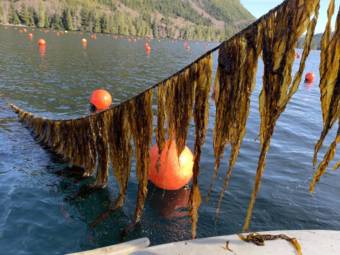
Employees check a line ribbon kelp, or Alaria marginata, in March at Seagrove Kelp’s Doyle Bay Farm, six miles outside of Craig, Alaska. State regulations require kelp farmers to gather seed from at least 50 wild kelp species within 50 km of the farm to help protect wild kelp stocks. The farm grows ribbon, sugar and bull kelp. (Photo by Nick Jones/Seagrove Kelp)

For years, Bret Bradford has lived the seasonal rhythm of a commercial fisherman. He spends summers gillnetting salmon out of Cordova, and in the winter, he looks for odd jobs around town.

When a friend asked if wanted to spend the winters growing kelp instead, he saw an opportunity for stable, year-round work.

“I thought, man, how hard could it be to grow kelp?” he said.

Bradford already has a boat and knowledge of the water. And the timing is perfect: kelp farmers plant seeds in the fall and harvest them in the spring, just before fishing season.

And he’s not the only one jumping on the kelp bandwagon. Interest in kelp farming has been building in Alaska since the state’s first commercial harvest in 2017. Bradford is one of more than 40 aspiring kelp farmers that have submitted applications to the state since.

But there’s still only a handful of farms producing a commercial crop. Mariculture advocates say that it’s not easy building an industry from scratch, or a market for it. Jumping into an industry still in its infancy isn’t without its challenges.

“For me personally, the biggest challenge of anything that I undertake is dealing with the bureaucracy,” Bradford said.

Bret Bradford on his fishing boat in Prince William Sound. Bradford is a commercial fisherman in the summer and is hoping to add kelp farming to his operation in the winter. (Photo provided by Bret Bradford/Blue Wave Futures)

Before they can put lines in the water, kelp farmers have to apply for state and federal permits, which include opportunities for public comment. The whole process can take up to two years, and a lot of money, time and expertise that fishermen like Bradford may not have.

Which is why he joined a collective of aspiring kelp farmers in Prince William Sound called Blue Wave Futures. Lawyer and fisherman Joe Arvidson handled the permitting process for all seven farms.

“And I had no idea what to do and neither did they. And so, I just jumped right into it,” Arvidson said.

In many ways, Blue Wave Futures is still just an idea. Only about half the farms are permitted, and none of them have kelp in the water for a commercial harvest.

But they are trying to lay the groundwork for a stable industry in the region, answering questions like where they’ll get seed, where kelp grows best, and, most importantly, who will buy their harvest.

“We don’t want to grow a bunch of kelp that we can’t sell, that we don’t have markets for, that we don’t have product development for, or even pilot projects that we can use it for to work on,” Arvidson said.

A 40-foot container van holds a mobile seed nursery in Seward, Alaska. With support from the Alutiiq Pride Shellfish Hatchery, the Nature Conservancy, and a Denali Commission grant, Blue Wave Futures built the nursery, where it grew kelp seed for seven different research sites in Prince William Sound. The collective plans to move the nursery to Cordova this summer. (Photo provided by Joe Arvidson/Blue Wave Futures)

Since the state government established a mariculture task force in 2016, the group has been working to grow a shellfish and seaweed farming industry that makes 100 million dollars a year. But that goal is still a long ways off: aquaculture sales totaled just $1.4 million in 2019, according to NOAA.

The interest in kelp farming is there. Lease applications nearly doubled last year, and a recent training by the Alaska Fisheries Development Foundation and other partners attracted hundreds of participants. The foundation’s executive director, Julie Decker, said they’ve had interest from a diverse group of people, including commercial fisherman, subsistence users, tribes, Native corporations and people interested in making kelp-based products.

But the infrastructure is still being built.

“It’s not simple, and so people that are interested should be prepared for challenges,” Decker said. “You know, whenever you’re doing something new, it’s not necessarily all outlined and cookie cutter off the shelf. “

Decker said one big hurdle is finding buyers for kelp. Blue Wave Futures wants to sell much of their harvest to Mat-Su farmers for fertilizer. Alaska researchers along with other partners are also looking at using kelp in biofuel, and Decker said they’re even hoping to attract a plant to the state to manufacture kelp-based plastics.

“It could really open up the demand for farmed seaweed,” she said,  “which would allow for a lot more people to get involved with the industry and know for sure that they had a market.”

Seagrove Kelp off Southeast Alaska’s Prince of Wales Island is one of just four farms that produced a commercial harvest in the state in 2019. The numbers for 2020 are confidential until all kelp farms report numbers to the state.

Founder Markos Scheer said some of their product that aren’t for human consumption, like pet food and fertilizer. But they also sell to companies like Juneau’s Barnacle Foods, which makes a line of trendy kelp-based products like hot sauces and pickles.

This is the farm’s second year growing commercially, and they have faced their share of challenges. Last year, herring spawned on some of their kelp, which delayed harvesting and reduced its quality.

“You know, you come in with an expectation, if we do this, it’s gonna work this way,” Scheer said. “And then most often, we’re not entirely right. And we’ve got to change that, and we say well this worked and this didn’t, and there’s a bit of trial and error in the process.”

Seagrove Kelp employees Melyssa Nagamine and Nick Whicker pull a line of ribbon kelp out of the water. (Photo by Nick Jones/Seagrove Kelp)

But overall, business is going well. They’ve put in applications to add new sites to the 100-acre farm. Scheer hopes expanding will help reach new markets.

“This is the kind of industry that could be a really significant leg on the economic stool for coastal Alaskans because you can do it in so many different places and do it viably,” Scheer said. “You know if we get the industry to a size that it needs to be, it’s gonna be a pillar of the economy for the next 100 years.”

Scheer, like other seaweed enthusiasts, sees kelp as an answer to problems both economic and environmental. It soaks up excess carbon dioxide from the oceans and doesn’t require fertilizers or chemicals once it’s in the water. It could provide an alternative for fishermen during low salmon years in Southeast and other regions.

But whether it will in fact fuel a billion dollar mariculture industry in Alaska is still unknown.

Federal government extends public comment period for Arctic seal critical habitat

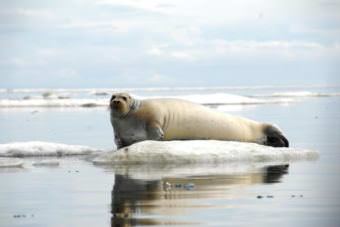
A bearded seal rests on ice in 2011 off the coast of Alaska. (Photo by John Jansen/NOAA’s Alaska Fisheries Science Center)

The federal government is extending the public comment period for proposed critical habitat for ringed and bearded seals. Both species had been listed as “threatened” under the Endangered Species Act during the Obama administration in 2012.

Designating an area as critical habitat means it contains features deemed essential to threatened species. Taking up a large swath of Arctic waters, the chosen area for the seals contains sea ice that they rely on for hunting and nursing their young.

A critical habitat designation does not mean that it’s off limits to human activity. However, if the government makes a decision about the area, they must consult with local biologists to ensure the species and habitat aren’t negatively impacted.

The National Oceanic and Atmospheric Administration proposed critical habitat for the two species of Arctic seals in January.

By law, the critical habitat should have been designated shortly after the seals had been listed as threatened. But the process was delayed by almost a decade, in part due to numerous lawsuits from the state of Alaska, the oil industry and others.

The original deadline for the public to weigh in on the habitat was March 9. It has now been extended to April 8.

Comments can be submitted online or by mail.

Cleanup efforts conclude for Sitka Sound fuel spill

The fishing vessel, Haida Lady, near Sitka on March 3. The vessel was raised with lift bags and dewatering pumps after it sank, and is now tied off to shore. (Photo provided by U.S. Coast Guard)

Cleanup efforts concluded on Wednesday after a sunken fishing vessel spilled diesel fuel in Sitka Sound.

Hanson Marine removed around 1500 gallons of diesel and oily water from the vessel’s fuel tanks and another nearly 300 gallons of oil from the water nearby. The Coast Guard contracted with the Sitka-based company to conduct clean-up efforts, after noticing a sheen around the sunken fishing vessel on Friday.

The company also used lift bags and dewatering pumps to bring the submerged vessel to the surface and then tied it off to shore.

According to a Coast Guard press release, the Sitka’s Marine Safety Detachment will continue to monitor the vessel’s condition. Impacts to the environment are unknown at this time. According to the Coast Guard, no wildlife was observed within the worksite.

Southeast Alaska streams play important role in carbon cycle, researchers find

A helicopter lands on a beach to collect a water sample from a remote creek in Southeast Alaska. (Photo courtesy of Rick Edwards/USFS)

An important part of tackling climate change is understanding how carbon moves through different ecosystems. The burning of fossil fuels is often highlighted for its role in releasing carbon into the atmosphere, but features like landslides, glaciers and rivers all play a part too. A recent study examined how the carbon-rich waterways of the Tongass National Forest fit into the global carbon cycle.

When Dave D’Amore and his colleague Rick Edwards started working at the Pacific Northwest Forest Service Research Station in Juneau, the streams of the Tongass caught their attention.

“One of the things I noticed was the dark, tea-colored water coming out of the wetlands and so Rick just one day asked me, ‘Well, how much carbon do you think is in that?’” D’Amore said. “And I’m like ‘Well, I don’t know. It seems like we should probably figure that out.’”

What makes the water brown is something called dissolved carbon. It’s basically just tiny bits of organic matter.

“It’s literally hundreds or thousands of different things, different chemicals. There may be sugars, simple carbohydrates. There may be proteins. There may be complex and not very tasty organic acids,” Edwards said.

Those tiny particles were the focus of a recent study published in the Biogeosciences Journal of Geophysical Research that Edwards and D’Amore headed up along with five other researchers. The goal was to figure out how much of that organic matter Southeast streams and rivers dump into the Gulf of Alaska each year.

“It’s an accounting exercise, much in the same way that you would measure and monitor the flows of money through different sectors of the economy,” Edwards said.

The researchers traveled from northern British Columbia to the southwestern tip of the Yukon gathering water samples. Then, they paired the field data with map data and statistics. What they found wasn’t insignificant. The amount of dissolved carbon being moved by the Southeast Alaska drainage basin is equivalent to 10.7 million barrels of oil.

This accounting is important for setting carbon budgets and regulating greenhouse gas emissions, D’Amore said.

“Most government agencies and nations are now trying to quantify the total amount of carbon that is either taken into the terrestrial system or released,” he said.

According to the Environmental Protection Agency, the amount of carbon dioxide in the atmosphere has increased by more than 40% since the start of the industrial revolution. Because forests like the Tongass hold onto carbon, they can serve as a buffer for increasing greenhouse gas emissions. But to know how much of a buffer they actually provide, policymakers need to account for how carbon moves through the forest ecosystem.

“If you didn’t include this dissolved carbon in the total flux from that pool, you would overestimate the storage in the terrestrial system,” D’Amore said.

The paper also looked at an understudied region and provided an opportunity to collaborate across national boundaries. Two of the study’s authors were Canadian. Cross-boundary research has increased over the last decade, said geographer and another study coauthor Frances Biles.

“Before about 2010, most of our studies pretty much ended at the Canadian border just as if the watersheds just suddenly ended there and had no influence on what was happening in southeast coastal waters,” Biles said.

She credited efforts from Alaska Coastal Rainforest Center in Juneau and the Southeast Alaska GIS Library with helping foster those relationships and opening up the doors to research across the ecosystem.

Sunken fishing vessel causes fuel spill in Sitka Sound

The 52-foot fishing vessel, Haida Lady, partially above the waterline near Sitka on March 2. Coast Guard Sector Juneau personnel received a report that the vessel sank on Feb. 26. (Photo provided by U.S. Coast Guard)

A sunken vessel has caused a diesel fuel spill in Sitka Sound.

The Coast Guard received a report of a sheen on Friday on the water between Cobb Island and Silver Point, south of Sitka. An Air Station Sitka crew flew over the site and found the fishing vessel Haida Lady submerged and surrounded by a large sheen of diesel.

According to a report from the Department of Environmental Conservation, the vessel owner reported 1,500 gallons of diesel fuel and 55 gallons of hydraulic oil on board at the time of sinking.

The Coast Guard hired Sitka-based Hanson Maritime to help with clean-up efforts. The company has surrounded the site with containment boom, a floating barrier that holds in fuel and oil. They’re also using sorbent boom to soak up excess oil.

Petty Officer Brian Wereda from the Coast Guard’s Marine Safety Center said there were some delays in clean-up efforts because of weather, but things are now moving forward.

“The incident is contained and now Hanson Maritime is stabilizing the vessel and trying to orientate it with divers and lift bags into an upright position to where we can remove the fuel and oil from it,” he said.

Approximately 825 gallons of diesel fuel had been removed from the vessel by Tuesday afternoon, according to the Coast Guard. Wereda said it’s unknown how much fuel was spilled, but that Hanson Maritime will continue working to clean up and contain the area.

“The Coast Guard and state and local stakeholders will continue responding until all the threats to the environment have been removed or mitigated,” Wereda said.

No one was onboard the Haida Lady at the time of sinking, according to a Coast Guard press release. The DEC Situation Report identified possible risk to wildlife, including marine birds, Steller sea lions and whales.

Cruise ships don’t appear to be behind Ketchikan’s beach bacteria problem — so what is?

Rotary Beach south of Saxman is also called Bugge’s Beach. (File photo by KRBD)
Rotary Beach south of Saxman is also called Bugge’s Beach. It’s one of only two tested beaches in the Ketchikan area that regulators say shouldn’t be included on the EPA’s impaired waters list. (KRBD file photo)

For the fourth year in a row, weekly summer water quality tests show that most Ketchikan beaches have elevated levels of bacteria that could make people sick. That happened this year even without dozens of cruise ships sailing through the Inside Passage and discharging wastewater.

And it’s less of a surprise than you might think.

Ketchikan’s federally recognized tribe has been working with Alaska’s Department of Environmental Conservation to monitor fecal coliform and enterococci bacteria levels at Ketchikan’s beaches since 2017. But Meredith Pochardt of the Southeast Alaska Watershed Coalition told attendees at a recent public meeting that this year was different.

“2020 gave us a really unique opportunity to monitor for bacteria around Ketchikan without cruise ships,” she told a half-dozen or so attendees. “And we’re still seeing pretty elevated levels.”

At some sites, bacteria levels were higher than they’ve ever been. Others, like the city’s Thomas Basin harbor, saw improvements that regulators credit to sewer line repairs.

“And so that just opens up more questions and hopefully some more dialogue,” Pochardt said.

All of Ketchikan’s beaches exceeded state standards for fecal coliform bacteria at least once in the summer of 2020. (Southeast Alaska Watershed Coalition graphic)

That cruise ships don’t appear to be contributing to Ketchikan’s beach bacteria problem isn’t as surprising a conclusion as it might seem.

For some quick background: fecal coliform bacteria levels are measured in colony-forming units per 100 milliliters — in simple terms, you take a water sample, filter out the bacteria, drop it onto a petri dish and count how many bacteria colonies form. Do some math, and you get the standard unit for fecal coliform bacteria: CFU per 100 ml.

Cruise ships’ wastewater has to average less than 14 CFU per 100 ml. DEC’s Gretchen Augat put that in perspective.

“That’s extremely low, extremely safe. It is what we use as our most stringent fecal coliform criteria in the state,” Augat said at the meeting.

So, in theory, you could safely swim right next to cruise ships’ wastewater pipes. You could harvest mussels and clams and eat them raw, assuming they’re not tainted by other toxins. That 14 CFU number? That’s less bacteria than is allowed in Ketchikan’s drinking water reservoirs. (That “raw water” is chemically treated before it’s pumped to taps around town.)

Cruise ships are able to achieve those low bacteria levels because they have advanced treatment systems onboard. But on shore, Ketchikan’s wastewater treatment plants are far less effective.

The Mountain Point wastewater treatment plant run by Ketchikan’s borough is allowed to put out 200 CFU per 100 ml — more than 10 times as much as cruise ship systems. DEC’s Augat told Alaska’s Energy Desk that septic systems are held to a similar standard.

And then there’s the city-run Charcoal Point wastewater plant.

“On a daily level, the Charcoal Point [plant] is allowed to, or permitted to discharge 1.5 million CFU,” the watershed coalition’s Pochardt said.

That’s the maximum limit for a day. Over a month, it’s required to average no more than 1 million CFU per 100 ml — more than 70,000 times the limit for cruise ships.

The plant is allowed to put out that much bacteria because it’s exempt from some requirements of the federal Clean Water Act. It’s only required to do what’s called “primary” wastewater treatment — essentially, letting solids settle out of the water before shooting it into the sea. Ketchikan’s city-run plant is not required to do “secondary” treatment, which uses bacteria to break down waste products and generally results in cleaner water.

And it’s not the only plant like that in the area: wastewater facilities in WrangellPetersburgSitkaHaines and Skagway have similar permits and are allowed to put out similarly high concentrations of fecal coliform bacteria.

But Pochardt said DEC and the watershed coalition aren’t pointing fingers.

“One of the important things to point out is we don’t know, and we can’t currently tell the magnitude of each source’s contribution to the bacteria levels that we’re seeing at the sampling locations,” Pochardt said.

A two-mile swath of the Tongass Narrows serves to dilute the flows from Ketchikan’s wastewater treatment plant. Samples taken by the city of Ketchikan and a DEC contractor from within and around the mixing zone met state bacteria standards in 2020. (Alaska DEC graphic)

She said leaky septic tanks, pet waste, small boat harbors and private sewer systems are other potential sources for bacteria.

And there’s reason to believe Charcoal Point isn’t the problem. The city of Ketchikan tracks the bacteria levels in and around the two-mile “mixing zone” near the plant, and for at least the past year, bacteria have stayed below state standards. And a separate water quality study sponsored by DEC also found low levels of bacteria near the sewer plant. The only location that tested above standards in that study was a small boat harbor: Thomas Basin.

While it’s not clear where the bacteria are coming from, environmental regulators are sounding the alarm. DEC recommends that all of the Ketchikan beaches tested, except for popular Rotary Beach and Mountain Point Surprise Beach, be included on the EPA’s “impaired waters” list. That would require the state to come up with a plan to address the bacteria problem. DEC’s Chandra McGee explained at another recent public meeting.

“We’ll be working with the community on a watershed plan and implementing actions from that plan to hopefully bring all of these beaches into compliance with water quality standards in the future,” she said. Environmental regulators are seeking comments on the decision to list Ketchikan’s beaches as impaired.

And while DEC has monitored Ketchikan’s beaches since 2017, it’s not stopping there. Monitors sampled waters all over the state this summer, taking advantage of low cruise ship traffic to establish a baseline, said DEC Environmental Program Specialist Brock Tabor.

“We’re specifically looking for pollutants. A couple different things: We’re looking at bacteria concentrations, which is of great interest to the public. We’re also looking at selected metals that we identified to be associated with cruise ship discharges in the past,” Tabor told Alaska’s Energy Desk.

The study’s data is preliminary, but it found high levels of bacteria near small boat harbors around the state — Juneau, Wrangell, Petersburg, Homer, Valdez and, of course, Ketchikan. And in Seward and Nome, monitors found elevated levels near the cities’ commercial and cruise ship docks.

That study also found high levels of dissolved copper and nickel at several sites in Knik Arm near Anchorage. Those can be toxic to marine life.

Tabor said DEC plans to continue water sampling in 2021.

Site notifications
Update notification options
Subscribe to notifications