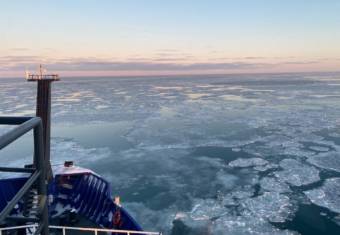
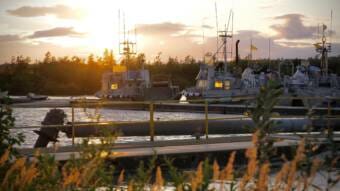
The Sikuliaq travels north in the Chukchi Sea in November 2021. (Photo courtesy of Seth Danielson)
The final research cruise of 2021 in the Bering and Chukchi seas came through the region in November. Scientists on board observed a variety of marine mammals, saw sea ice growth in real-time and found evidence of a healthy ecosystem despite warmer water temperatures from the summer.
Seth Danielson, a professor with the University of Alaska Fairbanks College of Fisheries and Ocean Science, led as chief scientist. The first time measurements were recorded from the Bering Strait in November was in 1960, according to Danielson.
“After 1960 there weren’t any other cruises that I’m aware of, in the month of November, until 2011. And that was a cruise that Karen Ashton led. Since Karen’s cruise in 2011, there have been a couple more that have gone north in November,” Danielson said. “A couple of them did manage to sample some stations on the shelf (of the Chukchi Sea), the way we did. They did that in pretty warm years.”
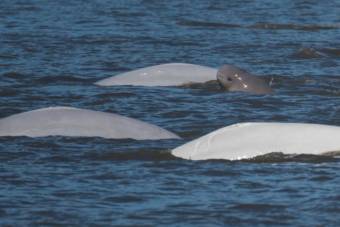
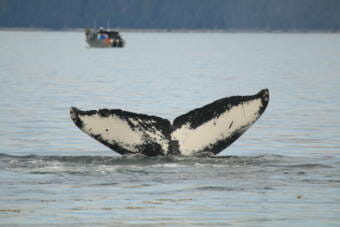
“I was surprised by how few bowheads and how many gray whales and humpbacks there were out there,” Berchok said.
Alaska Sea Grant’s Gay Sheffield remarked that local observations from across the region supported Berchok’s assessment too.
Berchok was observing marine mammals from the bridge of the ship on a regular basis throughout the nine-day voyage. The research team headed north from Seward on Nov. 7 and stopped through Nome on their return around Nov. 16.
Various measurements from the Sikuliaq organized in color-coded graphs by Seth Danielson and research team from their November research cruise. (Screenshot from Strait Science presentation/YouTube)
They witnessed roughly a 20% or more increase in sea ice extent while in the Chukchi Sea during their trip, according to Danielson.
“Why we ever got a situation like this where it’s near freezing at the surface and warm near the bottom (of the sea). And the only thing I can think of is that it was the advection, the currents carrying ice over this region. And so ice did not form in place, but it must have been carried in,” Danielson said.
Other scientists on board the Sikuliaq were taking measurements from the Bering and Chukchi Seas to study water temperature, salinity and oxygen levels.
Southwest of St. Lawrence Island, there was a healthy amount of productivity for this late in the season happening in the Bering Sea ecosystem, according to Jackie Grebmeier, a researcher with the University of Maryland Center for Environmental Sciences.
“So there is still Chlorophyll,” Grebmeier said. “This is viable Chlorophyll on the bottom (of the seafloor) that can provide both food for consumption as well for microbial and carbon cycling. So it’s still going on into November although the values are about 50% less than what we have during the real productive times in July.”
Four DBO mooring sites were monitored by the research team on board the Sikuliaq during their November 2021 cruise. (Screenshot from Strait Science presentation/YouTube)
Grebmeier, Danielson and other scientists from the Sikuliaq are still compiling their final observations. The research team will publish more formal findings sometime in the next couple of years.
Boats in the Dillingham harbor. August 24, 2020. (Photo by Brian Venua/KDLG)
A youth art competition will help determine messaging for signs in Dillingham’s harbor in an effort to keep the water clean.
Alaska Sea Grant fellow Tav Ammu said elementary, middle and high school students in Dillingham can submit a design that shows what a clean harbor means to them.
“Just to remind folks when they’re using the harbor, that people care about pollution and to remind folks not to pollute, and that there are other options and good ways to manage waste while they’re there,” he said.
Along with Alaska Sea Grant, the competition also has support from the Bristol Bay Native Association.
Ammu is organizing the contest as part of his fellowship, which focuses on the Alaska Clean Harbors project. It’s the state’s branch of the Clean Marinas program — a national effort to clean up harbors, marinas and ports and keep them free of pollution.
While the effort is a big deal in the Lower 48, Ammu said, it hasn’t gained much traction in Alaska.
“So we’re trying to bring a little bit more life back into it and see what harbors and areas want more attention, and want to make it more of a priority because we all want clean waters for our salmon and our lifestyles,” Ammu said.
The state’s Division of Water began tracking water quality in Alaska ports and harbors in 2015. In 2020, there was a decrease in ship traffic during the pandemic. The division expanded the project to evaluate how that decline affected water quality.
The division selected sites to represent potential pollution — like small boat harbors, cruise ship ports and commercial shipping docks. It conducted testing at 16 ports from Nome to Ketchikan, and at 20 sites along major shipping lanes throughout southeast Alaska.
According to the tests, the amount of fecal coliform bacteria exceeded water quality standards in some Southcentral and Southeast ports, often around small boat harbors. There is no direct link between increased fecal bacteria and harbors, Ammu said. But raising awareness of pollution is a first step toward cleaner water.
“It starts with harbors, and there’s a huge amount of folks in harbors. And so if bad practices are being done there, it can get worse and worse and worse and get beyond manageable and really impact local ecosystems — and people.”
The state hasn’t monitored harbors in Bristol Bay yet. Ammu will continue to survey fishermen and residents on how they would rate the harbor’s cleanliness until Jan. 15.
The deadline for students to submit art for the signs is Jan. 31. The winner’s design will be featured on signs around the harbor, and they will receive a $50 gift card.
A tendering vessel brings kelp back to Kodiak for processing. Kelp farming is taking off in Kodiak and making waves on the Kenai Peninsula, too, where there are several permitted kelp farmers on Kachemak Bay. (Photo courtesy of Chris Sannito)
Alaska’s economic development districts are in the running to win $50 million in federal money to grow the state’s seaweed and shellfish farming industry, known collectively as mariculture.
The U.S. Economic Development Administration announced this week that the proposed mariculture project is among 60 finalists for a Build Back Better Regional Challenge grant. Advocates say the money could help with the state’s goal of building a $100 million industry by 2040.
More kelp and oyster farms have been popping up along Alaska’s shorelines in recent years. The National Oceanic and Atmospheric Administration valued Alaska’s mariculture industry at $1.4 million in 2019.
But the industry still has a long way to go.
“Where we stand right now is, for the most part, we’re more of a cottage industry than a full-blown industry,” said Tim Dillon, who directs the Kenai Peninsula Economic Development District.
He said a lot of the mariculture action in Alaska is playing out in Southeast.
In Southcentral, it’s mostly concentrated on the far side of Kachemak Bay. Dillon said he sees potential for producers hailing from other parts of the Kenai Peninsula — and Alaska — as well.
“It depends on who wants to play,” he said. “And we want to make sure we’re there to help. And one of the big issues and things we’re working on is to find out, how much money do you think you need to go from A to C? And whether that investment is worth it or not.”
Every finalist for the Build Back Better grant — including the Alaska mariculture cluster — gets $500,000. Dillon said they’ll use that money to further flesh out their goals for the project.
The final grant proposal is due in March. The 20 to 30 finalists who pass through that second phase can get up to $100 million to support industries in their regions.
The grant money comes from the federal American Rescue Plan Act – the COVID-19 relief stimulus package passed by the feds earlier this year. The Alaska project clocks in at around $50 million.
The Kenai Peninsula district’s counterpart in Southeast Alaska, Southeast Conference, is the project’s lead.
Executive director Robert Venables said a big hurdle facing producers now is the small size of the industry, particularly when it comes to marketing and selling a final product.
“It’s kind of an awkward stage of things right now where there’s a lot of small businesses scattered around coastal Alaska and they don’t have economies of scale to really take that big leap forward,” he said. “And so this will help them with supply and infrastructure in order to step up, throw in the workforce component and develop the markets and, all of a sudden, you add an element to our economy that simply does not exist today.”
One area for growth outlined in the project proposal is workforce development. Dillon says mariculture jobs could help balance the decline of other industries in Alaska’s coastal communities, like commercial fishing.
Bringing more of the industry into the public eye is also a priority. Dillon said he’s still learning himself, from experts at the Alutiiq Pride Marine Institute in Seward and other scientists around the state.
“I didn’t know what a FLUPSY was a year ago,” he said. “That’s the equipment they use for oysters for going from seed to spat to eventually oysters.”
The mariculture program was one of nearly 530 applicants to the Build Back Better program.
Another Alaska project is a finalist for the grant, too. That project, proposed by nonprofit Spruce Root, would support more sustainable forest development in Southeast as an alternative to the region’s logging economy.
Former State Sen. Hollis French addresses the Alaska Senate on April 7, 2014 during debate on House Bill 266, the state’s operating budget that would begin on July 1. (Skip Gray/Gavel Alaska)
It’s been nearly five years since a Hilcorp pipeline off the coast of Nikiski began leaking fuel gas into Cook Inlet, a problem that lasted for months.
State regulators will now revisit the circumstances of that leak at a hearing next week. The Alaska Oil and Gas Conservation Commission will hear a complaint from a former commissioner after he successfully sued the agency for not taking action several years ago.
The former commissioner is Hollis French, who’s also served as a Democratic state senator from Anchorage. At the time of the leak, he served on the conservation commission, which is charged with preventing waste in the oil industry and protecting the environment.
French said he doesn’t think commissioners will change their minds or that fine Hilcorp as a result of the hearing. But he does think setting precedent is important.
“The agency’s position on this has been extremely shortsighted,” he said. “And I’m hoping, through this presentation, to at least let the public know why I feel so strongly about this. And maybe the agency will learn something in this process.”
The pipeline in question is eight inches wide and carries gas from Nikiski to a platform in the inlet that uses it as fuel.
Cook Inletkeeper filmed the gas leak from a helicopter in February 2017. At the time, Inletkeeper threatened to sue the oil and gas company. (Courtesy of Cook Inletkeeper)
The line sprung a leak late in December, 2016. The leak continued for three months until Hilcorp, which had cited danger from ice, repaired it.
Commissioners said it was up to federal regulators, not state ones, to look into the leak. Since the gas had already left the place it was produced, they said, it belonged to Hilcorp and was no longer up to them to regulate.
But French disagreed, saying that the state commission had a responsibility to investigate. After Gov. Mike Dunleavy fired French from the agency in 2019, he petitioned the commission to take a deeper look.
French said the commission should hold a hearing on the leak because it constitutes waste — which is the commission’s job to prevent.
“Any leak means that the gas that’s leaked is never going to be used to make electricity or heat our houses,” he said. “When gas is shooting up in the air, any person walking down the street would look at that gas and go, ‘That gas is being wasted!’”
In its decision, the Alaska Supreme Court said the commission needs to show evidence that the leak didn’t constitute waste if it’s arguing it has no jurisdiction.
Grace Salazar with the Alaska Oil and Gas Conservation Commission said it has not yet heard from Hilcorp on whether it plans to attend the hearing next week. A Hilcorp spokesperson did not respond to requests for comment.
Salazar said the commission cannot comment on whether it still stands by its original decision.
The ruptured Hilcorp line released an estimated 210,000 to 310,000 cubic feet of gas daily, enough to power more than 1,000 homes.
The line was first installed in 1965 and carried fuel gas made up mostly of methane. Investigators say that a rock on the ocean floor caused the 2017 leak.
But the line has a history of leaks dating back to 2014. Its most recent reported leak was last spring. Following that leak, the feds ordered Hilcorp to replace the line.
The population of endangered southern resident killer whales has dwindled to 76 individuals. (Courtesy Holly Fearnbach/NOAA)
A University of Alaska Fairbanks researcher who listens to killer whales using underwater microphones has learned some interesting things about the creatures.
Hannah Myers is a Ph.D. marine biology student with UAF’s College of Fisheries and Ocean Sciences. A recent paper Myers co-authored in the journal Scientific Reports delves into the mysteries of where North Pacific killer whales spend their time in winter and which of their undersea calls originate from which pods or ecotypes, which are like subspecies.
Myers says the most abundant of the three main ecotypes living in the waters off Alaska’s coasts are the resident killer whales, which vocalize distinct, repeated calls that can be used to identify them.
Listen here:
The following transcript has been lightly edited for clarity.
Hannah Myers: So when I hear a particular call in a recording, and it’s a resident killer whale, I often know which family group is present or which pod is present. So, obviously, it’s pretty tough to do winter fieldwork on the water in Alaska due to, you know, really nasty weather, limited daylight hours. And so we only had data from May to October. And that’s where this acoustic study was really something brand new.
So questions that we had: Where can we find the whales in the winter? What might they be doing there? Is it the same whales? Is it somebody different? Things like that.
Casey Grove: So hydrophones, I mean, describe the process to me of actually going and using those. You have to take them out, drop them down, you said, and then you have to go pick them back up, right?
Hannah Myers: Yeah, we do. And it’s always kind of an exciting and nerve-racking process. We put them on an anchor and drop them overboard and then come back to our GPS points a year later, and we actually grapple for them — so drop out a hook over the side of the boat and try and pick up the line connected to the hydrophone and bring it back up. And we’ve actually had pretty remarkable success doing that in over 100 feet of water.
It’s always an exciting and relieving feeling when that line comes over, and the hydrophone comes up with it covered in, you know, all kinds of algae and weird invertebrates growing on it close to the sea floor over the course of a year. But yeah, scrape those off, get her cleaned up and open it up and take the the memory cards out and replace the batteries and drop it back down.
Casey Grove: That almost sounds like “Deadliest Catch” to me or something with the hook. So, you extract this audio from the hydrophone, and we actually have a clip of some of that I’m going to play right now.
Killer whales: (whale calls)
Hannah Myers: What we’re hearing there is the 8016 pod. And that’s a group of 13 whales, resident fish-eating whales. And in that group we have a grandmother and her three brothers, her three adult daughters, adult son and then her daughter’s offspring. So resident killer whales are thought to be unique among mammals, in that both their female and male offspring stay with the mothers for life. And so in this recording, you can hear sort of the two main call types that are part of that 8016 dialect that I mentioned. We sort of have nicknames for the different calls. So in that recording, you heard the “hey” call, and then the three-tone call. And whenever I hear those, I know that the 8016s are present.
Casey Grove: So they’re literally saying, “hey,” in at least one of those calls?
Hannah Myers: Well, I wish I knew what the whales were actually saying to one another, but I don’t, that’s just what we’d nickname it, because it almost sounds like someone yelling, “Hey!” But yeah, I mean, it’s thought that these unique dialects are probably useful for group identification for the whales, since they have this really important social structure. We sometimes compare it to if you were running around shouting your last name sort of.
Casey Grove: “Myers! Myers!”
Hannah Myers: Exactly.
Casey Grove: We all do that at family gatherings from time to time. That’s super interesting. And what about your research, what results surprised you the most?
Hannah Myers: Yeah, there were a few things that surprised me about this work. So we dropped the hydrophones in areas where this long-term monitoring had showed the killer whales could be found pretty reliably during summer months. But, like I said, we really had no idea if they were going to be there in winter or not. We just didn’t know where they were going to be.
And we found really high use throughout the winter in some areas, and especially Montague Strait, which is the western entrance to Prince William Sound. So on some winter months, we were hearing killer whales, you know, nine out of 10 days, which was really surprising because a lot of the time when we document whales in a given area, there’s a clear correlate with that, like a chinook salmon run that we would expect them to be interested in, you know, being in that area to eat that salmon. But obviously that’s not happening in winter. So it’s a big mystery, you know, what it is that they’re out there for at that time.
And then another thing that was pretty exciting about this study is recording the mammal-eating killer whales as much as we did. They, on average, are a lot quieter than the fish-eating killer whales because their prey can hear them, so they can’t really afford to be vocalizing a lot. That being said, we did record them.
We have the Gulf of Alaska transients, and this is thought to be over 100 — possibly several 100 — animals, but we didn’t really have good recordings of them that we could use to identify them on the hydrophones. And so we were hearing this group of calls on the hydrophones pretty consistently, one of them we nicknamed the “rooster call” because it sounded exactly like a rooster crowing. And it was sort of this mystery, like, who’s making these calls? And a researcher we collaborate with, she actually recorded a group of Gulf Alaska transient killer whales in Kachemak Bay in August 2020 and photo-identified them and got this really amazing recording that included those calls. That was a really exciting part of the study, solving the rooster mystery.
Bleached kelp on San Juan Island, Washington, during this summer’s heat dome. (Courtesy of Robin Fales)
During this summer’s stifling heat wave, Robin Fales patrolled the same sweep of shore on Washington’s San Juan Island every day at low tide. The stench of rotting sea life grew as temperatures edged toward triple digits — roughly 30 degrees above average — and Fales watched the beds of kelp she studies wilt and fade. “They were bleaching more than I had ever seen,” recalled Fales, a Ph.D. candidate and marine ecologist at the University of Washington. She didn’t know if they would make it.
Never in recorded history had the Pacific Northwest experienced anything like the “heat dome” that clamped down on the region in late June 2021. Temperatures reached a withering 116 degrees Fahrenheit in Portland, Oregon, and 121 degrees in Lytton, British Columbia — the highest ever recorded north of the 45th parallel.
Scientists said the event would have been “virtually impossible” without climate change. It killed hundreds of people, damaged roads and power lines, and devastated crops. It also caused widespread ecological fallout, the full extent of which scientists have yet to grasp.
Initial reports were sobering: A billion shellfish and other intertidal animals baked to death on the coast of British Columbia. The Portland Audubon Society declared a “hawkpocalypse” as it tended to scores of sick and injured birds. And in eastern Oregon, state officials estimated that tens of thousands of sculpin, a bottom-dwelling fish, perished in streams already throttled by drought.
‘They were bleaching more than I had ever seen’
By fall, headlines and memories had faded, but the heat wave’s impacts linger on. In fact, researchers have learned that short bursts of high temperatures can pose a greater threat to plants and animals than long-term warming, and may even increase the risk of extinction.
In one recent study, researchers looked at 538 species from around the world, nearly half of which had already disappeared in at least one location. They found that the doomed populations endured greater (and faster) increases in maximum yearly temperature than others. Surprisingly, though, they often experienced smaller changes in average temperature, said John Wiens, an evolutionary ecologist at the University of Arizona and a co-author of the study. “The most important variable is these hottest summer temperatures.”
Extreme heat can kill organisms outright, especially if they are also exposed to intense sunlight. Dehydration sets in and organs fail as enzymes stop working and proteins sustain damage. The trauma can make survivors more susceptible to disease and predation and reduce or delay reproduction. Hot weather can also cost animals by discouraging them from foraging or hunting. And these events are happening more often: By 2040, heat waves are projected to become 12 times as frequent as in a non-warming world.
After the latest episode in the Pacific Northwest, researchers began tracking the damage to a variety of species and ecosystems, like coastal forests, which fared especially poorly. Scorched leaves turned hillsides sickly shades of orange, and trees already stressed by drought dropped their needles prematurely. But the deadliest impacts may be invisible, said Christine Buhl, an entomologist at the Oregon Department of Forestry: Thirsty trees, for example, may have suffered damage to their roots and vascular systems if they couldn’t pull enough moisture from the ground. “We will know in coming years how bad it was,” Buhl said.
‘You can still go around and find the legacy of that event’
Australia provides a grim preview. After a string of heat waves hit the western part of the country in 2010 and 2011, scientists documented widespread tree death, among other impacts, which later contributed to beetle outbreaks and wildfires, said Joe Fontaine, a fire ecologist at Murdoch University in Perth. Even now, he said, “you can still go around and find the legacy of that event.”
Yet heat waves may also help species adapt to long-term warming by driving rapid evolutionary changes, said Lauren Buckley, a climate change ecologist at the University of Washington. They can weed out unfit individuals, giving those that tolerate hotter temperatures an advantage. Scientists have seen evidence for such shifts in populations of Douglas fir and fruit flies. But “there’s sort of a sweet spot,” Buckley said, between a stress test and a massacre.
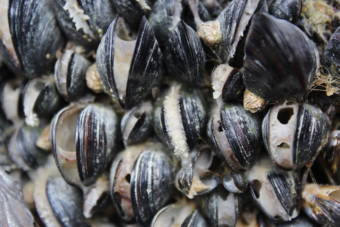
It’s too early to know whether the recent temperature spike hit the sweet spot for some — if any — Northwest species. On San Juan Island, however, Fales found a measure of hope. After the heat wave, Fales surveyed the damage to the kelp she studies and determined that while it had lost about half its biomass, most of the plants were still alive. Many mussels survived, too.
That may be because warm spring temperatures spurred them to mount defenses prior to the heat wave, Fales said, by producing heat-shock proteins that repair other damaged proteins, for example. But there’s another possible factor: By celestial happenstance, summer low tides on the island always occur during mid-day, exposing intertidal organisms to peak temperatures and making it “a hotspot location,” Fales said. Perhaps the kelp and its neighbors had already begun to adapt.