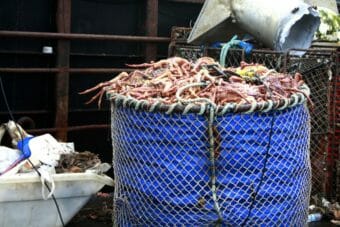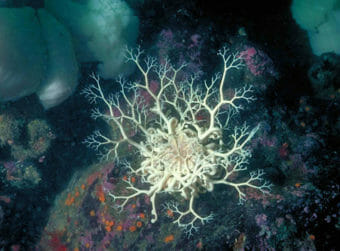
Red king crab from the Bristol Bay fishery. (KUCB file photo)
For the first time ever, the Bering Sea snow crab fishery will not open for the upcoming season. Alaska’s Department of Fish and Game announced the closure Monday afternoon. The Bristol Bay red king crab fishery will also be closed this year — for a second year in a row.
Gabriel Prout co-owns the F/V Silver Spray with his dad and brothers. The Silver Spray is a 116-foot steel crabber that’s homeported in Kodiak.
He said he wasn’t surprised that Fish and Game closed the king crab fishery — in a normal year, he’d go out for king crab, too. But numbers have been on the decline and that fishery didn’t open last year, either.
“The real shocking part is the total and complete collapse of the snow crab fishery which no one expected last year when it happened, and a complete closure this year was equally as shocking,” Prout said.
Miranda Westphal, an area management biologist with Alaska’s Department of Fish and Game, said the sudden decline in snow crab came as a shock to biologists as well.
Back in 2018, there was record recruitment in the Bering Sea snow crab stock. Those numbers started to go down in 2019, and there was no survey in 2020 due to the pandemic.
“And then in 2021 when they surveyed, we saw the largest decline we’ve ever seen in the snow crab population, which was very startling, I think, for everyone,” Westphal said. “It wasn’t something we expected, we were expecting to have this record recruitment come through the population.”
The quota was down about 90% from 2020. This year’s population numbers were even worse, according to Westphal, prompting the fishery’s closure.
Westphal said they’re not totally sure what caused the snow crab collapse, but they suspect warmer ocean conditions caused by climate change may be partly to blame.
About 60 boats normally go out for Bering Sea snow crab, according to Westphal.
Prout, the Kodiak fisherman, said a deckhand might make $50,000 to $80,000 in a good year, with a boat’s overall catch typically worth $1.2 million to $1.5 million.
There is a small tanner crab fishery slated to open on Oct. 15 in the Bering Sea. Prout said that’s a Band-Aid, though.
“It really has been in the past a kind of a bonus when you have to fish that alongside the snow crab,” he said. “But seeing as there’s no snow crab this year with the closure, we’re contemplating whether or not we should even make the trip out west with the high fuel prices.”
He estimates that right now it costs about $100,000 in fuel roundtrip to make it to the Bering Sea fishing grounds.
The price of steel – needed to maintain the Silver Spray’s more than 200 crab pots – has also jumped. He and his family are still waiting on fishery disaster payments to come through from the federal government for past poor seasons and closures.
Prout said his family tenders in Prince William Sound during the summers – they’re already eyeing that season to make up some of the financial loss from the crab closure. But others won’t have many options.
“People are really going to have to make some hard calls here, whether that’s selling out completely of their quota shares, selling their vessels, looking for other opportunities in other fishing sectors which is few and far between,” Prout said. “Fishermen are really going to be hurting the next year.”
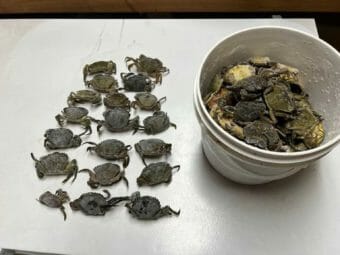
European green crabs collected from Metlakatla’s Tamgas Harbor this week. The crabs were trapped in shrimp pots. (Photo courtesy of Dustin Winter).
Wildlife officials in Metlakatla continue to trap record-setting numbers of invasive European green crabs, which threaten local subsistence food sources and fish habitat. The tribe’s Department of Fish and Wildlife has trapped hundreds of them — but the numbers keep growing.
Months after the first green crab shell was found on the beach in Metlakatla, the community is still trying to figure out how to handle the arrival of a species that officials call one of the most invasive around. They’re known to destroy fish habitat, eat other shellfish and compete for vital resources.
Carapaces, or shells, from invasive European green crabs found on the beaches of Annette Island this week. (Courtesy of Dustin Winter/Metlakatla Indian Community)
Dustin Winter directs the tribe’s Department of Fish and Wildlife. He said his department is doing all it can to keep up as the numbers soar. And as of now, that means trapping as much as possible.
“We’re still trying to figure that out. I mean, right now, we’re just trying to do it internally as much as we can — it’s definitely increased workload for the department,” Winter explained. “But right now, there isn’t any real long term plans as far as moving forward other than what we’re doing. And I mean, we’re going to try to keep those traps in the water in Tamgas Harbor and in other locations as we monitor those areas, too, but short term goal is just keep the traps in the water at Tamgas.”
But so far, that hasn’t seemed to put a dent in the population.
Officials trapped a record 62 crabs on Oct. 4, beating the record of 38 crabs set the day before. And wildlife monitors found another 55 the day after, according to Metlakatla’s mayor.
Winter said Tamgas Harbor has turned into a hotspot for the crabs.
“Well, it’s pretty concerning for us,” he said. “I mean, we’re going from single digits to, you know, we have a record of 11 last week, and then 13, at the end of the week, and then this week, we’ve got, you know, one day, catch of 38. And the next day is 62. So it’s very concerning.”
Spencer Guthrie with Metlakatla Indian Community’s Division of Fish and Wildlife works on an oyster bucket this summer. The container was used to trap green crabs. (Photo courtesy of Albert Smith).
Wildlife officials have been setting shrimp pots to catch the crabs.
“They’re (the pots are) real fine mesh,” Winter said. “I think they’re only like a half inch mesh, though. Because the juvenile crab that we were catching at the beginning were pretty small. So the shrimp pots are working really well.”
When they’re caught, wildlife officials collect biological information and freeze them.
Once the crabs are dead, they’re tossed into the compost pile at Metlakatla’s community garden.
Communities across the Pacific Northwest and the country have struggled to fight the spread of invasive green crabs. Most efforts have focused on trapping as many as possible.
Washington Gov. Jay Inslee declared an ongoing state of emergency in January because of the crab invasion across the state.
Chase Gunnell is a public information officer for Washington’s Fish and Wildlife Department. He explained that the crabs have been around the state for more than 20 years, but they’ve recently spiked to concerning levels in Puget Sound and the Salish Sea.
“We, at this point, have removed more than 170,000 European Green crabs from Washington waters this year alone,” Gunnell said.
He said trapping is the only technique that Washington has used against the crabs.
“And our real focus is really ‘boots in the mud,’ getting traps out there, (and) helping to identify, to coach the public on how to identify European Green crabs so they can report them,” Gunnell said. “But our focus is on population control through trapping.”
But he said he doesn’t think wildlife authorities will be able to exterminate the species.
“We are very concerned about potential impacts on our native species and aquaculture, and we do want to do everything we can, and to control this invasive species,” Gunnell said. “At least in Washington, we don’t expect that we’ll be able to eradicate them. We know that they’re here, we’re not going to be able to remove all of them from our waters.”
Further down the coast, wildlife officials are trying to make the crabs an attractive target for fishermen. In Oregon this summer, officials raised the recreational bag limit of the crabs to 35 — that’s to try and stop crabbers from throwing any green crabs they catch by accident back into the water to avoid fines. There are even a few recipes floating around Oregon’s government website.
An invasive green crab that was collected in Metlakatla this summer. (Photo courtesy of Albert Smith).
Officials are asking Alaskans in Metlakatla and elsewhere to keep an eye out for green crabs. European green crabs are the only species in Alaska that has three bumps between its eyes, and five spines behind each eye.
Winter said that anyone who thinks they’ve seen a green crab — dead or alive — should contact Metlakatla’s Fish and Wildlife Department. Anyone who spots European green crabs outside of Metlakatla is encouraged to call the Invasive Species Hotline at 1-877-INVASIV.
Norma Tunutmoak of Chevak shows off a message in a bottle she discovered after flood waters from an historic storm in September. (Emily Schwing for KYUK)
The remnants of Typhoon Merbok battered Alaska’s west coast in September, bringing hurricane-force winds, high seas, and severe damage to some Western Alaska communities. Homes were flooded and personal belongings were destroyed. But in its wake, the storm also left behind a few treasures.
After the storm tossed boats in Chevak like bath toys and scattered debris across the community, Norma Tunutmoak went out to survey the damage. Flooding carried loads of driftwood 17 miles inland from the Bering Sea coast. Tuntumoak, an avid beachcomber, said that she spotted something tangled among a pile of logs.
“I was like, ‘Holy cow, look at this!’” Tunutmoak said. “It was a message in a bottle.”
Her eyes lit up as she showed off a brown glass bottle with a roll of paper at her home.
When she opened the cork stopper and pulled the message out, it said that the bottle had been floating around in the Pacific Ocean and the Bering Sea for more than 20 years. According to the message, the bottle was dropped from a boat off the coast of Vancouver in 2000 as part of a long-term study on ocean currents. Tunutmoak contacted the scientist listed on the message. He’s since retired, she said.
Tunutmoak said that she had hoped the find might be more personal.
“But it’s OK,” she said proudly. “It’s still an amazing find.”
She said that she plans to display the bottle, and its message, on a shelf in her kitchen.
Up and down Alaska’s west coast, people have reported finding treasures from glass fishing floats to shoes and other flotsam. A giant prehistoric tusk discovered outside Newtok didn’t float in on a tide; it washed out of the tundra near Newtok.
“Half of it was showing from the tip and all the way to the end of it,” said Bruno Chakuchin, who discovered the tusk while scouring the coastline for debris.
Chakuchin said that the tusk was huge.
“Probably like 8 feet and 10 inches and probably a diameter of 1 foot, 6 inches,” he said.
It also weighed 128 pounds — too heavy for him to lift alone.
Tusks like this are popular among collectors and artists. Days after he discovered it, Chakuchin said that he wrapped it up and shipped it to a buyer in Anchorage.
“Depending on condition, they’ll go for about $150 a pound if it’s in really good condition,” he said.
That kind of cash can go a long way in a small community like Newtok. Chakuchin said that he’s likely to use it for bills, to pay for food and maybe invest in a four-wheeler.
“No I’m not gonna use it for fun,” he said.
Beachcombing offers a nice break for residents who are still cleaning up after their communities were ravaged by flooding, high winds and an historic storm surge.
A European green crab. (Photo by Emily Grason, Washington Sea Grant)
When Natalie Bennett was walking surveying a beach on Annette Island as part of a team trying to defend Southeast Alaska from marine invaders, she made a major but ominous discovery: the state’s first documented shell of an invasive European green crab.
Bennett, a summer intern with the nonprofit Sealaska Heritage Institute who was working with the National Oceanic and Atmospheric Administration, noticed the tell-tale spines on the side of the eye areas. Right away, she notified one of her internship advisers, Barb Lake of NOAA Fisheries.
“I told her, ‘This is kind of concerning me,’” Bennett said. “I handed it to her, and she said, ‘No, it can’t be.’”
Bennett’s July 19 discovery was the first step in confirming that European green crabs had spread farther north on the continent than ever been recorded before. They are small but highly aggressive crustaceans that are notorious for damaging native ecosystems.
Two days later, the team found Alaska’s first dead European green crabs in the area. Live crabs were found in the days to follow.
That was not a surprise, said an official with the Metlakatla Indian Community, the island’s tribal government that, in partnership with NOAA Fisheries, is leading the green crab search.
“Once you find the shells, it’s not very long after that there are live crabs,” said Genelle Winter, a grant coordinator with the Metlakatla Indian Community.
And as of Sept. 6, the tally was 94 live crabs, eight dead crabs and 21 carapaces or hard upper shells, Winter said.
Natalie Bennett, a Sealaska Heritage Institute intern working with NOAA Fisheries, holds the European green crab outer shell that she found on July 19 on the extreme high-tide line of an Annette Island beach — right below a sign warning visitors about the destructive invaders. Bennett’s discovery of the shell, called a carapace, was the first documented evidence of the invasive crabs in Alaska. After that first discovery, the Metlakatla Indian Community-NOAA Fisheries team found more carapaces, some dead crabs and dozens of live crabs. (Photo by Linda Shaw/NOAA Fisheries)
Annette Island, on which the town of Metlakatla is located, is at the far southeastern corner of Alaska. Movement of European green crabs into the area was considered almost inevitable, but this summer’s discoveries were stunning nonetheless.
“I just kind of figured eventually they would get up here. Be we all thought it would be a few years before they made it up here,” said Bennett, now back in her hometown of Juneau. “We just weren’t expecting them already.”
European green crabs — which, despite their name, can be red, yellow or mottled as well as green — are native to western Europe and northwestern Africa. They have been working their way westward since the early 1800s, when they were found on the U.S. East Coast, likely carried in ships’ ballast, according to NOAA.
The crabs made it to the West Coast by 1989, when they were discovered in San Francisco Bay. They have spread north since then, likely helped along with warming marine conditions resulting from climate change. In 2020, according to the Alaska Department of Fish and Game, green crab larvae were found in Prince Rupert, British Columbia, and the following summer, a population of adult green crabs was found on the province’s Haida Gwaii archipelago – dangerously close to Southeast Alaska.
The state Department of Fish and Game website lists a litany of negative impacts.
Besides cutting up eelgrass beds that are important for salmon and other fish, European green crabs gobble up native clams, mussels, snails and other species; they have been known to wipe out entire mussel beds, according to Fish and Game. They also have the potential to displace native crabs, including Dungeness, and they prey on oysters, which are important to the Alaska mariculture industry, Fish and Game warns.
Barb Lake of NOAA Fisheries and two other team member work on July 21 setting traps in the Tamgas Harbor area to snare invasive European green crabs. (Photo by Linda Shaw/NOAA Fisheries)
People in Southeast Alaska were already worried about the green crabs prior to their discovery in the state, “because they’re super-invasive and really good at destroying ecosystems,” Bennett said. “They shred eelgrass. They just destroy everything.”
To look for the invaders, she drew on lessons from her youth, when she accompanied an uncle on his forays collecting crab carapaces for sculptures. She found the green crab carapace on the highest tide line — coincidentally, right below a sign that instructed people to be on the lookout for the invasive and destructive crabs.
Now that residents of Metlakatla and their partners have found the crabs, what will they do?
“That’s a fantastic question. It’s one we’ve been asking ourselves ever since it happened,” Winter said.
The immediate focus is on plucking the crabs out of the water to prevent proliferation and spread. They are small, only about 2.5 to 4 inches across, and through some trial and error, Metlakatla residents and their partners have found that shrimp traps are the most effective tools for capturing green crabs.
Those they have collected are being stored in a freezer, with some samples sent out for DNA analysis, Winter said.
So far, the live crabs have been found only around a spot called Tamgas Harbor, though carapaces and carcasses have been found elsewhere, she said.
And so far, Winter said, there haven’t been any noticeable effect on fish populations. But there has been cut eelgrass, a typical result of European green crab presence, she said.
Tamgas Harbor is located on the southern side of Annette Island, one of the most southeastern points of Alaska. As of early September, discoveries of live invasive European green crabs have been limited to the Tamgas Harbor area. (Photo by Barb Lake/NOAA Fisheries)
The effort to find and capture the invasive crabs will continue as long as the tribe has funding for it, Winter said. “This is not a one-and-done operation. This is something that’s going to require a sustained effort over a long period of time,” she said.
The European green crab search-and-destroy mission is part of a broader campaign throughout Alaska to prevent the arrival of invasive species or, if they are present, to remove them.
Beyond Southeast Alaska, a particularly troublesome invasive species that have become established in the Southcentral and Interior regions is elodea, a fast-growing freshwater weed that can damage salmon spawning habitat and pose safety dangers to floatplanes. Another invasive species in Southcentral is northern pike, a fish that has been improperly transported from its natural range farther north and has fed on native fish in Southcentral lakes. Agencies and organizations are also on the lookout for zebra mussels, creatures that can attach to boats and be carried to new environments. In May, a boat being pulled northward by land was inspected at the Alaska-Canada border and found to have zebra mussels attached, albeit dead. It was decontaminated before being allowed to proceed to Alaska, according to the U.S. Fish and Wildlife Service, which staffs the border with agents to monitor such incidents.
As for Bennett, she is headed to the University of Alaska Southeast in the spring and is considering further studies in marine biology. She also remains curious about the European green crabs’ movement into Alaska. “I wish I were still in the internship so I could know how many more crabs they caught,” she said.
Admiral, a harbor seal pup rescued by the Alaska SeaLife Center, heads immediately to the ocean after being released from his crate on Aug. 24, 2022 in Kenai. (Photo by Hope McKinney/KBBI)
Two harbor seal pups who were rescued earlier this summer have returned to the wild.
The seals, named Cobalt and Admiral, spent the past two and a half months at the Alaska SeaLife Center in Seward, gaining weight and learning to catch and eat fish.
After passing their health checks, care specialists finally decided last month it was time for the seal duo to go back into Cook Inlet.
Dozens of adults and children came to watch on an overcast afternoon at Kenai North Beach. They were quiet as SeaLife Center staff opened the seals’ crates and the pups started to make their way to the ocean’s edge. Staff had warned the crowd to hold their applause and cheers until the pups were safely in the bay.
“We don’t want to spook them,” said Savannah Costner, an animal care specialist with the center’s wildlife response department. “This is the most people they’ve ever seen in their entire lives. So it’s going to be a little bit scary for them.”
The release only took about five minutes.
Admiral — a 50-pound male — booked it straight to the water, where he then waited for his sister Cobalt, who wasn’t so sure about the people hovering nearby.
She stared at the quiet audience and slowly waddled to the bay. There were other harbor seals swimming in the surf nearby.
As soon as the seals were in the water, the onlookers cheered.
The Alaska SeaLife Center Wildlife Response Program admitted the first two harbor seal pup patients of the summer on June 2, 2022. (Photo courtesy of Kaiti Grant/Alaska SeaLife Center)
They spent all summer at the SeaLife Center. And when they got released, the only evidence of their time at the center was a small blue tag with an identification number on their tail fins.
Cobalt and Admiral have graduated from “fish school.” (Hope McKenney/KBBI)
Costner said it’s special every time the center releases a rehabilitated animal back into the wild, but there was something extra sweet about seeing Cobalt and Admiral swim away. She helped care for and train the seals and oversaw their release.
“We all put our time into it, our love, our hopes and dreams into these animals and we want the best for them,” she said. “I think the fact that we had to do emergency medicine on Cobalt her first day with us and the fact that we got her here to this day is crazy. It’s amazing.”
For release day, the SeaLife Center invited volunteers and members to the long sandy beach. It was the first time in several years the center has held a public release because of the coronavirus pandemic.
The Alaska SeaLife Center Wildlife Response Program admitted the first two harbor seal pup patients of the summer on June 2, 2022. (Photo courtesy of Kaiti Grant/Alaska SeaLife Center)
Marie Mills is a member of the center and found out about the event when she got an email from staff. She loves pinnipeds – especially seals – more than almost anything.
“They’re cute and fat and chunky and jiggly. They’re just amazing,” she said, giggling on the beach.
Mills drove more than three-and-a-half hours from Wasilla for the release.
“I just love that the SeaLife Center can rehabilitate them and put them back in their home and not just stick them in a zoo somewhere,” she said.
There were some younger guests at the event too.
Hildy Coleman just turned seven and is in first grade. She was wearing a blue hoodie and boots as she pointed at the heads of harbor seals in the bay, hoping to spot Cobalt and Admiral who were just released.
Hildy’s mom took her and her older sister out of school in Kenai to watch the pups return home to Cook Inlet.
The Alaska SeaLife Center Wildlife Response Program admitted the first two harbor seal pup patients of the summer on June 2, 2022. (Photo courtesy of Kaiti Grant/Alaska SeaLife Center)
She said watching them wobble back to the ocean was kind of “funny.”
“People took three steps back and then [Cobalt] started to go,” Hildy said. “She stopped a little bit, and then she went again. [In the water], they kept on diving, then coming back up and diving again.”
Sasha Coleman – Hildy’s mom – was born and raised in the area and said there’s no place like it. Although her kids just started the school year, she said she didn’t want them to miss this.
“It’s just a neat experience to see,” she said. “It’s really, really cool to think how they literally were just off of our beach next to our home. They got rehabilitated, and they’re back in the wild again. And they’re super cute, too. Not a lot of kids get to see this kind of stuff.”
The Alaska SeaLife Center Wildlife Response Program admitted the first two harbor seal pup patients of the summer on June 2, 2022. (Photo courtesy of Kaiti Grant/Alaska SeaLife Center)
As the Colemans pointed at the seal heads popping up in the bay, Mills – who came from Wasilla – stood further down the beach in the surf, her back turned to the other onlookers.
“Seeing them both get out into the water was amazing,” she said. “There’s a lot of seals out there right now. I’ve counted at least four. And so they’re with their own kind out there. It’s amazing. It just makes your heart feel happy that they’re home.”
While this might have been Mills’ first in-person seal release, she said it won’t be her last. Her love for seals runs deep. She even wrote a song about it.
An orca pod seen in the Strait of Gibraltar in 2021. (Photo by Renaud de Stephanis/CIRCE Conservación Information and Research)
Ester Kristine Storkson was asleep on her father’s small yacht earlier this month, sailing off the coast of France, when she was violently awakened.
Scrambling on deck, she spotted several orcas, or killer whales, surrounding them. The steering wheel swung wildly. At one point, the 37-foot sailboat was pushed through 180 degrees, heading it in the opposite direction.
They were “ramming the boat,” Storkson says. “They [hit] us repeatedly … giving us the impression that it was a coordinated attack.”
“I told my dad, ‘I’m not thinking clearly, so you need to think for me,'” the 27-year-old Norwegian medical student says. “Thankfully, he is a very calm and centered person, and made me feel safe by gently talking about the situation.”
After about 15 minutes, the orcas broke off, leaving father and daughter to assess the damage. They stuck a GoPro camera in the water, she says, and could see that “approximately three-quarters of [the rudder] was broken off, and some metal was bent.”
A screen grab from a video of the encounter between a pod of orcas and the Storkson boat. (Ester Kristine Storkson)
For any vessel, losing steering at sea is a serious matter and can be dangerous in adverse conditions and some sailboats have had to be towed into port after orcas destroyed their rudders. Fortunately, the Storksons had enough of their rudder left to limp into Brest, on the French coast, for repairs. But the incident temporarily derailed their plan to reach Madeira, off northwest Africa, part of an ambitious plan to sail around the world.
There is no record of an orca killing a human in the wild. Still, two boats were reportedly sunk by orcas off the coast of Portugal last month, in the worst such encounter since authorities have tracked them.
The incident involving the Storksons is an outlier, says Renaud de Stephanis, president and coordinator at CIRCE Conservación Information and Research, a cetacean research group based in Spain. It was farther north — nowhere near the Strait of Gibraltar, nor the coast of Portugal or Spain, where other such reports have originated.
That is a conundrum. Up to now, scientists have assumed that only a few animals are involved in these encounters and that they are all from the same pod, de Stephanis says.
“I really don’t understand what happened there,” he acknowledges. “It’s too far away. I mean, I don’t think that [the orcas] would go up there for a couple of days and then come back.”
These encounters — most scientists shun the word “attack” — have been getting the attention of sailors and scientists alike in the past two years, as their frequency seems to be increasing. Sailing magazines and websites have written about the phenomenon, noting that orcas seem to be especially attracted to a boat’s rudder. A Facebook group, with more than 13,000 members, has sprung up to trade personal reports of boat-orca encounters and speculation on avoidance tactics. And, of course, there are no shortage of dramatic videos posted to YouTube.
Scientists don’t know the reason, but they have some ideas
Scientists hypothesize that orcas like the water pressure produced by a boat’s propeller. “What we think is that they’re asking to have the propeller in the face,” de Stephanis says. So, when they encounter a sailboat that isn’t running its engine, “they get kind of frustrated and that’s why they break the rudder.”
Even so, that doesn’t entirely explain an experience Martin Evans had last June when he was helping to deliver a sailboat from Ramsgate, England, to Greece.
About 25 miles off the coast of Spain, “just shy of entering the Strait of Gibraltar,” Evans and his crew mates were under sail, but they were also running the boat’s engine with the propeller being used to boost their speed.
As Evans was on watch, the steering wheel began moving so violently that he couldn’t hold on, he says.
“I was like, ‘Jesus, what’s this?'” he recalls. “It was like a bus was moving it. … I look to the side, and all of a sudden I could just see that familiar white and black of the killer whale.”
Evans noticed “chunks of the rudder on the surface.”
Jared Towers, the director of Bay Cetology, a research organization in British Columbia, says “there’s something about moving parts … that seem to stimulate them.”
“Perhaps that’s why they’re focused on the rudders,” he says.
The population of orcas along the Spanish and Portuguese coasts is small and de Stephanis believes that the damage to boats is being done by just a few juvenile males.
If so, they may simply outgrow the behavior, de Stephanis says. As the young males get older, they will need to help the pod hunt for food and will have less time for playing with sailboats.
“This is a game,” he speculates. “When they … have their own adult life, it will probably stop.”
An orca calf, photographed in the Strait of Gibraltar, in 2021. (Photo by Renaud de Stephanis/CIRCE Conservación Information and Research)
Towers says such “games” tend to go in and out of fashion in orca society. For example, right now in a population he studies in the Pacific, “we have juvenile males who … often interact with prawn and crab traps,” he says. “That’s just been a fad for a few years.”
Back in the 1990s, for some orcas in the Pacific, something else was in vogue. “They’d kill fish and just swim around with this fish on their head,” Towers says. “We just don’t see that anymore.”
Copyright 2022 NPR. To see more, visit https://www.npr.org.
Close
Update notification options
Subscribe to notifications
Subscribe
Get notifications about news related to the topics you care about. You can unsubscribe anytime.