KBBI is our partner station in Homer. KTOO collaborates with partners across the state to cover important news and to share stories with our audiences.
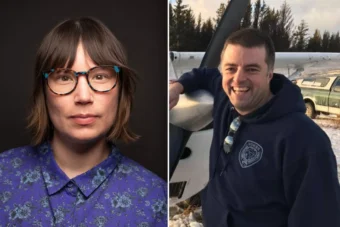
Jenny Irene Miller and Daniel Bunker. (Courtesy Native Movement and the Seldovia Village Tribe)
A Homer pilot and passenger from Anchorage died Monday in a plane crash near the Kenai Peninsula community of Nanwalek, after investigators say a landing attempt was aborted due to a dog on the runway.
The commercial flight operated by Homer-based Smokey Bay Air had been headed from Homer to Nanwalek at the time of the crash, said Clint Johnson, Alaska chief of the National Transportation Safety Board.
“Witnesses on the ground as well as another airplane in trail indicated that while the airplane was on approach to Nanwalek, there was apparently a dog that was on the runway,” Johnson said. “It appears that the pilot initiated a go-around, and during that go-around there was a loss of control.”
Johnson said the Cessna 207 didn’t touch down on the initial approach, and the dog wasn’t struck.
The plane crashed in a tide-line area near the north end of Nanwalek’s runway.
Alaska State Troopers identified the two people killed as pilot Daniel Bunker, 48, and passenger Jenny Irene Miller, 37.
Miller was a well-known Inupiaq artist and photographer originally from Nome, who was also celebrated as a role model and mentor for LGBTQ+ and two-spirit youth. Bunker is survived by his wife and their two sons, and remembered as a kind and skilled pilot.
Another passenger who has not been publicly identified was seriously injured in the crash and was transported to an Anchorage hospital.
Residents respond
The crash happened around 2 p.m. Monday. Troopers reported receiving multiple 911 calls. As they responded by helicopter with an NTSB investigator, many local residents headed to the crash site to help, Johnson said. The first responders included the local school principal and staff, according to the superintendent of the Kenai Peninsula Borough School District, Clayton Holland.
“Our principal and staff were involved with the immediate response to the wreck and we are thankful to them and all the other community members who responded to provide aide,” Holland said in a text message.
The Nanwalek runway photographed in May 2024. (Riley Board/KDLL)
Troopers spokesman Austin McDaniel said residents found the plane on a beach near the runway. The plane wasn’t submerged at the time of the wreck.
“They were able to get one male passenger out of the aircraft, bringing him to the medical clinic where he received medical treatment,” McDaniel said.
Locals tried to provide lifesaving care for Bunker and Miller, McDaniel said, but the two were declared dead at the scene.
Along with troopers and the NTSB, numerous other agencies also responded to the crash, including Guardian Flight, LifeMed, Maritime Helicopters, the U.S. Coast Guard and the Alaska State Park Rangers.
Remembering lives lost
Condolences poured in Tuesday for those impacted by the crash.
Holland, the Kenai Peninsula superintendent, said the crash is a tragedy for the entire Nanwalek community and Homer as well, and offered his thoughts and prayers for all involved.
Nanwalek is roughly 25 miles southwest of Homer and only reachable by boat or plane. It has about 240 residents.
in an online video from earlier this year, pilot Daniel Bunker said he regularly flew to three remote villages, describing it as a rewarding job and a way to connect the residents there to the mainland. Smokey Bay Air ran regular flights to Nanwalek, Port Graham and Seldovia.
“We are deeply saddened by the tragic plane crash involving Smokey Bay Air, and we mourn the loss of Daniel Bunker — a skilled pilot and kind soul who served our communities with dedication,” said an online post from Seldovia Village Tribe.
In a statement, staff and board members with the nonprofit Native Movement mourned Jenny Irene Miller’s sudden passing, describing her as a wonderful friend, a kind human and a true luminary. Miller was a board member at the nonprofit.
“Jenny was such a bright and kind human doing good work for the world, a good friend who always reminded me to be thoughtful of others and caring even when it’s hard to be,” said fellow board member and friend Tikaan Galbreath. “Every time I had the chance to be with her, it felt like the simple joys were more clearly present and laughter was easy to find. I’ll sorely miss her friendship.”
“It was easy to love Jenny,” said Misty Nickoli. “I felt peace in her presence. Which is a hard thing to accomplish in the work and lives that we live. She always made me feel special and beautiful. She always made room for kindness. My heart is with her wife, family and our community.”
A challenging runway
Johnson, with the NTSB, said crews were working Tuesday to recover the plane before waters rose.
“Obviously we want to get it out of there as soon as possible,” Johnson said. “We don’t want to risk losing the wreckage.”
The NTSB plans to transport the plane to Anchorage or Wasilla for a close inspection of the aircraft and its contents, as it continues to investigate what caused the crash.
Johnson said that animals on runways in rural Alaska have been reported to the NTSB before. But, he said, Monday’s incident is the first he can recall in which one has been a potential factor in a fatal crash.
“(In) Bush operations, you do see this,” Johnson said. “And animals, whether it’s a dog or a moose or whatever, obviously that’s going to be a peril that you have to contend with.”
A 1996 Federal Aviation Administration photo shows an overhead view of the curved runway in Nanwalek, which was formerly known as English Bay. (Federal Aviation Administration)
The NTSB has previously visited Nanwalek, which has an 1,850-foot curved runway with frequent high winds.
According to an NTSB report, the same aircraft that crashed Monday had a rough landing there during a Smokey Bay Air flight in August 2016. The pilot and sole occupant, who was unhurt, reported encountering “a pretty rapid shift in the winds in both direction and velocity” just before touchdown. The plane bounced, touched down again, then overran the end of the runway, damaging its propeller and a wing.
Smokey Bay Air could not be reached for comment Tuesday.
The NTSB is asking anyone who witnessed the crash and has not already spoken with investigators to contact them by email at witness@ntsb.gov.
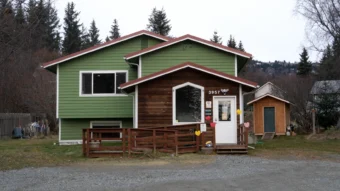
The Kachemak Bay Family Planning Clinic’s administrative and education building on Nov. 12, 2024. (Jamie Diep/KBBI)
Homer Police arrested a man Monday in connection to three shootings at two local nonprofits.
Homer Police Chief Mark Robl said officers found and arrested 30-year-old Josiah Kelly of Anchor Point after a second shooting at Kachemak Bay Family Planning Clinic’s administrative and education building Monday evening. The clinic had also been shot at earlier in the day.
Kachemak Bay Recovery Connection, an organization that supports people recovering from substance use disorder, also had its building shot at in late October.
“Kelly has confessed to us to all three of the shootings,” Robl said. “His motive for doing the shootings is, basically, he said he did those for religious reasons.”
Robl said they believe Kelly acted alone in the shootings. A faith-based crisis pregnancy center in Wasilla was also vandalized last week, but Robl said he doesn’t believe the cases are connected.
Claudia Haines, the family planning clinic’s CEO, told KBBI after the first shooting that someone fired eight rounds into the clinic on Monday morning.
“No one was hurt because it was before the work day began, thankfully. But it’s, it’s terrifying for staff and volunteers,” she said.
Charging documents say Haines told Homer Police after the first shooting that Kelly canceled the clinic’s trash service “due to him not agreeing with family planning.” Kelly is listed as the owner of Rubbish Removed and Recycled in Homer, according to state corporate records.
Paper hearts surround the entrance to Kachemak Bay Family Planning Clinic’s administrative and education building on Nov. 12, 2024. (Jamie Diep/KBBI)
The family planning clinic provides reproductive health services across most of the Kenai Peninsula. In addition to wellness checks and pregnancy tests, the clinic also provides gender-affirming care, contraceptives and testing for sexually transmitted infections.
This isn’t the first time the organization has been targeted. The family planning clinic’s Pride flags were also vandalized last year. Haines said they were already preparing for more attention from the public.
“Reproductive healthcare is a very push button topic right now, despite its access being a universal right,” she said. “So, we were bracing ourselves for something, but we’re so deeply saddened that someone would risk hurting people in order to send this kind of message.”
Willy Dunne is the vice president of Kachemak Bay Recovery Connection’s board of directors. He said the shooting caused a lot of fear in the community, but they’re moving forward.
“This was a setback, for sure, but there’s a really healthy, vibrant recovery community here, and people not only willing, but really anxious, to help folks recover from alcohol and substance use disorders,” Dunne said. “And so we’re really excited to continue moving ahead and developing our facility and developing our programs.”
Kelly is currently being held at the Homer Jail. He was arraigned Tuesday morning at the Homer Courthouse. Kelly was charged with multiple counts of misconduct involving weapons and criminal mischief, which are both felonies. His pre-trial is set for Nov. 22 at the Kenai Courthouse.
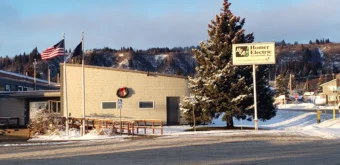
The Homer Electric Association building in Homer on Dec. 21, 2023. (Jamie Diep/KBBI)
The board of Homer Electric Association, or HEA, unanimously approved a purchase contract on Aug. 13 with Renewable IPP, a power producer that’s built several large solar farms in the state.
Jenn Miller is the CEO of Renewable IPP. She said the company is working to give Alaskans energy options beyond natural gas.
“When we started the company, our mission was to not only diversify Alaska’s energy generation mix, but to do it in a way that actually reduces energy costs for Alaskans,” Miller said.
The path to get the project approved is years in the making.
Renewable IPP has been working with HEA to build a solar farm on the Kenai Peninsula since 2021. They previously considered a site in Sterling before settling on the current location. Miller said they expect to finish construction by 2028.
“While folks might say, ‘Man, can’t you move faster?’” she said, “you know, we spent three years working it, and I think without that level of due diligence, you wouldn’t have a project that delivers value on so many fronts like you do with this Puppy Dog Lake Project.”
The Puppy Dog Lake Project in Nikiski would be the largest solar farm in Alaska. Once it’s built, the farm could produce up to 30 megawatts, which is enough to power about 9,000 homes where the average household uses about 550 kilowatt hours a month. Renewable IPP also built the state’s current largest solar farm in Houston, which produces 8.5 megawatts of electricity — less than a third of the power the Nikiski project is expected to.
The purchase agreement comes as Alaska’s railbelt faces a looming shortage of natural gas, with utilities looking for ways to import natural gas.
Since Renewable IPP set its sights on the peninsula, the Kenai Peninsula Borough Assembly also approved property tax exemptions for independent power producers.
The new solar farm would double the amount of renewable energy the region uses from about 12% to 24%, according to HEA. Keriann Baker oversees strategy for the utility, and she said the contract will allow them to purchase electricity for less than what they currently pay for power. But, Baker said the utility continues to support developing natural gas.
“We’d like to see some policies like royalty relief that makes it easier for producers here, because a strong and thriving natural gas environment is healthy for everyone, but at the same time, we also want to protect our members responsibly from the volatility that we’re seeing in the fuel market, and we want to diversify,” she said, “we just don’t want to do it in a way that provides rate shock to our members.”
In addition to solar energy, the board also approved replacing an old, inefficient gas turbine at the power plant in Nikiski. The utility doesn’t expect the replacement to happen until late 2027 or early 2028. Once both projects are online, Baker said they could cut about one sixth of the natural gas currently being used.
Baker said HEA is looking at other renewable energy sources outside of solar to accomplish that at the lowest cost to ratepayers.
“Really it’s anything right now. We’ve talked to tidal groups. We’ve talked to geothermal groups. We’ve talked to nuclear groups. We’ve talked to wind groups. I mean, we really are an all of the above utility,” She said.
HEA currently has an agreement with GeoAlaska, which is collecting data on Augustine Island to see if it’s possible to connect geothermal energy to the peninsula and beyond.
While the project and contract costs aren’t public until both parties finalize paperwork with the Regulatory Commission of Alaska, Miller said they received a $2 million grant from the Alaska Energy Authority that’s bringing down overall costs for ratepayers. They expect to finish the filing in the next couple months.
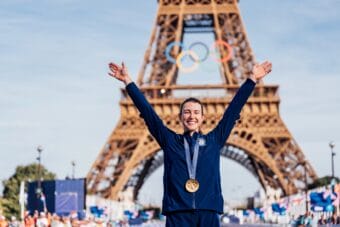
Paris Olympics two-time cycling gold medalist Kristen Faulkner of Homer celebrates at the Eiffel Tower. (Zac Williams/Courtesy of EF Pro Cycling)
Homer’s Kristen Faulkner came out of relative obscurity to win not one, but two gold medals in cycling at the 2024 Paris Summer Olympics.
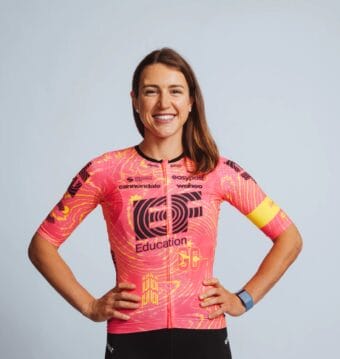
KBBI’s Jamie Diep spoke with Faulkner on Friday about how growing up in Homer shaped her fast-paced journey to the podium.
Editor’s note: The following transcript has been edited for brevity and clarity.
Jamie Diep: You went from gradually making a name for yourself in professional cycling to winning the first American Road Race and Team Pursuit in decades. How has that been for you throughout your time at the Olympics?
Kristen Faulkner: Yeah. You know, each race has been really special in their own way. You know, the first road race I think for the U.S. in 40 years. To be honest, I actually didn’t know that fact until after the race, and I wasn’t really thinking about what’s been done in the past or what hasn’t been done. I was just thinking about, you know, ‘how do I win this race?’ And afterwards, people came up to me and told me, you know, the history of it, and it made it quite special and quite unique.
And the same with the team pursuit, actually. It was the first time the U.S. has ever won gold in Team Pursuit. And so that was really special. I think we, we knew we had a really strong team going in. But we also knew that we had to pull a lot of things together on race day, and we had to really have a perfect race in order to win. So they were each very different races, very different journeys to get there, very different preparation. And the road race was more of an individual event. The team pursuit was more of a team event. And so they felt very different, even though they were both bike races. And so each win is very special in its own way.
Jamie Diep: Let’s talk about the road race. You know, that was an incredible finish. What was going through your mind as you pulled ahead of the pack in those last few miles of the race?
Kristen Faulkner: Well, I knew I needed to attack the group before the finish and go away solo to the finish line. And the reason is that I was not the fastest sprinter in the group. I was probably the weakest sprinter, and so I didn’t want to go to the line, because there were four of us and only three medals. And so I said, ‘If I go to the line with these girls, I’m probably not going to end up with a medal.’ And so I knew that the best moment to attack would be as soon as we caught those front two riders, because that’s when everyone was going to be the most tired. And so I said, ‘Okay, as soon as we catch them, I have to go.’ And it’s kind of a now-or-never moment, you know, I need to attack, and I need to go all in, and I can’t look back. And if it works and I’m going to win, and if it doesn’t work, I‘m gonna get fourth. But those are the cards I had to play. And in road racing, you really have to think on your feet. You have to go all in with your decision, and you can’t second-guess yourself, or won’t work. And so, yeah, I think in those last kilometers, I was like, ‘what is happening?’ But also at the same time, you know, just really focused on on the here and now and doing what I had to do to get across the line. There was no celebrating before the line. I wasn’t convinced I’d won until I was 500 meters from the finish line, and then I kind of knew, but yeah, it was a very calculated move, and I knew that I had to go all in, and I had to do it if I wanted the chance to win.
Jamie Diep: What about the team pursuit? You were a later pick for the event. What was it like winning that race as a team versus the road race, which is an individual event?
Kristen Faulkner: So actually the team pursuit, I’d been selected in June. So I was selected the same as all the other riders. There were five riders selected, four of which ended up racing, and so I knew quite early that I would be on that team. I think it was different, though, because I was the newest rider to the team. So the other three had ridden together at former World Championships. They’d rode together in Tokyo at the Olympics, and so I was the only one on the team who hadn’t ridden an Olympics with the team before. And I was also the only one who never won a medal in the event. And this was my very first year competing with the team. And so in many ways, I was the least experienced, and potentially the weakest one in the group in that way.
And physically, I was strong, but I was the least experienced, and so I guess I was the most unknown in the group. And so I think that race was really special to me, because I think I went into it feeling like, if we don’t get a medal, it might be on me, because, you know, they’re all experienced, and I’m showing up as the least experienced one. And so I felt that I had to really level up my game and really prove myself that I belong there.
So the last year has been such a deep learning trajectory. You know, I’m surrounded by three riders who were all way better than me a year ago, and I really felt that I had to earn my spot on that team. You know, I wasn’t the one who’d earned a medal. I hadn’t been to Tokyo before. And so the last year has been, I don’t want to say like an uphill battle, but that’s really, you know, what it is like, having to earn my cards on that team and to earn the respect of my teammates.
And so when, even though I was selected for the team, I still had a lot that I needed to improve on, and a lot to learn. And so on race day, I felt, you know, we had gold-medal potential, and I really wanted to contribute to the team winning, and I wanted to make sure that they felt confident that they’d selected me for the team, you know. And I had to earn that spot, and I really had to earn that spot. And so when we went into the race, I just said that you know, like, I have to make this the race of my life. I have to fight for my life, and I have to give 100% for my teammates.
Jamie Diep: In the midst of winning these races and doing all of these things. I’m sure it’s been a bit of a whirlwind, but we’re all still human. So after your races, what was the first thing that you ate, both for the road race and the team pursuit?
Kristen Faulkner: Well, actually the first thing that I ate was a cold Coca-Cola after the road race, because I needed the bubbles. You know, it was hot out. I needed the sugar, I needed the hydration. And so actually I crossed the finish line and I was given one Coca Cola, and I finished it right away. And I said, ‘Do you have a second one? I need a second one.’ So I actually had two Coca-Colas, were the first thing that I consumed after I crossed the finish line in the road race.
And then in the team pursuit, when I crossed the finish line, actually the first thing was just my recovery shake. It had, like, it was like a protein shake with a little bit of sugar. But then I also had some gummy bears, because I needed to just, you know, get some sugar in me.
And then when I came home, I think I had a really good dinner with some salmon, and I had a chocolate croissant for dinner, because I’ve been holding off on the chocolate croissant since I got to France. I don’t know how I had the willpower to not have one until then, but yeah, that night, I had a chocolate croissant, and it was absolutely delicious.
Jamie Diep: You’re from Homer, but you didn’t really get a start in cycling until you moved to New York and took all of those classes. So how did growing up in Homer shape you as an athlete?
Kristen Faulkner: It made me really resilient, you know, I think Alaskans are just resilient people. I think the upbringing, as a child in Alaska, you’re just exposed to more things, you know? You, you go to the wilderness, it’s the extreme cold. There’s a lot of independence. And in the culture, I think this kind of element of, you know, modern self-sufficiency in in Alaska, you know. We’re not, we’re not living subsistence in Alaska, but there’s still this element of, you know, it’s still kind of the free land up there, you know, and and so I think there’s this really strong sense of independence in the culture.
I think Alaska made me really tough. It made me feel that whatever I wanted in life, I really had to work for. It taught me to really be independent and have conviction in my own belief. And I wasn’t surrounded by the media growing up, I was, I don’t want to say off the grid, but Alaska as a state is a bit off the grid, you know? And in that sense, I think learning to just trust my gut and be independent and not think too much about what the rest of the world thinks, I think, is a really valuable lesson as a kid.
You know, the other thing is just my parents made me work a lot when I was a kid, (I) work(ed) in the hotel. I was scrubbing toilets as a housekeeper for a long time. I worked in landscaping. I was a busser in the restaurant. And so, you know, learning the value of hard work as a kid as well. So those are all really important things.
And you know, I think one of the most underrated things also is the sense of community. So when you, when you grow up in a really small town, you have teachers as your neighbors and everyone kind of knows each other and watches out for each other. And that’s something that I didn’t realize how much I needed and how much I valued for the first half of my life. And then when I moved to New York City, I realized it was such a big place and there were so many people, and I really missed that small-town feel. And that’s when I realized that if I wanted that, I really had to cultivate it. And part of the reason why I joined a cycling team is I really wanted that kind of team camaraderie, that community feel that I had in college sports and that I had growing up in Homer.
And when the Olympics came around, I had so many friends and family that came over to support me, and it just made me realize just how much of a huge deal it is when you, when you have people around you that have known you for so long, seen you struggle. Have seen you work hard? Have seen you when you fell, when you got back up. And I think having that community support me my whole life, hearing them cheer for me from when I went to Paris, and having babysitters and friends wearing T-shirts and said, ‘Go Kristen.’ You know that just meant so much to me, and really gave me a lot of strength, and made me realize that they really believed in me, but also they would be there for me no matter what happened, and no matter whether I earned a medal or not, and I think that really meant a lot to me.
And yeah, that sense of community is something I hope Homer never lets go of, and I hope it continues to cultivate, because it makes a big difference in people’s lives like me.
Jamie Diep: Finally, what’s next for you on and off the race course? Are there plans to return the Homer? I know that our mayor, Ken Castner, has mentioned holding a bike parade to celebrate your win.
Kristen Faulkner: Yeah, I actually have the Tour de France that starts in three days. So on the bike. That’s my next big goal, very soon with my EF-Oatly-Cannondale teammates. And so I’m really excited for that. It’ll be an eight-day stage race. It starts in Rotterdam, and then it kind of goes all the way through the east coast of France, all the way south. So that’s my first on-the-bike goal.
And then my kind of off-the-bike plans, I’m actually going to spend Christmas in Alaska this (December), so I will be returning home. And I just want to give a big hug to everyone who supported me, everyone who cheered for me, everyone who had ‘Go Kristen’ shirts, everyone who didn’t, you know, everyone who just has been there to support me this whole time. You know, I had people who I swam with as a little kid that were posting about what it was like to swim with me, and they were cheering me on and wishing me good luck. And I just want to give all those people a really big hug and tell them thank you, because they gave me so much support and strength when I needed it, and I think it made a big difference.
Jamie Diep: Thank you so much.
Kristen Faulkner: Okay, thank you. I appreciate it.
Kristen Faulkner, 31, won this year’s Elite Women’s Road Race in West Virginia. She finished the 127-kilometer race in under three and a half hours, beating the next racer by almost a minute.
While she says she competed in sports her entire life, the Homer athlete began her cycling journey seven years ago in New York. Faulkner worked in the finance industry at the time and went to an introductory cycling clinic in Central Park.
“New York City’s this concrete jungle, and so my time in Central Park was really kind of my ‘me time’ every day to feel like I was in as much nature as I could get in Manhattan,” she said.
The next year, she moved to California and got more serious about cycling. After doing her first road race in Europe, Faulkner says she got hooked on professional racing and switched to competing full time.
“When I started cycling, I was working at a desk job, and I thought, you know, I could work a desk job for the next decade, or I could ride my bike outside for the next decade,” she said, “and I think being from Alaska and having such a passion for the outdoors, it was clear to me which one I really loved a lot more,” she said.
She now lives in Girona, Spain, which she says is the epicenter for cyclists.
At the end of last year, Faulkner joined EF Education-Cannondale, an American women’s professional cycling team. The team made a splash earlier this month by placing third overall at La Vuelta Femenina in Spain — one of three grand tours held each year for women. This year’s Vuelta is more than 880 kilometers and is split up into eight races, or stages.
Faulkner won the fourth stage. She says doing well at the Vuelta was especially important for her after getting hit by a car led her to develop a blood clot in her lung last year.
“I had to take three months off of riding, and I wasn’t sure how it’s going to come back,” she said, “and so to come back healthy and strong and be competing against, you know, the best in the world, and winning was a really exciting thing for me to have happen.”
Faulkner eventually began training indoors and even won a race at the end of the last season. She began this season becoming comfortable with racing again. Faulkner says recovering from the injury became more of a psychological journey than a physical one.
“I think emotionally, it was really hard for me to kind of trust cycling again, and trust that I could be safe and to really let myself go all out on these climbs, and especially on the distance,” she said.
As a national champion, Faulkner will be one of two athletes who can compete in road racing wearing a jersey with an American flag design for the next year. In addition to road racing, Faulkner is also one of nine athletes being considered for the U.S Olympic squad for women’s team pursuit — an indoor cycling event where teams of four race against each other on a track.
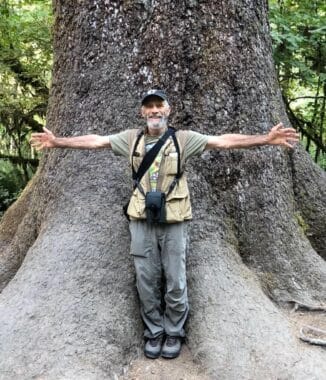
Dale Chorman posing in front of a tree. (Courtesy Dale Chorman’s family)
A Homer man died Sunday morning after being attacked by a moose.
According to an online dispatch posted by Alaska State Troopers, a cow moose charged at 70-year-old Dale Chorman and another person.
Journalist and writer Tom Kizzia was asked by Chorman’s family to speak on their behalf. He said Chorman and his friend were looking at newborn moose calves on Chorman’s property located east of Homer near Fernwood Drive when the moose charged at them.
“They were going down to see how close they could get to see if they could get any pictures of these newborn twins, but it was really thick, real dense part of the woods,” Kizzia said, “it was thick alder and elderberry, like we know around here, and suddenly out of nowhere, that moose was coming at them. They hadn’t seen it.”
Medics declared Chorman dead after arriving at the scene. Troopers say the moose has left the area. As of Sunday, troopers are still investigating the incident and the exact cause of death.
According to the Alaska Department of Fish and Game, cow moose with calves tend to be aggressive in late spring and summer. The department recommends running behind a solid object like a tree if a moose charges at you.
Close
Update notification options
Subscribe to notifications
Subscribe
Get notifications about news related to the topics you care about. You can unsubscribe anytime.