Oceans

A pup rescued near Sitka is Alaska SeaLife Center’s first fur seal patient in 6 years

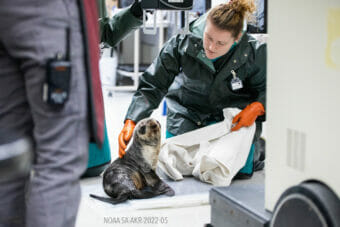
The Alaska SeaLife Center admitted a northern fur seal pup to the Wildlife Response Program on Jan. 31, 2023. (Courtesy Kaiti Grant/ASLC)

The Alaska SeaLife Center admitted a northern fur seal pup to its rehabilitation facility last week. It’s the Seward center’s first fur seal patient since 2017.

The female seal pup — estimated to be around six months old — was seen swimming erratically near the shore in Sitka last month, according to a press release from the center. Worried Sitka residents then reported the pup to the center’s 24-hour stranding hotline.

The female seal pup — estimated to be around six months old — was seen swimming “erratically” near the shore in Sitka last month. (Courtesy Kaiti Grant/ASLC)

Sitka is an unusual location to see northern fur seals this time of year, which the center said raised concerns for her survival by center staff. Northern fur seals typically breed much further northwest, in the Bering Sea and North Pacific Ocean.

Center staff got permission from NOAA and transported her to their facility for treatment. The center — also a public aquarium and research facility — is the only rescue and rehabilitation facility for marine mammals in the state.

Upon admission, the veterinary team discovered the pup was dehydrated and malnourished, with signs of an unknown infection in her bloodwork. She also seemed smaller than average for her age.

Staff are currently providing initial treatments and examining the pup further to understand more details about her condition.

If you see an injured or stranded marine animal, you can call the 24-hour Stranded Marine Animal Hotline at 1-888-774-SEAL.

NOAA denies emergency request to close red king crab savings areas

""
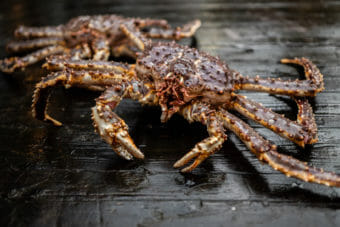
The red king crab savings area was established in 1996 and is permanently closed to bottom trawling, but it remains open to midwater — or pelagic — trawlers, pot fishing and longlining. (Bri Dwyer/Alaska Bering Sea Crabbers)

The National Oceanic and Atmospheric Administration has denied an emergency request Friday to close crucial habitat for Bristol Bay red king crab to all types of commercial fishing.

That comes after Alaska Bering Sea Crabbers petitioned in late September for a closure of the red king crab savings areas to protect the species during a time of historically low stocks.

The nonprofit, which represents independent crab harvesters, requested that the grounds be closed to all fishing gears from Jan. 1, 2023 through the end of June.

The Bristol Bay red king crab fishery has been closed to fishing for two years due to low population. Biologists have seen declines in recruitment and stocks for more than a decade. It’s not abundantly clear what is causing the crash, but some theories suggest climate change and warming ocean conditions may be in part to blame.

The savings area was established in 1996 and is permanently closed to bottom trawling, but it remains open to midwater — or pelagic — trawlers, pot fishing and longlining. Bottom trawling is allowed, however, in a small section within the savings area — known as the savings subarea — when Bristol Bay red king crab is not open to directed fishing.

Jamie Goen is the executive director of Alaska Bering Sea Crabbers. In a letter addressed to the North Pacific Fishery Management Council in December, she argued that pelagic trawling — or midwater trawling — has similar impacts to the sea floor as bottom trawling. She urged council members to consider closing the king crab savings areas for roughly 180 days of the year, when crab stocks are most vulnerable.

While the council said that the closure “could provide habitat benefits through reduced bottom contact by trawl gear and potentially reduce Bristol Bay red king crab mortality,” they argue those effects are uncertain and rely on assumptions that the closure would move fleets into areas with lesser impact to crab stocks. The council also said a provided analysis shows that the closure could negatively affect other species, like salmon and halibut.

Ultimately, despite Goen’s and about 25 other comments, the agency chose not to recommend the proposed emergency action.

And on Jan. 20, NOAA Fisheries announced that they had denied the petition and would not close the savings areas. Their reasoning: the emergency regulations wouldn’t address the low stocks or declining trends of mature female crab. They said taking emergency action and changing the rulemaking process isn’t worth it.

According to Alaska Bering Sea Crabbers, harvesters are “dismayed and deeply disappointed that NOAA Fisheries denied protections for dwindling crab stocks on the same day they opened pollock fisheries with increased harvest limits.”

The council is considering alternatives to the emergency action, including implementing an annual closure of the savings area and subareas to all commercial groundfish fishing gears through a normal rulemaking process — that would not include non-pelagic trawling.

NOAA is working to facilitate quick relief funding for various fishery disasters, including the most recent king crab and Bering Sea snow crab closures.

Historically, that kind of funding has taken years to reach the hands of fishermen.

Gov. Mike Dunleavy estimated a loss of more than $287 million to the red king crab and Bering Sea snow crab fisheries over the last two years.

Southeast Alaska’s porpoises have separate populations, and one may be vulnerable

A harbor porpoise swims in Alaska waters on July 7, 2016. DNA analysis and other information shows that Southeast Alaska’s porpoises have separate populations, and the more southern population appears to be more vulnerable to bycatch. (Photo provided by National Oceanic and Atmospheric Administration/Alaska Fisheries Science Center)

There are at least two distinct populations of harbor porpoises in Southeast Alaska waters, and one of them appears to be particularly vulnerable to deaths from entanglements in commercial fishing gear, according to newly released information from National Oceanic and Atmospheric Administration scientists.

The breakdown of Southeast Alaska’s porpoises into separate northern and southern populations contrasts with current management, which treats the region’s porpoises as a single population.

The more precise population definition, which is based on DNA analysis and other information, could affect management of Southeast Alaska’s commercial gillnet salmon fisheries.

At issue, said Alex Zerbini, lead author of both the NOAA report on genetics and related information and a recent study on population size, is bycatch: the accidental drownings of porpoises tangled in fishing nets.

“Either they’re going for the fish or sometimes they’re just traveling, and they can’t see the nets,” said Zerbini, who is with NOAA’s Alaska Fisheries Science Center and the University of Washington. “They hit the nets and they die.”

NOAA manages porpoises under the Marine Mammal Protection Act, and human activities like fishing are regulated according to that act’s conservation requirements.

The northern population, estimated at 1,619 animals swimming in Glacier Bay, Icy Strait and Cross Sound, appears to be resilient to current levels of bycatch, a term describing when fishers catch species other than those they’re targeting. But the southern population, swimming around Zarembo Island and Wrangell and estimated at 890 animals, might be already subjected to more bycatch than it can absorb.

The study by Zerbini and his colleagues, published in the journal Frontiers in Marine Science, quantified population estimates and “potential biological removal,” or the levels of bycatch deaths that each group could withstand. That came out to losses of 12 animals a year for the northern population and 6.1 animals a year for the southern population.

Current bycatch-caused deaths for the southern population were calculated at 7.4 animals per year, beyond the danger threshold. The estimated losses happening in the northern population, however, came out to only 5.6 animals a year, below that threshold.

A harbor porpoise swims in the Glacier Bay. The porpoises here and in other areas of northern Southeast Alaska were found to be genetically distinct from porpoises in more southern parts of the region. Porpoise numbers in northern Southeast Alaska have also bee more steady. (Photo provided by the National Park Service)

Exactly how much bycatch of porpoises is currently happening is unclear. A five-year NOAA report released in August documented only two cases from 2016 to 2020.

However, documented reports could miss actual cases. The gillnet harvests are not monitored through any mandatory observer program. A pilot program conducted by NOAA in 2012 and 2013, the Alaska Marine Mammal Observer Program, was able to monitor numerous interactions between the fleet and porpoises.

It’s possible that fishing crews do not even see dead porpoises caught in nets, Zerbini said.

The idea is that the porpoises in northern and southern waters of Southeast Alaska emerged from varying population trends, he said. If it were a single population, the trends would be similar, he said.

DNA analysis to confirm the difference was difficult. Typically, DNA analysis of marine mammals is done through analysis of tissue samples. But porpoises are so elusive that scientists turned to “environmental DNA” — samples of water into which the porpoises are frequently shedding small bits of skin, Zerbini said.

Meanwhile, there appears to be a third, completely different population of porpoises swimming in the outer waters around Yakutat. Much less is known about those animals, Zerbini said. “It is very likely that there are multiple different stocks within that unit, but we just don’t have the data to demonstrate that,” he said.

The emerging demographic pattern for Southeast Alaska fits with demographic patterns for porpoise elsewhere, where populations tend to range in small areas, he said. There are multiple defined population stocks in waters off California, for example.

Any formal determination separating northern and southern Southeast Alaska porpoise population stocks would be done through NOAA’s stock assessment review process. A draft assessment is pending, and there will be a public comment period before any final assessment is released, said Maggie Mooney-Seus of NOAA’s Alaska Fisheries Science Center.

This story originally appeared in the Alaska Beacon and is republished here with permission.

Maine lobster industry wins reprieve but environmentalists say whales will die

A man carrying a black tote off a docked lobster boat named Lil More Tail
The lobster fishing industry in Maine caught more than 100 million pounds of the crustaceans in 2021 valued at more than $725 million. (Kevin Miller)

PORTLAND, Maine — Lobsterman Curt Brown had already logged a full day on the water by the time he pulled up to a fishing wharf just blocks from downtown Portland restaurants bustling with lunchtime diners.

The 250 to 300 pounds of lobster he had hauled up from the cold Maine waters could land on a plate just up the street — or in a restaurant on the other side of the globe. And on this chilly December day, Brown was feeling more hopeful about the prospects for Maine’s iconic lobster industry.

“I think our industry, for the first time in a long time, can see a ray of sunshine and feel optimistic that the hard work we have been doing is being recognized,” Brown said.

Just a day earlier, the lobster industry had received welcome news in the fishery’s years-long battle with environmental groups over protections for the endangered North Atlantic right whale.

The state’s congressional delegation — which has locked arms with Maine’s billion-dollar lobster industry — had pulled off a procedural end-run by inserting a 6-year delay on new federal fishing regulations into a $1.7 trillion spending bill.

For Maine’s 5,000 licensed commercial lobstermen, it meant a reprieve from rules that they warned could destroy their industry — and decimate coastal communities — by forcing them off the water in some areas for months at a time and eliminating the vertical lines of rope connecting a string of traps on the bottom to a buoy on the surface. Those lines can become wrapped around whales’ fins or lodged in their mouths. But “ropeless” fishing gear, which relies on technology to allow fishermen to call a trap up to the surface, is still in development and is not available on a wide scale commercially.

“If you take away three months, four months, five months of the ability to go out and harvest lobster, you are not only going to impact harvesters,” Brown said. “You are going to impact many, many other businesses as well.”

a man in a hoodie and coveralls gesturing with gloved hands
Curt Brown contends the lobster industry already has adopted safer fishing methods to protect right whales. (Kevin Miller)

Conservation groups fighting to save the North Atlantic right whale, meanwhile, predicted the delay could put the endangered whale on an irreversible slide toward extinction.

“Is there a chance that we can save the right whale in 2028? Yeah, sure,” said Brett Hartl of the Center for Biological Diversity. “It maybe was a 50-50 proposition before. Now it’s like 95 percent to 5 percent against.”

Right whales are in danger

Slow-moving and measuring up to 50 feet long, North Atlantic right whales were hunted nearly to extinction more than a century ago. There are just 340 left in the world and biologists say their biggest threats are collisions with ships and entanglement in fishing rope. The migratory whales’ territory stretches the entire Atlantic coastline, from their calving grounds along the Florida and Georgia coast to their foraging grounds off of New England and the Canada.

Groups such as the Center for Biological Diversity and the Conservation Law Foundation have used the Endangered Species Act and the Marine Mammals Protection Act to force federal regulators to impose stricter regulations on the fishing industry.

But there has never been a right whale mortality tied to the Maine lobster fishery and no injuries traced back to the industry since 2004.

Environmentalists contend that’s because it’s often impossible to trace rope wrapped around a whale to a specific fishery. But Maine’s political leaders said it is evidence that those involved in the state’s lobster fishery are good stewards.

“In the 25 years that I’ve been privileged to represent Maine in the United States Senate, I have never seen a worse case of regulatory overreach to address a problem and blame an industry that is not at all responsible for a problem,” said Maine Sen. Susan Collins, a Republican.

The lobster industry was the second-largest fishery in the United States in 2019 in terms of economic value, according to the most recent federal data. Maine lobstermen hauled in more than 100 million pounds of the crustaceans in 2021 valued at more than $725 million.

Politicians support the lobster industry

Maine’s Democratic, Republican and independent political leaders have united behind an industry that contributes more than $1.5 billion to the state’s economy when factoring in jobs within the fishing industry, restaurant or food sales and lobster-related tourism. In addition to delaying any new regulations, the budget bill passed by Congress contains millions of dollars to research how often right whales are entering prime lobstering grounds in the Gulf of Maine and to speed up development of ropeless lobster gear.

“It merely pauses that economic death sentence until we have time to know how to navigate the solution and what the real definition of the problem is,” said Sen. Angus King, an independent.

But Erica Fuller, senior attorney with the Boston-based Conservation Law Foundation, said after the delay was announced that members of Congress who voted for it had “the blood of a magnificent endangered species on their hands.

“The science is clear: Humans are killing right whales faster than they can reproduce, and entanglement in lobster gear is a leading cause,” Fuller said.

While the National Oceanic and Atmospheric Administration lists entanglement in fishing gear as a primary cause of mortality and injury among right whales, there has never been a death traced back to the Maine lobster industry and only one documented injury from lobster gear since 2004.

But conservationists and scientists point out that injuries and deaths often can’t be traced to any particular fishery.

According to NOAA statistics, of the 34 North Atlantic right whales known to have died between 2017 and 2022, nine were attributed to entanglements in fishing gear, 11 to collisions with ships and 14 were of unknown origin.

Back on the Portland waterfront, lobsterman Curt Brown contends that his industry has done more to protect whales by switching to break-away rope, sinking rope and more traps per line. Brown, who is also a marine biologist for a lobster retailer, added that he’s never seen a right whale during his 30 years of lobstering.

“We are the largest fixed-gear fishery on the East Coast,” Brown said. “If we were entangling right whales, we would know. Someone would be seeing it and it would be documented. And we’re just not seeing it.”

Copyright 2023 MPR News. To see more, visit MPR News.

Hilcorp is sole bidder in controversial Cook Inlet lease sale

Industry watchers say the lukewarm response to the hotly contested sale points to a long-term trend of low interest in the inlet’s federal waters. (Photo by Sabine Poux/KDLL)

After months of back and forth over a high-profile oil and gas lease sale in Cook Inlet, just one company placed bids last week.

Hilcorp Alaska was the sole bidder in the Dec. 30 federal sale, bidding $63,983 on one tract in Lower Cook Inlet. The 2,304-acre tract is a small sliver of the nearly 1 million acres the Department of the Interior put up for bid.

Economist Roger Marks has been watching Cook Inlet’s oil and gas industry for decades and said he’s not surprised. He said there’s always been lethargic interest from companies in that part of the inlet.

“This was the market speaking,” he said. “And the market is pretty knowledgeable. And I think it just indicates that the federal outer continental shelf is just a poor place to think about developing oil and gas because of the geology.”

Friday’s announcement rounded out a long saga of cancellations and rescheduling for the hotly contested sale. Ultimately, the sale was written into federal law in the Inflation Reduction Act and squeezed in just before the clock wound down on 2022.

The tract Hilcorp bought is not far from Chinitna Bay in Lower Cook Inlet. It doesn’t border existing Hilcorp properties, and it’s unclear what the company wants with the tract. Hilcorp would not answer specific questions about the sale.

A statement provided by company spokesperson Luke Miller said, “Hilcorp is proud of our work to revitalize Cook Inlet natural gas production – an energy source that nearly two-thirds of Alaskans depend on to heat and power their homes and businesses. We look forward to continuing to responsibly produce Alaskan oil and natural gas, create Alaskan jobs and contribute to the state’s economy for decades to come.”

Oil and gas companies play their cards close to their chests, so it’s hard to know what they’re finding when they look for gas in places like Cook Inlet.

But Marks said the long-time lack of interest — even back in Cook Inlet’s heyday — shows that the geology of the area is probably just not good.

“All the production that’s ever occurred in Cook Inlet going back to the 1950s has been on state acreage,” he said. “So the geology on state acreage is good. Just under federal acreage, not good.”

Hilcorp was the sole bidder in a state sale last week, where it picked up six leases in the upper part of the inlet totaling 22,783 acres.

Sue Mauger is executive director of Cook Inletkeeper, one of the environmental groups that sued the feds over the sale last month based on what they said was an incomplete environmental review process.

She called the federal sale a flop and said the lack of new industry interest in federal and state sales both shows there are environmental and economic reasons to not hold auctions there. She said that’s a good thing for Alaska.

“We have a win in that we won’t have new emissions coming out of Cook Inlet with new development,” she said. “However, we have to figure out what the future is for heating our homes. And so the financial resources we’ve spent as a country and a state can now be clearly shifted to solving the problem with non-fossil fuel options.”

Hilcorp provides Southcentral with most of its natural gas supply, used to heat homes and generate electricity. Last year, it warned its buyers it might not have the supply to renew their contracts into the future.

Mauger said the plaintiffs are continuing with the suit and that they’ll keep asking the Biden Administration not to go forward with awarding the lease to Hilcorp. The feds have a 90-day evaluation process before they formally award a lease. Long-term, Mauger said they hope that the feds don’t hold any more lease sales in the inlet.

Environmental groups sue over Cook Inlet oil and gas sale

Cook Inlet oil platforms are visible from shore near Kenai, Alaska. (Photo by Rashah McChesney/Alaska’s Energy Desk)

Environmental groups are suing the federal government over next week’s federal lease sale in Cook Inlet, alleging the environmental analysis on the sale was incomplete and did not consider less harmful alternatives.

The long-anticipated federal sale will put up for bid nearly one million acres and was previously canceled, due to lack of industry interest. This time, it’s required in federal law, part of the 2022 Inflation Reduction Act.

Sue Mauger is executive director of Cook Inletkeeper, one of the plaintiffs in the suit. She said the environmental review process was hurried to comply with the end-of-the-year deadline.

“Just because they were rushed to get this done, that does not allow them to skip steps,” Mauger said. “And they clearly have.”

She said the Interior Department failed to consider alternatives that could lessen the impacts of oil and gas development on wildlife — like auctioning off a smaller area of the inlet, for example. And she said the process does not take into account the requirements of the National Environmental Policy Act, or NEPA, which sets the ground rules for environmental regulations

“We ultimately want no oil spills,” Mauger said. “We want minimal, if any, impacts to our whales and sea otters and fisheries.”

It’s unclear what would happen to leaseholders if a judge were to make a ruling on the case after the sale takes place.

Mauger said the plaintiffs hope oil and gas companies take the suit into account before they bid. And she said it’s important to let the federal Bureau of Ocean Energy Management know that it has to follow a more rigorous environmental review before it holds a sale like this one and another one in the Gulf of Mexico.

“Our hope is, first of all, that no one bids on Dec. 30,” she said. “And the second option is for BOEM to realize that they rushed through a lot of things and haven’t addressed a great many concerns, and that they go back and actually come up with a more reasonable environmental impact statement.”

The Department of the Interior declined to comment on the suit.

There’s no guarantee oil and gas companies will place bids in next week’s sale. Oil and gas company Hilcorp has been the only company to bid on federal leases in recent years. The company recently announced it was rethinking its natural gas contracts amid uncertain supply.

Currently, another lease sale is taking place in the state waters of Cook Inlet. That sale includes 2.8 million acres both on- and offshore from Wasilla to Anchor Point.

Site notifications
Update notification options
Subscribe to notifications