Oceans

3 Alaska trollers contemplate a summer without chinook

Sitka troller Eric Jordan helped found the Alaska Marine Conservation Council, and was on the board of directors of the Sitka Conservation Society for 20 years. (Courtesy Bethany Goodrich/Sitka Conservation Society)

Barring a stay, or a successful appeal, or other eleventh-hour legal action, there will be no troll fishery for king salmon in Southeast Alaska either this summer or winter.

The fisheries have been canceled by order of the U.S. District Court of Western Washington on largely procedural grounds. According to the ruling they stem from a violation of the Endangered Species Act, and the failure of the National Marine Fisheries Service to fully address the impact of Alaska’s king salmon trollers on an endangered population of orcas in Puget Sound called Southern Resident killer whales.

No other salmon species or commercial gear group or sport fishery – anywhere on the entire Pacific Northwest coast – is affected by the order, just commercial trolling for king salmon in Southeast Alaska.
Heading out every July 1 in search of Alaska’s most valuable salmon – also called chinook – has been an annual ritual across the region since before statehood.

Shortly after the court order came down, KCAW’s Robert Woolsey met with trollers Eric Jordan, Jacquie Foss, and Jim Moore to discuss what no king salmon season will mean for them, personally and professionally. This is their conversation, in three parts.

Part 1: The practical implications of a summer without Chinook

Foss: The cost of a boat exists whether or not the king salmon fishery happens or not. You have to pull it out of the water, you have to maintain your zincs. There’s work that you have to have just to make sure your boat stays fishing. And so that’s still happening for us. How we’re gonna pay for it is less certain.

Moore: I’m confident that we’re going to have a season. I’m confident that the king salmon season is going to open July 1st. I feel that we have so much support. Our congressional delegation is working behind the scenes. The State of Alaska is throwing its full weight into the fight. The Alaska Trollers Association are [intervenors and] co-defendants with the National Marine Fisheries Service and the State of Alaska. And everybody’s working pretty hard to make sure that we’re out on the water this summer. I don’t know exactly how it’s going to happen. It’s a legal court case. And so different parties hold their cards close. But I’m confident we’re gonna go ahead. So I’m planning on going ahead.

Foss: I always appreciate sitting next to Jim and his optimism, because I don’t always go there. The decision last week (May 3, 2023) was a gut punch. And fishing is how I can afford to raise my family in Sitka. So it’s really affected me in sort of a more existential way: Who are we if we’re not fishermen? Who are we if we’re not catching king salmon on our boat?

Jordan: It’s already affected boat values. I just had a survey on my boat, on what I would say as a very optimistic estimate. Even though I’ve made improvements since the last survey, [my boat] has lost about 20% of its value. Right away. People can’t sell their boats. I spent a whole week before this latest [court] decision preparing to sell gear at the Fisherman’s Flea Market because I’m getting ready to retire and I have thousands of dollars of really good surplus gear that’s basically worthless right now, except for the chum troll and coho gear. But thousands of dollars of king salmon plugs and spoons are just basically worthless.

Emotionally, I have to call my crew and tell them the situation. Some of them just love fishing king salmon. We do really well chum trolling, and Jim [Moore] and I helped pioneer that, but I’ve had crew members cry when I’ve told them that we’re gonna go chum fishing instead of king salmon fishing.

Foss: You know, it’s more of a spiritual problem than a financial one. Because fishermen are scrappy people. We will always figure out how to make expenses somehow. It’s just…we’d be broken in some way doing that, if that makes sense?

You know, not catching king salmon has a huge, huge impact to our financial bottom line: 40% of our income. And so there’s the argument, “Well, you can find the other 40%.” That 40% allows us to make the other 60%. So it’s not like you can just make up that amount of income somewhere else on the water or in some other fishery. It’s really holistic.

Jordan: There’s a miraculous, wondrous thing about catching king salmon and pursuing them all over the coast, from Dixon Entrance – like Jim’s fished – from Forrester Island to Cape Suckling. And the chum troll fishing is not going to save us. It’s gonna help.

Moore: Having fished a long time, I’ve seen a lot of changes in the fishery. And I have to say that when I bought my first boat, people said, “There’s no future in it. It’s over. It’s had its heyday and it’s going down.” But I’ve seen this cycle of boom and bust, optimism and pessimism several times. And that’s one reason why, you know, if we’re looking at grief over this court case, I’m in the first stage: denial.


Part 2: The importance of king salmon to the identity of trollers

Jacquie Foss trolls with her family aboard the Axel. Fishing for kings is a core part of her family’s identity. (Erin McKinstry/KCAW)

Jim Moore bought his troller in 1970. This summer will mark his fifty-third year as a professional salmon fisherman. Eric Jordan wasn’t born on a troller, but when he was still an infant, his parents rigged a bunk for him in the cabin of their boat, a 32-foot double-ender named “Salty,”  and he could watch them fish for king salmon through a porthole. Having fished every year since, Jordan is about to turn 73 years old.

Jacquie Foss doesn’t yet have that kind of seniority, but she might one day. She and her husband fish as a family, with their 8- and 10-year old children on board.

These three Sitka-based trollers are typical of the Southeast Alaska fleet: They have exceptional longevity in a difficult profession, and a multi-generational investment in their businesses.

Foss: Every year the fish – it’s exactly the same and nothing alike. You’re in the water, you’re dragging hooks. But are they going to hit the herring this year? Or is it going to be this spoon? Or is it gonna be the spoon that you have buried in there that worked 10 years ago that might work now? It’s about the puzzle. And it’s about the fact that our entire year really starts July 1. That’s our New Year: our whole life is centered around that July 1 opener.

Moore: I’m just so blessed to have found a livelihood doing something so interesting and creative. Every single day is different. And it presents a whole new set of problems to solve. “You know, I think I’ll try that green thing that I used 15 years ago,” and then have them hit it – that’s a tremendous feeling: success.

Foss: And it’s just this anticipation and joy, and just the puzzle of king salmon, because they could be where they’ve always been, they could not be there, you could have a 10-fish day, you could have a 300-fish day. That’s 300-fish day is a feat. One hundred is a lot –  just your arms are tired, but you’re not tired. It’s hard to come up with the words.

Jordan: What I said in my deposition on this Wild Fish Conservancy suit: because we handle each fish individually, our connection with them is strong. And we care about them, we respect them. And that comes from my friend Amy Gulick’s book captures, The Salmon Way in Alaska from the Indigenous origins thousands of years ago, right to the present. We honored these creatures, and in trolling, especially those that offer themselves to us, for us to sustain our bodies with the finest food on Earth. But we also sustain them by fighting to protect their spawning grounds, their passageways, their lives. And that’s what breaks our heart because we are fighting for them. And now we’re being excluded from their harvest.

Foss: It’s hard to not develop a connection, when you are intimately involved with ending a creature’s life. And it’s not something that anyone takes lightly. And you’re right… you’re right there. And it’s not easy, but it’s good. Because you know that you’re taking care of the creature quickly, as painlessly as you can. If you’re going to take life and you’re going to extract a resource and you’re going to eat meat, it’s really important to do that as respectfully to the creature that you’re taking it from as possible.

Jordan: Let me tell you, there’s a lot of grief in the troll fleet. A lot of grief, and families and people need help. So not only do we have to think about making financial arrangements so people can make or delay their payments with the state or CFAB [Alaska Commercial Fishing and Agriculture Bank] or whoever else. Banks. We also need to think about mental health counseling for people who are devastated and don’t know how they’re going to feed their families – literally.

Moore: You know, I’m proud of the product that we produce. This whole battle, this court battle with Wild Fish Conservancy trying to shut down a food-producing industry, without considering: there’s 300 million people right now – not killer whales – 300 million people are starving to death. There are 2 billion people that are “food insecure,” as they say. And I just feel sick about all of the energy being spent, all the resources being spent, just to try to be able to continue to produce food for people.

Part 3: Trollers and conservation

Jim Moore slips by Point Amelia in his troller Aljac. (Courtesy Eric Jordan)

In a state where fish landings are most often measured in the millions of pounds and millions of fish, the Southeast Alaska troll catch of king salmon is a small fraction of the overall harvest. This coming season – if there is a season – Southeast trollers will take just 149,000 chinook salmon.

Those fish are mixed into a salmon pie that is shared by Alaska, Washington, Oregon, and Canada – a pie that is sliced by an international agreement called the Pacific Salmon Treaty. Over the past couple of decades, Southeast trollers have accepted smaller slices of the pie to preserve the health of salmon stocks covered by the treaty, and they’ve even accepted deep cuts in the harvest of kings which originate in Alaska’s rivers – and aren’t subject to the treaty – to make sure that those stocks thrive.

In short, Southeast trollers have nothing to gain and everything to lose if king salmon don’t survive. They are conservationists, whether or not they use the label.

Foss: I want to make it very clear that trolling is (a) 100-year old fishery, and if it was not sustainable for a long period of time, it would be evident. And I have not ever seen another resource extraction group begrudgingly-but-willingly not go fishing to ensure the longevity of the species. Is that the right thing to do? Absolutely. When it became apparent that we were going to take a hit on king salmon in the last (Pacific Salmon) Treaty cycle for political and conservation purposes, we could weather it because the emphasis is making sure there’s fish in the future.

Jordan: Trollers have been the allies of conservationists for decades. Salmon fishermen all over this state fight things like Pebble Mine, things like the borax mine in Misty Fjords. Trollers have worked to protect the salmon habitat throughout the region from mines in British Columbia. I’ve written op-ed editorials on those mines, working with Salmon State and others. We are the greatest allies of people who want to conserve king salmon and other salmon species. And for us to be vilified and attacked is just plain wrong.

Foss: It’s really easy to look at a problem and decide that someone else should pay for it. It’s really, really hard to look internally to see what you’re doing and how you’re contributing to that problem. And I really feel like that’s what’s happening here [with the Wild Fish Conservancy lawsuit].

Moore: This fishery is the poster child for sustainability. There’s never been – that I know of – any run of salmon that’s been wiped out by a hook-and-line fishery. When I first started fishing, there was the criticism that it’s too inefficient. Well, we’re not hearing that much anymore (laughs). But anyway, we’re hearing these narratives that are just outright lies. Like “the increase in greedy corporate fishing.” My kids grew up on the back deck of the boat, you know, this is “greedy corporate fishing,” you know. They learned that they could work hard and produce something tangible. And your success depends on being able to understand and connect with something you can’t see directly. From that standpoint, it’s like science. I can’t decide whether it’s more like art or like science. It’s both.

Jordan: And one of the things that happens, as both Jim and Jacquie have mentioned, is the connection you develop with these places, the ocean, the ecology, the fish that you’re pursuing. It’s really a love affair.

Foss: You just love it. You love everything about it.

Moore: You know, I love the killer whale. I’m connected with the killer whale. This is not about saving the killer whale, this battle. It’s about destroying this industry. That’s the stated agenda: the Wild Fish Conservancy, they want to eliminate ocean fishing, mixed-stock fishing, and they want to eliminate the hatchery program. That’s a small minority viewpoint – a very small minority viewpoint. They had an opportunity to move their agenda, and they took it. But it’s an immoral decision. It makes me sick.

‘It’s not for the faint-hearted’ — the story of India’s intrepid women seaweed divers

Thangamma, about 80 years old, gathers seaweed off Pananthoppu beach, Pamban island, Tamil Nadu, India. Seaweed extracts are used in a booming global food industry. An estimated 5,000 women gather seaweed in the shallow reefs around Pamban island, which they sell to local factories. (Anushree Bhatter for NPR)

Early on a warm February morning, a group of ten women, ranging in age from 50 to 60, sit on the sandy shores of Akkal Madam beach on India’s Pamban Island, carefully bandaging their fingers. Wearing colorful blouses and saris, they wind thick strips of cloth over each digit and secure the ends with string. It takes them over 20 minutes.

The bandages, they’ve found, are the best way to protect hands from sharp rocks on the seabed when they go underwater to dive for seaweed, which they sell to a local factory.

“This is how we get ready,” says Bhagavathy. “We’ve tried gloves before, but they always slip away in the strong currents. And injuries are so common when your fingers are exposed.”

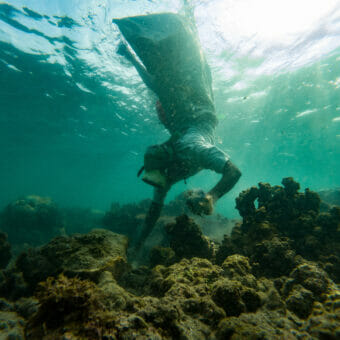
Bhagavathy shows the seaweed she collected. The divers hold their breath for 2 to 3 minutes while extracting seaweed from underwater rocks. (Anushree Bhatter for NPR)

Bhagavathy knows what she’s talking about. Now in her mid-60s, she has been collecting seaweed since she was 7.

(Like the other seaweed divers interviewed for this story, she prefers to be referred to by her first name only, as is the custom in these parts).

To keep the rocks from tearing at their feet, the women wear rubber slippers. They strap on goggles since they’ll be underwater with frequent dives each lasting up to 2-3 minutes over a 5-6 hour day. They’re mastered the art of holding their breath during these dives.

Thangamma, about 80 years old, dives in to gather seaweed. (Anushree Bhatter for NPR)

“It’s not for the faint-hearted. That’s why you won’t see any men here,” Bhagavathy jokes. The other women laugh as they wade into the warm waters.

But modern times and modern problems have made it harder to succeed in this old-fashioned occupation. A growing number of marine heat waves are causing a dropoff in the types of seaweed they gather. What’s more, the government now prohibits seaweed extraction in some areas to promote ocean health.

These women also face challenges on the homefront. Alcoholism among husbands and other male family members is a serious problem.

Nonetheless, an estimated 5,000 women from the region persist, determined to continue diving for seaweed.

“It’s our main source of livelihood,” says Munniammal, who’s in her mid-50s. “Our grandmothers and great-grandmothers have accompanied their husbands on fishing expeditions to collect seaweed as far as we can remember. It’s a tradition as much as it is our livelihood.”

Pamban, where the women collected seaweed that February morning, is a teardrop-shaped island known for its rich marine ecosystem. With over 4,000 species of plants and animals, it’s considered by UNESCO to be one of the world’s most bio-diverse hotspots.

The island is positioned between peninsular India and Sri Lanka, connected to the Southern Indian state of Tamil Nadu via a rail and road bridge that stretches over a mile and a half across the waters of the vast Indian Ocean. Eucalyptus, coconut and palm trees abound, and wooden fishing boats bob on turquoise waters as far as the eye can see.

There are no fishing boats on this particular beach, however; Akkal Madam is a deserted strip of baked sands at 8 a.m. when the women arrive after a 3-mile auto taxi ride from their village of Chinnapalam. A wild wind whips through their hair, and the sunlight is blinding.

The women who have gathered to collect seaweed in the shallow reefs tie white gunny sacks around their hips and plunge into the waters. They pluck at sprigs of springy seaweed, freeing them from the sharp rocks they grow on. They surface briefly and with one deft flick of the wrist throw the sprigs into the sacks tied to their waists. With hardly a backward glance they plunge into the waters again. From 8 a.m. until 3 p.m. they are mainly underwater.

Most of them wear shirts or t-shirts over their saris so their wet clothes don’t cling to them; the additional layer adds warmth. The strips of sari fabric thrown over the left shoulder streams behind like brightly colored flags as the divers slice through the waves. The water is cloudy because of frequent bouts of nitrogen and phosphorus, pollution that causes the growth of algae. The currents are strong, even on this nice sunny day.

On the beach on Pamban island, the seaweed gatherers go out only 12 days every month, collecting a week after the new moon and a week before the full moon. This is when the tides are weaker, the waters gentler and more conducive for seaweed gathering. There’s a gap of nine days between cycles to allow the seaweed to regenerate. (Anushree Bhatter for NPR)

In synch with the moon and the sea

Like anyone who depends on the sea for a living, the seaweed divers are exquisitely tuned into their natural surroundings.

On the beach on Pamban island, they set their own rhythm, harvesting seaweed only 12 days every month, their schedule governed by the lunar cycle. They collect a week after the new moon (roughly mid-month) and a week before the full moon (toward the end of the month). This is when the tides are weaker, the waters gentler and more conducive for seaweed gathering. There’s a gap of nine days between cycles to allow the seaweed to regenerate.

Thangamma carries her sack filled with seaweed. On a good day, a seaweed collector can earn about $6 from selling their goods to local factories. (Anushree Bhatter for NPR)

Other seaweed gatherers from Chinna Palam who are younger and more able, have a different working style.

They don’t just gather seaweed by the coast. As their foremothers did, the women collect seaweed further out at sea, off the coast of 21 uninhabited islets scattered like gems between Pamban and Sri Lanka. These islands now make up the Gulf of Mannar Marine National Park. The seaweed haul here is richer, especially around the coral reefs. They make double the income of those who gather seaweed by the coast. Since they must pool their money to hire boats for this expedition, they go out to sea only six times a year and leave the seaweed that grows around Pamban island for older women to harvest.

Small groups set out around 5 a.m., sharing a motorboat.

Their workday begins much before the crack of dawn, says Seeniammal, who is spreading the seaweed she gathered to dry just outside her home. That morning, she woke up at 3 a.m., made herself tea, prepared a meal for her husband and her granddaughter who lives with her and packed some rice for lunch on the boat.

By 5 a.m., she is accompanied by four other women on a motorboat, operated by a fisherman they know well. They each chip in about $1 for the ride. It’s a half-hour journey to the nearest island. Depending on the availability of seaweed, they may venture out to the other islands that are further away. Once they find the best spot, they moor the boat and dive in. The women are in neck deep waters usually until 3 p.m., because the strong currents would disrupt the work after that. Seeniammal gathered about 22 pounds of seaweed from that single trip, she says, almost double what women collect near the coast of Pamban.

A seaweed gatherer removes unwanted particles from the dried seaweed before it is weighed and sold. (Anushree Bhatter for NPR)

They usually make about $6 a day – compared to $3 to $4 for the women who stay on the island’s coast.

No matter where the seaweed is collected, the process of selling it is the same. Once the women return to their village, the seaweed is carefully weighed by representatives of local factories. Much haggling occurs.

Weighing the seaweed in Chinnapalam village, Pamban island, Tamil Nadu. (Anushree Bhatter for NPR)

Risks galore: poison fish, dizziness, human attackers, new laws

Holding on to this traditional way of earning a living poses many risks.

Poisonous fish abound in the coral reefs nearby.

“A few years ago, a poisonous fish sunk its thorns into me,” says Seeniammal. “It hides in the coral reefs, so we can’t ever spot it underwater. The pain is so excruciating, you’ll wish you were dead. I was rushed to the hospital and treated with an injection, but I was weak and disoriented for weeks afterward.”

The stonefish that is suspected to have stung Seeniammal is a well-known venomous reef fish with 13 venomous spikes. Other women chime in that they must constantly watch out for poisonous fish and stinging jellyfish.

There are other dangers. The women dive in small groups so they can look out for each other. Three months ago, a 50-year-old seaweed collector from a nearby village was raped and killed on an isolated beach.

The women also report that they sometimes grow dizzy while diving. If there’s any kind of accident, the seaweed collectors who travel by boat to their harvest spots must all return so the injured person can be treated. That means a loss of income, but, says Bakyam, age 40, it’s part of an unspoken pact: “We constantly watch out for each other.”

Then there are the legislative roadblocks. In 1986, the government established the Gulf of Mannar Marine National Park. Seaweed extraction in the protected waters of the reserve was declared illegal, with a jail term of three years for violators.

S. Mahendran, a Forest Range officer in the nearby town of Mandapam who is familiar with the women seaweed divers, says there’s a reason these restrictions existed.

“The islands are very fragile, eco-sensitive zones,” he says. “There is a buffer area of six to seven meters around each island to protect the coral reefs there. And any footfall on the island itself could pose a risk to its vegetation, particularly its medicinal plants and wild grass.”

The women are allowed to collect seaweed if they don’t breach that buffer zone, he says. But since the seaweed grows so close to the islands, that’s a thin line and not always possible, the women say.

So that restriction doesn’t stop the women, says Pandiammal, who is the head of the local village council. “We tell authorities that it’s our right to do so. We don’t know any other way to live.”

Rocky lives above water too

I interviewed nearly 50 seaweed-gathering women. They had one overriding concern about their lives when they were out of the water: the men in their community. They’re primarily fishermen – and, the women say, many of them are addicted to alcohol.

“Both men and women struggle to make a living. But the men tend to squander away hard-earned money on liquor,” Pandiammal says. “It’s made our lives above water as rocky as the seabed we face all the time.”

So fishing income earned by the men is squandered — putting pressure on the women to dive for more seaweed to make up for a husband’s lost income.

“Alcohol addiction is a huge problem in these parts and one that authorities are constantly battling,” says the forest officer Mahendran. “I truly admire the courage of these women. They must bear the burden of all the expenses after their husbands, who earn a good living, have frittered away their money on drinks.”

Many women say that the addiction grows worse from April 15 to June 15, during the state’s 45-day ban on mechanized boats, used by fishermen, so breeding season is not interrupted. Even the seaweed gatherers stay home so as not to disturb the marine life. The state government gives each family about $60 to compensate for the loss of the men who fish. But a woman’s income is not taken into account because a female labor force is largely invisible in a patriarchal country like India and a cash strapped state government battling a deficit can’t likely afford more, says Mahendran.

Children in Chinnapalam village, home to women seaweed divers. (Anushree Bhatter for NPR)

Changes for the worse — and the better

About 30 years ago, a plan was hatched to help the women.

In the 1990s, the Central Salt and Marine Chemicals Research Institute, a part of India’s Council of Scientific and Industrial Research, had the idea that teaching the women to farm seaweed would be not only less dangerous than collecting but more lucrative.

An agreement was forged with for-profit companies to cultivate a non-native species called Kappaphycus alvarezii, found in similar water in the Philippines.

Hundreds of rafts were set up close to the coast of Pamban island, laden with seaweed.

However, data from underwater photography taken since 2000 and published in the journal Current Science in 2008, revealed that the cultivated species has become invasive, smothering coral reefs in the protected reserve.

An effort to give women a new way to earn income involved cultivating an imported type of seaweed on rafts. But the species has reportedly become invasive, smothering reefs. (Anushree Bhatter for NPR)

An extensive open survey is required to establish whether the species is indeed invasive, says Vaibhav A. Mantri, senior principal scientist at CSIR-Central Salt and Marine Chemicals Research Institute. “There are contrary views on this subject,” he says.

So while the jury is out on seaweed cultivation, the army of seaweed collectors have seen changes for the better. India’s Recognition of Forest Rights Act of 2006, recognizes the rights of indigenous communities to make use of natural resources, and seaweed divers are now being issued ID cards by the state’s Fisheries Department. One of the objectives of this act is to “undo the historical injustice that occurred” to indigenous communities and to “empower them to use resources in the manner that they were traditionally accustomed.”

A seaweed farmer reseeds Kappaphycus alvarezii, a species of seaweed that is cultivated on rafts. (Anushree Bhatter for NPR)

A hundred women seaweed divers from Chinna Palam should receive ID cards later this month – Indian bureaucracy is blamed for the delays. That will enable them to collect seaweed anywhere without concern for the repercussions. All they would need to do to qualify is to prove that they’re members of the community that’s been collecting seaweed for generations. It’s a truce of sorts between the indigenous people who have loved and lived on these islands for four generations — and a government’s efforts to secure the marine reserve, says Mahendran.

“For us, it’s validation that we don’t destroy the islands,” says Pandiammal. “We protect them. If it weren’t for these islands, how could we live?”

Reporting for this story was supported by the Pulitzer Center on Crisis Reporting.

Kamala Thiagarajan is a freelance journalist based in Madurai, Southern India. She reports on global health, science and development, and her work has been published in the New York Times, The British Medical Journal, BBC, The Guardian and other outlets. You can find her on twitter @kamal_t

Copyright 2023 NPR. To see more, visit https://www.npr.org.

Southeast Alaska king salmon fishery is in limbo after orca lawsuit rulings and appeals

""
Trollers in Sitka. (Photo by Rachel Waldholz/KCAW)

A federal judge in Washington state issued a ruling this week that threatens to shut down trolling for king salmon in Southeast Alaska this summer.

The ruling comes in a lawsuit filed three years ago by a Washington-based conservation group called Wild Fish Conservancy that aims to protect a small population of orcas.

The lawsuit centers ons whether Alaska fishermen should be allowed to harvest king salmon, which are considered essential prey for the Southern Resident killer whales.

KCAW’s Robert Woolsey has been following the lawsuit from Sitka, in the heart of the Southeast salmon troll fishing region, and says whether the king fishery will be closed this summer remains uncertain.

Listen:

The following transcript has been lightly edited for clarity.

Robert Woolsey: If you look at the order, the language of the order says, yes, they’re definitely calling for the end of troll fishing this summer. But both the state and the Alaska Trollers Association, who are intervenors in this lawsuit, filed a notice to appeal to the Ninth Circuit Court. And they’ll probably ask for a stay of the order until the appeal is heard. So it’s possible that fishing might happen this summer. It’s still kind of an open question, though.

Casey Grove: Yeah. And I take it that uncertainty is pretty difficult for fishermen trying to just get ready for the season or to know if they should get ready for the season. I want to talk more about what the impacts might be to the fleet. But first, maybe let’s back up. Where did this lawsuit come from? What does it aim to do?

Robert Woolsey: Well, it all got real back in December of 2022, when another U.S. District Court judge in western Washington named Judge Michelle Peterson issued a report and recommendation that basically went in favor of just about everything the Wild Fish Conservancy was asking for. The Wild Fish Conservancy, in its lawsuit, had argued that the National Marine Fisheries Service had violated sections of the Endangered Species Act and the National Environmental Policy Act in failing to fully account for the impact of the Alaska Chinook fishery on this very seriously threatened population of killer whales in Puget Sound. So that report and recommendation had to be affirmed by another U.S. District Court judge. And that happened this Tuesday, when Judge Richard Jones basically issued a two-page order saying, “This is it. And I’m ordering the National Marine Fisheries Service to fix the flaws. And I’m also vacating this document that’s called an Incidental Take Statement.” And an Incidental Take Statement is essential to open a fishery that might impact an endangered species. And so this Incidental Take Statement that allows Chinook fishing to happen in southeast Alaska in summertime, and in winter, has been vacated.

Casey Grove: So, obviously, this is focused on king salmon off Alaska’s coast. But the orcas also spend a lot of time closer to Seattle, which is a huge city, it continues to grow. There have got to be other environmental factors going on there. So what are people saying about that?

Robert Woolsey: Well, everybody keeps coming back to this, Casey, including our congressional delegation. They all issued statements saying this lawsuit is outrageous, mainly in that it overlooks what probably are the real threats to Southern Resident Killer Whales, which are industrial toxins, population of the Puget Sound area, vessel traffic, all these other sources that probably are creating more harm for these animals than the harvest of what is actually very few fish in Southeast Alaska. I mean, the 2023 troll harvest allocation is only 149,000 kings. We’re not talking millions of fish that are being scooped up in Alaska.

Casey Grove: And I guess whether that sways the judge or the Wild Fish Conservancy, who knows, But I think what’s fair to say is that if that fishery gets shut down, it’s going to have a huge impact on those people, their families. What have you heard from them about that? I mean, what’s the impact going to be on Southeast Alaska in general, if this fishery gets shut down?

Robert Woolsey: Trollers are kind of the iconic Alaska fishing vessel. The fishery has been going on since territorial days. Trollers have these tall poles that extend out and they just cruise along gracefully over the waves catching fish one at a time. Each king salmon, each coho salmon, every fish that they bring aboard, is caught one at a time. Pound for pound, a troll-caught king salmon is the most valuable fish in Alaska. It’s possible that a king salmon is more valuable to Alaska than a barrel of crude oil. And the fishery is quite lucrative at the dock. It’s worth about $15 million. Statewide there are about 1,800 permits for salmon trolling, both power and hand troll. But only half of those permits might be fishing any given season. And once those fish are sold to the processor, and then the processor sells them and they enter sort of the economy, that $15 million is multiplied many times over. So it’s going to be a huge impact. But I don’t think it’s going to be the end of trolling, mainly because chum salmon has become so valuable in recent years. But it’s a loss to the people who have been doing this fishery or participating in this fishery for multiple generations. And it’s kind of a loss for everyone who feels that Alaska has bent over backwards to try and preserve this stock, and it’s being taken away on basically a technicality.

10 billion snow crabs disappeared from the Bering Sea. Scientists and fishermen are working to learn why

Federal and state researchers in Kodiak hope work being done in the lab will provide more information about how Bering Sea crab populations handle climate change. (Elyssa Loughlin/Alaska Public Media)

The snow crab population in the Bering Sea off the western coast of Alaska has fluctuated for decades. An increase in young crabs back in 2018 gave way to optimism that fishing would be good for years to come, but the hope was short-lived.

Gabriel Prout and his family own the fishing vessel Silver Spray in Kodiak, Alaska.

He said it was obvious something was wrong the last few years. The Bering Sea fishing grounds are usually covered in sea ice in the winter. But there wasn’t much ice, and they fished further north than usual. Finding snow crabs was still difficult.

“It was just very poor fishing,” said Prout. “We searched for miles and miles and miles and really didn’t see anything.”

The fishing vessel Silver Spray has been tied up at the dock in Kodiak since the Bering Sea snow crab season for this year was canceled. (Elyssa Loughlin/Alaska Public Media)

More than 10 billion Bering Sea snow crabs disappeared in Alaska between the years 2018 and 2022, devastating a commercial fishing industry worth $200 million just last year. The population crash coincided with a marine heat wave that hit the Bering Sea. Now, fishermen and researchers are working to figure out what happened, and they think warmer ocean water could be to blame.

Bycatch, which is the catch of a non-target species, has also drawn criticism from fishermen for its effect on the snow crab fishery. Even with the fishery closed to crabbers, the bycatch limit for the trawl sector is 3.6 million individual snow crabs this season.

But such a large, sudden die-off and the lack of sea ice was a red flag for scientists like Erin Fedewa, a research fishery biologist with the National Oceanic and Atmospheric Administration.

“That was an immediate potential smoking gun when we saw this Arctic species suddenly in decline,” she said.

That’s because sea ice is an important ingredient in the snow crabs’ life cycle. In the winter, it accumulates on the water’s surface. And during the summer, the ice melts, sending cold, dense water sinking to the ocean floor, where it hovers just above freezing at around 35 degrees.

Scientists call it the cold pool, and it’s a sanctuary for young crabs. Warmer temperatures can lead to starvation, and higher rates of disease. At the Kodiak Fisheries Research Center, state and federal researchers are piecing together how all those factors contributed to the crabs’ collapse.

Tanks filled with seawater pumped in from the bay replicate conditions on the seafloor.

“And then we can hold the different portions of the same population in, say, five degrees Celsius, eight degrees Celsius. And we can begin to look at the response of those species once they’re in these warmer temperatures,” said Fedewa.

Researchers study juvenile crab populations at the Kodiak Fisheries Research Center in Kodiak, Alaska (Elyssa Loughlin/Alaska Public Media)

Scientists use the pools to study how different temperature and pH levels affect the crabs’ development — how fast they grow and how quickly they die.

“We know that increases in temperature increase metabolic rates of fish and crab, causing them to need to eat more and more,” said Fedewa.

In a shrinking cold pool, that means more crabs pushed into the smaller space, fighting for less food. Across the hall from the federal lab, Ben Daly, a research coordinator with Alaska’s Department of Fish and Game, is also trying to figure out how a smaller cold pool affects crabs in the Bering Sea.

“That’s part of what we’re doing now is trying to untangle the what happened part. That’s only half of the challenge. The other half of the challenge is what do we do next,” he said.

His team has been tagging crabs in the wild with satellite transponders that will track their movement over time. He’s hoping the tags provide more detailed information about the distribution of crabs across the cold pool.

And in March, a group of state and federal researchers headed out on the Silver Spray to continue studying crab populations outside the lab. Federal scientists complete population assessments in the Bering Sea annually in the summer.

Ahead of the trip, Gabriel Prout said this winter survey is a big step in understanding more about the species overall.

“We’ll be doing 20 days of pot survey and pot pulling, measuring the crab, sexing the crab, and sizing the crab,” he said.

And tagging the crabs with Daly’s satellite transponders.

Prout and his family are grateful for the work. The many fishermen that rely on snow crabs for income are left with more questions than answers right now.

“We’re sitting tight trying to count our pennies and figure out how to make our way forward,” Prout said.

Scientists say it will likely take years before the snow crab population rebuilds. If another marine heatwave hits the Bering Sea, it could be even longer. But they’re hopeful that lessons learned from snow crabs might provide insight into how other marine species handle climate change as the ocean warms.

This story was created in collaboration with NOVA with major funding from the Corporation for Public Broadcasting.

Proposed Bering Sea marine sanctuary draws pushback from fishing industry

The Aleut Community of St. Paul says the sanctuary designation would give it greater authority to protect the region’s vast ecosystems and resources, including rich fishing grounds and habitat for the federally protected northern fur seal. Commercial fishing representatives railed against the proposed sanctuary during an April 6 meeting in Anchorage, saying the sanctuary could threaten the largest fishery in the nation. (Ian Dickson/KTOO)

A proposed marine sanctuary in the Pribilof Islands has drawn major pushback from the commercial fishing industry, ever since the National Oceanic and Atmospheric Administration accepted the nomination last June.

The Aleut Community of St. Paul — the tribal government for the Pribilof Island community of around 500 people — says the sanctuary designation would give it greater authority to protect the region’s vast ecosystems and resources, including rich fishing grounds and habitat for the federally protected northern fur seal.

The national marine sanctuary would be named Alaĝum Kanuux̂, or Heart of the Ocean — and if approved, it would be the first of its kind in Alaska, possibly creating a new precedent for resource management in the state.

Lauren Divine is the director for the tribe’s ecosystem conservation office. She said the sanctuary designation would make the tribe a co-manager for the region’s resources, which are currently managed by the State of Alaska and the National Marine Fisheries Service.

“That co-management aspect is really important because it’s a step towards self determination, sovereignty,” Divine said in an interview. “It really speaks to going back to Indigenous stewardship of lands and waters, which have operated successfully and sustainably since time immemorial.”

Divine also said the sanctuary would act as a spotlight, bringing tourism, research, and education dollars to the region.

NOAA accepted the tribe’s nomination last year, which set off panic bells in the commercial fishing industry. Many in the industry have voiced concerns that bringing in another co-manager could threaten the industry, even though NOAA and the tribe say the change would not affect fishing regulations.

Commercial fishing representatives railed against the proposed sanctuary during an April 6 meeting in Anchorage, which NOAA hosted to clear up confusion within the industry.

Todd Loomis is the director for Ocean Peace, a commercial fishing company that runs a half dozen catcher-processor boats in the area. After watching a presentation about the sanctuary nomination process, he told NOAA representatives that it was still confusing, and uncertainty was bad for business.

“I saw a lot of wiggle words in terms of the authorities, what applies and what doesn’t apply. And it did not provide any comfort,” said Loomis.

A big concern for opponents is the Alaska pollock fishery in the Bering Sea. It’s not only the largest fishery in the region; it’s the largest in the United States. NOAA valued the 2021 fishery at about $383 million.

Dennis Robinson is the president of the Qawalangin Tribe of Unalaska, where he is also the city’s vice mayor. He’s concerned the proposal will threaten a fishery that NOAA touts as a poster child of sustainability.

“These are the best managed fisheries in the world and you want to put a sanctuary in the middle of it,” said Robinson, commenting on behalf of the tribe. “We are opposed to it.”

The issue has caused so much rancor that both of Alaska’s U.S. senators, Lisa Murkowski and Dan Sullivan, have chimed in. In February, they wrote a joint letter to NOAA asking the agency to revoke the nomination.

Despite the industry’s fears, supporters say the sanctuary would not create any new fishing regulations. Divine, from the tribe in St. Paul, said the designation would not prevent fishing in the region, and any new regulations would still have to go through the North Pacific Fishery Management Council, like they currently do.

“Sanctuaries, by legal definition, cannot exclude fisheries. That’s not an activity that they can prohibit,” said Divine. “Commercial fisheries will continue into the future. Subsistence fisheries will continue into the future.”

While the Bering Sea is incredibly rich and biodiverse, it is also experiencing vast changes, largely due to climate change. Seabirds, fish and marine mammals have all been affected.

George Pletnikoff is from the neighboring Pribilof community of St. George. He told attendees at the NOAA meeting that pushback against the sanctuary has been based on misinformation and scare tactics.

“It’s not a boogeyman,” said Pletnikoff. “It’s just an attempt to take care of our home. It’s dying, and you know it’s dying. And I don’t know other ways to do it.”

The sanctuary process is long and complicated. While NOAA has accepted St. Paul’s nomination, representatives from the federal agency said they have not made a decision about initiating the next step, which would be a multi-year designation process.

This floating ocean garbage is home to a surprising amount of life from the coasts

A piece of plastic debris that’s been colonized by both costal barnacles (pink and striped) and a gooseneck barnacle from the open ocean. (Linsey Haram/SERC Marine Invasions Lab)

Scientists studying a giant collection of plastic trash floating in the middle of the open ocean have found some unexpected inhabitants: dozens of marine species that usually stick close to the coast.

Among the plastic debris, the researchers found all kinds of nonnative species, from anemones to worms to little crustaceans.

“To find that many coastal species on a relatively small sample size was shocking,” says Linsey Haram, a marine ecologist who did this research while working at the Smithsonian Environmental Research Center.

The findings, published in Nature Ecology & Evolution, should help overturn the long-held idea that the open ocean is a barrier that most coastal species could never breach.

Haram and her colleagues made this discovery after examining 105 items of debris collected from an area known as the Great Pacific Garbage Patch. This region between Hawaii and California has become a giant garbage soup, because currents drag in floating debris that accumulates over time.

Most of the plastic trash from there that was examined by researchers showed signs of being colonized by coastal species.

“As we started going through the plastics, it ended up that we saw coastal species on 70% of the 105 debris items,” says Haram.

This derelict fish crate found in the Pacific Ocean was home not just to barnacles and other animals that normally live out at sea, but also coastal anemones. (Linsey Haram/Smithsonian)

Even though biologists knew that coastal species can occasionally travel on ships or floating debris, scientists had long thought that coastal species couldn’t live long-term out at sea or establish new communities there.

That’s because differences in temperature, salinity, and the available nutrients found in these two watery environments all seemed like potential deal-breakers.

But the March 2011 tsunami in Japan forced marine biologists to rethink their old assumptions. Identifiable junk from Japan started turning up in places like Hawaii years later, carrying coastal species that had somehow managed to survive.

So Haram and her colleagues decided to sample some of the garbage out in the Pacific, with the help of a nonprofit called The Ocean Cleanup, which had gone out to the Great Pacific Garbage Patch in November of 2018 and January of 2019.

The Earth’s oceans have five “gyres,” which are like whirlpools that pull things in. In each gyre, garbage accumulates in so-called “patches.” The most famous lies between Hawaii and California. (NOAA)

The researchers asked for common plastic trash items like buckets, crates, bottles, household items, ropes, and parts of fish traps. “And then we had a wild-card category, which was if they came across anything that was super weird and interesting but couldn’t necessarily be categorized otherwise,” explains Haram.

Examining the trash back in the lab, researchers found hundreds of marine invertebrate specimens – and 80% of the species were coastal.

Species already known to live in the open ocean were thriving on the plastic garbage too, says Haram, but “we also saw this very prominent and diverse group of coastal species that honestly, we just wouldn’t have expected to find.”

What’s more, some of the coastal species were reproducing on their makeshift, floating plastic homes. One Japanese anemone, for example, clearly had been making more copies of itself.

Marine ecologist Linsey Haram analyzing sponges and other marine life on plastic debris. (Luz Quiñones/Smithsonian SERC)

“Definitely anemones were the weirdest thing that we saw. We didn’t expect to see them because they didn’t have a very big signature in the Japanese tsunami debris work,” says Haram.

Over two-thirds of the time, there were coastal and open-ocean species living together on the same piece of trash, she says, which means they must now be routinely interacting.

“What that interaction looks like, we’re unsure, but there’s definitely competition for space, right?” says Haram.

The unlikely neighbors also probably compete for food, and may eat each other. The researchers spotted coastal anemones that were eating a kind of purple snail that’s native to the high seas.

The kinds of small creatures examined in this study often serve as food for larger species, so Haram says these findings have possible implications for all kinds of animals higher up the food chain like turtles, fish, and marine mammals.

A lab worker at the Smithsonian Environmental Research Center analyzes a net that has been colonized by a mix of coastal organisms and open-ocean organisms. (Linsey Haram/SERC)

“I was surprised that they saw such high numbers of coastal species,” says Sabine Rech, a marine biologist with the Universidad Católica del Norte in Chile, who has studied life on ocean garbage in the South Pacific. “Beyond the surprise, I think the implications could be huge.”

The tsunami event showed that coastal life could survive a long trip at sea, but that was a dramatic, one-off event, she says.

“With the latest research, we see that it’s just something that is normal now, that is happening all the time,” says Rech. “Coastal species are traveling on a regular basis, all the time, away from their habitat.”

That could increase the risk of species finding new places to take hold and become invasive, she says, adding that the idea that coastal species are able to make a go of it out at sea if they just have something durable to anchor onto is “a little revolution” in scientists’ thinking.

“It’s a bit scary,” she says, as well as fascinating.

Rech and her colleagues didn’t see such a diverse array of coastal life when they studied dozens of pieces of debris from the South Pacific, but she says it may be that this is a more harsh, nutrient-poor environment.

On the other hand, says Rech, this study makes her wonder whether the South Pacific really has small numbers of coastal species out there – or if researchers just haven’t found them yet.

“That,” she says, “is what I’d really like to know.”

Copyright 2023 NPR. To see more, visit https://www.npr.org.

Site notifications
Update notification options
Subscribe to notifications