Ned Rozell, University of Alaska

Ned Rozell is a science writer with the Geophysical Institute at the University of Alaska Fairbanks.
Scientists may have found a reservoir of magma in Interior Alaska

A volcanic crater northeast of Healy, Alaska that is part of the Buzzard Creek maars. (photo by Chris Nye)

For years, scientists have wondered why North America’s highest mountain is not a volcano. All the ingredients for volcanic activity lurk deep beneath Denali, which sits above where one planetary plate grinds past another.

Recently, while looking for something else, researchers found a reservoir of what might be magma, seven miles beneath the muskeg of middle Alaska.

The spot intrigues Carl Tape because above it, at the ground surface, are ancient volcanic features.

Tape is a seismologist with the University of Alaska Fairbanks Geophysical Institute. A few years ago, he headed a team that peppered seismic instruments along the Parks Highway and on the Denali seismic fault. They installed hundreds of seismometers at spots along the road and dozens more right on the fault.

While looking at the seismometer data, which revealed ground motions large and small, Tape and his colleagues noticed a spot where earthen waves slowed down as they passed through.

“Sometimes a slowdown is due to sediments, such as those in the Tanana (River) valley,” he said. “Sometimes it’s due to magma. This one is beneath the Buzzard Creek maars.”

The Buzzard Creek maars are two vegetated craters northeast of Healy. They formed when molten rock rose to the water table and blew up about 3,000 years ago. Geologists have found rocks around Buzzard Creek with the same chemical signature as Aleutian volcanoes.

Those volcanic features near Healy are within a region scientists have named the Denali Volcanic Gap. The gap is a puzzling absence of volcanoes from Mount Spurr (across Cook Inlet from Anchorage) to the Wrangell Mountains in eastern Alaska.

Volcanic activity of the Aleutian Islands seems to end at Mount Spurr. But if the curve of the Aleutian Arc were to extend north, it would intersect the Alaska Range.

Other conditions there are favorable for volcanoes, too: Most of the Aleutians are located about 60 miles above where the slab of the Pacific plate plunges beneath the North American plate. The Buzzard Creek craters and the mountains of the Alaska Range (including Denali) are located about 60 miles above the interface of the giant plates.

University of Utah student Santiago Rabade pored over subtle signals picked up by the dense network temporary seismometers Tape and his team had set up quickly in February 2019. Then they performed rare winter fieldwork to detect aftershocks from the magnitude 7.1 Anchorage earthquake on Nov. 30, 2018.

The earthen hum generated by ocean waves disturbing the sea floor is a constant source of noise we can’t feel but seismometers can; that signal allowed the scientists to detect the patch of magma beneath the Buzzard Creek craters.

“We had zero plan to look for what we found,” Tape said. “It’s fun to find results when you don’t seek them. And it’s generally better science.”

A next logical step to discover more about the mystery magma spot would be to cluster seismic instruments directly above it. Tape is hoping his team’s recent paper will inspire someone to take a closer look at the red blob that might help solve the riddle of the Denali Volcanic Gap.

A 1783 eruption in Iceland may have been catastrophic for northwest Alaska, scientists say

Trees living at their environmental limits in Alaska, such as these burned black spruce, often preserve past climate clues in their growth rings. (Ned Rozell)

Two-hundred and forty-one years ago, when General George Washington marched back into New York City as British troops were walking out, a volcano erupted in Iceland.

For eight months in 1783, Laki volcano spewed lava and belched noxious fumes into the atmosphere. One-quarter of Iceland’s population died, and the sulfur-rich gases that spread worldwide reflected the sun’s rays, making many places on Earth cooler.

Using evidence held in white spruce trees, researchers think the Laki eruption was a catastrophe for northwest Alaska residents, who had no idea why their July turned into November that year.

Rosanne D’Arrigo of the tree-ring lab at Lamont-Doherty Earth Observatory in New York once told the story of Alaska’s year without a summer.

On a poster in a cavernous meeting hall in Washington, D.C., a few years ago, she displayed a photo of tree rings from a white spruce tree from Alaska. Amid a series of dark lines is a faint one that lines up with the year 1783.

Tree rings are thick-walled cells that form in conifers late in the growing season. The hard-to-see tree ring in D’Arrigo’s example shows a most unusual year — 1783 — amid centuries of normal spruce growth.

D’Arrigo, Alaska archaeologist Karen Workman and the late Gordon Jacoby once wrote of a “disaster for northwest Alaska Inuit” caused by the Laki eruption and the cold temperatures that followed. The scientists based their conclusion in large part on cores of wood pulled from white spruce trees at the northern treeline.

Archaeologist and Alaska adventurer James Louis Giddings examines some artifacts. (Photo courtesy of John Christeson)

James Louis Giddings gathered many of those plugs.

In June of 1940, Giddings, an archaeologist and mining engineer educated at UAF, flew from Fairbanks to Allakaket. Once in that small village, he aimed his compass at a mountain pass across the Koyukuk River that would lead him to the headwaters of the Kobuk River.

Giddings then started walking. He carried a 40-pound pack and a .22 rifle, along with “a change of heavy underclothes one must wear as mosquito protection.”

He lashed together a log raft when he reached the Kobuk River. He floated its length, taking tree cores along the way and stopping at known and possible archaeological sites.

At the mouth of the Kobuk, he turned right and traveled up the Noatak River. When Giddings was finished there, he went on to the Seward Peninsula, not finishing his scientific journey until he walked into the town of Haycock, not far from today’s village of Koyuk.

In fall of 1940, Giddings wrote his master’s thesis, detailing his remarkable season of fieldwork and the hundreds of tree cores he acquired.

Half a century later, scientists at Lamont-Doherty used some of Giddings’ samples. With tree-ring records from Giddings and others in Alaska and the real weather station data gathered at the University of Alaska and other places, the researchers reconstructed Alaska summer temperatures from the late 1600s to the present.

They figured average Alaska temperatures from May to August were about 53 degrees Fahrenheit for most of that time. In 1783, the May to August average temperature was about 44 degrees.

“You have this anomaly that’s off the charts,” D’Arrigo said.

To further show the weirdness of 1783, the Lamont-Doherty scientists also cited a book of oral traditions from Natives of northwest Alaska, written by William Oquilluk.

In the book, Oquilluk describes four ancient legends, each linked to the near-extinction of everyone living in northwest Alaska. The first two events were too far back for the researchers to imagine what they might have been. The fourth and most recent disaster was the influenza epidemic of 1918 that hit Alaska and the rest of the world so hard.

The researchers argued that the third calamity in northwest Alaska was linked to the Iceland eruption. Oquilluk wrote of it as “The Time Summer Time Did Not Come.”

That year — perhaps 1783 — migratory birds had returned to Alaska in the spring and all seemed normal, until after June passed. Then, “suddenly it turned into cold weather” and people “could not go out hunting and fishing,” Oquilluk wrote.

“In a few days, the lakes and rivers, recently thawed, froze over. Warm weather didn’t not return until spring (early April) of the next year,” the Lamont-Doherty scientists wrote.

An old friend returns to Icy Strait

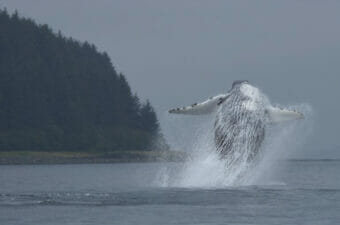
A female humpback whale Glacier Bay National Park and Preserve biologists know as #219 surfaces in the waters near the park. (NPS photo by Janet Neilson taken under the authority of scientific research permit #21059, issued by the National Marine Fisheries Service)

There was a time when Christine Gabriele wondered if she’d ever see one of her favorite creatures again.
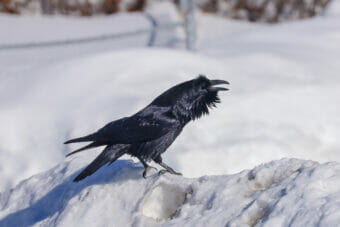
That 42-year-old female humpback whale — known as whale #219 to Gabriele and other biologists at Glacier Bay National Park and Preserve — had been missing from her favorite Icy Strait herring-fishing grounds in Alaska.

No one had seen the whale in two years.

Gabriele feared the worst. A heat wave from 2014 to 2016 that warmed the Gulf of Alaska and North Pacific Ocean had killed sea birds en masse. She and others also documented a nosedive in the Alaska population of humpback whales, likely because of warmer waters that did not favor the krill and small fish that marine mammals and seabirds eat.

But as she motored along doing her whale surveys in Glacier Bay, Gabriele hoped.

Then, one late August day in 2017, Gabriele’s colleague Janet Neilson spotted a familiar whale tail in Icy Strait, just southeast of Glacier Bay. It was 219.

“I was ecstatic,” Gabriele said recently from her office in Gustavus, Alaska, just before she stepped into her boat for another whale survey in late August 2023. “She is special to me. She’s one of the first I learned to recognize when I started to work as a whale biologist in the early 1990s.”

That whale, the mother of at least 13 calves biologists had seen in Alaska waters over the years, had traits that might serve her well in tough times.

“She’s very unflappable, solid and solitary. She’s a calm whale,” Gabriele said.

Though 219 has greatly enhanced the whale population during a lifespan that is similar to a human’s, she by chance did not have a calf alongside her in 2014. That was lucky.

“Females that had a calf at the start of the heat wave had it tough,” Gabriele said. “Gestation and lactation take a lot of energy, so they were starting out in a depleted state.”

Even though 219 made it through the warm period — when waters of the northeastern Pacific Ocean were 4 to 10 degrees Fahrenheit above normal from California to the Gulf of Alaska — she looked stressed.

“In 2018 and ’19, she looked skinny and her skin looked bad,” Gabriele said. “We could see her shoulder blades; that’s how thin she was. I would bet money she stopped reproducing during the marine heat wave, went somewhere else and came back looking terrible.”

The Alaska population of humpback whales migrate between here in the summer and Hawaii or Mexico in the winter. Gabriele thinks that 219 must have found adequate food somewhere other than Alaska in the summers she was missing from Icy Strait.

“I don’t know where she went, but she had to do something different,” Gabriele said.

Baleen whales like the humpback have an incredible ability to fast: When migrating in December, January and parts of February, humpbacks can survive on their fat reserves. But they rely on finding plentiful food when they return to Alaska waters in spring.

Gabriele and her colleagues estimated that Glacier Bay humpbacks declined by more than half during the recent marine heat wave. More recently, in 2019 to 2023 the whale population in the area has stabilized at about 70% of its previous abundance.

“It really hit home for me watching this very stable whale population fall apart,” she said. “I realized just how close whales and I are in the food chain. My dinner plate is not very far from the whales’.

Gabriele points out that biologists have executed the humpback population study every year since 1985 using the same method: photographing the whales’ tails — each as distinctive as a fingerprint — as the whales dive. That has helped tell a long-term saga of the whales.

“Lately, it’s a sad story to tell, but I’m glad we’re able to tell it,” she said.

On the bright side, Gabriele reported that she and Neilson have documented 11 calves in summer 2023, “a fairly good number.” When those calves return in the future, eventually the females among them bring their own calves, which builds the population.

And — yes! — they have also spotted and photographed 219 this summer. Seeing that familiar gray-black body arcing through blue Alaska waters is a comfort to those who know her.

“When the whales are doing well, we are too,” Gabriele said.

Making sense of raven talk

A Fairbanks raven looks down on an observer at the Shopper Forum Mall in May 2020. (Photo by Hannah Foss/UAF)

Be careful what you say, ravens. Doug Wacker is listening to you.

Wacker studies animal behavior at the University of Washington Bothell. Since August 2022, he has been in Fairbanks, following ravens. When he hears them vocalizing, Wacker points at the big, black birds with a microphone attached to a plastic dish that resembles a giant contact lens.

Wacker is recording as much raven talk as he can in Fairbanks. He wants to find meaning, if any, in the squawks, rattles and water-droplet/computer sounds that so often come from those black beaks.

Many of Wacker’s recordings are the voices of members of the greatest local congregation of ravens he has found so far — at the Fairbanks dump.

“I never thought I would go do an academic sabbatical in a landfill,” Wacker said during a recent presentation.

Wacker wonders if there is any pattern in the array of sounds that come from a raven’s mouth. Over the years, researchers have identified up to 116 different vocalizations from ravens.
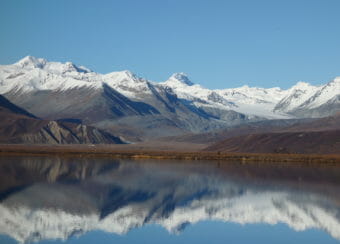
Doug Wacker walks a Fairbanks road last fall while pursuing ravens, the voices of which he is recording. (Photo by Kim Wacker.)

Though scientists who study ravens have debated that number, William Boarman and Bernd Heinrich described a few types of specific calls in a raven description they wrote for the Cornell Lab of Ornithology’s Birds of North America. The distinct calls were begging, vocal play, predatory alarms, demonstrative calls, knocking, comfort sounds, chase calls and mimicry.

Wacker is now recording the sounds of ravens (and their present cohorts bald eagles) at the Fairbanks landfill 24 hours a day. He is also recording at many other places opportunistically.

Wacker wants to further decode raven calls using machine learning, which he describes as using a computer to look for patterns.

He said humans are biased in their descriptions of sounds, noting that scientists have described the same call ravens use to announce they have found food as an aw, a kow, a ky and as a yell.

“We’re all calling the same call something different,” Wacker said.

He looks at raven calls with spectrograms — visual displays with colored peaks and valleys that spill over his computer screen. These allow him to compare the sounds using his eyes as well as his ears. For example, he can measure with precision the length of a raven’s call and the time between syllables.

A raven vocalizes on the west side of Fairbanks in April 2021. (Photo by Hannah Foss/UAF)

He hopes that as he uploads snippets of Fairbanks raven chatter, the machine-learning computer will separate raven calls into categories he would not have come up with himself.

For now, Wacker taps his brake and steps outside his car near Wendy’s, where he records ravens talking over the traffic on Airport Way.

With the help of artificial intelligence, he might gather enough raven talk during his sabbatical year to help us humans come up with a better idea of how our dumpster companions are communicating.

Which raises a question: Do we really want to know what ravens are saying about us?

Alaska’s small glaciers are on their way out

Gulkana Glacier, here seen from Summit Lake off the Richardson Highway, is shrinking back into the mountains of the Alaska Range. (Photo by Ned Rozell.)

Glaciers worldwide are withering. Half of them will disappear by the end of this century, and much of the ice lost will vanish from mountains in Alaska, scientists say.

Authors of a recent cover story in the journal Science used high-performance computers to predict the fates of 215,547 glaciers on Earth. They excluded the great ice sheets of Greenland and Antarctica.

Their conclusions: Goodbye to Bird, Crow, Daisy, Dogshead, Polychrome, Prospect, Red, Rex, Shakespeare and Spoon glaciers by the year 2100. If not earlier.

True, most of us won’t be here in 77 years either, but warmer air temperatures will probably erase those Alaska glaciers and a few dozen more — including an Anchorage water source named Eklutna Glacier — before then.

A visitor stands on the shore of a lake near Worthington Glacier, which is accessible by the Richardson Highway not far from Valdez. (Photo by Ned Rozell.)

UAF Geophysical Institute scientists including David Rounce (now at Carnegie Mellon University in Pittsburgh) and Regine Hock are the lead authors on the study.

Using supercomputers at UAF, they forecast the future of the world’s glaciers under a few different warming scenarios, each of which humanity is currently speeding past.

“Even under the very optimistic scenario corresponding to the goal of the Paris agreement, about half of the glaciers are expected to be lost by the end of the century,” Hock said.

In their data-set, the scientists looked at glaciers all over the world, in regions they called Arctic Canada North, Central Asia, and Russian Arctic, among a dozen others. Alaska is one of the places with the most ice to lose. Alaska’s glaciers have already shrunk in elevation three feet each year during the past two decades.

Alaska glaciers are huge contributors to global ice loss because there are so many of them, and a lot of them are huge. Many Alaska glaciers are also at low elevations where gravity conveyor-belts their ice into the melting zone.

If the planet’s temperatures continue on this trajectory, favorite roadside glaciers will slip out of sight. This will likely play out in most Alaska glacier-towns, including Juneau, by the end of the century.

“Mendenhall Glacier may not disappear completely, but it will certainly retreat so much that it won´t be visible from the visitor center, even for the (most optimistic) scenario,” Hock said.

Visitors take images of Mendenhall Glacier near Juneau in summer 2022 from inside the Mendenhall Glacier Visitor Center. (Photo by Ned Rozell.)

Aside from aesthetics, why does the disappearance of glacier ice matter? Hock said that all that fresh water now dumping into the Gulf of Alaska will affect ocean circulation and ecosystems.

Also, worldwide seas could rise half a foot from the loss of glacier ice by 2100.

Rounce compiled a list of more than 200 named Alaska glaciers that will be gone by the end of the century if the planet’s average yearly temperature rises 4 degrees C from what it was before the Industrial Revolution. That’s a lot of goodbyes.

Here’s the list:


  • Adams Glacier
  • Aho Glacier
  • Alexander Glacier
  • Anderson Glacier
  • Andrei Glacier
  • Andrews Glacier
  • Annin Glacier
  • Arey Glacier
  • Baby Glacier
  • Baker Glacier
  • Baldwin Glacier
  • Barnard Glacier
  • Bear Lake Glacier
  • Bench Glacier
  • Bettles Glacier
  • Bird Glacier
  • Boundary Glacier
  • Bravo Glacier
  • Brilliant Glacier
  • Burns Glacier
  • Cantwell Glacier
  • Canyon Glacier
  • Cap Glacier
  • Carl Glacier
  • Cascading Glacier
  • Casey Glacier
  • Chamberlain Glacier
  • Charpentier Glacier
  • Cheja West Glacier
  • Chigmit North Glacier
  • Chigmuit South Glacier
  • Chikuminuk Glacier
  • Clara Smith Glacier
  • Claremont Glacier
  • Clark Glacier
  • Clear Glacier
  • Coal Glacier
  • College Glacier
  • Concordia Glacier
  • Contact Glacier
  • Corbin Glacier
  • Crab Glacier
  • Crow Glacier
  • Cul-de-sac Glacier
  • Daisy Glacier
  • Dartmouth Glacier
  • Deadman Glacier
  • Detached Glacier
  • Dickinson Glacier
  • Dixon Glacier
  • Dogshead Glacier
  • Doroshin Glacier
  • Downer Glacier
  • Eagle Glacier
  • Eaglek Glacier
  • East Alapah Glacier
  • East Yakutat Glacier
  • Echo Glacier
  • Eklutna Glacier
  • Exit Glacier
  • Explorer Glacier
  • Falling Glacier
  • Ferguson Glacier
  • Fleischmann Glacier
  • Flute Glacier
  • Fourth Glacier
  • Girdled Glacier
  • Gooseneck Glacier
  • Gracey Creek Glacier
  • Gray Glacier
  • Greenpoint Glacier
  • Heiden Glacier
  • Henry Glacier
  • Hidden Glacier
  • Hogback Glacier
  • Holyoke Glacier
  • Hubley Glacier
  • Hummel Glacier
  • Hunter Creek Glacier
  • Icicle Glacier
  • Indian Glacier
  • Irene Glacier
  • Johnson Glacier
  • Johnson Glacier
  • Johnson Glacier
  • Kachemak Glacier
  • Kadachan Glacier
  • Kashoto Glacier
  • Killey Glacier
  • Kings Glacier
  • Koniag Glacier
  • Kulavok Glacier
  • Lafayette Glacier
  • Lare Glacier
  • Latouche Glacier
  • Le Blondeau Glacier
  • Leaking Glacier
  • Lechner Glacier
  • Leffingwell Glacier
  • Lemon Creek Glacier
  • Little Jarvis Glacier
  • Loomis Glacier
  • Lowell Glacier
  • Marshall Glacier
  • Martin Glacier
  • Maynard Glacier
  • McCall Glacier
  • McCallum Glacier
  • McCarthy Creek Glacier
  • McCarty Glacier
  • McCune Glacier
  • Metal Creek Glacier
  • Milk Glacier
  • Mineral Creek Glacier
  • Mint Glacier
  • Morse Glacier
  • Mother Goose Glacier
  • Muth Glacier
  • Neacola Glacier
  • Nelson Glacier
  • North Baird Glacier
  • Nugget Creek Glacier
  • Ogive Glacier
  • Okpilak Glacier
  • Organ Glacier
  • Patton Glacier
  • Pedro Glacier
  • Pegmatite Glacier
  • Penniman Glaciers
  • Polychrome Glacier
  • Popof Glacier
  • Porcupine Glacier
  • Prospect Glacier
  • Ptarmigan Glacier
  • Puget Glacier
  • Rainbow Glacier
  • Ranney Glacier
  • Rasmuson Glacier
  • Raven Glacier
  • Red Glacier
  • Rex Glacier
  • Riley Creek Glacier
  • Ripon Glacier
  • Roaring Glacier
  • Romer Glacier
  • Saksaia Glacier
  • Saussure Glacier
  • Schubee Glacier
  • Schwanda Glacier
  • Scidmore Glacier
  • Seefar Glacier
  • Seth Glacier
  • Shakespeare Glacier
  • Shephard Glacier
  • Shiels Glacier
  • Silver Glacier
  • Skee Glacier
  • Slope Glacier
  • South Glacier
  • Split Glacier
  • Split Glacier
  • Split Thumb Icefall
  • Spoon Glacier
  • Stony Glacier
  • Sumdum Glacier
  • Sunrise Glacier
  • Surprise Glacier
  • Talkeetna Glacier
  • Tasnuna Glacier
  • Texas Glacier
  • The Knife Creek Glaciers
  • Thiel Glacier
  • Through Glacier
  • Thumb Glacier
  • Tigertail Glacier
  • Tikke Glacier
  • Tired Pup Glacier
  • Tkope Glacier
  • TlikakilaNorthFork
  • Toboggan Glacier
  • Tok Glacier
  • Toklat1
  • Toklat2
  • Tommy Glacier
  • Tongue Glacier
  • Tonsina Glacier
  • Trail Glacier
  • Truuli Glacier
  • Tsina Glacier
  • Twentyseven Mile Glacier
  • Twin Glacier
  • Ultramarine Glacier
  • Villard Glacier
  • Warm Creek Glacier
  • Wedge Glacier
  • West Alapah Glacier
  • West Gulkana Glacier
  • West Yakutat Glacier
  • Westbrook Glacier
  • White Glacier
  • Whittier Glacier
  • Williams Glacier
  • Windy Glacier
  • Yuri Glacier

A bird the size of your fist flew from Alaska to Tasmania in 11 days

A man stands on the tundra holding an antenna horizontally, pointed away from him
Bird researcher Jesse Conklin uses a radio antenna to relocate young bar-tailed godwits outside Nome on July 15, 2022. One of the birds Conklin and Dan Ruthrauff fitted with a satellite transmitter that day later flew from Alaska to Tasmania in a nonstop 11-day trip. (Photo by Dan Ruthrauff.)

A bird the size of your fist has made humans all over the world marvel at the things we can’t do.

Like fly. For 11 days straight, from Alaska to Tasmania, your toes not touching earth or water. That’s an average of 765 miles each day, enough to tire a long-haul truck driver burning diesel on the interstates rather than body fat gained from tiny clams.

The bird that became a star is a bar-tailed godwit born this summer on the camouflage tundra not far from Nome.

On July 15, 2022, biologists captured and loosely fitted a three-week old chick with a tiny transmitter. They knew the godwit would inflate to three times its size by the time it was ready to leap off the Alaska mud.

A hand holding a brown bird with spindly legs and a long, black peak
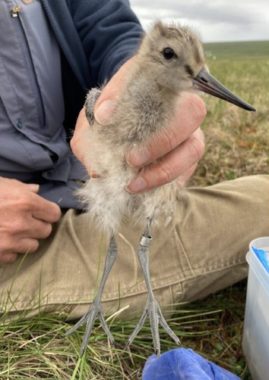
Scientist Jesse Conklin holds a bar-tailed godwit chick not far from Nome. This was about a month before the bird embarked on an 8,425-mile nonstop flight to Tasmania that took 11 days without rest. (Photo by Dan Ruthrauff.)

Bar-tailed godwits are creatures not thought about by most people. They fly over vast, lonely oceans to nest invisibly in bumps of tundra vegetation.

Months later, after poking their pencil bills into mud to gorge on clams and other small things, they disappear from Alaska during storms that drive us to our tents. The next year, they reappear as a surprise, skittering to a landing on soft tundra in April after traveling from New Zealand to Asia and past Japan, the Kamchatka Peninsula and the sweep of the Aleutian Islands. The birds have done this for thousands of years.

Two biologists cupped this wonder of a bird gently in their hands last July before its first migration into the unknown.

Jesse Conklin and Dan Ruthrauff had a plan to do something different this year in researching a bird whose migration was already the stuff of legend; in fall of 2007, scientists saw that one had flown directly — in eight days — from Alaska to New Zealand. The young bird that just landed in Tasmania went much farther in one go.

To find out exactly what that bird did, Conklin and Ruthrauff in summer 2022 upped the difficulty of already tedious rubber-boot fieldwork. They wanted to find godwits born this year, rather than adult birds that are larger, easier to fit with a transmitter and more likely to survive the monitoring period.

“We had conducted breeding studies before on the Yukon (River) Delta and it was pretty demoralizing,” said Ruthrauff, who works for the USGS Alaska Science Center in Anchorage. “We expended a huge field effort to find very few nests, all of which were depredated before they hatched.

“But when godwit nests hatch, the adults very aggressively defend their broods and are quite easy to catch using recorded playbacks of chick calls. We thought that if we just put ourselves in a situation to find just-hatching nests that we might have some luck.”

The men captured three juvenile bar-tailed godwits — balls of fluff not able to fly at such a young age — and fitted each with a backpack transmitter powered by a solar panel the size of a postage stamp.

The transmitters fell off two growing birds in the days following, but the device stayed with one bird. That bird’s transmitter blipped a signal to a satellite every few hours during its fall migration, revealing the nonstop flight from Alaska to Tasmania.

“Based on its size, we estimate that we tagged it at about 3 weeks old, when we deemed that it was big enough to carry the transmitter,” said Conklin, an independent researcher. “So, (the bird) hatched some time in late June, and made the record-breaking flight at about 4 months of age. Pretty good, eh?”

A map of the Pacific with a green line from western Alaska to Tasmania
The track shows a juvenile bar-tailed godwit’s route as it took off from Southwest Alaska on Oct. 13, 2022, and arrived 11 days later in Tasmania. (Map courtesy of Jesse Conklin.)

As both researchers refreshed their computers to get the latest on their young bar-tailed godwit, they were surprised by where it went, as most godwits fly direct from Alaska to New Zealand.

“We were on pins and needles for 12 days, watching as the winds pushed (the bird) to and fro . . . and eventually to Tasmania, about as far as a godwit from Alaska can possibly go,” Ruthrauff said.

Conklin was flying from his home in California to New Zealand in a commercial jetliner at the same time his bird was heading southward over the deep blue sea, its organs shrinking as it flapped along without refueling.

Conklin is now in New Zealand to study juvenile godwits. He wants to find out more about how young birds develop their adult skills. And, he hopes he will soon meet the hardy bird he and Ruthrauff held in July — if that godwit flies from Tasmania to New Zealand.

“It was a surprise that our first tracked juvenile went to Tasmania, for sure,” Conklin said. “About 65%-70% of the Alaska-breeding population spends the non-breeding season in New Zealand, and the rest is generally found on the east coast of mainland Australia.”

Ruthrauff has a reverence for these birds that cover so much of the globe silently amid all the changes, such as the human development of crucial oceanfront feeding grounds on the Yellow Sea off Korea and northern China.

“I try to remain boringly objective and detached but, honestly, holding shorebirds is pretty amazing, a real privilege,” Ruthrauff said. “So much wildness contained in one svelte, disinterested little package!”

Site notifications
Update notification options
Subscribe to notifications