Arctic

An influx of chum salmon in the Canadian Arctic could be the same fish missing from Western Alaska

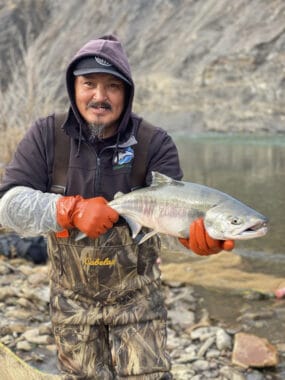
Frankie Dillon displays a chum salmon caught in the Big Fish River, near Aklavik, Northwest Territories, in 2023. (Photo by Colin Gallagher, DFO)

Johnnie Storr grew up fishing with his dad in the hamlet of Aklavik, a small town on the Mackenzie River Delta in Canada’s Northwest Territories. Depending on the season, they looked for Arctic char, Dolly Varden or whitefish.

“We fished for char in the fall time,” Storr said. “Soon as there was enough ice, we walked out and set nets for whitefish.”

Storr is Inuvialuit and Gwich’in, and heads the local Hunters and Trappers Committee, which helps manage Indigenous hunting rights in the region. He said elders say chum salmon have always lived in small numbers in the Mackenzie River, but in the last decade there has been a clear uptick.

“I think it was 2019 where we have seen a big jump,” he said. “I think we had at least 300 salmon brought into the Hunters and Trappers Committee.”

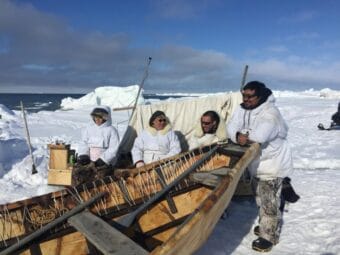
In recent years, all five salmon species have shown up in rivers from northeast Alaska to Nunavut, in Canada’s eastern Arctic. Chum salmon, one of the most cold-tolerant salmon species, are the most commonly found.
Storr said some people eat them, but personally he doesn’t prefer salmon.

“We were releasing them just because we really prefer char around here,” he said.

A research collaboration between local Indigenous fishers, Fisheries and Oceans Canada and the University of Alaska Fairbanks is investigating this jump in salmon in the Canadian Arctic. A study published last week found climate change-driven ocean warming is at the center of the shift.

For salmon to make it all the way from the Bering Sea to the Canadian Arctic, ocean conditions need to be just right, said Joe Langan, a postdoctoral fellow at UAF who co-authored the study.

“We call it a two-part mechanism. You need warm conditions in the late spring Chukchi Sea … we think that salmon are following that north,” Langan said. “And then if the Beaufort [Sea] clears of ice and warms up as well, it kind of opens the door for them.

Graphs show a correlation between the number of salmon caught in the western Canadian Arctic (top) and relatively warm ocean conditions in the Chukchi and Beaufort seas (bottom). (Figures by Joe Langan)

Langan said the longer this Arctic ocean corridor remains warm and ice free, the more salmon make it to western Canadian Arctic rivers.

Human-caused climate warming is rapidly transforming the Arctic — sea ice is declining, water temperatures are higher and summers are longer, said Karen Dunmall, a research scientist with Fisheries and Oceans Canada.

“The salmon are really one of the tangible examples of this change,” she said. “They are showing up because the environment is changing.”

An infographic shows the ocean conditions north of Alaska that allow salmon to migrate to the western Canadian Arctic. (Infographic courtesy Fisheries and Oceans Canada)

Dunmall has worked with Arctic communities to study the impacts of climate change on fisheries for more than two decades. Local fishers offer samples from salmon they catch and their questions drive her research: Where are these new salmon coming from? And will they disrupt the local ecology?

Salmon are born in rivers, spend their adult lives in the ocean, and generally are known to return to their home rivers to spawn and die. Dunmall said the increasing abundance of salmon in the Arctic means that some of these newcomer fish probably originated somewhere else.

“The fact that they’re showing up in the Canadian Arctic in rivers suggests that they may not be able to go back to their natal streams if they get so far north,” she said. “They just follow the urge to spawn and try to find something that might be suitable.”

In recent decades, Western Alaska has seen record low chum runs. Scientists say the decline is at least in part due to marine heat waves and warming rivers.

Could Alaska chums be heading north?

“It’s likely in part some of the same fish,” said Curry Cunningham, a UAF fisheries ecologist who contributed to the study. He said it’s possible that some of these salmon are finding more suitable habitat further north.

“As we see warmer temperatures in the Arctic, there’s at least access for these chum to be moving further north and the potential that some of the freshwater habitats may be becoming more conducive,” Cunningham said.

Dunmall said her team is working on genetic studies of the fish to try to nail down whether they’re the same ones missing from Alaska.

But the new Arctic salmon aren’t exactly a welcome addition in Canada. Storr, in Aklavik, said there’s concern they could be encroaching on the spawning habitats of char and Dolly Varden. And he worries the local fish could be susceptible to unfamiliar salmon parasites.

Storr knows that 300 miles south, families along the Yukon River have been hurting, going many years without a normal salmon harvest.

“If there was a way we could send them back, we would send them back,” Storr said.

A sea ice monitoring project is a climate adaptation tool for Utqiaġvik whalers

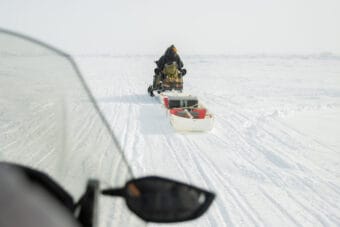
Josh Jones, researcher with UAF’s Geophysical Institute and International Arctic Research Center, tows a sled of equipment that measures sea ice thickness along the coast of Utqiaġvik on April 22, 2024. (Valerie Lake/Alaska Public Media)

On a foggy afternoon in April, scientists Matt Druckenmiller and Josh Jones revved a pair of snow machines to the edge of the shorefast sea ice, the wide sheet of ice connected to the coastline off Utqiaġvik.

As they neared the end of the trail, the sun broke through the fog, illuminating miles of chunky, translucent blue ice blocks.

“Turned out to be quite an afternoon. It’s nice out here,” Druckenmiller observed. He and Jones parked at the end of a whaling trail, one of the paths that local whalers carve every year to reach the open water of the Chukchi Sea.

Matt Druckenmiller, Research Scientist at the University of Colorado Boulder’s National Snow and Ice Data Center, carries a weapon for polar bear protection while studying sea ice along the coast of Utqiaġvik on April 22, 2024. (Valerie Lake/Alaska Public Media)

For Druckenmiller, who has been studying this ice since he was a graduate student in 2007, the landscape of jagged ice shards and boulders seemed flatter than usual.

“This year, there’s a lot fewer grounded ridges than you would maybe normally see. But there are some out here,” he said.

Grounded ridges are tall, thick formations anchored deep in the water below. Ice formations vary from year to year but as climate change progresses, whalers say the big ridges are harder to find.

This ice landscape supports Utqiaġvik’s annual spring bowhead whale hunt, a vital part of the community’s subsistence hunting calendar. And it’s changing fast. Sea ice extent in the Arctic last year was the sixth lowest on record since 1979.

Utqiaġvik’s shorefast ice formed within the last six months, and in another few months, it’s likely to completely disappear.

Dark clouds show where open ocean water meets the pack ice in Utqiaġvik on April 22, 2024. (Valerie Lake/Alaska Public Media)

Multi-year ice, sea ice that sticks around through the summer and into the next winter is also becoming rare.

“Last I remember was maybe 2021,” said Jones. “There was a small piece of multi-year ice off town.”

Every spring, Druckenmiller and Jones spend a few weeks in Utqiaġvik monitoring ice thickness along the sprawling network of whaling trails the community builds and relies on. The data they collect becomes a helpful tool to understand each year’s ice conditions — and how climate change is shaping the ice long-term.

Druckenmiller, a research scientist at the National Snow and Ice Data Center in Colorado, and Jones, a researcher at the University of Alaska Fairbanks Geophysical Institute, are with a UAF initiative called the Alaska Arctic Observatory and Knowledge Hub. AAOKH compiles data and observations from local Indigenous knowledge holders and scientists to provide coastal Arctic communities an ongoing record of how the environment is changing.

AAOKH’s research is meant to center Indigenous knowledge and support the priorities of local communities, like subsistence hunting and fishing.

“Before, research was not necessarily trying to meet community needs. It was more science for the sake of science,” said Roberta Tuurraq Glenn-Borade, AAOKH project coordinator. Glenn-Borade, who grew up in Utqiaġvik, spoke to Alaska Public Media in December, after AAOKH’s research was included in NOAA’s 2023 Arctic Report Card.

“I think that’s one thing that AAOKH has made a difference in, to really listen and understand what we can do today to start meeting those needs,” she said.

Druckenmiller and Jones’ project monitoring the ice along whaling trails began in the early 2000’s, when longtime North Slope Borough wildlife biologist Craig George partnered with local whaling captain Warren Matumeak to map trails and record ice conditions.

Electrical equipment used to measure ice thickness sits inside a plastic tote on a sled on the sea ice of Utqiaġvik on April 22, 2024. (Valerie Lake/Alaska Public Media)

More than two decades later, whaling trail data collection is still going strong. That afternoon on the ice, Jones opened a plastic tote tied to a sled behind one of the snow machines and pressed a few buttons. Inside, an electromagnetic conduction device began to chime.

“You can think of it as kind of similar to a metal detector in a way,” Druckenmiller said.

As it’s dragged down the trail in the sled, the device emits electromagnetic waves to calculate how thick the ice is. Later, Druckenmiller and Jones download the data and compile it into a map of the community’s whaling trails, color coded for ice depth – blue lines indicate the thickest ice, red lines show the thinnest, at just two feet or less.

They send the maps out on social media, email them to whaling captains and drop printed copies around town.

Druckenmiller says there’s value in maintaining a long term record of the ice to track climate change. But this science has a more immediate impact too.

“We also really appreciate being able to provide something to the whaling community that’s helpful,” he said. “It facilitates a relationship, it facilitates sharing knowledge, and that enables us all I think, to better understand the ice.”

Billy Adams, a longtime whaler and sea ice expert in Utqiaġvik, agrees.

“People are excited when the maps are out,” he said. Adams also serves as an observer for AAOKH.

Whaling crews spend a lot of time scouting the ice each spring, but Adams said the maps are a helpful tool for determining where the thickest ice is. They also serve as a resource in emergencies, to make it easier to locate crews on the ice.

Adams and other whalers have helped support the mapping efforts for nearly two decades by sharing sea ice knowledge and identifying trails. Adams said it’s a good example of science and traditional knowledge partnering to protect subsistence resources.

“When you bridge science with local experts, using Indigenous people, I think it’s a way to find the truth,” he said. “That can be fairly done – equitable research involving Indigenous communities around the Arctic.”

Josh Jones, researcher with UAF’s Geophysical Institute and International Arctic Research Center, reviews a radar map of the sea ice around Utqiaġvik on April 24, 2024. (Valerie Lake/Alaska Public Media)

Druckenmiller and Jones’ maps are just one tool to provide whalers with information. A radar station and webcam set up on top of an Utqiaġvik office building in 2008 provide snapshots of the ice that crews can check to monitor how conditions are changing.

Jones said they know these tools are helpful because they get a flood of texts and emails whenever the site crashes.

“We don’t know how many people are using it until it goes down,” Jones said. “And then we hear from a bunch of people.”

Arctic sea ice is rapidly disappearing due to climate change. In the last 10 years Adams said he’s seen dramatic changes, from thinner ice to ice-free seas well into the fall and early winter.

Druckenmiller and Jones’ maps are just one tool to provide whalers with information. A radar station and webcam set up on top of an Utqiaġvik office building in 2008 provide snapshots of the ice that crews can check to monitor how conditions are changing.

Jones said they know these tools are helpful because they get a flood of texts and emails whenever the site crashes.

“We don’t know how many people are using it until it goes down,” Jones said. “And then we hear from a bunch of people.”

Arctic sea ice is rapidly disappearing due to climate change. In the last 10 years Adams said he’s seen dramatic changes, from thinner ice to ice-free seas well into the fall and early winter.

Asisaun “Asi” Toovak, City Mayor for Utqiaġvik, in her office on April 23, 2024. (Valerie Lake/Alaska Public Media)

Asisaun Toovak, mayor of the city of Utqiaġvik and a whaler herself, remembers the shorefast ice stretching eight miles wide.

“Now, it’s maybe half of that,” she said.

Toovak and other whalers say it’s harder to find the thick, flat ice crews rely on to support the 40 or 50 ton bowhead whales they pull in. She said tools like the whaling trail maps and radar images are part of a process of adaptation that help make whaling “more efficient and more safe.”

“We’re not sitting here, hoping the ice doesn’t start to melt. We’re sitting here, first thinking about how are we going to adapt to that environment?” she said. “How are we going to continue food sovereignty and our cultural practices by adapting to that change?”

Toovak said she doesn’t worry her community will lose the ability to hunt bowheads, even as the sea ice declines. She said they’ll find a way to adapt. They’ve been whaling for 10,000 years, and she expects they’ll be whaling for another 10,000.

For one Utqiaġvik family, spring bowhead whaling marks an important milestone

Quincy Adams slices through bowhead whale meat to distribute to his family and community members in Utqiaġvik on April 24, 2024. (Valerie Lake/Alaska Public Media)

For the Aaluk Crew, last Wednesday was cooking day.

The night before, the whaling crew, captained by Bernadette and Quincy Adams, had landed the first bowhead whale of Utqiaġvik’s spring season. The crew flag, featuring a harpooned bowhead tail framed by a sunset, waved above the Adams’ two-story home, signaling the successful hunt.

The garage door rolled up and steam flooded out into the yard.

Inside was a picture of a jubilant chaos. Late 2000’s pop music blasted from a bluetooth speaker as crew members and family bustled between huge pots, tending to different cuts of meat — boiling slices of bowhead blubber and skin, or uunaalik, heart, tongue and intestines.

Children ran underfoot, people fed babies tiny pieces of cooked meat. A husky named Avvaq sat tied up in the snow, hoping for scraps. Laughter ricocheted off the walls. Everyone buzzed with excitement for Utqiaġvik’s first spring bowhead.

Natasha Itta laughs with the other members of the Aaluk Crew while preparing bowhead meat to share with the community of Utqiaġvik on April 24, 2024. (Valerie Lake/Alaska Public Media)

“Whaling brings so much joy,” said Natasha Itta, a member of the Aaluk Crew.

Meat from this catch will feed the crew and their neighbors for months to come. It will also be sent to other North Slope villages and even family in the Lower 48.

“The bounty just goes all over the place,” Itta said.

An ulu sits on top of a silver tray stacked with pieces of boiled maktak from a bowhead whale after being cooked by the Aaluk crew in Utqiaġvik on April 24, 2024. (Valerie Lake/Alaska Public Media)

For Inupiat communities on the North Slope, bowhead whaling is a central part of spring. But climate change is adding an extra element of uncertainty to the whaling season.

Warmer temperatures are driving a decline in the region’s sea ice, which is forming later in winter and thawing earlier.  Whalers say the shorefast ice, or the ice still attached to the coastline at this time of year, is becoming thinner and less predictable. That poses an extra challenge — and possible danger — for crews, who must cross the ice to reach open water and then rely on it when they pull in whales that can weigh more than 60 tons.

Tomi Phillip squeezes a piece of bowheat muktuk to check for firmness while boiling the meat before distributing the food to the community of Utqiaġvik on April 24, 2024. (Valerie Lake/Alaska Public Media)

Itta said a possible future without stable ice and successful spring hunts is scary to think about.

She said whalers are thinking about how to adjust if the shorefast ice won’t support spring whaling in the future, like potentially going out earlier in the season when the ice is firmer — but then there’s a risk that whales won’t be migrating yet.

“It’s going to take a lot of adapting,” Itta said. Traditionally, bowhead whaling starts in late March or early April, with feasts and festivals following in the summer. Losing that rhythm would be hard, Itta said. “It’s almost like you lose a piece of your identity. Because that’s who we’ve always been, that’s who we’re going to be.”

Donald “Button” Adams of the Aaluk Crew, talks about how it felt to bring home his first bowhead whale and share it with his community of Utqiaġvik on April 24, 2024. (Valerie Lake/Alaska Public Media)

But this season is already a success. It also marked an important milestone: the 31-foot-whale caught by the Adams crew was landed by 17-year-old Donald “Button” Adams — his first as striker.

Donald is the son of the Aaluk Crew captains Bernadette and Quincy Adams. He’s not one to brag.

“I don’t know. It’s pretty cool,” he said with a shrug, in a crowded kitchen.

But his parents couldn’t hide their quiet pride.

“It’s a big deal. He’s been working really, really hard,” said Bernadette Adams, Donald’s stepmom. In 2014, Bernadette became the first known woman from Utqiaġvik to land a bowhead.

Bernadette Adams, co-captain of the Aaluk crew, shows off the tip of the harpoon she used to catch her first bowhead whale during a family gathering at her home on April 24, 2024. (Valerie Lake/Alaska Public Media)

Donald has been going out on the ice since he was seven years old, learning from his parents: “What to look for on the ice, when to go out, when not to go out, which way the wind direction is going,” he said.

For several years, he’s been training to take on the role of striker from his father, Quincy. The striker stands in the bow of the boat and launches the darting gun to harpoon the bowhead.

On the night of the successful hunt, the crew set out just before midnight, Donald said. They prayed with the boat and then launched it from the ice.

“The water was pretty flat, almost glass,” he said. “Then we saw a whale along the tuvak — that’s the edge of the ice where the ice and the water meet.”

That first whale quickly disappeared. But soon, the crew spotted another one, about 300 yards out. As they sped towards the second whale, Donald said, they saw it spout just 20 feet away, and closed in to where they expected it to surface next.

“Sure enough, right beside us the whale popped up,” Donald said. He threw the harpoon. “It was a good shot, too.”

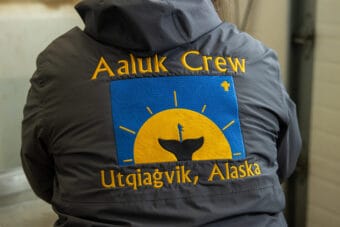
Members of the Aaluk Crew proudly wear their branded hoodies and jackets while cooking the meat of the bowhead whale they caught the night before. (Valerie Lake/Alaska Public Media)

Experienced hunters themselves, Donald’s parents know what it takes to be a successful striker.

“We told him you gotta show us you can do it,” Bernadette said. “We made him go and help cut multiple whales. ‘You got to ask questions,’ I said. ‘It’s not just from us you’re gonna learn, it’s from everybody else.’”

Donald was ready to serve as striker last fall — until he broke his leg in an accident on the boat. Just then, the crew spotted a whale. Despite his broken leg, Donald refused to let them turn around, Bernadette said.

“He was like ‘just go after it!’” Bernadette recalled.

Quincy said it’s hard to express how it felt to watch his son take on this new role.

“I don’t have any words for that,” he said. “I don’t have any words for watching that happen. It’s just so humbling to see.”

Quincy Adams, co-captain of the Aaluk crew, directs a group of men as they divide up the bowhead whale they caught the day prior. The meat will be distributed to members of the community of Utqiaġvik on April 24, 2024. (Valerie Lake/Alaska Public Media)

The crew towed the 32-ton whale back to their camp and heaved it onto the ice with the help of snow machines. It took about 40 people another six hours to process the catch to bring into town, Donald said.

In the garage on cooking day, teenagers darted in and out with massive sheet trays, sliding batches of cooked meat into plastic totes lined with trash bags to share with anyone from the community who stopped by.

In the yard outside the Adams’ house, big chunks of meat lay scattered in the snow, waiting to be processed. Quincy and a few other men cracked jokes while they portioned out cuts for crew and family.

Whaling is about providing for others, Quincy said.

“It’s just built in us. It’s something that we yearn to do,” he said. “If we’re not successful, then we find other ways to feed the community. But doing this and feeding the community is what it’s all about.”

This first bowhead was an auspicious start to Utqiaġvik’s spring whaling season. Since last week, crews have caught five more.

Scientists, Alaska Native leaders say the Arctic faces a growing crisis from plastic waste

A walrus is seen in Alaska’s Chukchi Sea in June of 2010. Research by a University of Alaska Fairbanks student found microplastics, mostly tiny fibers, were lodged in muscle tissue, blubber and livers of walruses harvested by hunters from St. Lawrence Island and Wainwright. (Sarah Sonsthagen/U.S. Geological Survey)

Vi Waghiyi grew up in the village of Savoonga on St. Lawrence Island, where meat from walrus, seal and bowhead whale sustained her family through long winters. 

“My people continue to live off the land and ocean like we have for millenia,” Waghiyi said. “Our elders call the Bering Sea our farm.”

Today, as an elder herself, Waghiyi wants her grandson to have access to the same traditional foods. But food security in the Arctic is increasingly threatened.

The burning of fossil fuels is heating the region four times faster than anywhere else on the planet. Warming waters are disrupting the food chain, and melting sea ice is erasing animal habitat and making hunting more dangerous.

“And we are some of the most highly contaminated people on the planet because of our reliance on our subsistence foods,” Waghiyi said.

Because plastic waste piling up across the planet is making its way up to the Arctic. Plastics contain toxins that have been linked to long-term health problems like cancer, hormone disruption and damage to the heart, liver and kidney, which threaten Alaska Native communities. That’s according to a new report from Alaska Community Action on Toxics and the International Pollutants Elimination Network. 

Waghiyi, who is the director of environmental health and justice for Alaska Community Action on Toxics, is a co-author on the report, along with other scientists and Alaska Native leaders who are calling for an end to new plastic production worldwide. They’ll represent Alaska’s Arctic communities at a meeting of the United Nations later this month. 

Pamela Miller, a long-time Alaska scientist who works with both organization, is also a co-author. She said strong currents in the ocean and the atmosphere naturally move from lower latitudes to the poles, carrying plastic and other pollutants along with them. 

“We now know that there are microplastics in fish, in walrus, in ring seal, bearded seal, spotted seal, and many different whale species,” Miller said. “These are the animals that have been relied on for centuries for sustenance.”

The accumulation of plastics in the Arctic is made worse by climate change.

“We also know that with climate warming happening so rapidly that the highest concentrations of microplastics are found in those areas where there’s the most rapid melting of sea ice,” Miller said.

The melting of sea ice, permafrost and glaciers also release plastics and chemicals that have long been bound in ice. 

In 2022, the United Nations set out to write a treaty on how to deal with growing plastic waste. They’ve held several meetings to hash out the terms, including one happening later this month in Ottawa, Canada. There, the authors of the new report will join representatives from more than 170 other countries. 

Miller says there’s only one real solution to the plastics problem. 

“The first thing is to curb the production of chemicals and plastics,” she said. “Since they’re reliant on fossil fuel production, that also means curbing fossil fuel production.”

But not everyone agrees with her. 

Most plastic is created with chemicals derived from fossil fuels. And as demand for oil and gas in transportation or home heating drops with the switch to cleaner energy, many in the fossil fuel industry see plastics as a way to support their future business.

At a treaty meeting last fall, representatives from oil and gas producing companies and countries pushed for recycling and cleanup solutions instead — despite years of research suggesting that only a small fraction of recycled plastic gets transformed into new items.

Waghiyi says she hopes that Arctic Indigenous communities are able to push back against those industry interests. 

“Our people have done all we could to make sure our land, airs and waters are protected,” Waghiyi said. “These multinational corporations do not take human health into account.”

She says she’s headed to Ottawa to fight to protect the health and food of her grandson. 

Russian objection to US territorial claims off Alaska complicates maritime relationship

An Arctic “fogbow” is seen from the deck of the Coast Guard cutter Healy during the 2016 Hidden Ocean mission to an Arctic Ocean region known as the Chukchi Borderland. The research cruise gathered multiple types of data, including information used to create seafloor maps to support the U.S. claim to extended outer continental shelf territory in the Chukchi Borderland lying beyond a 200-mile exclusive economic zone. (Photo provided by Caitlin Bailey/Global Foundation for Ocean Exploration)

New U.S. claims to seabed territory off Alaska have run into an obstacle: an objection from the Russian government.

The Russian government, which has staked territorial claims to most of the Arctic Ocean, is challenging the U.S. claims made in December to sovereignty over 520,400 square kilometers of extended outer continental shelf in the Arctic Ocean – an area bigger than California — and another 176,330 square kilometers in the Bering Sea.

The U.S. does not have the right to make such claims because it is not a party to the United Nations Convention on the Law of the Sea, Russia’s delegation argued at a meeting in Jamaica last month of the International Seabed Commission.

“We categorically reject the selective approach of the United States of America to the use of international law, with an emphasis on its rights and a complete disregard for obligations,” the delegation’s statement said.

U.S. Sen. Lisa Murkowski, R-Alaska, said the Russian objection is puzzling because the claims made in December by the U.S. State Department did not overlap any territory claimed by Russia.

“I don’t know whether they would do it other than just to be obstreperous. But that wouldn’t be surprising,” she said at a Thursday news conference in Anchorage.

Whatever grounds Russia might cite, its objection is an example of how the U.S. is at a disadvantage because it has not ratified the Law of the Sea treaty, under which such claims are adjudicated, she said.

The U.S. is still allowed to submit a claim without ratifying the treaty, she said. However, “we’re not, basically, at the table to defend it,” she said.

“It’s kind of like going to court and just hoping that the pleading that you filed is going to be rock-solid and all of your cites are going to be just very conclusive, but you don’t have the ability to argue your case as the attorney that drafted that,” said Murkowski, who worked as a lawyer before holding public office.

Murkowski in November, along with several colleagues, introduced a resolution seeking Senate ratification of the Convention on the Law of the Sea. It was her third official attempt to get the Senate to approve the treaty.

As with all outer continental territorial claims, the U.S. claims made in December concern only the seabed, not the ocean above it. The claims could affect future economic activities, such as deep-sea mining or the placement of fiber-optic cables.

The U.S. claims in the Arctic add to a series of claims made by other Arctic nations that date back several years.

Russia’s claims, as amended in 2021, extend from the Eastern Hemisphere to the Western-Hemisphere side of the North Pole, based on its interpretation of the continental shelf.  While the U.N. Commission on the Limits of the Continental Shelf approved most of the claimed territory, other areas claimed by Russia overlap and conflict with territorial claims made by Canada and by Denmark on behalf of Greenland.

When it comes to even existing U.S. territorial rights, there have been some conflicting signals from Russia.

An effort in the Russian Duma aims to sever the U.S-Russia Bering Sea boundary agreement that dates back to 1990, when the Soviet Union still existed. Russian Foreign Minister Sergey Lavrov has tried to counter that effort, defending the agreement as valid and a benefit to the nation.

One high-ranking Russian official has even raised the specter of leaving the U.N. Convention on the Law of the Sea.

Russia has taken more aggressive actions in the Bering Sea and Arctic in recent years. In a now-notorious 2020 incident, a Russian warship crew confronted some U.S. pollock fishermen and ordered them to move. And there have been more military operations, including exercises in the Bering and Chukchi seas last September that drew U.S. Coast Guard scrutiny.

Asked about new doubts cast by some Russian officials about recognition of the existing Bering Sea maritime border, Coast Guard Lt. Commander Jed Raskie told the North Pacific Fishery Management Council on Thursday that he has not yet seen any follow-through on those sentiments. There has been no detectable action “that has signaled that they’re going to proactively challenge that,” Raskin told the council, which is meeting this week in Anchorage.

Cross-border cooperation between the U.S. Coast Guard and its Russian counterpart has deteriorated but not ended entirely, he told the council.

“The communications between us and the Russian Border Guard are relatively low right now, and that’s because of the strained relationship between the two nations,” said Raskie, who is based in Juneau. “We still have very good contact, and we maintain good communications just to make sure that if something that becomes an issue with either safety, life at sea or pollution, we would, obviously, be able to contact them proactively for that.”

In the first three months of 2024, there were no observed incursions by foreign vessels, from Russia or elsewhere, into U.S territory in the Bering Sea, Raskie said. But this is a slow time of year for fishing in that part of the Bering Sea, and things may change in the summer and fall along the maritime boundary, he said.

“I think the answer is we’ll see what happens over the next few months. And we’re standing by,” he told the council.

This story originally appeared in the Alaska Beacon and is republished here with permission.

Microplastics found in body tissues of walruses harvested by Alaska hunters

A walrus is seen in Alaska’s Chukchi Sea in June of 2010. Research by a University of Alaska Fairbanks student found microplastics, mostly tiny fibers, were lodged in muscle tissue, blubber and livers of walruses harvested by hunters from St. Lawrence Island and Wainwright. (Sarah Sonsthagen/U.S. Geological Survey)

For the first time, tiny bits of plastic have been found in body tissue of Pacific walruses, lodged in the animals’ muscles, blubber and livers.

The findings, from a University of Alaska Fairbanks student research project, add to growing knowledge about the widespread presence of microplastics in the world’s natural environment, even in remote locations.

“It’s a reflection of the plastic age we live in. It’s ubiquitous,” said Tony Blade, a UAF undergraduate who presented his findings in a presentation at last week’s Alaska Marine Science Symposium, a major science conference held annually in Anchorage.

Microplastics are tiny pieces of plastic, smaller than 5 millimeters – or one-fifth of an inch – in length, with some too small to be seen without microscopes.

Blade’s project, conducted under the supervision of UAF marine biology professor Lara Horstmann, examined body tissues of five walruses harvested by subsistence hunters. The samples were donated by hunters from Gambell and Savoonga, Siberian Yup’ik villages on St. Lawrence Island in the Bering Strait region, and from Wainwright, an Inupiat village on the Alaska mainland.

Every one of the 15 samples – muscle, fat and liver from each of the five walruses — held microplastics.

In all, there were 73 microplastics isolated from the tissues, almost all of them fibers. In four of the walruses, muscle tissue had the highest concentration of microplastics, though in one walrus from Savoonga, blubber had the highest concentration. Most of those found were clear; black fibers were the second-most prevalent.

Blade’s research shows that the plastic bits, far too small to be seen with the naked eye, are somehow getting beyond stomachs and digestive tracts and lodging directly into body tissues – a process that scientists call translocation. Although his work is the first to make such a finding in Pacific walruses, emerging research elsewhere is turning up microplastics in body tissues of other marine mammals.

Exactly how the plastics are passing through biological barriers to get into tissues is yet unknown, Blade said. Also yet to be understood, he said, is what the presence of plastic in their bodies does to the walruses. “We don’t know what that means as far as biological health of the animal,” he said.

Walrus cows and yearlings are seen resting on sea ice on April 18, 2004. (Photo by Joel Garlich-Miller/U.S. Fish and Wildlife Service)

Follow-up work by Blade and Horstmann is already underway, with samples from 20 walruses harvested by St. Lawrence Island hunters. That work will examine whether there are any age- or sex-related patterns to microplastics presence in body tissues, Blade said.

One reason that walruses were chosen for his project, he said, is that they are culturally important to Indigenous people of the region.

Another important reason is the way that they eat, he said. Walruses feed on clams, snails and other creatures that dwell on the ocean floor, the area of the sea known as the benthic zone.

“They’re digging through ocean sediment. And prior studies have shown that microplastics in the Bering Strait region are settling into the sediments of that area, as well as being taken up by organisms like mussels, crustaceans, invertebrates that walruses are eating directly,” he said.

The idea that walruses are more at risk for plastic consumption because of their benthic eating habits is consistent with recent findings by another UAF researcher who has focused on microplastics ingested by spotted seals in the Bering Strait region.

Alexandria Sletten, whose project was the thesis for her newly acquired master’s degree, also presented her findings at the symposium’s poster session in a follow-up to a presentation last year.

Of the 33 seal stomachs she examined, 32 had plastic. Those seals that fed more heavily at the benthic level – where walruses eat — had more plastics in their stomachs than the seals that fed on prey at the nearer-to-the-surface area known as the pelagic level, she found.

Blade’s walrus discoveries also fit with some groundbreaking findings by Duke University researcher Greg Merrill, who recently documented the presence of microplastics in body tissues of a variety of marine mammals.

Tony Blade, a University of Alaska Fairbanks student, stands by a poster summarizing his findings about microplastics in body tissue samples from five Pacific walruses. Blade discussed his findings at an evening session of the Alaska Marine Science Symposium on Jan. 30, 2024. (Photo by Yereth Rosen/Alaska Beacon)

Merrill, in a presentation at the symposium, described his findings about tissues from 22 marine mammals of 12 species.

Animals tested ranged from bottleneck dolphins and whales found dead after strandings in North Carolina and California to mammals harvested by subsistence hunters or found stranded in Alaska: bearded, spotted and ringed seals and beluga, gray, minke and fin whales.

Two-thirds of the animals tested had microplastics, mostly fibers, in at least one type of body tissue, according to Merrill’s study.

“Translocation is occurring. Plastic that is ingested, those microplastic particles, are moving around in the body and depositing into different tissues,” Merrill said in his conference presentation.

The marine mammals are consuming plastics indirectly, eating prey that acquired the microplastics at lower levels in the food web, Merrill said. But even if the consumption is indirect, the quantities can be staggering, he said.

Large filter-feeding baleen whales are taking in up to 10 million plastic particles a day, “which is a pretty staggering number.” While most are expelled out in feces, some are passing through to various body parts, he said.

Merrill was able to find microplastics in preserved samples dating back to 2001, indicating that microplastics have been finding their way into marine mammal bodies for decades.

“It’s a process that has been happening for quite some time, likely since plastics have been ending up in the environment, dating back to post-World War II,” he said.

This story originally appeared in the Alaska Beacon and is republished here with permission.

Site notifications
Update notification options
Subscribe to notifications