Arctic

New study hints at huge price tag from permafrost thaw in Alaska

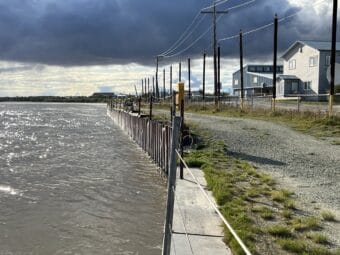
Thermosiphons, the row of black poles underneath the telephone wires, line the bank of the Kuskokwim River in Bethel. They were installed to keep the permafrost below ground frozen and prevent the bank from sliding into the river. (Photo courtesy Dr. Joey Yang)

There are already several inches of snow on the ground in Fairbanks, but you won’t find any surrounding Vladimir Romanovsky’s house. Romanovsky, a permafrost expert and professor emeritus at the University of Alaska Fairbanks, keeps the ground shoveled.

“My house, it’s right on the boundary between permafrost and non-permafrost,” he said.

Snow is an insulator; it keeps the ground several degrees warmer than the air. And if there is permafrost below his house, he doesn’t want to risk it thawing, potentially cracking the foundation or creating other structural problems.

“That’s why, just in case, I am shoveling snow around the house to make the ground colder. If there’s some deeper permafrost there, that will prevent it from thawing,” Romanovsky said.

Permafrost is the frozen layer of ground on or just under the Earth’s surface found in polar regions. Romanovsky is part of a team of international scientists who are trying to understand how quickly it’s thawing.

As the climate warms due to human-produced carbon emissions, the Earth’s upper layers of permafrost are at risk of disappearing. The rate it thaws has enormous financial consequences for communities living above permafrost now. Those include Fairbanks, Utqiagvik and dozens of villages in western, northern and Interior Alaska.

The team modeled different scenarios of warming to see the effects on permafrost and published their findings in August in Proceedings of the National Academy of Sciences. In severe warming scenarios they found that more than 75% of Earth’s near-surface permafrost, 10-13 feet below ground, will be gone by the end of the century. Even in more moderate warming scenarios, more than half will disappear.
Based on the air temperature data they recorded, Romanovsky said we’re heading toward that severe warming scenario already.

“We’re kind of on the higher end of the predictions [based on] the real changes in temperature,” he said.

That means three-quarters of the world’s near-surface permafrost is set to vanish by 2100.

This has major implications for cold-climate regions like Alaska, where permafrost covers the majority of the state and thawing is already well underway. One of the biggest impacts is to the built environment.

Buildings, homes, roads, and other infrastructure need stable surfaces to remain sturdy. But when the ground beneath is literally melting, those surfaces start to sink and become unstable. This is already a major problem for rural Alaska communities built on permafrost — and it’s going to get worse.

Ilya Benesch is the Arctic construction manager for the Cold Climate Housing Research Center in Fairbanks, which does building research and answers housing design questions. He said the center is fielding more frequent permafrost-related questions.

“I get calls regularly, it’s one of those steady themes: ‘Hey, I’ve got a sinkhole in my yard. Hey, how do I level my home?’” Benesch said. Lately even: “Do you know anybody that’s a house mover?”

These calls are a sign that climate change is progressing, Benesch said. “I personally think there’s only going to be more of this,” he said.

Benesch, a journeyman carpenter by trade, said there are lots of strategies for building on permafrost, like using continuous steel or wood beams to build a structure that’s rigid enough to handle sinking in places. The constraint is always cost.

“With technology nowadays, we can make it work, but it’s going to be very, very expensive,” said Dr. Joey Yang is a civil engineering professor at UAA.

Yang studies solutions for building on thawing permafrost in places like Bethel, Nome and Utqiagvik. Homes in these areas are often built on adjustable foundations that can be modified as the ground shifts below. Roads and other infrastructure require thermosiphons, big pipes that use cold surface air — or sometimes, air conditioning units — to cool the ground below and keep it from moving.

Yang said as permafrost thaw continues, these solutions will become more crucial — and more costly.

“I think as the climate is going the direction it was predicted, this is just life as usual, we just have to deal with it,” he said.

Scientists say the only thing that could stop permafrost thaw is to significantly curb global carbon emissions to slow warming. But for now, climate change is already here, Yang said, and Alaskans are shouldering the bill.

Humpback whales increasingly sighted in Arctic Alaska waters better known as bowhead territory

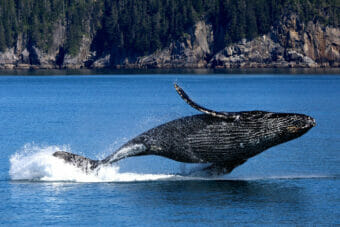
A humpback whale breaches in Kenai Fjords National Park on June 12, 2013. Humpback whales, with their distinctive fins, are being increasingly spotted farther north in Arctic waters used by ice-adapted bowhead whales. (Photo by Kaitlin Thoreson/National Park Service)

Qaiyaan Harcharek was hunting for bowhead whales in the spring of 2007 when he first saw a humpback whale in the waters off Utqiagivik, his hometown and the nation’s farthest north community.

He and his fellow hunters had been “boating and boating and boating for days,” heading toward the site where a whale was spouting from its blowhole, when they encountered the humpback in the Beaufort Sea, well north of where that species usually swims.

“It should have been a bowhead because that’s all that’s ever up there that time of year,” Harcharek said

That is no longer the case. Humpback whales, better known in the waters between the tropics and the Bering Sea, are now commonly spotted in Alaska’s Arctic waters.

A bowhead whale and a calf in the Arctic on May 29, 2011.
A bowhead whale and a calf in the Arctic on May 29, 2011. (Photo by Corey Accardo/NOAA)

A recently study co-authored by Harcharek reviews the multitude of sightings since his 2007 encounter, and it shows how they have increased exponentially.

Aerial surveys conducted form 2009 to 2019 by the National Oceanic and Atmospheric Administration’s Alaska Fisheries Science Center tallied 150 sightings of 220 humpback whales in the Arctic waters, with twice as many sightings between 2017 and 2019 as in the three years prior.

Most of the humpbacks were seen between about 67 and 68 degrees north latitude, which is slightly north of Kotzebue, according to the data. It appears that there is some sort of feeding hotspot near the Inupiat village of Point Hope that is drawing large numbers of humpback whales, said lead author Kate Stafford of Oregon State University’s Marine Mammal Institute.

Farther north, where Harcharek’s 2007 encounter with a humpback was one of the first ever reported in the waters off Utqiagvik, the total sightings have not been as numerous, but there has been a similar increase in recent years. Data collected by the North Slope Borough’s Department of Wildlife Management shows that from 2020 to 2022 there were six nearshore sightings of humpback whales in the far-north waters, some with multiple animals, according to the study. In one single event in 2022, 10 humpback whales were seen breaching and slapping their pectoral fins on the water.

Harcharek, who said he sees a humpback whale “darn near every time I go boating,” has mixed feelings about the new arrivals.

“It’s fascinating to see new species. However, we don’t know what impact that is going to have on the whales that we live off of,” he said. “It’s fascinating. It’s interesting. It’s also a little terrifying because we rely on the bowhead for so much.”

A bowhead whale skull, seen on Aug. 6, 2022, is one of several displayed on the beach at Utqiagvik. Bowhead skulls are thick enough to break through sea ice, and they are among the characteristics that allow the whales to thrive in Arctic waters. Bowhead hunting is an important part of Inupiat culture. (Photo by Yereth Rosen/Alaska Beacon)

The catalyst for the study, Stafford said, was a 2021 boat survey with the late Craig George, the renowned whale biologist who worked for decades at the North Slope Borough’s wildlife department. They were watching a whale feeding in the Beaufort Sea that they assumed was a bowhead. Looking closer, she said, they saw the distinctive fin of a humpback whale.

That led them to a search of records kept by the borough and to consultations with Inupiat residents. People were eager to share their knowledge with George, Stafford said.

“Of course, Craig was the go-to person when people saw something interesting,” she said. “Because people trusted him with their information and observations and because he would listen to them with respect and with consideration, people went to him.”

Bowhead whales, with their thick bow-shaped skulls that can break through ice, have evolved to thrive in the Arctic. Inupiat hunting tradition targets bowheads and belugas, another Arctic-dwelling species.

In contrast, Alaska’s humpback whales spend part of their lives in the warm climates, wintering in Hawaii, Mexico or the waters off Japan and the Philippines.

There are five population groups of North Pacific humpback whales, three of which summer in Alaska waters. They are commonly seen in Southeast or Southcentral Alaska and the Bering Sea. They were known to occasionally range as far north as the southern Chukchi Sea, above the Bering Strait, but those appearances were considered rare – until now.

A humpback whale’s characteristic stub-like, humpy back fin is seen in this undated photo. (Photo provided by National Oceanic and Atmospheric Administration)

The new study, published in the journal Marine Mammal Science, shows how that range has expanded farther north still.

A possible explanation for the expansion, the study said, is climate change. Long-term warming has reduced Arctic sea ice, not only in the summer melt season but, as the past year’s record shows, throughout the year.

If lack of sea ice is a factor, humpback whales are not the only species taking advantage to expand northward. Previous studies have shown how killer whales are increasingly present in Arctic waters used by bowheads. One of those studies, led by George and published in 2017, tracked trends for wounds in the bodies of harvested bowheads and found increasing incidence of killer whale bite marks; a related study, published in 2020, provided direct evidence of killer whales preying on Arctic bowhead.

Another factor that might be at play, also related to climate change, may be warmth-driven changes in the food web that created more favorable foraging conditions for humpback whales, Stafford said.

Another possible explanation is the steady increase in the North Pacific humpback population, she said.

Humpbacks have thrived sufficiently in recent years that some are no longer considered members of an endangered or threatened species. Previously, all humpback whales worldwide were listed as endangered, but in 2016 NOAA Fisheries identified 14 “distinct population segments” and determined that Endangered Species Act protections were no longer warranted for most of those.

Biologist Craig George stands on Utqiagvik’s beach on Oct. 4, 2018. George, who went missing while rafting the Chulitna River last week, devoted much of his research to the effects of sea-ice loss. In past decades, the waters here would have been frozen over by October; in 2018, there was no ice within sight. (Photo by Yereth Rosen/Alaska Beacon)

Of the three distinct population segments that swim in Alaska waters, one is classified as endangered, one as threatened and one, which winters in Hawaii, no longer has any Endangered Species Act listing.

George died in July in a rafting accident near Denali National Park and Preserve. The newly published study may not be the last to bear his name as an author due to his work before his death, Harcharek said.

“Honestly, I would not be surprised if there’s other work. Although he was retired, he was never going to be retired completely,” he said.

George’s death hit Utqiagvik hard, Harcharek said. “I’ve known him my whole life,” he said.  “I’m sad. It sucks right now. We just lost an encyclopedia of knowledge of whales and ecosystems. That’s aside from just the amazing person he was.”

This story originally appeared in the Alaska Beacon and is republished here with permission.

Scientists observe chum salmon spawning in North Slope rivers

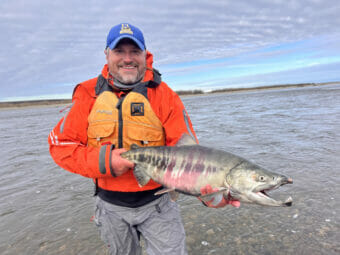
UAF associate professor Peter Westley holding spawning male chum salmon from the Anaktuvuk River in September 2023. (Joe Spencer/Alaska Department of Fish & Game)

University of Alaska Fairbanks associate professor of fisheries Peter Westley is clear that there’s nothing new about salmon straying into Arctic Ocean waters. Westley says the fish have long been occasionally observed and caught, but their numbers appear to be increasing.

“And we were interested in whether the change in the sort of frequency of salmon being encountered…is that a perhaps indicator that the salmon are not only showing up in the ocean but are showing up in rivers and are potentially working to establish populations in a new region.”

Last month, Westley lead a team that aerially surveyed two Colville River tributaries, the Anaktuvuk and the Itkillik, and counted about a one hundred chum salmon equally split between the two Arctic rivers. He says movement of a species farther north is a clear signal of climate change.

“So in the past where those fish might have been sort of hopeful colonists showing up and kind of giving it a go, the conditions are just changing enough that we might be on the cusp of having it be a viable success story for the salmon.”

Elizabeth Lindley, a PhD student working on the project, says that while the development is positive for the salmon, it’s not necessarily good for the region’s people.

“Being Yupik and from Bethel, I was really interested in this question about salmon, which are really important to me, maybe impacting other Indigenous ways of life and ecosystems,” she said.

Lindley helped organize and lead an Arctic salmon workshop last December where she says people shared difference perspectives on the movement of the fish.

“Some community members that were present expressed concern over increasing salmon and not wanting to catch more salmon because it interferes with cultural harvesting practices, but I think it really varies by the person and the community,” she said.

Lindley says the impact of salmon sharing spawning grounds with Arctic char and Dolly Varden is among the unanswered questions.

The UAF team deployed temperature sensors in gravel where the chum salmon were observed spawning to track whether the water remains warm enough for the eggs to survive. The origin of the Arctic chums is unknown, but Westley says analysis of samples gathered from the fish this fall will provide clues.

“Extract DNA and sort of compare that to the genetic structures of known populations,” he said. “You can also use the water signatures, the chemistry of the waters themselves that gets archived in the ear bones, the otoliths.”

Lindley and Westley both emphasize the value of Indigenous knowledge in understanding the history and future of salmon in the Arctic Ocean and North Slope rivers. The UAF lead research group plans to head back to the Anaktuvuk and Itkillik rivers next fall to look for smolt as well as more spawning adults.

Northern Alaska cable break repaired after 14 weeks of internet outages

A rocky stretch of coastline near Nome (Laura Kraegel/KNOM)

Repairs are complete to a severed fiber optic cable affecting Internet and cellular services to much of Northern and Western Alaska.

GCI announced the repairs in an email to customers Monday, 14 weeks after the cable was cut in an ice scouring event in the Arctic Ocean west of Prudhoe Bay. Many people in the affected regions experienced spotty internet and cellular services, and at times, no internet connectivity at all.

The company that built and owns the cable, Quintillion, originally anticipated service would be restored in eight weeks, but that timeline slipped several times.

When the cable initially broke, GCI switched customers to the company’s satellite and TERRA networks which allowed for some connectivity. But GCI spokeswoman Heather Handyside said the company is beginning to transfer customers back to the faster fiber-optic service that connects to the Quintillion cable.

“That restoral effort has already begun,” Handyside said. “And I believe that consumer customers are already seeing better service as a result.”

Handyside said GCI will be monitoring the network throughout the week. She said once network levels improve, the company will discontinue the credits it’s been providing customers since the initial cable break in June.

“It’s going to take us a while, maybe you know throughout the rest of the week, to fine tune things to make sure that traffic levels are optimized, and that everyone is receiving the connectivity that they were receiving prior to the break,” she said.

Updates to the network are being made during midnight and 6 a.m. Internet services through Northern and Western Alaska are expected to improve throughout the week. Quintillion cable break outage updates can be found on the company website.

Why it’s so important to figure out when a vital Atlantic Ocean current might collapse

As the planet heats up, Greenland’s ice sheet is pouring more meltwater into the Atlantic. Scientists are tracking whether this could cause a collapse in a crucial ocean current. (Mario Tama/Getty Images)

Deep in the Atlantic Ocean, there’s a massive current the size of 8,000 Mississippi Rivers. Its role in the Earth’s climate is so powerful that it determines weather from the equator to Europe, crop production in Africa and sea level rise on the East Coast.

Scientists say there’s a risk this vital current could shut down as the climate gets hotter, a collapse that could have dire consequences worldwide.

Researchers have been trying to determine when the Atlantic might cross that tipping point. But answering that is no easy task.

Now, a new study finds the collapse of the current, which is known as the Atlantic meridional overturning circulation, or AMOC, could happen far sooner than scientists have previously thought, possibly within a few decades, as a result of human-caused global warming.

“It’s a worrisome result,” says Peter Ditlevsen, professor of climate physics at the University of Copenhagen in Denmark and an author of the study. “It calls for quite immediate actions. We need to reduce emissions. We need more brakes on the train.”

Other researchers caution that the timeline of such a collapse — or even whether the AMOC will collapse at all — remains unclear, given the sheer complexity of understanding an ocean system that stretches thousands of miles. Previous assessments have suggested a collapse is unlikely this century.

The new study adds to a growing body of research suggesting crucial tipping points in the climate system are incredibly hard to predict, and that humans are changing the fundamental processes of the Earth faster than we can understand them. Given the potential for catastrophic impacts, scientists say further research to understand the AMOC is more urgent than ever.

“The AMOC is a bedrock of our climate system,” says Nicholas Foukal, an assistant scientist at the Woods Hole Oceanographic Institution who was not involved in the study. “It redistributes heat globally and it’s something that we just take for granted.”

A conveyor belt for heat

When it comes to weather, Europe has a lot to thank the AMOC for. Cities like London and Paris are warmer than their counterparts at similar latitudes in North America.

“In Scandinavia, we have a sort of pleasant, mild climate,” Ditlevsen says. “And if you compare that with the U.S., we are at the latitude of Alaska, which is much colder than Scandinavia.”

Milder winters in Europe are largely thanks to an influx of heat from the AMOC. The current carries vast amounts of warm water from the equator, which travels north up the East Coast of the U.S. before crossing to Europe. That’s where the water cools off, releasing heat into the atmosphere.

The cold, salty water is denser and heavier, causing it to sink near Greenland. Like a massive ocean conveyor belt, the current then returns in the direction it came from, flowing south along the ocean floor.

Scientists know this conveyor belt has collapsed in the past. Around 12,000 years ago, temperatures around Greenland suddenly dropped by about 18 degrees Fahrenheit. That shift is attributed to a sudden shutdown of the AMOC — and demonstrates the potential impact of such a climate tipping point.

“A tipping point is a strong result to a small change,” Ditlevsen says. “It’s when you’re pushed over the cliff. When you reach the cliff, you drop.”

Looking for the tipping point

To determine how close that tipping point might be, Ditlevsen analyzed ocean temperature records near Greenland over the past 150 years and ran a statistical analysis to track the fluctuations in temperature. He and his co-author found increasing variability in temperatures, which they say is a sign the AMOC is weakening. Based on their analysis, they estimate the AMOC could collapse between 2025 and 2095. That’s decades earlier than other studies have found.

While researchers disagree on the timing of such a collapse, there is broad consensus on the potential consequences. A collapse in the AMOC could have ripple effects around the planet. Temperatures in Europe could fall, while heat in the tropics would rise, exacerbating climate change that’s already occurring.

Rainfall could decrease across the Sahel region of Africa, threatening crop production for millions of people. The summer monsoon could weaken across Asia and sea levels could rise even faster in the Eastern U.S. Scientists have already found that subtle shifts in Atlantic currents can have serious effects on marine life, like threatening endangered North Atlantic right whales.

“It’s going to affect agriculture,” Foukal says. “It’s going to affect disease, especially in the equatorial region. It’s going to affect mass migration.”

When is still a big question

Still, a midcentury collapse is at odds with what other research studies have found. A report from the Intergovernmental Panel on Climate Change found the AMOC is unlikely to collapse this century.

“Whether it will collapse is still a question,” Foukal says. “I think that there is still quite a bit of uncertainty.”

Foukal says this most recent study relies on temperature records from a small part of the system and doesn’t simulate what would happen to the entire current itself. He says it’s also crucial to understand the cause of a collapse to estimate the timing — something Ditlevsen’s study didn’t address.

The last time the AMOC shut down, the Earth was coming out of an ice age. Scientists believe a vast amount of fresh water from melting glaciers poured into the Atlantic, interfering with the conveyor belt. Fresh water is lighter than salt water and can inhibit the sinking motion that powers the entire current.

A similar thing could happen again, as humans continue to heat the atmosphere by burning fossil fuels. Ice in the Arctic and Greenland’s ice sheets are melting at an increasing pace, also adding fresh water to the Atlantic. But Foukal says researchers are still trying to determine whether that would be enough to cause a complete collapse.

What’s more likely, he says, is that the AMOC could weaken this century. That could still cause some of the same serious impacts as a collapse, though to a lesser extent. Some studies have shown a weakening is already happening, but other researchers say that given the normal fluctuations in the current, it will take more time to make that call.

Direct measurements of the Atlantic circulation have only been made since 2004. Given the depths and distances the AMOC covers, it’s challenging to keep tabs on it. But with the potential for such widespread impacts, scientific researchers say further research is more urgent than ever — as well as rapid action to limit how much the planet warms.

Copyright 2023 NPR. To see more, visit https://www.npr.org.

Craig George, renowned Arctic wildlife biologist and whale expert, missing in rafting accident

Biologist Craig George stands on Utqiagvik’s beach on Oct. 4, 2018. George, who went missing while rafting the Chulitna River last week, devoted much of his research to the effects of sea-ice loss. In past decades, the waters here would have been frozen over by October; in 2018, there was no ice within sight. (Photo by Yereth Rosen/Alaska Beacon)

A veteran Arctic scientist who was one of the world’s most distinguished whale experts was missing after a rafting accident in Interior Alaska last week.

Craig George, a retired senior biologist with the North Slope Borough Department of Wildlife Management, went missing on Wednesday while rafting the Chulitna River with companions south of Cantwell near Denali National Park, the Alaska State Troopers reported. His body had not been found as of Monday, a trooper spokesperson said.

George, 70, spent decades studying bowhead whales and documenting their long-term increases. He also studied the myriad ways that reduced sea ice and other climate-change impacts have affected Utqiagvik and the rest of coastal Arctic Alaska.

He published studies on such subjects as increased predation on bowheads by killer whales that can now swim farther north, the way changes in shore ice have affected Inupiat hunting practices, and ways to preserve traditional food cellars that are dug in the warming permafrost.

He moved to the town then known as Barrow in the 1970s. He was an animal caretaker at the Naval Arctic Research Laboratory before embarking on his long career with the North Slope Borough. He became known for his collaborative work with Inupiat experts.

George had talents and accomplishments beyond his scientific work. He was a pillar of the Utqiagvik community. He was a musician, and often performed a song he wrote called “Keep on Whaling.” The son of Newbery Award-winning author Jean Craighead George, he and his sister collaborated to complete one of his late mother’s unfinished books after she died. The book is titled “Ice Whale”; like many of Jean Craighead George’s books, it was partly inspired by her son’s scientific work in Arctic Alaska.

Tributes to George poured in over social media once news of his accident was released.

D.J. Fauske, director of external affairs for the North Slope Borough, wrote on his personal Facebook page about memories from first grade, when he was a student at Ipalook Elementary School and first met George.

“He was kind, gentle, humble, funny, and could teach you something without you even knowing you were in the middle of an academic lesson. No such thing as a dumb question to him. . . . It’s been a pleasure working for my hometown borough, and people like Craig were a big part of the reason. He helped so many people and helped preserve and protect an Inupiat culture that was judged and stereotyped for years by outsiders. He helped combine thousands of years of traditional local Inupiat knowledge with world class technology and data.”

Suzanne Little, who oversees Alaska land conservation for the Pew Charitable Trusts, played in a band with George, and performances included a mid-1980s event in what was then the new Barrow High School.

“Dr. Craig George, aside from being an amazing friend, musician, songwriter, father, spouse and stellar community member, was one of the first western science biologists, along with Dr. Tom Albert, who listened to the Indigenous Knowledge of the Inupiat People and instated a Bowhead Whale census program to prove the Indigenous people were correct about the Bowhead whale population NOT being endangered. . .Craig’s work provides us all a roadmap,” she posted on Facebook.

Cheryl Rosa, deputy director of the U.S. Arctic Research Commission, commented: “Dr. Craig George was a remarkable Arctic research scientist with a unique scientific curiosity that drove his work, his results often endearingly delivered with softspoken humor and humility. He was a great proponent of co-production in research—far before it became a buzzword—and was fair and empathetic, in both science and life. The respect he showed the communities he worked with earned him a place as a trusted partner and showed the rest of the scientific community how research could be improved with local input. Craig was a mentor to many and a friend to even more. Many scientists entered and remained in the field of Arctic research because of him. He was a wonderful person and will be deeply missed.”

The search for George has been hampered by high water in the river, said Austin McDaniel, a spokesman for the Alaska State Troopers. A dive team is waiting for water levels to fall so that specialized equipment can be deployed in the river, McDaniel said.

This story originally appeared in the Alaska Beacon and is republished here with permission.

Site notifications
Update notification options
Subscribe to notifications