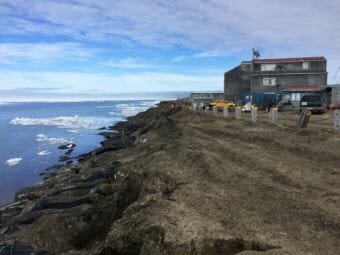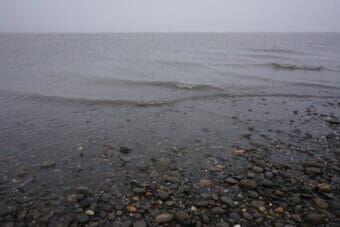
The Utqiagvik coastline, in a residential area near downtown. (Ravenna Koenig/ Alaska’s Energy Desk)
It’s been a week since ice severed a fiber optic cable in the Arctic Ocean, cutting communications to at least half a dozen communities in Northern Alaska. Many are still without internet or cellular service, and the company that owns the cable says it will be two months until the line is repaired.
The break is disrupting normal life for many communities above the Arctic circle — including vital emergency services.
The cable connected most of Northwest Alaska. Quintillion, the Alaska-based company that owns the line, says the break primarily affected Nome, Kotzebue, Point Hope, Wainwright and Utqiagvik, as well as the villages of Atqasuk and Nuiqsut.
Last Wednesday, the North Slope Borough issued an emergency declaration stating that the fiber break would “severely impact” the ability to provide essential services such as search and rescue, police, fire and utilities.
Atqasuk is feeling the break’s repercussions. Doug Whiteman is mayor of the community of about 300 people, which is 60 miles southwest of Utqiagvik. He says emergency communications aren’t working like they should between communities.
“We had a circumstance with 911 calls. The village police officer could call Barrow and they could hear, but their replies didn’t come back,” he said. “It’s a one way conversation.”
Whiteman says the borough is advising the community to stay off what limited internet is available. He says right now, public safety, the health clinic and fire are all sharing one satellite phone.
Further south, Wainwright — a community of nearly 700 people — is encountering similar challenges.
Mayor Chester Ekak says Wainwright is having problems with their 911 services, too. They also experienced one way communication with emergency services in Utqiagvik, which forced them to find a work-around.
“We had to set up a temporary dispatch facility and utilize VHF for police, fire and ambulance call out,” he said.
He says it’s not just emergency response that’s ground to a halt. It’s also daily life.
“It’s affecting businesses. Day-to-day operations. Stores turned into cash-only stores — they all were affected by the cable break,” he said.
Ekak says the ATMs require an internet connection, so now customers can’t withdraw money for the cash-only businesses. And Ekak says it’s also affecting people who receive assistance like EBT because they can’t use their cards.
Businesses in Kotzebue are also feeling the effects. Lewis Pagel is the owner and lead physician at Arctic Chiropractic. He says his office is without internet, which means he can’t process insurance billing, and his patients can’t schedule appointments.
“Also, my credit card machine won’t work either. So I can’t collect payments at the office. So from a financial standpoint, it’s pretty detrimental,” he said.
Pagel’s office isn’t alone. Kotzebue City Manager Tessa Baldwin says the fiber break is disrupting government operations — and that the city is unable to connect to their server, internet and phone.
“The city is without internet, andI went over there yesterday morning to pay my business taxes. But they can’t process anything,” she said. “We’re very lucky that our emergency services are still in operational mode.”
This week, Baldwin says the city was scrambling with payroll. They were able to resolve the issue, and now over 100 people employed by the city will be receiving their checks — a few days late.
“It’s been extremely difficult to manage a city with no internet or phone service,” she said.
Baldwin says there have been other issues including meeting the city’s grant deadlines and communicating with city partners outside of Kotzebue.
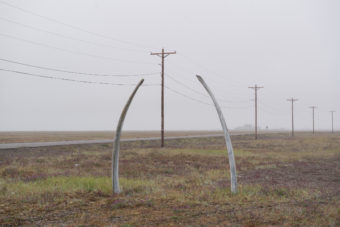
Whalebones welcome visitors to Point Hope. (Photo by Mitch Borden/KNOM)
A man firing a rifle in the Northwest Alaska village of Point Hope Wednesday was shot and killed by a North Slope Borough police officer, Alaska State Troopers say.
According to a trooper report posted online Thursday morning, troopers were informed at about 12:30 p.m. Wednesday of the shooting. The suspect was identified as 40-year-old Point Hope resident Robert Nash.
The Alaska Bureau of Investigation responded to the village, about 330 miles southwest of Utqiagvik.
Troopers said, according to the bureau’s preliminary investigation, Nash had been firing a rifle at residents and buildings in the community of nearly 900 people.
Staff at the local AC store in Point Hope, reached at midday Wednesday, said the village was on lockdown.
A responding borough police officer found Nash armed with a long gun on the outskirts of town, according to the trooper report.
“The officer gave commands to Nash to drop the firearm, however, he refused and pointed the weapon at the officer,” said the trooper report. “Due to the actions of Nash, the NSBPD officer fired their duty weapon, striking Nash.”
Nash was taken immediately to the Point Hope clinic, where he died, said troopers. Nobody else was injured during the incident.
Troopers said Nash’s family has been notified, and his body has been sent to the state medical examiner’s office for an autopsy.
Nash’s shooting is being examined by the Alaska Bureau of Investigation. Its work will be reviewed by the state Office of Special Prosecutions.
This is a developing story. Check back for updates.
The Beaufort Sea is seen on Aug. 23, 2018, from East Dock on the North Slope. The Liberty Unit, which has yet to be developed, is located about 20 miles east of here. (Photo by Yereth Rosen/Alaska Beacon)
Before the ConocoPhillips’ massive Willow project emerged as a subject of excitement and controversy, a different North Slope oil project promised to open a new Arctic oil frontier.
The Liberty field, with an estimated 150 million barrels of recoverable oil, was to have been the first producing oil field located entirely in the federally controlled Outer Continental Shelf, in the icy Beaufort Sea.
It has a long history, dating back to Royal Dutch Shell exploration drilling in the 1980s. It was pursued by BP Exploration (Alaska) Inc. for two decades. It is now part of Hilcorp’s Alaska portfolio after BP sold off its Alaska assets and, ultimately, departed the state.
And it is currently in limbo.
As state officials pin high hopes on Willow and the revenues and jobs it will generate, the history at Liberty provides a cautionary tale about the uncertainties of oil development projects.
Just a few years ago, Liberty’s current owner was projecting confidence in the project. A Hilcorp development and production plan – the third drawn up over Liberty’s lifetime — was approved in late 2018 by the Bureau of Ocean Energy Management. But that approval was overturned by the federal 9th Circuit Court of Appeals on Dec. 7, 2020.
At Hilcorp’s request, BOEM’s sister agency, the Bureau of Safety and Environmental Enforcement, in December of 2019 put the three leases that comprise the Liberty prospect into suspension, a status that was renewed in 2021, according to BOEM. The suspension is in effect for three years and stops the clock from ticking toward lease expiration, according to BOEM.
The agency in 2021 asked Hilcorp if it still planned to pursue the project; Hilcorp responded in 2022 with a letter saying it is updating its Liberty oil-spill response plan.
BOEM said in a statement that as of March, it had not received an updated plan.
The image on the cover of the final environmental impact statment issued in 2018 by the Bureau of Ocean Energy Management shows where and how the Liberty project would be built. The EIS evaluated what was the third development and production plan submitted over the project’s lifetime. (Image provided by Bureau of Ocean Energy Management)
That history has left Liberty on the sidelines amid the discussion and controversy about the ConocoPhillips’ much-bigger Willow project.
“Liberty seems like an age ago,” said Erik Grafe, a staff attorney for Earthjustice, an environmental law nonprofit. Grafe managed litigation against federal approval of the project.
Fifteen years ago, however, there was much excitement in Alaska about Liberty.
BP had an ambitious plan to develop the project by producing oil from the shore using ultra-extended-reach drilling. Liberty would have the longest wells in the world, potentially reaching up to 40,000 feet in length, to be drilled by the world’s largest land-based drill rig, commissioned by BP and built by Parker Drilling specifically for the project.
The $1.5 billion project received the go-ahead from BP’s corporate headquarters in 2008, and the company’s Alaska leaders hailed that news with an announcement to reporters.
“This is about as sexy as it gets,” BP Alaska Exploration Inc. President Doug Suttles told reporters at the time. “This is an example of what I’ve referred to as exploration through technology.”
Two years later, Suttles was BP’s chief operations officer and was embroiled in the response to the Deepwater Horizon disaster in the Gulf of Mexico. Four years after BP sanctioned Liberty, it officially withdrew the development plan, even though construction at the site had already started. In 2018, dismantling work began on the giant rig BP had built for Liberty; the rig wound up never drilling a single well. In 2019, BP announced it was leaving Alaska and selling off its remaining assets – including Liberty – to Hilcorp. That sale was made final in 2020.
BP’s ultra-extended-reach drilling project was never a good idea, said Mark Myers, a former Alaska Department of Natural Resources commissioner who served previously as director of the U.S. Geological Survey and director of the Alaska Division of Oil and Gas.
“It was just, technologically, a bridge too far,” said Myers, a geologist who serves on the U.S. Arctic Research Commission and previously also served as a chancellor for research at the University of Alaska Fairbanks.
The problem with such long-distance directional drilling is that it would have required too much drilling through a difficult shale layer, called Kingak, that is known for swelling and slumping, Myers said. Typically, operators on the North Slope try to limit their penetration of the Kingak layer, he said.
The entrance of what was then the BP Exploration (Alaska) Inc. building in Midtown Anchorage is seen on Aug. 27, 2019, just after the company announced its plan to sell off all its Alaska assets. The slogan above the door reads: “Prudhoe Proud: Pioneering the Past, Fueling Alaska’s Future.” BP drew up two separate development plans for Liberty. In 2014, it sold half of the project share to Hilcorp, and Hilcorp became the unit’s operator. In 2020, Hilcorp assumed full ownership of Liberty, along with ownership of all remaining BP assets in Alaska. (Photo by Yereth Rosen/Alaska Beacon)
The plan for ultra-extended-reach drilling was replaced by a more traditional Alaska development and production plan featuring an artificial island similar to four others that are in use elsewhere on the North Slope. That island plan was the one overturned by the 9th Circuit Court of Appeals in 2020. No updated plan has yet been submitted to federal regulators.
Despite the stall, there are still factors weighing in favor of Hilcorp eventually developing the Liberty project, Myers said.
“The oil’s there. It’s not very far from infrastructure,” he said. “They’re definitely motivated to do it.”
The nearby infrastructure, importantly, is now owned and controlled by Hilcorp, eliminating the need for what might be a difficult negotiation with other parties for access, he said.
On the negative side is Liberty’s location, Myers said. “Offshore is always more tricky than onshore,” he said. Arctic ice – which can gouge underwater oil structures – is one of the major complications, he said.
Another point weighing against Liberty’s development, Myers said, is President Biden’s withdrawal of remaining Beaufort Sea territory from future oil and gas leasing schedules. The action putting the unleased portions of the Beaufort off-limits to future development came at about the same time the administration approved the Willow project.
The withdrawal does not affect the existing leases in federal waters of the Beaufort – the three currently suspended Liberty leases and the three leases that are part of the Hilcorp-operated Northstar unit, which is mostly on state territory. But it diminishes investment prospects on those existing leases, Myers said. “It is easier to get investment if you have an active leasing program,” he said. If there is no leasing program, “it’s giving the message that it’s a difficult place to work.”
Hilcorp, which now operates the giant Prudhoe Bay field and other fields acquired from BP, may be busy with work other than Liberty, Myers said. “It’s got its hands full, likely, with its existing infrastructure,” he said.
And the risk of litigation continues, he said.
Hilcorp declined to respond to numerous requests for comments on its plans for Liberty.
Though they were both seen at different times as groundbreaking Arctic Alaska developments, there are some important differences between Willow and Liberty.
A copy of the two-volume 2001 draft environmental impact statement on the BP’s first development plan for the Liberty field is seen on a shelf on Thursday at the Alaska Resources Library and Information Services on the University of Alaska Anchorage campus. More volumes analyzing Liberty development plans are on other shelves at the library. So far, three separate Liberty development plans have been proposed. (Photo by Yereth Rosen/Alaska Beacon)
An obvious difference is location; Willow is onshore, where development is easier, while liberty is offshore. They differ in size; Willow is about four times as big in reserves, with about 600 million recoverable barrels estimated, and ConocoPhillips plans to spend several billion dollars on Willow, much more than the $1.5 billion planned by BP.
But there are links and parallels.
The legal issues that tripped up the federal government’s 2018 approval of Liberty’s most recent development plan also applied to litigation over the Trump administration’s initial approval of Willow in 2020. In both cases, courts overturned approvals based on what were considered flaws and omissions in the analysis of greenhouse gas emissions, Earthjustice’s Grafe said, though there were other issues in each case. While the Liberty case went all the way to the 9th Circuit Court of Appeals, the 2021 federal court ruling overturning Willow approval was not appealed. In Willow’s case, the BLM drew up a supplemental environmental impact statement that resulted in the Biden administration’s approval of a pared-back development plan.
Both Liberty and Willow are in federal territory, meaning that development would produce less revenue to the state than would be the case for oil fields on state land or in state waters.
In the case of Liberty, there was potential for the state to reap up to 27% of the royalties because of a federal law that allows for royalty sharing for oil produced between 3 and 6 miles offshore, under a provision of the Outer Continental Shelf Lands Act. The environmental impact statement released by BOEM in 2018 estimated such revenues would total $1.4 million a year. The state would not be entitled to taxes on oil produced at Liberty because that is federal territory, but it would have the ability to impose property taxes on any pipeline or other associated facilities that extend to state land.
In Willow’s case, what would be the state’s share of the royalties from produced oil is allocated by federal law to North Slope communities. Without royalty contributions to the general fund and with various tax credits that would reduce overall production tax revenues, Willow would lose the state money in its early years, with totals ranging from under $400 million to over $1 billion, depending on the estimate.
The Alaska Department of Natural Resources still includes Liberty in its list of projects that could produce oil in the future – albeit, not among the top five key projects like Willow that are considered most likely and most important.
Some legislators have expressed skepticism about Liberty’s inclusion in the list of pending oil projects.
Sen. Jesse Kiehl, D-Juneau, is among them. At a Jan. 18 hearing where DNR officials gave the production forecast – and made a passing mention of Liberty — he raised a question about the project, noting that he remembered hearing about its impending development many years ago when he was a legislative aide sitting in the same Senate Finance Committee room.
“I got the whole saltshaker out, not just the grain,” Kiehl said later about his remark.
This story originally appeared in the Alaska Beacon and is republished here with permission.
This 2019 aerial photo provided by ConocoPhillips shows an exploratory drilling camp at the proposed site of the Willow oil project on Alaska’s North Slope. (ConocoPhillips)
ConocoPhillips can begin construction immediately on the Willow project in the western Arctic, a federal judge ruled Monday.
U.S. District Court Judge Sharon Gleason denied requests for an injunction that would have stopped the company from working in the final weeks of the winter construction season, which will likely end in late April, when the tundra becomes too soft for heavy equipment to travel on.
Environmental groups and local residents who oppose the project filed two lawsuits last month, claiming the decision to allow ConocoPhillips to develop its leases in the National Petroleum Reserve was made contrary to environmental laws.
Those cases are still pending. But the judge declined to stop work on Willow in the meantime, saying the plaintiffs did not convince her that the company’s winter construction plans would cause serious and irreparable harm.
Her decision frees ConocoPhillips to embark on its plan to build ice and gravel roads, open a gravel mining site and begin hauling and dumping gravel in the National Petroleum Reserve-Alaska. Noise and vibration from blasting at the mine site won’t cause permanent harm, the judge wrote.
She acknowledged that the mayor and some residents of Nuiqsut — the closest village — have concerns about Willow, but Gleason said she gave “considerable weight” to the views of the North Slope Borough, the regional Native corporation and the village corporation for Nuiqsut, all of whom support the project and the winter construction activities.
The Wilderness Society, one of the groups that is suing, issued a statement vowing to continue to fight the project.
Rachel Kallander, founder and director of the Arctic Encounter Symposium, speaks at a press conference during the 2022 symposium in Anchorage (Lex Treinen/Alaska Public Media)
Arctic leaders and ambassadors from 20 countries will be meeting in Anchorage for the Arctic Encounter Symposium this week, with security of the region at top of mind.
The policy-focused forum is billed as the “largest Arctic convening in North America.”
“We’re hosting leaders from the U.S., Canada, Iceland, Denmark, Sweden, Norway, Finland, and then many states as well that have interests in the Arctic or are observer states with the Arctic Council,” said founder Rachel Kallander.
Notably missing from the list of participating nations: Russia.
The Arctic Encounter Symposium has taken on new importance since the Arctic Council, an intergovernmental forum, went dormant last year after Russia’s invasion of Ukraine. It’s Russia‘s turn to chair the council and the other member countries have condemned the invasion. They put council meetings on pause until the chairmanship passes to Norway this year.
At the Arctic Encounter event, Norway’s senior Arctic official is scheduled to articulate his country’s priorities for during its two-year chairmanship of Arctic Council.
“At the top of many people’s minds is national security, and sort of the future of the Arctic Council, and the diplomatic efforts and cooperation among states in the Arctic, given the conflict that started last year with Russia,” she said.
The conference runs March 29 through March 31. Students can get free tickets to the conference sessions.
Climate protesters unfurled a “stop Willow” banner at the Interior Department’s headquarters, where President Biden was speaking. (Liz Ruskin/Alaska Public Media)
While climate activists unfurled an anti-Willow-project banner in front of the Interior Department headquarters near the White House Tuesday, President Joe Biden was inside, bragging about his environmental and climate record.
“My first year in office we protected more lands and waters than any American president since John Kennedy,” he said, to cheers in the agency’s auditorium.
He announced new monuments in Nevada and Texas, as well as a new marine sanctuary southwest of Hawaii that covers an area larger than all of Alaska.
But outside the building, the protesters weren’t impressed. They haven’t let up on Biden since last week’s decision approving Willow, ConocoPhillips’s plan to drill 200 oil wells in Alaska’s western Arctic.
They’ve launched a series of protests in Washington, D.C. that could undercut his message on climate change and alienate the young voters who supported his 2020 election.
Biden made action to reel in greenhouse gas emissions a central part of that campaign. His decision on Willow – the largest pending oil project on federal land – quickly galvanized opposition online, particularly among young people, who watched anti-Willow TikTok videos by the million.
Art student Nadia Nazar was an organizer of Tuesday’s protest at the Interior Department. (Liz Ruskin/Alaska Public Media)
So far, the in-person protests haven’t been of that scale, but the sustained focus could threaten to tarnish Biden’s legacy on climate.
“Biden keep your promise – stop Willow,” some 20 activists chanted Tuesday. They beat plastic buckets with drumsticks. For a backbeat, they played a recording of Biden’s voice on a loop, making promises in 2020 they say he broke.
“No more subsidies to the fossil fuel industry,” Biden said during a presidential debate. “No more drilling on federal lands. No more drilling, including offshore. No ability for the oil industry to continue to drill. Period.”
Baltimore art student Nadia Nazar is an organizer with a youth-led climate justice group called Zero Hour, part of a coalition she said organized the event at the Interior Department. She said they want Biden to feel the pressure when he makes future decisions on oil development, and to know that his re-election could be on the line.
“A lot of young people turned out and voted for him last election,” she said. “He made these promises to us. And the climate crisis is something that’s so important to not only us, but so many people here in the U.S.”
Protesters on Monday disrupted a presentation at a Washington think tank featuring White House climate advisor Ali Zaidi, and a group called Climate Defiance says it intends to blockade the White House Correspondents Dinner next month.
Close
Update notification options
Subscribe to notifications
Subscribe
Get notifications about news related to the topics you care about. You can unsubscribe anytime.