KOTZ - Kotzebue

KOTZ is our partner station in Kotzebue. KTOO collaborates with partners across the state to cover important news and to share stories with our audiences.

Advocates push for drastic measures, as the Western Arctic Caribou Herd drops to a new low

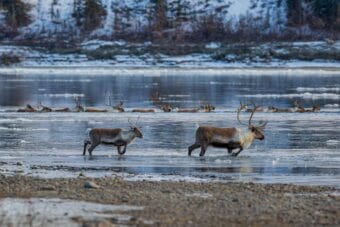
Caribou crossing the Kobuk River as it freezes up during the fall migration.
Caribou crossing the Kobuk River as it freezes up during the fall migration. (Used with permission from Jim Dau)

The latest estimate for the Western Arctic Caribou Herd is 121,000, a steep drop from 2023. The last time the herd’s numbers were this low, Jimmy Carter was president — almost 50 years ago.

Once one of the world’s largest herds, its range is the size of California, stretching across a large swath of Northern and western Alaska. For the remote communities of the region, caribou are not only a central food source. They also have considerable cultural significance to the remote communities of the region.

Alex Hansen is a Kotzebue-based wildlife biologist with the Alaska Department of Fish and Game. He said the latest population count from earlier this year is down considerably.

“Basically, based on the last count in 2023, we’ve lost 20% of the population,” Hansen said.

Hansen’s department announced the findings at the annual meeting of the Western Arctic Caribou Herd working group held in Anchorage this month. The working group makes recommendations about the herd to federal and state regulators, who then set policy and bag limits for hunters.

This year’s population count led the working group to classify the herd as “critical, declining.” It’s the lowest population tier in their management plan. The designation directs managers to intensify efforts to the maximum extent possible for the survival of the herd.

Hansen also urged the working group to be pointed with their recommendations to the Alaska Board of Game, which meets every three years. Under state law, that board is ultimately responsible for any regulation changes.

Hansen says if the board doesn’t act in 2027, the herd’s steep declines could continue unabated for another three years.

“Six years we’ve lost the number of caribou that we have currently,” Hansen said. “So we can kick the can down the road. ‘Another few more years, let’s not do anything for the Board of Game this time. Let’s wait til the next time.’ That’s about five or six years from now. What do we have at that point? Maybe nothing.”

At last year’s Board of Game meeting, the caribou working group recommended that the board dramatically reduce the caribou harvest for the region’s hunters to four animals per year, with just one permitted cow or female caribou.

The Board didn’t follow that recommendation, which disappointed many subsistence users throughout the herd’s range. Instead, it set the limit at 15 caribou per year (only one of which could be a cow). The Board also opened up hunting to up to 300 non-resident hunters to take one caribou a year through a draw permit for Game Management Unit 23, which covers most of the Northwest Arctic. Typically, non-resident hunters don’t hit that limit.

Charlie Lean is a member of the working group that advocates for the herd. He represents the Nome region.

“I think we need to make suggestions, as we did two years ago at the Board of Game,” Lean said. “Maybe the Board of the Game will see the light.”

The working group voted again to recommend a limit of four caribou per year and to close hunting for non-residents for the management area that includes most of the Northwest Arctic. They also recommended if the herd population drops to 75,000, all hunting would automatically cease. Hunting could resume if the population rebounded to 100,000 caribou or a level that allows for a healthy sustained population.

The Western Arctic Caribou working group has classified the herd in a “critical, declining” state. This designation helps determine management plans. The working group recommended a hunting moritorium if the population declines to 75,000. The hunting ban would not be lifted until the herd reached a “preservative, increasing” tier of 100,000 caribou. (Western Arctic caribou working group meeting packet)

Tom Gray, who represents reindeer herders, shared the same sentiment of many of the working group members.

“It’s not my freezer that I’m worried about, it’s the caribou herd itself,” Gray said. “We need to keep that in the back of our heads as we’re trying to preserve this caribou herd.”

The working group also recommended a proposal to the Board of Game to make it legal for private citizens to shoot animals that predate caribou from aircraft within the herd’s range.

Predator control for caribou in Alaska is a controversial practice, but it has been used in Southwest Alaska to try to boost the Mulchatna caribou herd’s calf population.

Those who support reduced harvest limits could also request an emergency action through the Federal Subsistence Board, which is scheduled to meet in April.

On the state management side, next the Board of Game meeting is scheduled for January 2027. The deadline for proposals to the Board is May 2026.

Northwest Arctic continues recovery efforts 3 weeks after major flooding

Alaska Organized Militia members remove debris while supporting storm recovery operations at Kotzebue, Alaska, Oct. 15, 2025.
Alaska Organized Militia members remove debris while supporting storm recovery operations at Kotzebue, Alaska, Oct. 15, 2025. (Photo courtesy of the Alaska National Guard)

It’s been nearly three weeks since a storm caused major flooding and erosion damage in Kotzebue and other Northwest Arctic communities. That was before the remnants of Typhoon Halong made their way through the region.

After assessing the damage in multiple communities, officials said the region is moving quickly to make repairs as winter sets in.
Kelly Hamilton is the emergency manager for the Northwest Arctic Borough. He says more than 150 homes in Kotzebue have already been assessed for damage after the Oct. 8 flood and the remnants of Typhoon Halong a few days later.

The region saw similar flooding last year, too. Hamilton said many of the homes that needed repairs last year will have to go through the same process again, tearing out and replacing damaged flooring and insulation.

This year, he said the borough had a better game plan to start that work immediately.

“If at all possible, help the residents de-water, dehumidify, dry out their house, and then help them to the extent the borough can and get things buttoned up for winter,” Hamilton said.

Gov. Dunleavy declared a disaster for the region on Oct. 9, which was later amended to include damage from ex-Typhoon Halong. But Hamilton said it’s a tight timeline to get relief.

Temperatures in Kotzebue are already in the low teens and 20s this week, making repairs more challenging.

“The residents need a dry place to live, and winter is on the way,” Hamilton said. Otherwise, they’re just living on an ice block.”

According to Hamilton, a coordinated response between the borough and multiple local, state and even national agencies — including Maniilaq, NANA and the City of Kotzebue— helped assess the damage.

Hamilton said the borough’s Village Public Safety Program also helped, but now about a dozen of the borough’s VPSOs are deployed in the Yukon-Kuskokwim Delta to help with emergency response efforts there.

Damage in Kivalina and Deering

Kotzebue wasn’t the only community in the Northwest Arctic to experience damage.

In the community of Kivalina, over 280 residents sheltered at the school during the night of the Oct. 8 storm. Several returned home to flood damage.

The Alaska Organized Militia, including Alaska National Guard members, deployed eight people to Kivalina for repairs and assessments, according to Jeremy Zidek, a public information officer with the Alaska Division of Homeland Security.

Emergency officials said Kivalina also received help from the nearby Red Dog Mine, which was able to transport water, non-perishable food items and diapers to the community via helicopter. Many Kivalina residents have already applied to the state’s individual assistance program for financial help.

Zidek said the community of Deering had erosion near their health clinic.

Erosion in Kotzebue

Zidek also said emergency officials are working with Alaska Native Tribal Health Consortium on Kotzebue’s sewage lagoon, which had just undergone repairs.

“Those repairs were just completed about a week before the storm from last year’s storm,” Zidek said.

Representatives from the Alaska Department of Transportation and Public Facilities said there was significant slope erosion in Kotzebue, especially along Ted Stevens Way. The road is closed because of the severity of the erosion, and repairs are ongoing.

“We’re working on the repairs between the bridges, and we’re working as fast as we can,” said Angelica Stabs, a public information officer with the division. “We just saw a lot of erosion.”

Kotzebue resident Matt Bergan said his home experienced damage from the flooding. He spoke at a recent Kotzebue City Council meeting. Bergan said he thinks there should be more of an effort for long-term planning.

“It seems like there’s plenty of money to respond to emergencies and fix things like we’re doing now, but it seems harder to get the money for preventive measures before disasters happen,” Bergan said.

Residents have until Dec. 9 to apply for state individual assistance and can apply for federal individual assitance until Dec. 22.

State of Alaska Individual Assistance (IA) – Deadline is December 9, 2025
To register for State of Alaska Individual Assistance:
Call 1-844-445-7131, Monday – Friday, 8 a.m. – 4 p.m.
Or apply online https://ready.alaska.gov/Recovery/IA

FEMA Individual Assistance (IA) – Deadline is December 22, 2025
To register for FEMA Individual Assistance:
Call the FEMA dedicated Alaska Center at (866) 342-1699
Or apply online at https://disasterassistance.gov
 
Red Cross Assistance
To Register for assistance through the American Red Cross:
Call 1-800-RED-CROSS

Kotzebue issues mandatory evacuation order ahead of flooding from coastal storm

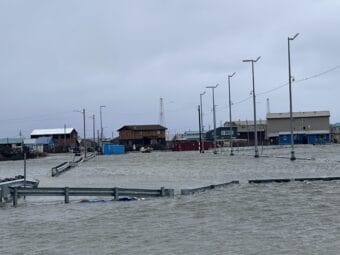
Flooded roads near Kotzebue's dock on Wednesday afternoon.
Roads near Kotzebue’s dock were flooded Wednesday afternoon. (Desiree Hagen/KOTZ)

The city of Kotzebue is under mandatory evacuation orders. That’s as the community prepares for flooding the National Weather Service warns could be worse than last year’s flood, which led to dozens of evacuations and two families losing their homes.

Flooding had already begun by Wednesday afternoon, and the Weather Service forecast said water could rise as high as 10 feet above the high tide line. Flood waters are expected to peak around 8 p.m. Wednesday night.

Forecast from National Weather Service, issued at 2:20 p.m. on Wednesday. (Courtesy of National Weather Service)

The city said Wednesday afternoon that the mandatory evacuation was issued to assist elders and to prepare residents to evacuate before dark. On Tuesday night, 28 residents stayed at Kotzebue Middle High School, which is the local evacuation point.

Kotzebue mayor Derek Haviland-Lie said first responders might not be able to reach people’s homes during the worst of the flooding.

“There may be a point, sometimes within the next 24 to 48 hours, that emergency services might not be able to make it to your home,” he said. “If that is the case, if you don’t go to the shelter, you’re going to have to shelter in place.”

As of this afternoon, barricades had been set up on the road past the airport and in other vulnerable areas of town. Haviland-Lie says the community should be prepared for power outages to several areas around town – including the airport area. Flights in and out of Kotzebue are also canceled.

“They’re worried about the water getting into their transformers that are out in the airport area. So there is going to be at some point where at least the airport is going to be without power. They have no choice,” he said.

The Kotzebue Electric Association is asking residents to report all outages and says that crews will respond when conditions are safe.

Flooding has already been reported in multiple sections of town including Front Street and the areas near Kotzebue’s airport and hospital. School is canceled Thursday. Both the city and borough closed early on Wednesday for non-essential workers.

Kotzebue’s Front Street around 4 p.m. on Wednesday, October 8. (Desiree Hagen/KOTZ)

The state also issued a notice Wednesday afternoon that it had activated its emergency operations center in preparation for a series of storms that are set to hit Western Alaska through the weekend. Kotzebue and other communities, including Kivalina, Shishmaref, Golovin, and Nunam Iqua, are expected to be among the hardest hit.

Residents in other Northwest Arctic communities have also reported that they’ve begun evacuating in preparation for the flooding. Kivalina residents are evacuating to higher ground at the school, located seven miles from the community.

This is a developing story. Check back for updates.

Ambler Road project remains in limbo after Army Corps of Engineers waited months to revoke permits

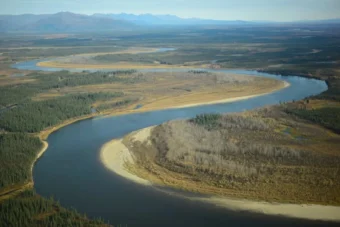
The Kobuk River runs through the Ambler Mining District, where a new road would be built to connect the Northwest Arctic with the Dalton Highway to Fairbanks. (Berett Wilber/Alaska Public Media)

Last June, the Biden administration rejected the Ambler Road Project, a proposed 211-mile road that would branch west from the Dalton Highway to a mining district. But the Pentagon did not give the Army Corps of Engineers a directive to revoke the road’s permitting until five days before President Donald Trump’s inauguration. Now it appears that the permits – and the project – may not be dead, but in limbo.
Major development projects need dozens of environmental permits from multiple agencies to move forward. It’s federal law. And for nearly a decade, permitting for the Ambler Road project has been a back-and-forth between presidential administrations.

Several tribes and conservation organizations say the road would cause irreparable harm to the land and subsistence resources. Mining companies and development supporters, including Gov. Mike Dunleavy and Alaska’s congressional delegation, say the road is necessary to access a region that mining companies say could contain valuable deposits of copper, zinc, lead, silver and gold.

Delayed Action?

The first Trump administration greenlit the project. Then multiple lawsuits challenged it. After a lengthy review process, the Biden administration rejected part of the project in June 2024, which canceled the entire thing.

But it wasn’t until Jan. 15 that then-President Joe Biden’s Pentagon ordered the Army Corps of Engineers to kill one set of permits that are critical to the road megaproject — the 404 permits. 404 permitting is part of the Clean Water Act. When developers need to dredge or fill wetlands, they require 404 permits from the Army Corps of Engineers.

The Ambler Road project has these permits to cover the entire length of the road corridor — which includes around 1,431 acres of wetlands, including a half-acre of open water. Corps spokesperson John Budnik confirmed in an email the timeline and the directive to revoke the 404 permits. And he confirmed that the permits instead remain suspended — not quite dead.

Rob Rosenfeld, a consultant for several tribes that oppose the project, believes the Corps dragged its feet and should have killed the 404 permitting after the Biden administration rejected the project in June. Rosenfeld said the Corps’ inaction went against the wishes of 88 tribal governments that oppose the project.

“The intent for the tribes was to have that revoked,” he said. “Finally, in the 11th hour, on Jan. 15, the assistant secretary of the Army issued the order to revoke.”

Rosenfeld said it is uncommon for a commander or his staff to ignore orders issued by a superior officer.

“It was either done intentionally or accidentally,” said Rosenfeld. “The chain of command in the Department of Defense is something that is typically unbreakable. I don’t know if I’ve ever heard of it.”

An uncertain future

On his first day in office, Trump ordered that the Biden administration’s decision on the road be thrown out and replaced with Trump’s own pro-development decision. The 404 permitting remains in limbo.

Budnik shared an official statement from the Corps:

“With the change of administrations and the new Executive Order regarding this project, we are currently pending updated guidance and will have more information as soon as it is available,” it read.

Representatives of multiple pro-road interests, including the Alaska Industrial Development and Export Authority, the state-backed economic development corporation, and three mining companies with stakes in the region, could not be reached for comment.

But the project still faces major obstacles. Nana Regional Corporation, a landowner along the road’s route, has withdrawn from the project, for now. A representative from Doyon, Limited, noted that while it is a major stakeholder for the project, Doyon does not support or oppose the road. According to Rosenfeld, permitting that was revoked under the Biden administration, like the National Historic Preservation Act Programmatic Agreement, would have to be rewritten, which could take at least a year.

“Nothing will happen quickly,” said Rosenfeld. “I can say the collective we — the environmental organizations, the tribes and those Alaskans that don’t want that road — are going to fight it in the courts.”

Bridget Psarianos is the senior staff attorney for Trustees of Alaska, an environmental law firm based in Anchorage. She said the Army Corps could still revoke the 404 permits, reinstate them or modify them.

In the meantime, though, Psarianos said the permitting is “sort of paused.”

Correction: This article has been updated to reflect that Doyon, Limited, a stakeholder for the Ambler Road, has maintained a neutral stance on the project.

Kotzebue airport reopens as flood damage assessments and cleanup continue

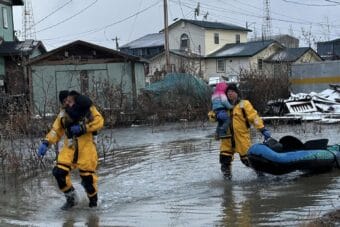
Rescue workers carry children after Tuesday’s flooding in Kotzebue. (From Northwest Arctic Borough Facebook page)

Recovery efforts continued Thursday in Kotzebue, after a storm and severe flooding Tuesday night destroyed buildings and forced 80 residents to evacuate their homes. Emergency responders are trying to assess the damage as winter quickly closes in.

“I think a lot of the debris, what we are seeing, they don’t even know whose it is, whose stuff it is in their yard, because things are floating around,” said Paulette Schuerch, who works with the Native village of Kotzebue. The tribe has been working with the state, borough and city on the emergency and cleanup response.

Officials said the flooding destroyed Kotzebue’s dock, several roads and bridges and dozens of structures at multiple subsistence camps. The force of the storm also transported four large dumpsters to a sandbar in Kotzebue’s lagoon.

City officials said two homes were also destroyed, displacing a family of six and a disabled elder. The family sheltered at Kotzebue’s school Wednesday night, and the elder stayed at the Nullaġvik Hotel. Coordinated efforts are underway between the city, Kotzebue’s tribe and local churches to secure long-term housing, supplies and food for the affected residents.

Schuerch said although 80 people evacuated to shelter on Tuesday, a lot more people may have left their homes to stay with family or friends. Many more residents’ homes were damaged. She said while many homes are still standing, they may have unstable foundations, damaged insulation, or other repairs that could cause serious safety issues as winter quickly approaches.

“All the insulation and floorboards really need to be an immediate resolution, because they’re going to freeze,” she said.

The City of Kotzebue is encouraging residents to document storm damage and to submit it to their planning department. It’s required for individuals to receive disaster assistance.

City officials said portions of Kotzebue’s sewer lagoon were also impacted, but need to further assess the damage.

Ten members of the Alaska National Guard are expected to arrive on Friday.

“The airfield is open right now, recently open, but it wasn’t for a couple of days,” said Alan Brown, a guard spokesperson. “Our ability to get there – logistics takes so much more energy and time, and it’s much more complicated the further out you are.”

Kotzebue’s airport opened Wednesday night for limited flights after being closed for more than 48 hours. Representatives from Maniilaq Health Center said an emergency flight coordinated with Alaska State Troopers and the Red Dog Mine was able to deliver critical medication to Point Hope on Wednesday while most planes were unable to fly.

Airport officials said the runway and weather equipment necessary for airline travel was damaged by the flood. The access road to the airport also experienced significant damage. Brown said those things can make a big difference.

“Something happens in rural Alaska of this degree, logistics becomes a real factor, whether or not, you know, we can get supplies in,” he said. “That takes a lot more time.”

State officials and the Alaska chapter of the Red Cross are set to arrive in Kotzebue within the next few days. Officials said more emergency supplies like bottled water, dehumidifiers, fans and building materials will hopefully come in soon.

Gov. Mike Dunleavy declared a state disaster on Tuesday.

Kotzebue flooding declared state disaster as residents recover

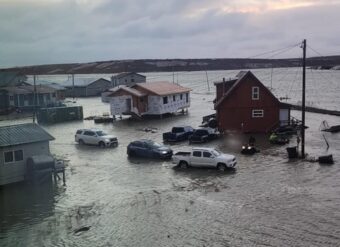
Flooding near Kotzebue’s lagoon on Oct. 22, 2024. (Courtesy Micheal Andrew Gudmundson)

The Northwest Arctic community of Kotzebue is starting recovery efforts after a coastal storm caused widespread flooding in the town of over 3,000 people. Gov. Mike Dunleavy issued a disaster declaration Tuesday in response, and emergency efforts are continuing as multiple organizations assess the damage.

Residents began evacuating their homes on Tuesday afternoon as rising water levels threatened numerous structures. Over 80 residents evacuated their homes on Tuesday night. Residents were evacuated by the city’s ambulances, with some people riding in the buckets of bulldozers.

The majority of displaced residents stayed in Kotzebue’s high school gym, and others at the hospital, hotel, businesses or with relatives. The borough and a local restaurant, Little Louie’s, provided pizza and breakfast in the morning.

Representatives from a multi-agency emergency response team say at least one home has collapsed into Kotzebue Sound because of the flooding. Officials say multiple homes may also be too damaged to live in, as winter quickly approaches.

Dozens of tents at a seasonal fish camp on Kotzebue’s northside of town have completely washed away and at least one sled dog team has also been displaced. The city says seasonal structures around the Swan Lake dock have also washed away.

Kotzebue schools and numerous businesses remained closed on Wednesday. The town’s airport runways closed on Tuesday due to excessive ice and winds. Flights were scheduled as of noon on Wednesday – although it was unclear if those planes would be able to land. Photos circulating on social media show Alaska Airlines’ terminal flooded.

Emergency officials are encouraging residents to take photos and save receipts in order to document the damages.

Several other communities have also experienced flooding because of the storm, including the coastal communities of Deering and Shishmaref.

Site notifications
Update notification options
Subscribe to notifications