KOTZ - Kotzebue

KOTZ is our partner station in Kotzebue. KTOO collaborates with partners across the state to cover important news and to share stories with our audiences.
Heavy storms set to hit Northwest Arctic will likely disrupt fragile sea ice

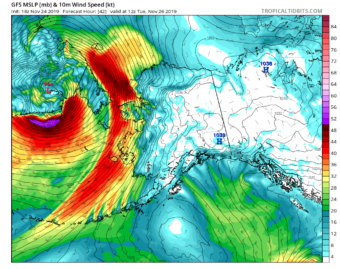
This map shows a storm inbound for the Northwest Arctic, with the color field representing wind speed. (Graphic courtesy of Rick Thoman)

Large snow storms are set to hit Western Alaska this week. While the storms are nothing new for this time of year, they are likely to disrupt sea ice in the region, which is forming at a much slower rate due to an abnormally warm year.

By the end of November in decades past, there was a thick layer of traversable ice in the Chukchi Sea. This year, there’s a lot of open water in its place. But Rick Thoman with the International Arctic Research Center says that sea ice had better conditions to grow this November than in the last few years.

“We’ve been in a comparatively cold pattern, lots of east and northeast winds,” Thoman said. “And that’s allowed sea ice to grow better than we have had in several of the recent autumns.”

However, large winter storms are set to hit the Chukchi and Northwest Bering Seas this week, and Thoman says that means the streak of good sea ice conditions is coming to an end.

Thoman says that storms like these are typical for this time of year. While ice is normally strong enough to withstand them, this year’s ice conditions are a little slimmer.

“The ice, of course, is new, so it’s relatively thin,” Thoman said. “It’s not like spring ice. Much more susceptible to disruption by these storms that there’s nothing new in them per se, but they’re acting on a lot of water instead of, historically, a lot of ice.”

Thoman says that while lower sea ice conditions pose safety and hunting risks, they can also lead to an overall temperature increase for the region. He says that Kotzebue average temperatures have risen by about ten degrees in the last few decades.

“That is tied to what we had in the spring, the unprecedented early loss of ice in Kotzebue Sound and the exceptionally warm water temperatures in the Sound over the summer,” Thoman said.

The National Weather Service has issued a winter storm warning for the Northwest Arctic from Monday night to Wednesday morning, highlighting heavy blowing snow and potential power line damage.

Kotzebue is forecasted to get 3 to 5 inches of snow, with surrounding villages getting as much as 13.

Study finds marine mammal viruses are traveling between oceans as sea ice recedes

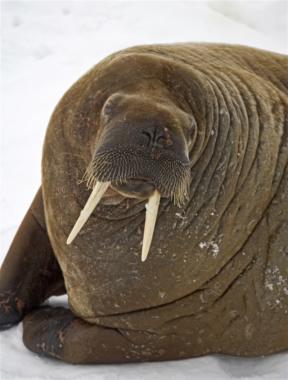
A walrus on the ice in the Arctic Ocean. (Photo by Mike Dunn/National Oceanic and Atmospheric Administration and the NC State Museum of Natural Sciences)
A walrus on the ice in the Arctic Ocean. (Photo by Mike Dunn/National Oceanic and Atmospheric Administration and the North Carolina State Museum of Natural Sciences)

As sea ice in the Arctic decreases due to climate change, it’s opening the way for more than cruise ship travel. Scientists have found evidence that links the decline of sea ice to the emergence of a virus in Arctic marine mammals that has killed thousands of seals in European waters.

While the virus isn’t proving harmful to Arctic species and those who subsist on them, its presence highlights a new disease risk for the region.

In two outbreaks — one in 1988 and another in 2002 — the Phocine distemper virus, PDV, killed thousands of European harbor seals in the North Atlantic Ocean. University of California Davis researcher Tracey Goldstein said the virus spread to multiple species, but hit seals the hardest.

“The virus in seals causes them to have respiratory disease, they get pneumonia,” Goldstein said. “It also affects their neurologic systems, so you’ll see animals coming up on the beaches coughing, some of them having seizures, being unaware of their surroundings.”

The disease is native to the Atlantic Ocean, but in 2004, PDV was found in Arctic sea otters for the first time.

Since the early 2000s, the Arctic has seen declining sea ice, opening new open water pathways between the Arctic and Pacific Oceans. A 15-year study published this month by Goldstein and other UC Davis researchers found that the new pathways are allowing contact between Arctic and sub-Arctic populations. Goldstein says that means diseases can also be carried across oceans.

“As ice changes, and animals move further, they will come in contact with new species and bring whatever it is that they normally have that may not be killing them into the Arctic,” Goldstein said. “And so we just have to be aware of that and continue to monitor for that.”

The study found that, since 2001, there have been various spikes of the distemper virus in Steller sea lions, bearded ring seals and various other Arctic marine mammals. But Goldstein said there was no link between the spikes and marine mammal deaths.

“We know it’s here, but we’re not at the moment seeing wide evidence that it’s killing seals,” Goldstein said. “So that’s good news for us, and it might mean that the seals in the Pacific are just not as susceptible as harbor seals in the Atlantic.”

And Goldstein said that just like measles, which only affects humans, the virus doesn’t hurt species that feed on those mammals.

“So people up there won’t get sick from the virus, and their children won’t get sick,” Goldstein said. “It’s definitely not a human health concern.”

Goldstein said that PDV is the first major example of a virus travelling between ocean marine species. While this particular virus isn’t doing widespread damage, its emergence opens the door for other viruses to pop up between oceans. And it’s something researchers will have to continue to monitor as sea ice continues to diminish.
New proposed LNG project would ship gas from North Slope to Asia on icebreaking tankers

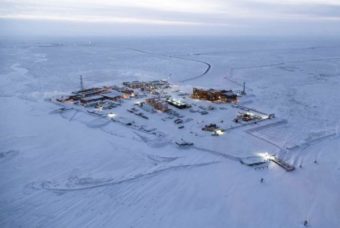
Construction on Exxon Mobil’s Point Thomson field in December 2015. (Photo courtesy of Exxon Mobil/MSI Communications)

A new company headed by former Alaska Lt. Governor Mead Treadwell has announced a project that would ship liquefied natural gas from the North Slope to Asia markets. Qilak LNG made the announcement Wednesday that it plans on shipping gas on icebreaking tankers from fields in Point Thomson.

The company is a subsidiary of Dubai-based Lloyds Energy, a company that’s been focused on LNG since forming in 2013. Treadwell serves as CEO of Qilak.

Since the 1980s, there have been dreams of shipping LNG through Arctic waters, but climate change has made the prospect more feasible in recent years.

“Over the last three and a half decades, we’ve seen a significant reduction in the amount of sea ice,” said Qilak President David Clarke. “And also in the nature of that ice. There’s much less multi-year ice and a lot more first-year ice in the Arctic.”

Clarke, a former longtime BP project manager, says the Russian Yamal LNG project has had success since beginning their gas exports two years ago. Since then, they’ve sold gas to markets in both Europe and Asia, and that gives Qilak confidence that the Alaska project would be financially feasible. Clarke also says Qilak’s project would be much cheaper than the proposed Alaska LNG pipeline project.

“By eliminating the 800-mile pipeline, we can reduce the cost to about two-thirds,” Clarke said.

The proposed state Alaska LNG pipeline was a major construction goal of former Gov. Bill Walker, but the project has stalled since the election of his successor, Gov. Mike Dunleavy.

Clarke says that the major costs of the project will be construction of a liquefaction plant and the offshore structure. He says they plan on leasing the icebreaker tankers, a plan Clarke says was similar to what the state planned on doing with its project.

At an Anchorage press conference Wednesday, Qilak announced that they have partnered with Exxon Mobil, who will supply at least 560 million cubic feet of their Point Thomson field for LNG mining.

“And that’s enough to generate four million tons a year of LNG, over a 20-year period,” Clarke said.

Clarke says the project is much smaller in scale than the Alaska LNG pipeline project, which estimated 20 million tons of LNG a year. Clarke says he’s open to gas from Exxon’s other partners, but he wants the project to show viability at a smaller scale before expanding.

“It makes it a lot more manageable in terms of matching supply and demand for the LNG and also a lot less capital has to be raised for the initial phase,” Clarke said.

As far as benefits to the state, Clarke says that LNG project would generate revenue for the state and North Slope Borough from Exxon as it expands in the region.

“We won’t generate as many jobs as building a pipeline, but we will generate jobs,” Clarke said. “Exxon will generate jobs doing their expansion, and we will have about 200 permanent staff at the liquefaction plant.”

He says that the company plans on reaching out to local communities to reduce impacts to whaling and subsistence in the area. Additionally, he says that LNG spills on tankers are much rarer than other fuel spills. The tankers don’t run on heavy fuel oil and are instead mostly powered by LNG, which evaporates when spilled into the ocean. He says that creates a minimal pollution risk for the Arctic, though LNG emissions do still affect the atmosphere.

Clarke says Qilak has already completed an initial feasibility study for the project, with a more detailed one to start next year. He says, ideally, the project would begin exporting LNG in the mid 2020s.

Site notifications
Update notification options
Subscribe to notifications