KOTZ - Kotzebue

KOTZ is our partner station in Kotzebue. KTOO collaborates with partners across the state to cover important news and to share stories with our audiences.
State extends deadline for PFD applications to April 30

(Rachel Waldholz / Alaska’s Energy Desk)

Alaskans who have not filed their Permanent Fund Dividend application yet have been given a small reprieve due to COVID-19 concerns. The deadline to file for the 2020 PFD has been extended to April 30.

State PFD offices have been closed to the public since mid-March due to concerns over the spread of the coronavirus, prompting the extension.

The state Permanent Fund department says filing online is easiest, and payments for online applicants will be issued on Oct. 1.

Paper applications are available on the state website. Applications must be postmarked by April 30 and mailed to a PFD office. PFD checks for paper applicants will be disbursed Oct. 22.

According to the budget passed by the legislature March 29, this year’s PFD will be $1,000. Gov. Mike Dunleavy has not signed the budget yet.

Bush Alaska lawmakers seek extension of REAL ID deadline due to coronavirus concerns

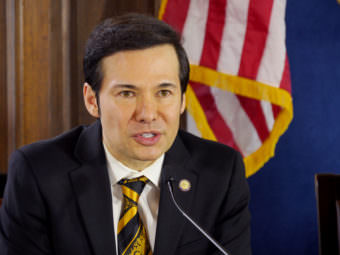
Rep. Neal Foster, D- Nome, discusses budget issues at a House Majority press availability on March 21, 2017. Foster co-chairs the House Finance Committee, and was concerned about the potential effect of further budget cuts.
Rep. Neal Foster, D- Nome, at a House Majority press availability on March 21, 2017. (Photo by Skip Gray/KTOO)

Update (Tuesday, March 24, 11:55 a.m.) — Wesley Early, KOTZ – Kotzebue

At a news conference Monday, President Donald Trump said he will be extending the deadline for Americans to be REAL ID compliant. Trump did not give specifics as to when the new deadline will be announced, stating it will happen “very soon.” (Read more)

Original story

Legislators who represent the bulk of Alaska’s villages are asking the state’s congressional delegation to try to extend the deadline for Alaskans to get REAL ID-compliant identification. The request comes amid concerns over the coronavirus.

The federal government is mandating that any Alaskan who wants to travel commercially on a plane must have one of those IDs by Oct. 1.

In a letter to Sens. Lisa Murkowski and Dan Sullivan, as well as Congressman Don Young, the Alaska House Bush Caucus wrote that the state Division of Motor Vehicles has yet to come up with a process to help rural Alaskans. Many of them don’t have DMV access in their villages to get their REAL IDs.

The lawmakers say those problems have been compounded by travel concerns brought on by the coronavirus. As of Monday morning, there were no confirmed positive cases of coronavirus in any of the state’s numerous village communities, but several villages have enacted various travel restrictions for their communities.

The caucus notes that the federal government has already extended several deadlines, including the deadline to file taxes and suspension of student loan interest and nationwide standardized testing.

The Alaska House Bush Caucus is made up of Reps. Bryce Edgmon, I-Dillingham; Tiffany Zulkosky, D-Bethel; Neal Foster, D-Nome; and John Lincoln, I-Kotzebue.


Updated: Alaska state basketball tournaments canceled

Noorvik’s and Kiana’s girls basketball teams, seen playing here in Kotzebue, both qualified for the 2020 ASAA 1A Basketball tournament. The tournament has been postponed due to coronavirus travel concerns. (Photo by Wesley Early/KOTZ)

Update (Monday, March 15, 11:03 a.m.) — Wesley Early, KOTZ – Kotzebue

The Alaska School Activities Association canceled this year’s state basketball and cheerleading tournaments due to concerns over the coronavirus. They had previously been postponed.
In a statement released Saturday, the ASAA says “MarchMadness Alaska is possibly the largest statewide gathering each year and ASAA would not be acting responsibly if we were to host this year’s event.”

The move comes a day after Gov. Mike Dunleavy ordered schools closed through March 30. Health officials have advocated people practice social distancing, limiting physical contact with others.

The state tournament had originally been scheduled for the week of March 15, with teams traveling from across the state to compete in Anchorage.

Original story

As Alaskans prepare for the first confirmed case of coronavirus in the state, the state’s high school athletic department is taking safety precautions.

In a statement on their website, the Alaska School Activities Association wrote that the ASAA/First National Bank state basketball and cheer tournaments have been postponed until further notice.

The ASAA has also canceled the Alaska Association of Student Governments Spring Conference to be held at Mt. Edgecumbe High School in Sitka.

The ASAA says that “the decision on whether or not to cancel the basketball and cheer championships will be made at a later date.”

To prevent the spread of coronavirus, the ASAA also recommends that anyone over the age of 60, anyone with underlying health conditions or respiratory issues should avoid travel to this weeks regional and conference tournaments.


Revisions to VPSO laws gain support from Native groups, though some parts remain controversial

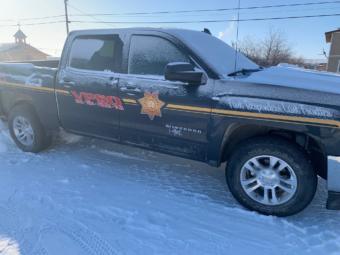
A Village Public Safety Officer vehicle parked in Kotzebue. (Photo by Wesley Early/KOTZ)

A bill that would substantially reform the state’s Village Public Safety Officer Program received public testimony last week from various Native leaders across the state.
While initially set up with a focus on wildlife management and search and rescue, the Village Public Safety Officer program has evolved over the last few decades as the primary form of law enforcement in rural villages. House Bill 287 was written with recommendations from a legislative working group to update the program to meet current rural public safety needs.

The VPSO program is administered through ten regional nonprofits throughout the state.

Melanie Bahnke with Kawerak Inc., a tribal consortium in the Bering Strait region, testified to the House Tribal Affairs Committee that current statutes limit how Native communities can keep their residents safe.

“Flexibility for example to have rotating VPSOs in our region, the ability to direct resources for infrastructure has been hindered,” Bahnke said. “Housing, holding cells… the way the current statute is prohibits the state of Alaska from expending resources on those types of things.”

Like all people who called in or testified in person, Bahnke was in support of the bill, which increases partnerships between the state public safety department and VPSOs, as well as updating statutes that are decades old. Joel Jackson with the organized village of Kake believes that high turnover rates and difficulties in hiring new officers are addressed in the new bill.

“I think I saw the report, one out of three villages still don’t have law enforcement and that’s very sad in this day and age,” Jackson said. “So I hope the committee and the working can come to find something that will hopefully bring all police protection to all our villages and the urban areas. Wherever you live, we all should have that.”

VPSOs aren’t the only form of law enforcement in rural villages, but there are concerns for the availability and reliability of alternatives.

While state troopers have jurisdiction in villages, it can sometimes be days before a trooper responds to a call due to their spread-out nature. Local village governments can hire village police officers, or VPOs, and felons and sexual offenders technically qualify for those positions, leading to controversy over their use. A bill introduced by Gov. Mike Dunleavy, HB 224, would make hiring tribal police officers or “peace officers” with certain criminal backgrounds illegal.

Support for HB 287 has not been universal. There are concerns from the Department of Public Safety and at least one grassroots organization that under the new bill, convicted felons and those charged with domestic violence could also be hired as VPSOs.

Lawmakers addressed some of those concerns in some amendments to the bill that require the Department of Public Safety grant a waiver to convicted felons and they must wait 10 years after a conviction to qualify to be a VPSO. The same waiver is required for those convicted of domestic violence misdemeanors. Additionally, those with sexual crime convictions are ineligible.

Ken Truitt, a staffer for Rep. Chuck Kopp, helped put the bill together. He says that while those with criminal records could end up qualifying to be VPSOs, it’s up to the discretion of tribal entities to hire them.

“The statute doesn’t say that an organization must hire somebody,” Truitt said. “It just says that they can consider somebody with those types of backgrounds.”

Representative Kopp noted that many concerns over background are coming from communities with well-staffed public safety options.

“It’s very easy for us to sit home safely in our beds in a city and moralize about how public safety should be provided in communities where no trooper or police officer would ever serve,” Kopp said. “So I just wanted to put on the record that we need to recognize that some flexibility must be granted to improve public safety in rural Alaska.”

After public testimony, HB 287 was moved out of the House Tribal Affairs committee to the House Judiciary committee.


Former Kivalina substitute teacher charged with sexually exploiting children

Kivalina
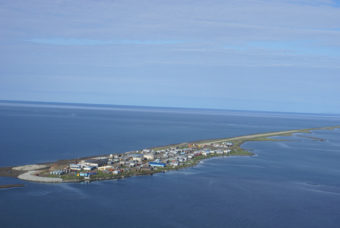
Kivalina, Alaska, in August 2009. (Creative Commons photo by Lt. Cmdr. Micheal McNeil/U.S. Coast Guard )

A former substitute teacher at the McQueen School in the Northwest Arctic village of Kivalina has been charged with several child exploitation crimes.

According to a release from the U.S. Attorney’s office, 21-year-old Jayson Knox was arrested on Wednesday. He is suspected of soliciting explicit pictures from children in Kivalina. He’s also charged with sending obscene photos to a minor and attempting to meet some of the children for sex.

According to the charging documents, Knox corresponded with 10 girls in the village — the youngest is 11 years old. Using Snapchat and Facebook Messenger, he solicited photographs from several of them, while also sending sexually explicit messages and photos. Investigators said Knox admitted to kissing and groping one of the girls behind the school, and asked to meet several others at an abandoned warehouse in the village.

Knox said in interviews that he believed most of the girls were under the legal age of consent, which in the state of Alaska is 16 years old. He stated he thought one of the girls may have been 16. He said he had begun corresponding with the alleged victims shortly after he began working for the school in 2018.

If convicted, Knox faces a mandatory minimum sentence of 10 years to life in prison.

Citing ‘escalation of violence,’ Noorvik pleads with local, state officials for law enforcement

Noorvik’s village clinic. (Photo by Master Sgt. Jack Braden/U.S. Air Force)

Residents of the Northwest Arctic village of Noorvik, where there is no village public safety officer, say their town is feeling increasingly unsafe.

Describing a “dangerous escalation of violence,” villagers have drafted a letter to local, state and federal officials asking for permanent law enforcement.

“Threats of violence are heard on the radio daily,” Angie Sturm said at the last Northwest Arctic Borough Assembly meeting. “I don’t let my daughter go out. She’s not allowed to go outside by herself.”

Sturm serves as finance director for the borough, but she was speaking as a concerned Noorvik resident speaking about how unsafe she and other residents feel, she said.

“There was an incident where there were two individuals shooting at a home, an occupied home where there were children inside,” Sturm said. “And then a couple weeks later, they had an arson of an occupied home, again where children were present.”

https://www.facebook.com/angie.sturm.37/posts/2493660117521693

Sturm authored a letter signed by 77 Noorvik residents directed at officials including the mayor of the town, Governor Mike Dunleavy and the Alaska congressional delegation saying the community wants an Alaska State Trooper and Village Public Safety Officer posted to the village.

Staffing for VPSO positions has been difficult in recent years for the Northwest Arctic Borough. Recently, though, the borough hired three officers to serve in Kobuk, Noatak and Kiana. The new hires just began their training in Sitka, according to Aucha Kameroff, the borough’s public safety director. Before the new hires, it had been months since there was a VPSO in any Northwest Arctic village.

Kameroff says there are currently seven state troopers that serve Kotzebue and the surrounding villages. However, during the assembly meeting, Kameroff recounted an experience with a trooper official highlighting how inconsistent troopers can be.

“I said, ‘why can’t people from the troopers office, during their work week, go to the village and do their work out of there?’ And she said they’re not available to do that,” Kameroff said. “While at the same time, one of the troopers was sent from this region, from Kotzebue, to go down to cover in Dillingham. I said we have a dire need and this is what’s going on in our region, and then one of our troopers is sent to Dillingham?”

Kameroff expressed the need to continue to pressure the troopers to maintain an effective presence in the region.

VPSOs are hired by local regional nonprofits — in this case the Northwest Arctic Borough. They get funding from the legislature. Last year, Governor Dunleavy cut $6 million from the program, saying that the funds came from unfilled positions. Borough Assembly member Walter Sampson said that at a recent Alaska Municipal League meeting, the governor’s message was different.

“His message was ‘if you have qualified VPSOs that are willing to come to work, let me know. We’ll hire them,’” Sampson said.

Dunleavy was set to call in to the borough meeting, but spokesman Jeff Turner said a scheduling conflict prevented that from happening. A request for comment on the letter from Dunleavy and the Department of Public Safety went unanswered as of this report.

As communities grapple with keeping their residents safe, borough officials say alcohol bootlegging and the introduction of drugs like meth into the villages are exacerbating the problems. Assembly member Sandy Shroyer-Beaver noted that the tight-knit nature of the villages makes reporting crimes an issue as well.

“None of us want to call on a family member or a friend,” Shroyer-Beaver said. “But if we seriously want to make some of these changes, you can’t expect the borough to save you. We can do our part to hire a trooper or get a VPSO, but community members also need to come forward and start assisting.”

While not immediately offering a solution for Noorvik, the borough says they will continue to try to bolster their VPSO program with grants and assistance from the state.

Currently a legislative working group headed by Sen. Donny Olson, a Democrat who represents the Northwest Arctic among other communities, and Rep. Chuck Kopp, an Anchorage Republican, is working with the Department of Public Safety to revise state statutes for the VPSO program which haven’t been updated in decades. Supporters hope it will lead to more effective law enforcement in villages statewide.

While she’s not optimistic, Sturm says she will keep the issue alive until it’s solved.

“I’m going to continue to place pressure on this body, on this state and on our regional organizations until we get somebody in Noorvik,” Sturm said.

Site notifications
Update notification options
Subscribe to notifications