KOTZ - Kotzebue

KOTZ is our partner station in Kotzebue. KTOO collaborates with partners across the state to cover important news and to share stories with our audiences.
UAF researchers use space-based radar to measure methane emissions in Arctic lakes

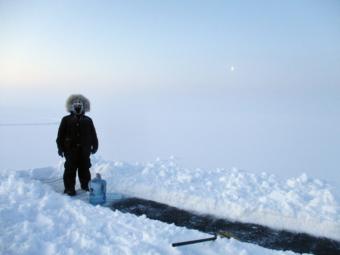
Ph.D. student Natalie Tyler stands next to a bubble survey transect in winter 2019. (Photo courtesy Melanie Engram/University of Alaska Fairbanks)

One of the many greenhouse gases that is contributing to global warming is methane. Methane is emitted a lot of ways, including from lakes across Alaska.

However, studies on how much methane flows up from those lakes into the atmosphere haven’t always been very accurate.

New research from the University of Alaska Fairbanks utilizing radar instruments positioned on satellites has led to a breakthrough in lake methane emission research. That research could help climate scientists better see how Alaska’s lakes contribute to the world’s methane emissions.

As permafrost under lakes begins to break down, it releases carbon, which is broken down by tiny microorganisms, which in turn, release methane.

“Sometimes you’ll sit on the edge of the lake and you can see a little pop,” said Melanie Engram, a researcher with the University of Alaska Fairbanks Water and Environmental Research Center. “And you might think ‘oh hey, it’s a fish.’ But it could also be a little methane bubble that’s coming out.”

Since methane is an odorless, colorless gas, it can be difficult to monitor how much is released by lakes. But not when they’re frozen.

“The ice forms around the bubbles; more bubbles are released and [ice] forms around the bubbles,” Engram said. “And the ice creates a time-lapse freeze frame, pardon the pun. It’s a freeze-frame historical record of the methane bubbling.”

To study these methane bubbles, Engram and other researchers use small bubble traps to make micro-measurements of methane and then scale them up to the full area. However, she says, those aren’t super accurate.

“The bubbling is very spatially erratic and it’s sporadic; you’ll see a big stream of bubbles and then it will shut off for a while,” Engram said.

Methane ebullition bubbles form in early winter lake ice in Interior Alaska. A yard stick is included for scale. (Photo courtesy Melanie Engram/University of Alaska Fairbanks)

Now, UAF researchers have begun to use what’s called a synthetic aperture radar, or SAR, to better map methane being released from lakes. Basically, a satellite sends a pulse down to a lake. A portion of that pulse bounces back to the satellite in what’s called a backscatter. Backscatters range in luminosity from kind of dim to very bright.

“The radar return was brighter in lakes that had more methane, and it was dimmer or lower in lakes that had less methane,” Engram said.

Engram and other researchers used SAR to map methane emissions from 48 lakes across five regions of Alaska, including the northern Seward Peninsula near Kotzebue, lakes near Atqasuk — south of Utqiagvik — and the Fairbanks area.

Of course, researchers still had to go out to the lakes that SAR was mapping to make sure it actually worked. To Engram’s delight, it did.

“It was really exciting for me to go out to a lake that was really bright in SAR, and to snowmachine out to it and dig down in the snow, and there were just bubbles everywhere in the ice,” Engram said. “I was excited. I said, ‘This is working! Yay, it works!’”

Engram says the success of using SAR to map out methane emissions in Arctic lakes means the system can monitor thousands of lakes across the state. And that’s not just exciting from a research perspective. Engram says that there isn’t a lot of global data on methane release from lakes, and use of the SAR can help create a baseline to track in the future. That will be useful to climate scientists tracking changes in the atmosphere.

“People measure methane in the atmosphere and they say how much comes from anthropogenic sources like oil fields and automobiles and agriculture and dairy cows,” Engram said. “They try to divide it up so we can see the different sources. And this will help [balance] the global methane budget.”

Studies show that methane is about 30 times stronger than carbon dioxide as a heat-trapping gas. And while methane is naturally emitted from these lakes, Engram says the amount is drastically dwarfed by the amount produced from those anthropogenic sources.

Engram’s research using SAR to track methane emissions in arctic lakes was the subject of a UAF research paper that was published this month in the scientific journal Nature Climate Change.

Under Dunleavy’s new CARES Act distribution, rural boroughs will get more funding

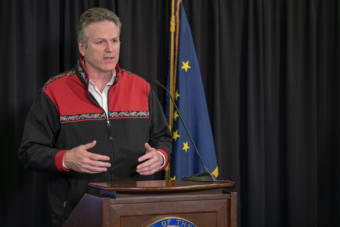
Alaska Gov. Mike Dunleavy speaks about the state’s COVID-19 response from the Atwood Building in Anchorage, Monday, April 20, 2020. (Creative Commons photo by Alaska Governor’s Office)

On Friday, Alaska Gov. Mike Dunleavy amended how much money municipalities would receive from the $1.5 billion the state received in the federal CARES Act. Three Alaska boroughs would get considerably more funding under the new distribution plan.

When Dunleavy signed this year’s budget, it came with a whole slew of line-item vetoes that he said could be made up from federal COVID-19 relief money. He’s since walked back that sentiment. During a press conference Monday he said he originally believed that the money could be used to make up for revenue shortcomings.

“It was our understanding, when I say our understanding … many governors, that the impacts of the pandemic on states including municipalities as a result of the business close-downs, as well as any expenses for dealing with the pandemic would be covered by the federal government,” Dunleavy said.

Under his original distribution plan, the Northwest Arctic Borough would have received a total of $1.2 million in community assistance from the CARES Act. Borough Mayor Lucy Nelson says that amount was considerably less than what the region normally gets from the state.

“We normally receive $4 million for reimbursement and then a $300,000 community assistance program amount,” Nelson said.

Dunleavy says he revised the distribution plan after talking with municipal leaders around the state. He says the state overlooked some factors when calculating the original amounts. The new plan gives considerably more funding to the Northwest Arctic Borough, the North Slope Borough and the Kodiak Island Borough.

He says the additional CARES Act money for those municipalities was diverted from funds originally designated for health and social services.

The North Slope Borough is receiving $2.5 million under the revised plan, more than double the amount from the previous plan. The $5.7 million the Kodiak Island Borough is getting is about 1.5 times what was originally proposed.

The Northwest Arctic Borough is set to receive about $4 million under the governor’s revised distribution plan. That’s about three times what they would’ve gotten under the old plan, Nelson sees it as getting closer to what they generally receive anyway from the state, which she says is vital.

“But it’s pretty close to [the amount] and to me it’s better than the 50% school bond debt [funding] that we received,” Nelson said.

She says the borough doesn’t have a lot of pots of money they can pull from. The borough receives most of its revenue from an agreement with Teck Resources. That company operates Red Dog, a zinc and lead mine 80 miles north of Kotzebue. That agreement can’t be renegotiated until 2026. And, Nelson says raising taxes on residents is almost impossible due to most Northwest Arctic Borough communities being economically distressed.

Nelson says moving forward, a big question for boroughs across the state will be how the CARES Act funding can be used.

“We can only spend it for what the distribution plan says,” Nelson said. “If we can’t apply it to school bond debt, then they’ll probably ask for the money back. So it’s not really clear. We’re still not really sure.”

Dunleavy says the state is hoping to get further clarification from the federal government. He expressed hope that Congress would explicitly provide more flexibility in a future law.

Editor’s note: This story has been updated to more accurately reflect the governor’s hopes for federal CARES Act funding moving forward.

Sullivan defends CARES Act funding for Alaska Native corporations

U.S. Sen. Dan Sullivan, R-Alaska, addressing the Alaska Federation of Natives at the Dena’ina Civic and Convention Center on Oct. 20, 2018. (Photo by Zachariah Hughes/Alaska Public Media)

Republican U.S. Sen. Dan Sullivan is defending Alaska Native corporations benefiting from the $2.2 trillion CARES Act.

The for-profit corporations created under About the Alaska Native Claims Settlement Act are eligible for a share of the $8 billion in funding set aside for Native American tribes. That’s led to some heated rhetoric in the Lower 48 and on Capitol Hill.
During a live call-in to KOTZ on Monday, Sullivan described opening the CARES Act up to Native corporations as a win for Alaska.

“And we were glad to get that in there because it would mean more resources to Alaska,” Sullivan said. “Not just for Alaska tribes, but our regional and village corporations. We thought that was very important, and we thought it was, to be perfectly honest … we thought it was noncontroversial.”

But the move has proven controversial — especially among tribal governments both here in Alaska and in the Lower 48.

Some say they’re upset that for-profit Alaska Native corporations, which are structured much differently than sovereign tribal governments, will also be entitled to that funding. So far, three Alaska tribes have even joined a lawsuit against the U.S. Treasury Department to block the funding. The lawsuit states that the companies “which conduct business worldwide through dozens of subsidiaries, are not ‘Tribal governments.’”

Sullivan said he isn’t familiar with the brewing legal fight, but he said that because Native corporations provide socially and economically for their shareholders, they are entitled to the funding.

“The tribal governments have sovereignty, and we certainly respect that and want to help all tribes. But the Alaska Native corporations also have an important and very unique role, and in many ways are delivering help to all parts of our state on behalf of Alaska Native people.”

In an op-ed to Indian Country Today, several executives from regional Native corporations echoed Sullivan’s sentiment, stating “the CARES Act is unambiguous: Alaska Native villages, Alaska Native regional corporations, and Alaska Native village corporations are ‘tribes’ under the law.”

Sullivan also accused Lower 48 tribes — which have business interests of their own — of hypocrisy.

“It’s a little bit, I would say, rich to have some of these Lower 48 tribes that have huge billion-dollar casino operations, that are clearly for-profit, somehow attacking Alaska Native regional and village corporations,” Sullivan said. “It’s a little ironic. Nobody’s talking about that.”

While money could go to tribes that operate casinos, it would not go directly to the businesses, unlike how the CARES Act has positioned for-profit Native corporations to receive stimulus funds.

Opposing tribes also have taken aim at Tara Sweeney, the assistant secretary for Indian Affairs with the U.S. Interior Department. Several tribes have accused Sweeney, who is a former executive and current shareholder with Arctic Slope Regional Corp., of putting Alaska Native corporations ahead of other tribes.

Senate Minority Leader Chuck Schumer of New York — a Democrat — joined in criticism of Sweeney, stating in a tweet that by giving money to Alaska Native corporations, Sweeney seeks to profit.

Sullivan took offense to Schumer’s comments, stating in a POLITICO interview that the concerns were a “bunch of bulls—.” He said Schumer and other critics are ill-informed.

“Some of the people attacking Tara hadn’t even read the law, because if you read the CARES Act, it’s 110% clear that some of these funds will go to Alaska tribes and our village and regional corporation shareholders,” Sullivan said. “Again, not to enrich anyone, but to help them deal with the negative impacts of the pandemic.”

Sullivan said the money set aside for tribes is set to complete disbursement by April 26.


CARES Act has $124 million for Alaska’s airports

An Alaska Airlines flight comes in for a landing at the Juneau International Airport.
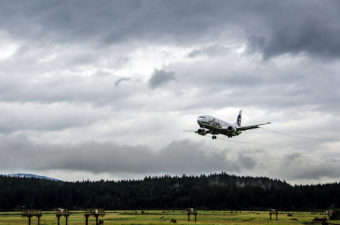
An Alaska Airlines flight comes in for a landing at the Juneau International Airport. Juneau’s airport will receive $21.7 million in federal grant money due to the CARES Act. (Photo by Heather Bryant/KTOO)

The Department of Transportation announced Tuesday that airports in Alaska will receive more than $124 million in federal aid.
The money is the state’s share of $10 billion issued to airports nationwide by the CARES Act.

In a press release, Transportation Secretary Elaine Chao said the funding is to preserve airport operations and secure workers’ jobs. It can be used for airport capital projects, as well as payroll, utilities and debt payment.

The funding formula given by the federal government is based on passenger numbers per airport, so airports with more people coming through brought in more money.

For instance, travel via the Ralph Wien Memorial Airport in Kotzebue brought about $1.3 million in funding to the state, while the much larger Ted Stevens International Airport in Anchorage brought in more than $26 million.

But, that might not be how the money gets divvied up in Alaska, says Alaska Department of Transportation spokeswoman Meadow Bailey.

“We don’t fund by specific airports like that, so we’ll have to get legislative authority first before we can move forward and then we’ll work across the system both rural and international before we can allocate funding,” Bailey said.

She says the funding will likely be handed out on a needs basis.

Bailey says that, on average, Alaska airports are seeing about an 83% decrease in passenger travel. That hits international airports harder than smaller rural airports, which don’t get money from passenger fees.

“For our international airports, that translates to a monetary impact right now,” Bailey said. “For our rural airports, it doesn’t have an immediate impact, but obviously on the budget across the state, there’s impacts.”

In keeping with the state’s “hunker down” health mandate, travel across Alaska has been restricted heavily. Airports aren’t the only industry hurt by reduced travel. RavnAir Group, the largest rural air carrier in the state, filed for bankruptcy and laid off all its staff following a 90% drop in revenue from coronavirus travel restrictions.

Bailey says the priority for the state Transportation Department is to make sure that airports remain safe and operational so they can resume use once various travel restrictions are lifted.

How coronavirus travel restrictions actually led to more cops in Kotzebue

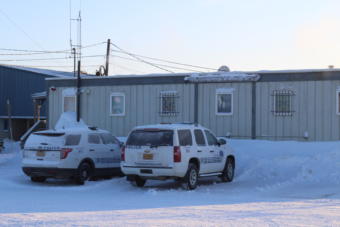
Police vehicles parked in front of the Kotzebue Police Department building. (Wesley Early/ KOTZ )

As the coronavirus creates health and travel concerns across the state, public safety is at the front of many Alaskans’ minds. In Kotzebue, however, they’ve actually seen a small boost in local law enforcement.

Kotzebue police work a little differently than in bigger cities in Alaska. For starters, most of them aren’t residents of the city, or even the state.
“They come to Kotzebue, work there two weeks, and then they are off for two weeks, and they fly back to whatever state they’re from,” said Kotzebue Police Chief Thomas Milliette, who lives in Kotzebue full-time.

Most of the officers in Kotzebue work a two week on, two week off schedule — something most Alaskans associate with oil and mining workers. Milliette says it’s been difficult to hire local police in a small town of around 3,000 people. They view the shift schedule as an incentive to recruit new hires.

With the outbreak of the coronavirus, travel has been restricted heavily. While one would think that would cause issues for the Kotzebue police who travel regularly to the village, Milliette says the opposite happened.

“We actually just reached out to them and asked them if they’d be willing to come to Kotzebue and stay here and weather the storm with us, and not travel back home,” Milliette said.

And they did. Milliette says the department currently has four officers in a mandatory 14-day quarantine, in keeping with the state health mandate.

“But when that’s done, and of course they’re still healthy, they’ll come to work and they will work here in Kotzebue until things get better for us,” Milliette said.

Milliette says that the department will have eight officers total, plus the additional correctional staff. Currently, there are two officers working at night, with one in the day. Milliette hopes that that will change with the additional officers.

“What I foresee is to continue to have two officers on at night, an officer working swing shift, and an officer on during the day,” Milliette said. “It’ll be a great benefit because we won’t have to respond to calls like what we’ve had to do for a really long time.”

Milliette says that he’s heard concerns from community members in the past about having a police force that operates in swing shift. The main concern is that officers don’t have an opportunity to become invested in the community since their off-time is spent elsewhere. While Milliette understands the concern, he maintains that even though these officers live elsewhere, they’re still committed to keeping Kotzebue safe.

“They were willing to leave their family members back in the Lower 48, some of which could be laid off. They have a hard time getting groceries back home,” Milliette said. “But our guys were still willing to come to Kotzebue and help our community out and stay here.”

Milliette says, pending any personal emergencies, the officers plan on staying in Kotzebue full-time for as long as they can.

REAL ID deadline extended to October 2021 as coronavirus limits DMV access nationwide

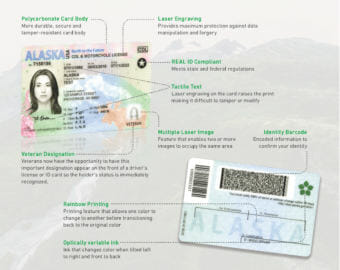
A diagram shows the features on Alaska's new REAL ID.
A diagram shows the features on Alaska’s new REAL ID. (Graphic by Alaska Division of Motor Vehicles)

The U.S. Department of Homeland Security has extended the deadline for getting a REAL ID to October 2021.

The federally-compliant REAL IDs were set to be required by October of this year for anyone traveling by plane throughout the United States.

Rural Alaskans have had a hard time getting their IDs, because many don’t have access to a state Division of Motor Vehicles office. Now, the coronavirus pandemic is making access difficult for people throughout the United States, too.

In a statement, acting Homeland Security Secretary Chad Wolf said, “States across the country are temporarily closing or restricting access to DMVs. This action will preclude millions of people from applying for and receiving their REAL ID.”

Wolf said the extension will give the government time to work with Congress to get the IDs issued as soon as possible once the coronavirus health crisis subsides.

Those wishing to apply for a REAL ID must have a birth certificate or passport and a valid document with their Social Security number on it, like a Social Security card or a W-2 form. They also need two documents with their physical address on them, including mortgage and bill payments, rental or land ownership documents, or letters from employers or local governmental bodies. Additionally, they will need documents for any name changes due to things like marriage and adoption.


Site notifications
Update notification options
Subscribe to notifications