KOTZ is our partner station in Kotzebue. KTOO collaborates with partners across the state to cover important news and to share stories with our audiences.

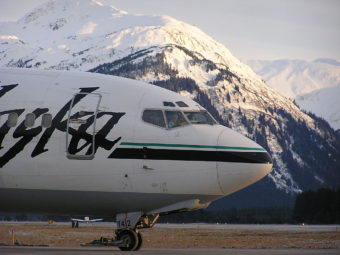
An Alaska Airlines plane at Juneau International Airport. (Photo by Heather Bryant/KTOO)
Alaska Airlines says it will issue formal warnings to any passengers that refuse to cover their faces on board a flight. The Seattle-based company says its new “yellow card” policy is in response to the COVID-19 pandemic.
In a statement made June 30 the air carrier says that passengers who repeatedly refuse to wear a mask on a flight will be issued a warning in the form of a yellow card. That will trigger a review, and passengers could be suspended from future Alaska Airlines flights.
There are several exceptions to the mask enforcement policy, such as for children under the age of two, those with breathing problems or other disabilities that make wearing a mask impractical.
Flight attendants will provide masks for passengers who forget their masks, and starting this month, they will also provide individual hand sanitizer wipes on board.
The change comes at a difficult time for airlines across the nation. Ravn Air, the state’s largest rural air carrier, filed for bankruptcy in April, while Alaska Airlines, which has the most scheduled flights into and throughout the state, reported its first quarterly loss in more than a decade as reservations took a sharp dive.
A map of the proposed Ambler Road project (Map courtesy of the Bureau of Land Management)
The Alaska Industrial Development and Export Authority board voted to put $500,000 into the controversial Ambler Road project on Wednesday. The state agency is in charge of making investments and providing loans to various business interests across the state.
The Ambler Mining District Industrial Access Project, commonly known as the Ambler Road project, has been a lightning rod for controversy for years, pitting the desire to expand business and mining interests in the state against the concerns over impacts to the environment and subsistence.
The road would lead to the Ambler Mining District, northeast of Kotzebue, which has deposits of copper and other metals that companies want to be able to truck across the state.
Board members heard public testimony over the phone from people across the state. Supporter Michael Jesperson of Anchorage says that Alaska is too dependent on oil, and needs to develop other industries like mining.
“We need to look to the future, not just now,” Jesperson said. “My kids need jobs when they graduate college. I would like the economy to improve and the value of my house to go up. None of that’s going to happen in a bad economy.”
However, to get to the site, the road would start near the Dalton Highway and cross Gates of the Arctic National Park. Environmentalists have expressed strong opposition to building a road through a national park. The Army Corps of Engineers completed its final environmental impact statement at the end of March. It says that the road could affect air and water quality, wildlife migration and erosion.
Residents like John Horner of Kobuk are fearful that building the road could affect access to caribou and other sources of subsistence hunting.
“This is going to affect my kids and their kids’ futures as well,” Horner said. “We cannot eat money. One word that comes to mind with this Ambler Road is ‘genocide.’ You guys are slowly going to kill off our culture, our way of life which defines who we are as Indigenous people.”
As AIDEA has weighed financially supporting the Ambler Road, a new factor has come into play in the last several months: the COVID-19 pandemic. As businesses across the state struggle to stay afloat due to the pandemic, the AIDEA board has received criticism from the public over who they’re giving funds to. The first meeting the board held during the pandemic was in March and saw overwhelming opposition to giving funds to the Ambler Road. During that meeting, the board approved putting $35 million dollars into the Arctic Infrastructure Fund, while simultaneously designating the Ambler Road as an Arctic project.
While testimony was much more even this time around, just over half of the testimony was in opposition to the Ambler Road.
“I implore you, do not go ahead with this expenditure for the benefit of overseas-headquartered megacorporations,” Palmer resident Loren Karro said. “Put the money towards helping Alaskans survive these extraordinary times.”
The company that’s been developing a prospect in the Ambler Mining District is Ambler Metals LLC, a Fairbanks-based subsidiary of Trilogy Metals, based in British Columbia.
While many village governments have come out in opposition to the road, regional borough governments have taken a more measured approach. In testimony on behalf of the Northwest Arctic Borough, Siikauraq Martha Whiting says that the borough supports AIDEA putting the money toward the project, but emphasized the importance of reaching out to villagers.
“We request that you continue building relationships with stakeholders within the Northwest Arctic Borough, especially in the communities of Ambler, Shungnak and Kobuk, as this project is in their homeland and in their backyard,” Whiting said.
The up to $500,000 approved for the road by AIDEA this week will be matched by Ambler Metals LLC. It is to go towards aerial photography of the proposed route, public outreach and hiring an external program manager.
Editor’s note: Martha Whiting serves on the board of directors for KOTZ Broadcasting.
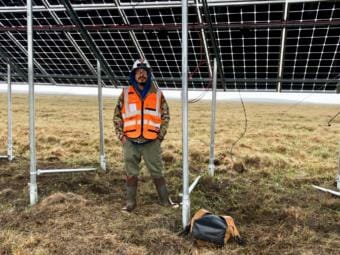
Edwin Bifelt, Founder and CEO of Alaska Native Renewable Industries, stands in front of the Kotzebue Electric Association’s solar project in June 2020. Tiffany Creed/KOTZ)
Since construction of Kotzebue Electric Association’s solar project began in May, a locally hired crew has clocked in ten-hour days, six days a week. They’ve hauled 1,440 solar panels across uneven tundra and installed the final one on June 18. The 576-kilowatt project is the second largest in the state, next to the Willow Solar Farm in the Matanuska-Susitna Borough.
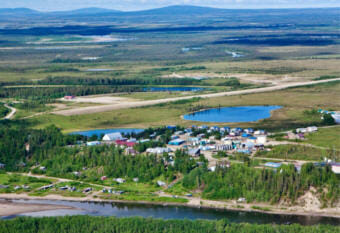
The construction site is southeast of the local airport, at the end of a long, gravelly access road. The rows of panels bring new fixtures to a rolling landscape marked by an aging wind farm that began Kotzebue Electric Association’s run with renewable energy in the late 90s.
“When we first installed the first three wind turbines at the wind farm, as we call it, we thought that was the greatest thing ever in the world,” said Matt Bergan, an engineer with Kotzebue Electric Association.
The coast of Northwest Alaska proved to be a prime location for capturing wind energy, and Bergan says, over the years the project expanded.
“Now we have 900-kilowatt turbines, in addition to our fleet of smaller turbines which are aging and approaching end of life,” he said.
Bergan is overseeing the new solar project, which in a lot of ways offsets those obsolete turbines. He says it was made possible by a global drop in the price of solar hardware over the last several years. Installation costs in tundra and permafrost are still relatively high, however.
“It makes it somewhat more affordable, and that’s what we’re really going to see once it’s operational, is what the cost-benefit analysis looks like as far as what we’re producing vs. what it costs. It looks promising, though,” Bergan said.
Kotzebue Electric Association general manager Martin Shroyer says that initial costs have been absorbed by local entities that also have a stake in rural energy concerns. NANA Regional Corporation received federal money to split between Kotzebue and the villages of Buckland and Deering for solar, the Northwest Arctic Borough contributed funds to the project through a grant, and Kotzebue Electric Association contributed some funding of their own.
“So once we received that money, or grant, we hit the ground running,” Shroyer said.
Shroyer says that there have been some delays to the project, the most recent being the COVID-19 pandemic which put construction behind about five weeks and increased costs. Installation was supposed to begin in late February after a successful 2019 bid from general contractor Alaska Native Renewable Industries.
The company is based out of the Interior village of Huslia, which, like Kotzebue, is off the road system, but about ten times smaller in population. Founder and CEO Edwin Bifelt worked on a similar solar project in the neighboring village of Hughes, which has a population of about 75. His next bid is east of Kotzebue in Shungnak.
“You could do this with any community in the state, so we’re hoping to keep going with this for the next five, ten years,” Bifelt said.
Keeping in step with the goals of the Kotzebue Electric Association project, he wants to maintain a focus on local hire in rural sites.
“Growing up in the village, or rural Alaska, I knew that there was always a lot of talent in the community. A lot of skilled tradespeople,” Bifelt said.
Local employment is indeed another way these renewable projects allow for rural self-reliance. Along with local hire, Shroyer says the scale of the project is also driving interest from the community.
“I think the amazement is how big it is. How, it’s only 576 kilowatts, but how much land it takes. It’ll generate a good seven months out of the year and it’s pretty exciting; we’ve got our board excited, and locals,” he said.
Though the electric association will still rely on diesel generators, its goal is to get to about 50% renewables. Once the project is up and running, residents should see the fuel cost adjustment figure go down on their utility bills.
The Native Village of Shungnak (Photo courtesy of Northwest Arctic Borough)
State officials are monitoring a roughly 15,000-gallon heating oil spill in the Northwest Arctic village of Shungnak, according to the state Department of Environment and Conservation.
The Native Village of Shungnak reported the spill at around 1 p.m., Saturday. Officials say a fuel tank for the school in Shungnak was overfilled during a delivery from a barge. The fuel was intended for the local Native store and the Alaska Village Electric Co-op tanks.
A Shungnak response team cleaned up the spilled oil and began pumping it into containers. An excavator was dispatched to the area to remove contaminated soil.
DEC officials say one potential area of risk is the Kobuk River, which is about 160 feet away from the extent of the spill. They also listed Shungnak’s drinking water source as another risk area; it’s about 295 feet away.

DEC and U.S. Environmental Protection Agency officials are in contact with the local response team. COVID-19 travel restrictions have prevented officials from either agency from heading to the spill site.
The Alaska Federation of Natives logo on a podium during the organization’s annual convention on Oct. 15, 2016. (Photo by Mikko Wilson/KTOO)
The Alaska Federation of Natives, which represents 191 federally recognized Alaska Native tribes and 11 regional corporations, has announced the date and theme of their annual convention.
This year’s theme will be “Good Government, Alaskans Decide.” A release from AFN says the theme highlights “the challenges and opportunities the Native community and all Alaskans face, including responding to and recovering from the pandemic and resulting economic downturn.”
The keynote speaker for the convention will be Alaska House Speaker Bryce Edgmon, the first Alaska Native Speaker of the State House. Edgmon is an independent from Dillingham, currently serving his second term as speaker.
This will be the first convention without the participation of the Arctic Slope Regional Corporation, who withdrew from AFN at the end of last year. The corporation is the largest in the state, representing Inupiaq shareholders primarily from the North Slope region.
The convention will be held October 15th through the 17th at the Dena’ina Center in Anchorage.
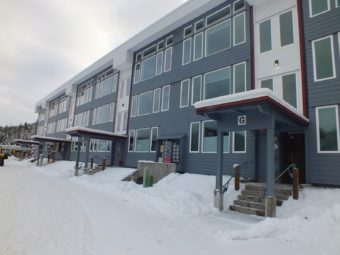
The Island Hills apartment complex in Juneau. The state housing authority is offering assistance on rent and mortgage payments for Alaskans impacted by the COVID-19 pandemic. (KTOO file photo)
In an effort to keep Alaskans in their homes during the COVID-19 pandemic, the state housing authority is offering assistance with mortgage and rent payments.
The program is run through the Alaska Housing Finance Corporation.
“One of the things that we have been hearing consistently for the last few months is that people are concerned about paying for their rent or paying for their mortgage,” said AHFC spokeswoman Stacy Barnes said. “And if they’re unable to do that, that they would be evicted or they would be foreclosed upon.”
The funding for the program comes from $10 million of the $1.5 billion the state received in federal CARES Act funding. Those who qualify for the program are families who have lost income due to the pandemic, and now at less than 80 percent of their area median income.
“The area median income in Kotzebue is $62,000,” Barnes said, “So to be eligible for this program, you would need to be making in your household, no more than $49,600, post-COVID.”
The amount is a little higher in Alaska’s larger communities. In Anchorage, the household income threshold is just under $78,000. In Fairbanks it’s roughly $74,500, while in Juneau, it’s just over $94,000.
Those who apply for the program would be put in a lottery system to receive a one-time $1,200 payment that could go towards paying for rent or a mortgage. Barnes says a lot of CARES Act funding across the country is distributed on a first-come first served basis, and she says using a lottery system allows rural communities a better chance at getting assistance.
“By allowing everyone to participate over that two-week window and lotterying the names at the end, everyone in Alaska who’s experienced hardship has an equal opportunity to receive funds,” Barnes said.
Barnes says the state anticipates serving between 8,000 and 12,000 households with the $10 million.
The application window for the program opens Monday, June 15 and closes Friday, June 26 at 11:59 p.m.. The AHFC plans on distributing the money in July.
Close
Update notification options
Subscribe to notifications
Subscribe
Get notifications about news related to the topics you care about. You can unsubscribe anytime.