KOTZ - Kotzebue

KOTZ is our partner station in Kotzebue. KTOO collaborates with partners across the state to cover important news and to share stories with our audiences.
Village of Buckland, pop. 500, sees large spike of COVID-19 with 11 new cases

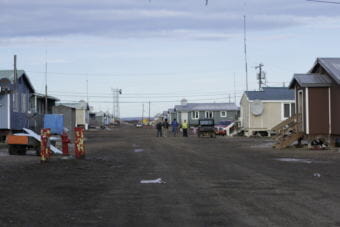
The Northwest Alaska village of Buckland on Oct. 15, 2018. (Photo by Nathaniel Herz / Alaska’s Energy Desk)

The Northwest Arctic Borough village of Buckland has seen a large spike in positive cases of COVID-19.

On Monday, regional health care provider Maniilaq Association announced that 11 residents of the village tested positive for the virus on Thursday, Sept. 17. Ten of the residents were close contacts of a previous positive case.

Maniilaq officials say six of the residents are showing symptoms of the virus, and all of them are medically isolated in Buckland. The results came after a community-wide testing effort by Maniilaq health workers. Last week, five previous cases of COVID-19 were announced for Buckland residents, with four of them medically isolated in the village.

Buckland is a village of around 500 people about 75 miles southeast of Kotzebue. The Maniilaq service area comprises the Northwest Arctic Borough and the North Slope village of Point Hope.

Maniilaq also announced a new case of COVID-19 at Red Dog Mine. A resident of Noorvik is medically isolated at the mine after testing positive for the virus on Sept. 17.

Maniilaq officials say they are conducting contact tracing to see if anyone was in close contact with the individual.

Kotzebue sees cluster of COVID-19 cases

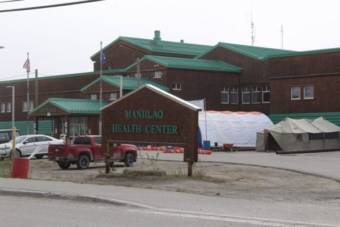
Maniilaq Health Center (Wesley Early/KOTZ)

Ten Kotzebue residents have tested positive for COVID-19 this week, including two employees of local health care provider Maniilaq Association.

Maniilaq officials said Monday that a resident tested positive after traveling to Kotzebue from Anchorage and experiencing symptoms of the virus.

The next day, Maniilaq announced that three other Kotzebue residents, including two of its employees, tested positive for the virus as well. The two employees don’t perform health services at Maniilaq. One of the three individuals who tested positive on Tuesday is showing symptoms of the virus. Officials say they don’t believe those cases are travel-related.

Then on Wednesday, six passengers returning to Kotzebue from out of state all tested positive for the virus. All six medically isolated themselves in Kotzebue immediately after testing.

With these 10 new cases, there have now been 60 positive cases of COVID-19 in the Maniilaq service area, which covers Kotzebue, the surrounding Northwest Arctic Borough villages and the North Slope village of Point Hope.

‘Wipe the slate clean’: Environmentalists sue Trump administration Ambler Road approval

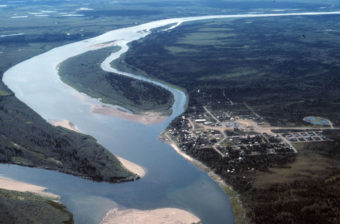
Aerial view of Ambler and the Kobuk River in the summer. (Photo courtesy of the National Park Service via UAF Gates of the Arctic Research Portal)

Nine environmental groups are suing the Trump administration for approving the 211-mile Ambler Road project.

“The agencies don’t have enough information to be issuing these permits in the first place,” said Bridget Psarianos, an attorney representing the plaintiffs. “And this environmental review process should never have even been allowed to move forward.”

On July 23rd, the Bureau of Land Management approved a route for the controversial project, a private-access gravel road that would extend from the Dalton Highway to the Ambler Mining District in Northwest Alaska, through Gates of the Arctic National Preserve.

In a lawsuit filed in the U.S. District Court for Alaska Tuesday, plaintiffs wrote that federal agencies failed to comply with several acts — including the Alaska National Interest Lands Conservation Act, the Clean Water Act and the National Environmental Policy Act — when pushing the project forward.

The nine plaintiffs in the case are the Northern Alaska Environmental Center, Alaska Wildlife Alliance, the Center for Biological Diversity, Earthworks, the National Audubon Society, the National Parks Conservation Association, the Sierra Club, the Wilderness Society and Winter Wildlands Alliance.

The Alaska Industrial Development and Export Authority (AIDEA) has been pushing the project along with federal agencies for several years. The state agency is in charge of making investments and providing loans to various business interests across the state.

Psarianos says permits were issued for the project at different stages of the road’s design, and should be voided.

“We’re asking the court to completely vacate and set aside these permits and pretty much wipe the slate clean and send AIDEA and the agencies back to the drawing board,” Psarianos said.

Mining companies hope to use the road to access deposits of copper and other metals in the Ambler mining district, then to truck ore out. The road has drawn concerns from environmentalists and tribal governments over impacts to wetlands and subsistence hunting in the region.

In a brief email statement, AIDEA spokesman Karsten Rodvik wrote that the state agency is aware of the lawsuit and “the matter is under review and consideration.”

This story has been updated.

Bureau of Land Management approves route for Ambler Road

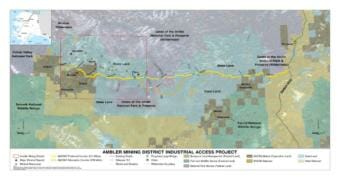
Map showing the BLM-approved route for the Ambler Road
A map of the proposed Ambler Road project (Bureau of Land Management)

The Bureau of Land Management has approved the proposed route for the controversial Ambler Road project.

In its record of decision released Thursday, the BLM approved a route for the private access road that would span 211 miles from the Dalton Highway and cross Gates of the Arctic National Park to get to the Ambler mining district in Northwest Alaska.

The road has been touted by Ambler Metals LLC, a subsidiary of British Columbia-based company Trilogy Metals. The company hopes to use the road to access deposits of copper and other metals in the mining district, then to truck ore out.

Environmentalists have strongly opposed the the road, especially the decision to route it through a national park. Subsistence hunters in the area are concerned about possible effects on the migration of caribou, a staple in the local subsistence diet.

The BLM completed its environmental assessment of the road in March, acknowledging potential impacts to air and water quality, wildlife migration and erosion.

Infants strut their maklaks online as Northwest Alaska’s baby pageant goes virtual

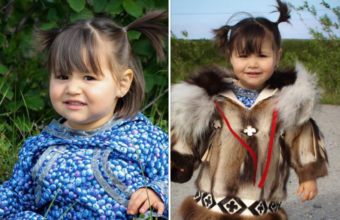
Two photos of a child who participated in the contest. On the left, she is wearing a blueberry-print atikłuk. On the right, a replica of a parky made in 1949
Brandi Qalhaq Williamson’s daughter, Wren Anniviaq, wears a blueberry-print atikłuk and a replica of a parky made in 1949. (Photo Courtesy of Lovie Harris Baby Beauty Contest)

Any other year, an announcer would have read this description of Brandi Qalhaq Williamson’s two-year-old daughter’s traditional regalia to a captivated crowd:

“Wren’s parky has a squirrel and muskrat head body, with wolverine tassels and a wildflower qupak design above. Her bottom qupak design is the same as Argagiaq’s, in a much smaller version made with a black and white calfskin with dyed alder leather trim. The sunshine ruff is made with 67 pieces of wolf stitched together to make a continuous circle, with wolverine and sea otter inside the ruff.”

Instead, it was a caption on a photo posted in a Facebook group.

This year, to protect vulnerable people from COVID-19, the annual Lovie Harris Baby Beauty Contest went virtual. The contest allows parents to announce their newborns and toddlers to the community while showcasing craft, culture and creativity.
“It gives the parents a chance to show the history of their families – if they’re from upriver, or coastal,” said Saima Chase, the organizer of the contest, and former baby contestant back in 1982. “Each family has different types of designs for atikłuks, parkys, trim, and I think it gives them a chance to showcase what and where their babies came from, where their family’s from.”

A woman holding up a baby during the 1982 contest.
Jennie Johnson holds baby Saima for the baby contest in July 1982. (Photo courtesy of Lovie Harris Baby Beauty Contest)

The event has been going on for decades, with Chase’s aunt, Lovie Harris, spearheading it in the ’80s and ’90s. The city honored Harris after her death by naming the contest after her.

Chase says it takes a lot of work to sew traditional garments, and she wanted to give parents who had already invested a lot of time and effort a chance to participate before their babies were too old. She says that she wanted the essential elements of the pageant to remain.

“I didn’t want them to be discouraged by everything that was going on,” she said. “I wanted to make sure we kept it like we usually do when we have in-person competitions – when we introduce them, with their Inupiaq names and who their grandparents are and where they came from and then what they’re wearing and who made it.”

Shylena Naaqtauq Lie has experienced both live and virtual baby contests with her sons Leif and Bjorn. Leif won the overall prize in 2018. He wore a full sealskin suit with a waterproof coat and pants made of seal intestine. She didn’t get to see her vision for her youngest boy, Bjorn, pan out the way she thought this year.

“Because I thought it would cancel, I didn’t quite get all the sewing done that I had anticipated,” she said. “I was planning on making a fish leather vest and a few other items that I didn’t get to make.”

Even so, in the pictures she submitted to the contest, her son wears a parky made from the fur of a black bear caught by the boy’s late grandfather. Though she felt the virtual contest was well done, she misses the collaborative energy the live contest brings.

“It’s a competition, but we’re all kind of helping each other out, and just seeing each other’s creativity really helps encourage others to try and do something different for themselves as well,” she said. “So, I’m hoping it’ll be live.”

By going virtual this year, the contest was opened up to parents who have relational ties but live outside the region. Williamson, Wren’s mother, is originally from Ambler but now lives in Craig. She says this change made it easier for her daughter to participate this year.

“I was actually thankful that they found an alternative way to have everybody participate,” she said. “It was awesome too, because people who normally don’t get to be in Kotzebue, they were able to participate from Anchorage, Noorvik, Kiana, Shungnak, Kobuk, Ambler.”

In addition to overall placements in both age categories, titles like “Most Traditional” are usually bestowed upon babies, who, by the end of a long pageant, are sometimes sleeping as the certificates and trophies are given out.

This year, no prizes were given, partially due to a halt in fundraising, though each participant was sent a certificate in the mail. Chase says she didn’t want the event to turn into a social media popularity contest but rather, an opportunity to lift spirits and continue tradition.

Federal program offers a slice of the broadband spectrum to tribes

The Altona Brown Health Clinic in the village of Ruby
The Altona Brown Health Clinic in the village of Ruby. The village of Ruby has applied for a broadband license through a new program from the FCC.  (Photo from the Department of Commerce, Community and Economic Development; Division of Community and Regional Affairs’ Community Photo Library)

Broadband internet access in Alaska’s village can be difficult, spotty and — with few local options — expensive.

Now, a new program from the Federal Communications Commission is giving tribes across the country the opportunity to claim licenses within the 2.5 GHz spectrum that would allow them to provide broadband to their communities.

To understand what the 2.5 GHz spectrum is, Mariel Triggs suggests thinking about it like a radio signal. She’s the CEO of MuralNet, a nonprofit tech company that helps tribal communities across the country with maintaining internet networks.

“You have AM radio, you have FM radio, and you have the 2.5 GHz band as well,” Triggs said. “And what’s great about the 2.5 GHz band is that it’s prime spectrum in order to broadcast internet.”

In order to claim part of that spectrum, you need a license from the FCC. Starting in February, the agency opened a Rural Tribal Window where tribes can apply for those licenses for free. If approved, they would control a section of the spectrum that falls on their tribal land.

Triggs said that once a tribe has that license, they can begin to build their network.

“So if you have access to the internet at one spot super fast — say the tribal government center or maybe the hospital, school or library — you can broadcast that internet to the homes in the surrounding community pretty easily,” Triggs said. “Put up a little bit of cellular equipment, which is off the shelf and pretty cheap, and then you deliver the home units, very much like a hot spot.”

Triggs has done similar work with Lower 48 tribes, and she says the results speak for themselves. For example, a tribal college in Arizona recently used their spectrum access to help students and staff work remotely when the coronavirus began to spread.

“So it just took a couple days for Dine College and Navajo Technical University to deploy their own network and connect their faculty, staff and students off-campus,” Triggs said. “Which meant they didn’t have to come on campus and possibly get exposed, and they were able to continue classes.”

Triggs said the spectrum can be used to establish a network to provide free internet access to tribal members, or to use a network to drive down the price of competing internet service providers.

Several Alaska tribes have already applied for the FCC program, including the Yukon-Koyukon village of Ruby, about 230 miles west of Fairbanks.

Ryan Lee Madros is the maintenance official for the village. He said the village intends to use their broadband spectrum to start their own network. The COVID-19 pandemic has shown how the spectrum could help with telehealth services, he said.

“Our tribal members can contact their doctors in town easier from home,” Madros said. “They don’t have to go through a whole process of getting tested and flying back into Fairbanks and seeing their doctor and getting another test and flying back out.”

Triggs said that basic broadcast equipment runs for about $15,000 — a drop in the bucket when compared to the millions of dollars that the licenses go for when auctioned off to internet service providers like GCI and AT&T.

“Getting that proprietary, protected spectrum is the hard part, and the FCC is making it really easy right now,” Triggs said.

By putting tribal governments in control of their own internet broadcasts, Triggs said it’s like a new form of sovereignty.

“You don’t have to try to convince someone else to do what’s right by your people,” Triggs said. “You get to decide yourself.”

The application deadline for tribes to file with the FCC is Aug. 3. After that, the broadband spectrum will be auctioned off by region. Triggs said tribes can go to tribal25.com for assistance on the application.

Site notifications
Update notification options
Subscribe to notifications