KOTZ - Kotzebue

KOTZ is our partner station in Kotzebue. KTOO collaborates with partners across the state to cover important news and to share stories with our audiences.

Kotzebue Iñupiaq dancer Jacqui Lambert showcased in Biden campaign victory video

Jacqui Lambert, originally from Kotzebue, was one of several Americans featured in the Biden campaign’s victory video. (Screenshot from Joe Biden video)

After several days of counting votes across the country, Joe Biden claimed victory in the 2020 presidential election on Saturday morning.

The campaign circulated a victory video featuring the jobs and hobbies of Americans from coast to coast. Set to Ray Charles’ rendition of “America the Beautiful,” the video portrayed Biden’s promise to be a president for all Americans. Across various social media platforms, it was viewed over 60 million times.

About 27 seconds in, 28-year-old Jacqui Lambert fills the frame, performing an Iñupiaq dance with Cook Inlet behind her. Lambert had posted one of her dances on Instagram shortly after Indigenous People’s Day in October, and she says the video caught the attention of Alex Troutman, an independent videographer with Blackfish Media.

“He reached out and said that he was in touch with the Biden campaign, and they wanted to do this spot about America and having representation of all kinds of people across the nation,” Lambert said.

A couple days later, Lambert filmed the performance at the Carr-Gottstein Park in Anchorage. She says that because the performance was filmed in October, she thought it was going to be used to try to get out the vote ahead of the election. By the time Election Day came and went, she assumed they weren’t using it.

“It was surprising to wake up the next morning to the video announcing his victory,” Lambert said. “I knew I was going to be a part of this video, but I had no idea that it was going to be on the morning that it’s announced that he had won, after I’d been waiting for so long.”

Jacqui Lambert performing the “Bow and Arrow No Song” Inupiaq dance in president-elect Joe Biden’s victory video. (Screenshot from Joe Biden video)

While only featured for a couple seconds in the spot, Lambert posted the full dance for her social media followers, which had grown since the campaign video was released.

“That was… the Bow and Arrow No Song is what we call it in Kotzebue, but it’s danced across many Iñupiaq and Inuvialuit communities,” Lambert explained.

Lambert grew up in Kotzebue and has been dancing since she was a child. She lives in Anchorage now, but continues to perform with the Kikiktagruk Northern Lights Dancers. Her performance atikluk in the video was made by May Douglas, the dance group’s elder. Lambert says she was happy that the Biden campaign made an effort to show the diversity of America by including its Indigenous people.

https://twitter.com/jacquiiwithacue/status/1325273192844324864?s=20

“It was such a relief to be able to see that embracement, where over the past few years I’ve heard so many comments,” Lambert said. “Trump has made comments about Pocahontas, not knowing the terrible story behind who she really is. And kind of arming a lot of people with this knowledge that use a Native woman’s name as an insult in this political ground.”

Lambert grew up dancing at the local NANA museum for tourists and had always been fascinated by life outside of Kotzebue, and she says she loved being a part of the diversity of the country.

“My inner child is totally amazed by this experience,” Lambert said. “It just feels a little amazing to see even the stories of all these other Americans in this video as well, and seeing the expansion of who we are. And knowing that my simple life and my simple story of growing up in Kotzebue, there was a glimpse of it shown.”

Lambert says she’s hopeful that the Biden administration will address many issues plaguing Native communities across the country, including the alarming rates of missing and murdered Indigenous women.

“Shining more light onto that and acknowledging the situation within the Native community when it comes to this violence and all of this disruption that’s happening and the way that it comes from a colonial perspective in the past,” Lambert said.

Lambert says Native advocates have been more successful in recent years in highlighting the historically testy relationship between Native people and the American government, and the incoming president would do well to learn from that history as well.

Correction: An earlier version of this story misspelled May Douglas’ first name.

Black teacher sues North Slope School District for not addressing students’ racist threats in Nuiqsut

Nuiqsut in June 2018. The village is near a growing number of oil developments in the western Arctic.
Nuiqsut in June 2018. (Photo by Elizabeth Harball/Alaska’s Energy Desk)

A former teacher at the Trapper School in the village of Nuiqsut is suing the North Slope Borough School District, claiming the district did not properly address racist actions by students.

In a lawsuit filed last week, attorneys for Candice Gardner, a Black woman, say that students in Nuiqsut made racist threats against her in a classroom setting in 2017. That includes an incident where a student called Gardner a “ni–er b–ch” and told her to “get [her] Black ugly ass out of our village.”

Attorneys also cite incidents of racist graffiti using the “N word” within the school building. The lawsuit quotes the principal of the school at the time saying the graffiti was “just a little bit” racially motivated and “done in a real cute little font.”

According to the lawsuit, Gardner was the only Black resident of Nuiqsut at the time, and racist actions like these had not occurred before.

When Gardner brought complaints to the school principal, her attorneys say, students were not appropriately disciplined and the harmful actions continued.

In a separate incident, while Gardner was on bereavement leave, lawyers say a student fashioned a noose out of rope and said, “this is for Ms. Gardner.”

According to the lawsuit, a police investigation found that the student’s parents were not contacted about the incident. Gardner says she feared for her safety, and alleges that the district did nothing to reprimand the student. When she requested a transfer to a different village school, lawyers say the district delayed the request indefinitely.

Lawyers also wrote that when Gardner made hate crime complaints to the district, officials refused to either release her from her contract or allow her to transfer schools unless she stopped her allegations of racism.

After filing an inquiry with the federal Equal Employment Opportunity Commission, Gardner was issued a notice of a right to sue earlier this month.

Gardner is suing under Title VII of the Civil Rights Act, which protects against discrimination on the basis of race.

North Slope Borough School District superintendent Pauline Harvey says it is district policy not to comment on pending litigation.

Pandemic dominates discussions as AFN convention goes virtual

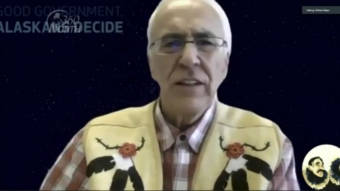
Alaska Federation of Natives co-chair Will Mayo during the virtual 2020 AFN Convention. (Source: 360 North)

Whether you watched on TV, Zoom or listened to the radio, this year’s Alaska Federation of Natives convention was different. With the coronavirus making an in-person convention unsafe, the state’s largest annual gathering of Indigenous people came together virtually.
There were no booths to browse handcrafted art pieces and attendees had to settle for virtual hugs. The convention was a drier affair than usual.

AFN Board of Directors co-chair Ana Hoffman addressed the new format as the convention opened.

“Even though we’re unable to meet in person this year due to the COVID-19 pandemic, technology does allow us to see and hear from our members from across the state of Alaska,” Hoffman said.

The theme of this year’s convention was “Good Government, Alaskans Decide.”

Bryce Edgmon, Speaker of the Alaska House of Representatives, gave the keynote address. Edgmon is the state’s first Alaska Native house speaker and used his speech to remind Native listeners that they’re the backbone of the state.

“A lot of people come and go,” Edgmon said. “But a lot of people, like us on this call, are here for the long run and we constantly keep an eye on the long term welfare of the state.”

Edgmon listed his mentors, prominent Alaska Native legislators like Al Adams, Reggie Joule, Frank Ferguson and Georgianna Lincoln. He said he expects Native leadership to continue to expand.

“We will have an Alaska Native governor,” Edgmon said. “We will have an Alaska Native Senate president, we’ll have another Alaska [Native] speaker. We’ll have somebody in Congress, and we’ll have somebody in the U.S. Senate. I know that time is coming. It’s just a matter of time.”

Edgmon ended his remarks with a plea that listeners wear masks, practice social distancing and wash their hands.

COVID-19 continued to dominate the convention as listeners heard a pre-recorded message from Gov. Mike Dunleavy and his wife Rose. The governor spoke of how devastating a prior pandemic, the 1918 Spanish Flu, was for rural Alaska. He said that damage informed his administration’s response to the current pandemic.

“As a result, in preparing for and battling this pandemic, rural Alaska, including our fellow Alaska Natives, were not an afterthought,” Dunleavy said. “During the planning and execution of mitigating approaches to deal with this virus, you were in fact front and center.”

Dunleavy ended his remarks highlighting cooperation between state and rural entities in combatting the pandemic.

“The partnership between Native health corporations, tribal leaders, village elders and the state is a testament to our ability to set aside what divides us and work together,” Dunleavy said.

Sen. Lisa Murkowski spoke live to convention attendees and highlighted her efforts in getting two laws signed into law — Savannah’s Act and the Not Invisible Act. Murkowski sponsored the former.

“We’ve begun to make some headway on the matter, the epidemic truly, of missing and murdered Indigenous women,” Murkowski said.

She also took a swipe at efforts to exclude Alaska Native Corporations from the Coronavirus, Aid, Relief and Economic Security Act. Recently, a District of Columbia Circuit court ruled that the for-profit corporations were not eligible for funds meant for tribes. Murkowski disagreed.

“So leaving ANCs out of the response fund in the CARES Act could disenfranchise tens of thousands of Alaska Natives,” Murkowski said.

Murkowski also pushed for resource development, touting efforts in opening the National Petroleum Reserve-Alaska and the 1002 section of the Arctic National Wildlife Refuge to development. She took time however to disavow the proposed Pebble Mine project, calling it the “wrong mine in the wrong place.” Her position mirrors that of Sen. Dan Sullivan, who came out strongly against the mine after a video surfaced showing the CEO of the project suggesting Alaska’s two Republican senators wouldn’t fight it.

Though occasional technical glitches prompted slight delays in panels and speeches, it didn’t take away from the focus of the day — how Alaska Natives and their various governments work together.

Earlier in the morning, the AFN board honored three individuals with their annual awards.

Katherine Gottlieb, former CEO of Southcentral Foundation was named Citizen of the Year. Gottlieb resigned earlier this year, shortly after her husband and two others were accused of falsifying dental records. Southcentral Foundation officials said they don’t believe Gottlieb was involved in any of those allegations.

The Denali Award, gifted annually to a non-Native person for their contributions, was given to Cook Inlet Tribal Council chief legal officer Lisa Reiger. The AFN Board also gave a special award to Alaska’s Chief Medical Officer, Dr. Anne Zink, for her efforts in leading the state’s COVID-19 response.

The convention will conclude Friday evening.

‘We need you for the future’: Elders and Youth Conference goes virtual

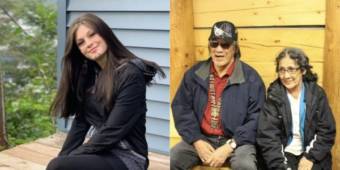
Kiley Kanat’s Burton (left) of Cordova and Rev. Traditional Chief Trimble Gilbert (pictured with his wife Mary) of Arctic Village were the keynote speakers for the 2020 Elders and Youth Conference. (Diana Riedel and Crystal Dzehgak Frank / Courtesy of First Alaskans Institute)

This year, the Elders and Youth Conference went virtual for the first time, in response to the COVID-19 pandemic.

This year’s meeting was a little different, conducted mostly through pre-recorded messages and live Zoom calls. However, both keynote addresses highlighted the desire to keep thousands of years of Native culture moving forward, pandemic or not.

The four-day annual meeting seeks to strengthen the bonds between the oldest and youngest generations of Indigenous people, with Alaska Native people from around the state participating.

Speaking over a Zoom call, Arctic Village elder Rev. Traditional Chief Trimble Gilbert, who is Gwich’in, spoke of lessons he’d learned from elders throughout his life. In his roughly 35-minute keynote, he touched on his love of Native food, the importance of being prepared for winter and the importance of keeping Native languages alive.

He says it is vital to make sure that younger Alaska Natives can continue to experience their cultures and ways of life.

“We are very lucky to have all the resources we have in Alaska, but this summer there’s no fish in the Yukon,” Gilbert said. “Slowly, we get into a lot of change. I know it, since the last maybe two years.”

This year’s commercial salmon runs in the Yukon River, Kotzebue and Bering Straits regions were all considerably lower than in past years. While there’s no definitive reason why, some have speculated it may be due to a warming Arctic climate.

Additionally, Gilbert discussed the importance of safety in the face of the pandemic.

“I hope young people listen to me when you go home, a lot of them going to cities,” Gilbert said. “We need you for the future. Make sure you take care of yourself. Wash your hands.”

Gilbert says he’s eager for the day when the virus blows over.

“So we want someday, hopefully, we might get together again to talk to each other face to face,” Gilbert said.

While the Elder keynote address focused on passing down traditional knowledge, the Youth address took aim at blood quantum. Blood quantum is an imposed standard of measuring “Indian blood,” often used to denote whether someone is eligible for tribal enrollment. Some tribes and federal agencies use blood quantum to also determine eligibility to participate in some cultural activities.

Fifteen-year-old Kiley Kanat’s Burton is Eyak, Aleut, Inupiaq and Koyukon Athabascan and is from Cordova.

Since she was 5, she grew up beading and sewing seal skin, learning from her mother and aunt. However, under some blood quantum standards, Burton says she’s less than a quarter Native and unable to participate in some cultural activities.

“Many members of the Alaska Native community are deeply concerned with the growing numbers of young tribal members who are unable to hunt or utilize marine mammals,” Burton said. “Hunting marine mammals, proper hide preparation and skin sewing are essential components to Alaska Native culture.”

The Marine Mammal Protection Act limits hunting and harvesting of marine mammals to only Indigenous people with at least one-quarter Native blood quantum. Additionally, most regional shareholder corporations require a one-quarter blood quantum to enroll and receive shares.

There are estimates that roughly 60 percent of Alaska Natives living in and around the Gulf of Alaska don’t meet that criteria. Burton says that she’s worried for the future for herself and other Native descendants.

“With blood quantum still used as an identifier of Native people, they will one day lose their status and recognition,” Burton said. “The moment when tribal members are no longer Native enough, based on colonial tactics that were used to assimilate, is the moment Indigenous people are bred out of existence.”

Burton ended her speech by urging others to speak out against regulations that limit who can identify as Native. For her part, she says she plans on educating her children one day about where they came from.

The 37th Annual Elders and Youth Conference will wrap up on Wednesday with the reading and passing of several resolutions. This year’s Alaska Federation of Natives Convention will take place starting Thursday, and is also virtual this year.

Tripp Crouse with KNBA helped with this report.

COVID-19 cases in several Northwest Arctic villages halts in-person schooling

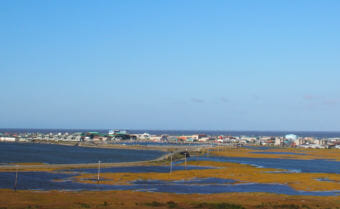
Kotzebue as seen from the road east of town (Photo by Zachariah Hughes/Alaska Public Media)

All three schools in Kotzebue, as well as three Northwest Arctic village schools, are in the red, high-risk operational zone. That means schooling will have to be conducted totally remotely.

Regional health care provider Maniilaq Association announced several positive cases of COVID-19 last week, including multiple cases in Kotzebue, and a case apiece in Noatak and Kiana. The village of Buckland continued to see community spread of the virus last week, with another positive case happening in the village.

According to Northwest Arctic Borough School District superintendent Terri Walker, for a school in a village community to move from the red zone to the yellow, medium-risk zone, they must have zero cases of COVID-19 over a 14-day period. Kotzebue has a threshold of four cases.

Reopening after all the other village schools, Kotzebue had allowed limited in-person schooling for a couple days last week, before having to move back to the red zone.

The schools in Selawik and Shungnak, which haven’t had a case of COVID-19 in the last 14 days, are also in the red zone due to staffing shortages.

The most recent cases in the Maniilaq service area were announced on Sept. 24, including two Kotzebue residents, two Kiana residents, and a resident each from Noatak and Point Hope. Among those cases, Kotzebue, Kiana and Noatak all had an individual test positive after returning from Red Dog Mine.

This story has been updated with school closures in Selawik and Shungnak.

Kiana resident tests positive for COVID-19 after returning from Red Dog Mine

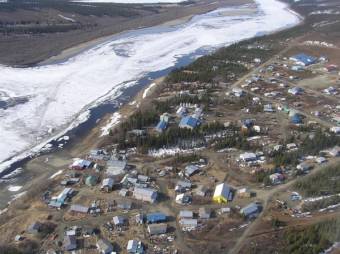
Kiana, Alaska, on the Kobuk River (Wikimedia commons image)

A resident of the Northwest Arctic village of Kiana has tested positive for COVID-19 after flying home from Red Dog Mine, local officials confirmed.

“They tested negative at Red Dog,” said village tribal president Ely Cyrus. “And I guess the results of the test on the third day was delayed, so they were allowed to come back to Kiana. And two days after they got back to Kiana, their positive test was confirmed, so they were in the community for a couple days.”

Cyrus says the individual and their family immediately went into medical isolation, and the local school has moved back into the red, high-risk zone — which means school will be entirely remote.

Teck, the operators of the mine, recently suspended travel from Red Dog to regional village communities. They’d previously suspended outbound village travel in March, resuming travel in May. This most recent restriction was lifted Monday.

Cyrus says the tribal council is asking Red Dog to suspend flights into Kiana as the mine continues its new testing protocols. People leaving Red Dog are now required to take two COVID-19 tests, with a three-day isolation period in between them.

“With this one that just kind of slipped through, we just ask that they hold off for a week or so on letting travelers back in, so they can update what their testing standard is,” Cyrus said.

There are currently 21 active cases of COVID-19 at Red Dog Mine.

Site notifications
Update notification options
Subscribe to notifications