KOTZ - Kotzebue

KOTZ is our partner station in Kotzebue. KTOO collaborates with partners across the state to cover important news and to share stories with our audiences.
Feds arrest 2 after seizing Fentanyl headed to Utqiagvik

“M30” Fentanyl pills similar to the batch recovered by authorities in Anchorage. (Photo courtesy of Drug Enforcement Agency)

Two Utqiagvik residents are in custody after officials say they intercepted fentanyl the two intended to sell.

According to a charging document, federal postal inspectors in Anchorage flagged a package sent from Arizona to 30-year-old Roberta Sielak of Utqiagvik. Inspectors opened the package and found 2.4 ounces of blue “M30” pills that contained fentanyl, the charges say. The pills were hidden in a vacuum-sealed bag and placed inside the motor housing of an Oster blender, which was in its original packaging, according to the charges.

Inspectors removed the pills and placed a tracking device in the package and sent it on to Utqiagvik, along with several federal and state agents, the charges say.

Officials say Sielak picked up the package from the Utqiagvik post office on Friday and brought it to 41-year-old Bryon McFadden. McFadden opened the package and, upon hearing the tracking device go off, fled his residence. North Slope police apprehended McFadden and questioned him. He stated he expected the package to contain marijuana, the charges say.

Officials searched McFadden’s home and found multiple Oster fan boxes, a white powder believed to be cocaine and an AR-15 style rifle.

Both Sielak and McFadden were in custody Tuesday and charged with a federal count of attempted possession of Fentanyl with intent to distribute.

Alaska Federation of Natives leadership calls for Trump’s resignation after violence at Capitol

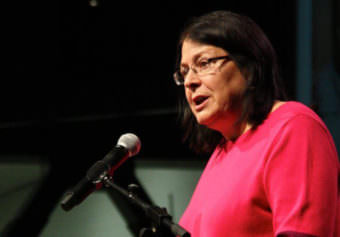
Alaska Federation of Natives President Julie Kitka is hopeful the state can create a seat at the federal table. (Photo courtesy Alaska Federation of Natives)
Alaska Federation of Natives President Julie Kitka. (Photo courtesy Alaska Federation of Natives)

The leaders of Alaska’s largest Alaska Native organization are calling for President Donald Trump to resign.

Alaska Federation of Natives president Julie Kitka said that she was horrified by Jan. 6’s deadly attack on the U.S. Capitol by Trump supporters. AFN joined Alaska’s congressional delegation in condemning the actions.

“It really truly was a riot. And we felt that we needed to come out and condemn it and call it for what it is,” Kitka said. “The full weight of the law needs to go on all those perpetrators and the people who planned this, because it was wrong.”

Five people were killed, including one capitol police officer, after a group left a Trump rally and forced its way into the Capitol building. AFN co-chair Ana Hoffman said one of the things most striking in the attack was police treatment of the rioters, most of whom were white. She said the police officers’ restraint was in stark contrast to treatment of Black and Native protesters in D.C. last year.

“I think the rest of the country was able to see the real disparity between how law enforcement and others respond to people of color versus the group that we saw at the Capitol,” Hoffman said. “So that is the reality that Alaska Native people, brown and Black people experience every day.”

Hoffman said last week’s events show police are capable of de-escalating violent crowds without using force.

“Acknowledging the difference in responses is another place for law enforcement to start,” she said.

AFN leadership say they support Senator Lisa Murkowski’s position that the president should go. Last week, Murkowski said the president had encouraged his supporters at the rally to march on the Capitol where Congress was certifying the results of the 2020 election.

Kitka said Murkowski showed leadership in bucking with her party to oppose the president.

“Knowing that she was pretty lone out there doing that, we just felt we needed to show public support behind what she is trying to say, what she is pushing for,” Kitka said. “She’s a very responsible leader and she is not radical. She is a common sense and solid person on that.”

The House of Representatives on Wednesday voted to impeach President Trump for the second time in just over a year. Alaska’s Congressman Don Young voted against impeachment.

The articles of impeachment will be sent to the U.S. Senate for trial. Kitka says AFN’s leadership plans to contact Senator Dan Sullivan ahead of any vote by senators.

This isn’t the first time AFN has condemned President Trump. They objected to his use of the name Pocahontas as a slur during remarks at a ceremony honoring the Navajo code talkers of World War II.

This story has been updated.

Northwest Arctic village of Kivalina on ‘high alert’ as 44 residents test positive for COVID-19

This week, 44 residents of the Northwest Arctic village of Kivalina have tested positive for COVID-19, according to regional health care provider Maniilaq Association.

In a release, Maniilaq officials say 30 residents tested positive on Monday, with another 14 testing positive on Tuesday. The village is on high alert, with officials describing the situation as “widespread community transmission.”

Locals are advised to hunker down and avoid contact with nonfamily members. The number of positive cases represents roughly 10% of the village’s roughly 440 residents.

This story is developing. Check back for updates.

‘I’ve made it this far largely because of where I’m from’: Noorvik man is now a Rhodes Scholar

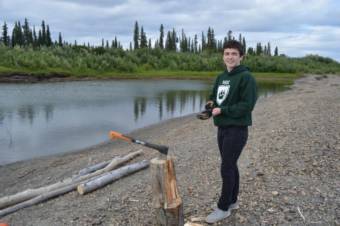
Wilfried Kuugauraq Zibell pictured by the Kobuk River. Zibell is a Harvard senior from Noorvik who was recently awarded the Rhodes Scholarship. (Photo courtesy of Wilfried Kuugauraq Zibell)

A university student from the Northwest Arctic village of Noorvik, population 600, was just awarded one of the world’s oldest and most prestigious academic awards. The Rhodes Scholarship funds two to three years of academic study at Oxford University in the United Kingdom.

In Noorvik, everyone spends a lot of time at the Noorvik Aqqaluk School. Wilfried Kuugauraq Zibell, whose parents were teachers, spent even more time there.

“My dad would teach me these big words,” Zibell said. “And I was two years old, wandering around the gym asking people for ‘assistance’ rather than for ‘help.’ And people just got a kick out of that, and that’s the kind of thing that I think set me on the course that I’m on today.”

Though not Iñupiaq, both Zibell and his father grew up in the village. His ties to the community run deep. He says he was encouraged by everyone in Noorvik to develop a love of learning.

“Whenever they saw me walking around with a book, they would hype me up a little bit and cheer me on,” Zibell said. “Being a creature of attention the way I am, I think that positive reinforcement really had a Pavlovian effect where now I’m addicted to reading books.”

Zibell excelled as a student throughout high school, serving as a student member of the state Board of Education as well as being part of the U.S. Senate Youth Program. He says when he found out he was accepted to Harvard, he was at a Ravn airline terminal in Kotzebue, where he and surrounding passengers erupted in joyous celebration.

Zibell brought his love of reading to Harvard, where he studies comparative literature, primarily between Yiddish and Iñupiaq works.

“I look at specifically displacement and people losing land and the way that is reflected in poetry,” Zibell said.

Zibell wanted to continue his studies of cultural displacement and the efforts to revitalize culture, which led him to apply for the Rhodes Scholarship. He said it was an arduous 7-month process where he was tasked with writing essays and other scholastic work, getting letters of recommendation and securing a sponsorship from Harvard. It didn’t help that Zibell was fighting COVID-19 when he started applying.

Though Harvard already has a competitive acceptance rate of around 4.7%, the acceptance rate for the Rhodes Scholarship is even lower, at roughly 0.7%. By the end of the process, when he was selected as a finalist, Zibell figured he was a long shot and prepared for the worst.

“And so when they actually said my name, and said that I won, I was completely unprepared,” Zibell said. “I had no idea how to react. I just stared at the Zoom camera in complete shock.”

Compared to his public celebration of getting accepted to Harvard, Zibell says getting the Rhodes Scholarship while hunkered down was more of a private affair. Though he admits he screamed with excitement out his window before calling his parents and other community members with the good news.

Zibell plans to study economic and social history while attending Oxford. He wants to tie all of his studies into helping support the culture of Native communities, as well as cultures of any communities in the world displaced by colonialism.

“Connect Iñupiaq revitalization work with Kalaallit revitalization work in Greenland or Irish revitalization work in Ireland,” Zibell said. “Because all of these fights are kind of the same work being done, the same fundamental struggle, for lack of a better word.”

Zibell says unlike some of his peers, many of whom come from well to do families, he owes everything to growing up in a tight-knit village.

“I’ve made it this far largely because of where I’m from and the people that raised me, and no shortage of blessings, of course,” Zibell said. “And it’s my responsibility to make sure that by my success, I can help other people. If I can’t do that, there’s no point in me having gotten this success in the first place.”

Zibell says the only uncertainty in his next steps will be if the pandemic forces him to learn remotely, or if he can pack his bags for Europe.

Alaska wanted Arctic ringed seals off endangered species list; federal officials rejected that request

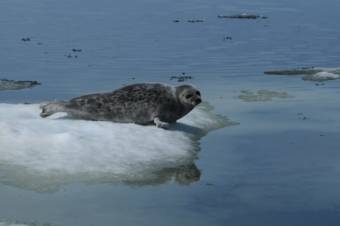
Ringed seal in Kotzebue Sound, Alaska
Ringed seal in Kotzebue Sound, Alaska. (Photo courtesy of NOAA)

On Wednesday, the National Marine Fisheries Service ruled against a petition from the state of Alaska to delist the Arctic ringed seal from the Endangered Species Act.

Last year, the state of Alaska partnered with several North Slope entities to write the petition, arguing that keeping the ringed seal listed as endangered could negatively impact economic opportunities for the state, as well as subsistence rights.

“Although we provided substantial new information to the service, they argued that information was considered in other ways, even though that information wasn’t available previously,” said Chris Krenz, a wildlife science coordinator for the state. “We are disappointed that they took that tact with this petition.”

Krenz says the state believes that the ringed seal isn’t threatened. Officials noted the ringed seal population is in the millions, despite measurable losses in sea ice. Though climate scientists with the National Marine Fisheries Service predict that by the year 2100, there will be little to no sea ice in the Arctic, Krenz argues that looking that far ahead doesn’t constitute the foreseeable future.

“There is way too much uncertainty to really understand how ringed seals will adapt or not to changes in our environment,” Krenz said. “We’ve also documented additional information that indicates ringed seals may have higher resilience than initially anticipated.”

The Obama administration listed the Arctic ringed seal under the Endangered Species Act in 2012, citing the effects of climate change on the ringed seal’s sea ice habitat.
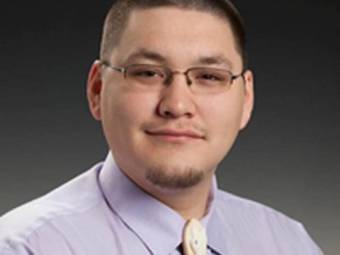
Kristen Monsell with the Center for Biological Diversity agrees with the federal ruling.

“The best available science shows that within the foreseeable future, so much of their habitat will be destroyed — it will just melt away from greenhouse gases — that the species will not be able to withstand that loss,” she said.

Monsell says the fact that the ruling came from the Trump administration underscores the need for federally protecting the Arctic ringed seal.

National Marine Fisheries Service will soon begin a five-year review of the Arctic ringed seal to determine whether or not the species should still be listed under the Endangered Species Act. Krenz with the state of Alaska says this will provide an opportunity for the state to continue to make their case for delisting.

Representative-elect Patkotak says he opposes joining a caucus that seeks cuts to certain rural Alaska programs

Josiah Patkotak is the representative-elect for Alaska’s House District 40 seat. (Photo courtesy of Josiah Patkotak)

As lawmakers begin to figure out what the makeup of various legislative caucuses will look like, Josiah “Aullaqsruaq” Patkotak is in a slightly different position than most other representative-elects.

With unofficial results coming in two weeks after the general election, Patkotak emerged victorious in the race for House District 40, which includes the North Slope, the Northwest Arctic Borough and several Interior Alaska villages.

While Republicans hold a slim majority in the state House, Patkotak, an independent, says he hasn’t committed to joining a legislative caucus yet. However, he says there are several programs he wants to ensure receive funding.

“As I lump them together, as I’ve had to talk to people over the last couple days, I call them PPT and PCE — petroleum property taxes and Power Cost Equalization,” Patkotak said. “Those are on the list of priorities. There are other things that I’m interested in looking out for, and I’m making sure those are involved in my decision making moving forward.”

With many of the Republicans who’ve been elected to the Legislature in favor of large cuts to funding for state services, Patkotak says he’s opposed to joining a caucus that would cut programs like PPT and PCE.

“Anybody that’s going to look at attacking programs or services that are going to affect my district negatively, that’s not something I’m going to be in favor of, obviously,” Patkotak said.

Gov. Mike Dunleavy proposed transfering oil property taxes from municipalities like the North Slope Borough to the state government last year. He didn’t repeat the proposal this year. And Dunleavy and some Republican lawmakers proposed eliminating the Power Cost Equalization Fund last year. It’s not clear whether Dunleavy will propose a similar change in the budget he introduces in December.

For now, Patkotak isn’t committing to any legislative caucus. He says he hopes to take his role as an independent lawmaker seriously.

“I have this deep belief that a lot of things that I’ve learned going whaling can be applied throughout my life,” Patkotak said. “That’s one of the things. You know when to strike the whale and you know when not to. And I think I’m just applying that same principle here. Like I said, I haven’t committed to anybody. All options are on the table.”

The Division of Elections expects to officially certify the results of the election next week, with lawmakers set to arrive in Juneau in January.

Site notifications
Update notification options
Subscribe to notifications