KOTZ - Kotzebue

KOTZ is our partner station in Kotzebue. KTOO collaborates with partners across the state to cover important news and to share stories with our audiences.
For newly minted Iñupiaq doctoral graduate, opening doors for Native scholars is vital

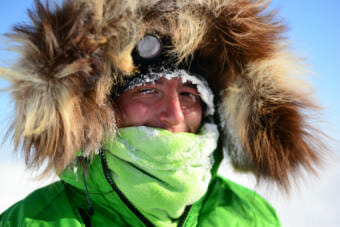
Dr. Cana Uluak Itchuaqiyaq is originally from Kotzebue and just completed her doctoral program in technical writing and rhetoric at Utah State University. (Cana Uluak Itchuaqiyaq)

The process of earning a doctorate takes a lot of time and work. And for one Iñupiaq woman, hearing the words doctor next to her name was emotional: Her response to passing her dissertation defense went viral this month after hundreds of thousands of people watched her reaction.

In a video Twitter post, Cana Uluak Itchuaqiyaq recorded herself getting the news she’d passed her doctoral program at Utah State University.

She covered her face and cried after being told she was the first person in the program to pass with distinction. As emotional as the whole moment was, Itchuaqiyaq said she was touched hearing how her name was presented.

“Hearing ‘doctor’ with a wholly Iñupiaq name was pretty overwhelming,” Itchuaqiyaq said.

Her doctorate is in technical writing and rhetoric. She said her focus has been on how using more traditional storytelling can inform how people communicate in more Western-focused academia.

“Using story is an incredibly effective way to communicate the stakes of an issue,” Itchuaqiyaq said. “Especially issues that affect populations or communities that are disenfranchised or that are marginalized in some way.”

Itchuaqiyaq said for the most part, academics and research institutions rely on more quantitative data in their work, often discounting personal experiences or stories.

“People will say, when you use story for example, they will say that’s anecdotal evidence,” Itchuaqiyaq said. “And I argue that is lived experience from people who are experts in that experience describing that.”

She gave an example of Iñupiaq hunters travelling on sea ice to catch seals. She said often people will ask what the trail was like, and a hunter could respond by describing how their eyelashes froze, or how ice was sturdier on the snow machine trip out, but began to break up under the weight of the snow machine and a freshly caught seal.

“They might use an anecdote or some kind of phrase to describe the weather,” she said. “What they’re really saying is it’s between this temperature range.”

Born in Kotzebue, Itchuaqiyaq spent most of her childhood traveling back and forth between Anchorage and the Northwest Arctic. Her parents divorced when she was very young, but both were in her life growing up.

Her journey through college wasn’t conventional by most metrics. Out of high school, she went to UC Berkeley. But at that point in her life,  she wasn’t ready for college, and didn’t finish her degree.

She and her then-husband had two children early in her 20s and moved to Boston where he was studying. She took night classes at Harvard, but she said she struggled with substance use toward the end of her last year.

She eventually entered a mental health facility.

“I didn’t graduate,” Itchuaqiyaq said. “I lived instead. And I’m really proud of that choice that I made to value my own life and get help. I’m grateful that I did that.”

A year later, she graduated with honors in 2006 and continued her education with a masters in communication from Idaho State University before entering her doctoral program.

Itchuaqiyaq said she’s remained sober since being admitted, and made other sacrifices to move forward. That included being apart from her kids as she went to school in Utah, and continuing to work on confronting trauma from her youth.

At the end of it all, Itchuaqiyaq said her work has been worth it.

“I’m going to be a professor at Virginia Tech. Wow!” she laughed. “It’s hard to believe for me. I was a drug addict, almost died from my drug addiction. I was this traumatized kid from the NANA region. Literally.”

Itchuaqiyaq talks openly about her experiences with trauma and substance use. She said in relating her personal experiences, she wants to show they don’t define a person, and someone can experience them and still be successful.

“It takes a lot of work, and a lot of support from others,” Itchuaqiyaq said. “But if you are stuck in some of these cycles. There’s hope for you.”

Dr. Uluak Itchuaqiyaq says that in recent years, there has been a wave of Alaska Native success stories in higher education and doctoral research, and she’s hopeful both her work and her story will help the wave grow even larger.

Redington declared winner of harrowing Kobuk 440

Ryan Redington at the finish line of the Kobuk 440 in Kotzebue Tuesday. April 6, 2021. (Berett Wilber/KOTZ)

Musher Ryan Redington won this year’s Kobuk 440 in Kotzebue Tuesday, after he and the other teams battled some of the toughest conditions in the competition’s history.

As the only team to complete the original upper Kobuk loop trail through the storm, 38-year-old Redington, from Knik, took home the $16,000 first prize.

The weekend storm had scattered other Kobuk 440 mushers along the trail in dangerous weather, and rescue teams spent a nerve-wracking night searching whiteout conditions to find them.

Once all were safe, a restart along a new route took place Monday morning in the Northwest Alaska community of Ambler.

Dempsey Woods, a musher from Kotzebue, gets out snacks for his dog team at the finish in Kotzebue. April 6, 2021. (Berett Wilber/KOTZ)

That meant the race’s actual winner couldn’t be announced until officials made adjustments to account for different distances the teams ended up traveling.

But that didn’t dim Nenana musher Tony Browning’s arrival in Kotzebue just before sunrise Tuesday. He was the first to reach the finish, and it was a meaningful end: This was his last sled dog race, after a long career mushing.

“I wanted this to be my last race, the Kobuk, because it’s my favorite race,” Browning said.

‘A little feeling of the past’

Though the race is ending for the year, its impact on the Northwest Arctic has not.

The only sled dog race above the Arctic Circle, the mission of the Kobuk 440 is to celebrate the Inupiaq tradition of long-distance dog mushing.

Musher Kevin Hansen prepares his dogs for the Kobuk 440’s 2 a.m. restart in Ambler. (Berett Wilber/KOTZ)

That’s something Kotzebue musher Kevin Hansen, who raced the course for the second time this year, thinks about a lot out on the trail.

“I think about it often actually when I’m out running dogs,” Hansen said. “About how, you know, my ancestors lived back in the day, and how they depended on dogs for their mode of transportation and really survival, to help them survive up in this country.”

As Hansen illustrates, the race isn’t a re-enactment of a historical way of life. It’s part of a continuous legacy, as contemporary as it is traditional, on routes people have traveled for thousands of years.

Martin Cleveland helps run the checkpoint in Ambler, and said it remains an important experience for the community.

“These kids, nowadays, I’m glad they get to see it,” Cleveland said. “They may not see it if they grow up to be adults. We do not know what the future holds for us. But I thank them for coming up this way. Every year, it’s always fun. The kids, being exposed to dog mushing, gives them a little feeling of the past.”

It’s a team effort for more than just the racers and dogs. It takes all the communities along the route to make the race happen.

The village of Ambler has been on a boil water notice for several months, but community members hauled water from the river every day so mushers and dogs could stay hydrated.

Trail crews in Ambler kept fires burning through the night to keep water thawed for mushers to feed and water their teams once they arrived at the checkpoint. April 3, 2021. (Berett Wilber/KOTZ)

And even a dozen hungry mushers couldn’t eat all the food that was donated and cooked, much of it made by volunteer Lolo Johnson.

“Homemade chili, spaghetti, caribou soup, chicken, potato salad, macaroni salad, donuts, cinnamon rolls, bread,” Johnson listed. “We made biscuits and gravy, we had bacon… cakes, cakes, cakes. Oh, we had blueberry cheesecakes.”

‘Are we on the trail?’

Along with trail crew and search and rescue teams who took care of humans during some of the most aggressive weather the race has ever seen, critical support for the four-footed racers came from two volunteer veterinarians, including Dr. Jessica Klejka, a Kobuk 440 and Iditarod veteran.

Race veterinarian and Iditarod and Kobuk 440 veteran musher Dr. Jessica Klejka in Ambler. April 3, 2021. (Berett Wilber/KOTZ)

She didn’t run a team this year, but did encourage her husband Sam Brewer to try. It was his very first mid-distance race, and it didn’t go as expected.

“We were mushing along and I got to the point where I could not see my leaders, Radar and Sally,” Brewer said.

“Of course, that’s something someone would say, ‘It got so bad I couldn’t even see my leaders.’ Here, I was watching it happen. Well, no one will even believe me if I say that, they’ll think I’m hyperbolizing. And we kept going — and it got to the point where I could not see Rudy and Ruble, my wheel dogs.”

Jessie, a sled dog from Sam Brewer’s team, hides out under an accumulated snow drift at the Ambler checkpoint. April 4, 2021. (Berett Wilber/KOTZ)

In the meantime, Klejka was worrying about him in the storm. She watched as veteran mushers Jeff King, then Nic Petit, who were directly in front and behind Brewer on the trail, pressed emergency buttons requesting support from the trail crew.

“Sam has never ever texted me from his inReach ever before, like ever in his life,” Klejka said. “And I got a text from an inReach that said zero visibility. Are we on the trail? I said go into hunker down mode. I look on the tracker And Nic makes it to Sam, it looks like they’re on top of each other, they’re within a thousand feet. But they don’t see each other.”

It wasn’t the sunny, light-filled, spring race his wife had described.

“I slept out under a tarp for about eight hours,” Brewer said.

But Brewer persevered. He ended up as one of only three mushers who made it to the Shungnak checkpoint. The trail crew had to track him down and tell him to turn around for the re-start in Ambler. And by the time he reached the finish line in Kotzebue around 1:30 p.m. Tuesday, beneath the icicles in his beard, he was all smiles.

Sam Brewer with his lead dogs at the Kobuk 440 finish line. April 6, 2021. (Berett Wilber/KOTZ)

“The team did awesome the whole way,” Brewer said. “They were incredible. Lot of interesting experiences in this race. Learned a lot. Lot of fun.”

As race winner Ryan Redington put it, if it was easy, no one would talk about it.

‘A pretty tough race’: Musher Tony Browning is first to cross Kobuk 440 finish line

Tony Browning was the first musher to cross the finish line of the 2021 Kobuk 440. (Berett Wilber/KOTZ – Kotzebue)

The Kobuk 440 sled dog race is winding down Tuesday as the first mushers and dog teams arrive back in Kotzebue.

Tony Browning, a veteran musher from Nenana, and his dog team dashed across the finish line first, around 7:20 a.m.

“It was a pretty tough race for sure,” Browning said. “The dogs did excellent. They came in motoring. I ran them kind of slow down the river, a little slower across the lake and then fired them up coming over the hills. And they just took right to it… whoosh.”

While Browning was first back in Kotzebue, a race champion has yet to be named: Race officials still must adjust teams’ times to account for different distances traveled during the weekend’s harrowing storm.
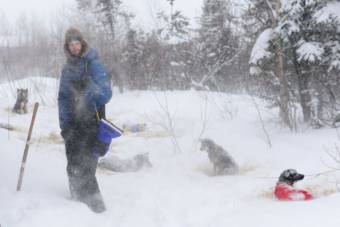
Blizzard conditions prompted two veteran mushers to hit their distress signals and forced others to turn around. Race officials then paused the race and rerouted the trail.

Alex Beck, one of the Kobuk 440 race veterinarians, taking feeding dropped dogs in Ambler. (Berett Wilber/KOTZ)

The competition restarted at 2 a.m. Sunday.

Browning said the last bit of trail from Kiana to Kotzebue was fairly calm, describing the snow as “sugary” and “grindy.”

Browning is a fixture in rural Alaska mid-distance mushing, having won the Kobuk 440 in 2000, four Nushagak Classics and the Nome Council 200 twice. He’s also placed in the top 10 at several Kuskokwim 300 races.

But, he said, this race will be his last.

“I wanted this to be my last race, the Kobuk, because it’s my favorite race,” Browning said.

Last week, before the Kobuk started, Browning described the competition as “extreme.” It’s Alaska’s last big mushing event of the season.

“It’s not something you can just go out there and just pull a hook and just go. You have to really know what you’re doing,” he said. “If you want to just finish the race, you have to know what you’re doing.”

Nine more mushers were still on the trail early Tuesday, with Ryan Redington and Gunnar Johnson on pace to arrive in Kotzebue at around noon.

This is a developing story. Check back for updates.

Kobuk 440 rerouted after ‘monumental’ storm upends race

Alex Beck, one of the Kobuk 440 race veterinarians, feeding dropped dogs in Ambler. (Berett Wilber / KOTZ)

After being inundated by blizzard conditions, the Kobuk 440 sled dog race is back on track after mushers regrouped, rerouted and restarted the race in Ambler.

Whiteout conditions had two mushers requesting outside assistance through their trackers. Three village search and rescue teams, as well as the racing association’s trail crew, were deployed to guide mushers into checkpoints. Many teams were pinned down by the weather for hours, unable to find each other and unsure if they were on the trail at all.
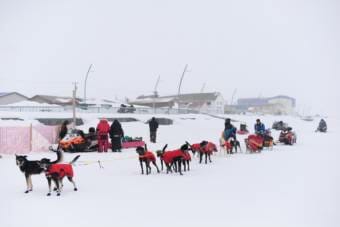
Hugh Neff has raced the trail for years. He said he turned around and returned to the Ambler checkpoint because he didn’t want to choose between the race or his life.

“It was pretty intense there,” Neff said. “Obviously the fear factor was just — I mean you were dialed in, just trying to go tripod to tripod, just trying to stay on the trail. It was blowing hard, you know. If you had an item on your sled — or even your sled — get away from you, you weren’t gonna see it again.”

Robin Gage, a member of the trail crew that helped guide disoriented mushers safely into Shungnak, painted a harrowing picture of the weather.

“I don’t know how to describe it for someone who’s never been in a blizzard but, just standing in a wind tunnel, just incessant, it just didn’t let up. You were surrounded by it,” he said. “So at some point you just got almost numb to it, because you can’t — I don’t know if you get used to it, but you just, it’s there, it’s all around you. You can’t do anything about it. It just made everything much more difficult, even talking. It was hard to even hear a snow machine running. Turn the key, and — is it running? Had to look at the headlight.”

After all of the mushers had either arrived safely, returned to Ambler or were far enough behind they weren’t at risk, race officials decided it was best to pause, let the dogs rest and figure out a new strategy.

They didn’t want anyone venturing back out toward the last two checkpoints — Shungnak and Kobuk — or onto the planned return route, race president Paul Hansen said.

“The original route was over to Selawik,” Hansen said. “The weather forecast for that route was high winds and blowing snow, and that’s all open tundra and was determined not to be safe.”

Afternoon snow covers a tired sled dog resting in Ambler. (Berett WIlber/KOTZ)

Ed Iten, the trail marshal, assembled mushers for a meeting in Ambler late on Sunday to let them know how the rest of the race would go.

To keep the field together and avoid putting people, dogs, and rescue crews at risk, mushers would head back toward Kotzebue by way of Kiana and Noorvik. They restarted at 2 a.m. Monday morning, under a clear, starry sky. Each musher will have to take eight hours of rest between the two remaining checkpoints.

While there have been weather holds in the Kobuk 440 before, there’s never been a full-scale reroute mid-race. Veteran Jeff King who was withdrawn from the race, leaving his team and returning to a checkpoint by snowmachine for frostbite treatment, said it was a stand-out.

“I was so thrilled by my team, but jeez, even the start was as monumental a weather challenge as I’ve had in 40 years,” King said.

The weather isn’t the only difficulty ahead. Race officials will have to do some complex calculations at the finish line to figure out who wins, no matter who arrives first, since the mushers have now traveled different distances depending on how far they made it before being recalled to Ambler.

For example, Ryan Redington struggled through the whiteout conditions and made it all the way around the originally planned loop without assistance. Nic Petit completed the loop, but was disqualified from the race for requesting assistance through his tracker.

Like Tony Browning, racer Hugh Neff left Ambler, but turned back after struggling through the wind became too much.

Other mushers got caught and pinned down in the storm, including Jeff King, who’s team starting slipping and sliding on glare ice as they faced into the wind.

“It just got worse and worse and worse,” King said.

Rookie Sam Brewer and Gunnar Johnson had to hunker down for hours, but managed to make it to Shungnak before being told to turn around to make it to the Ambler restart.

Mushers Kevin Hansen, Dempsey Woods, and DJ Starr never left the checkpoint once race officials told them to stay put. Philip Hanke and Reese Madden hadn’t yet reached Ambler by the time of the restart.

But there’s no question even before it’s finished the Kobuk 440 has lived up to its reputation. As race marshal Ed Iten put it,

“They call it the toughest race above the Arctic circle, and you’ve got to reinforce that now and then,” Iten said.

Race President Paul Hansen said mushers are now expected into Kotzebue in the early hours on Tuesday morning around 6:30 a.m.

A dozen mushers brave wind, snow and whiteout conditions as the Kobuk 440 kicks off

A dozen dog teams line up for the mass start to the 2021 Kobuk 440 Sled Dog Race. (Photo by Berett Wilber, KOTZ-Kotzebue)

Alaska’s mushing season is coming to a close. The last major race kicked off in Kotzebue Friday afternoon.

Braving heavy winds and below-zero temperatures, a dozen mushers embarked across the sea ice for their chance at claiming victory in this year’s Kobuk 440 Sled Dog Race.
The sound of barking dogs filled the cold air on the Kotzebue Sound sea ice as 12 mushing teams prepared to embark on the Kobuk 440.

It was six degrees below zero, but the heavy winds make it feel more like 34 below. A white fog blanketed the teams.

The 2021 race comes a year after COVID-19 forced the cancellation of the 2020 event. Veteran musher Hugh Neff from Fairbanks has run the race for years and said he’s excited to get back on the trail after missing out last year.

“For us, it’s the best part of Alaska,” Neff said. “Every year, everybody gears up for Iditarod of the Yukon Quest, which my wife is in charge of. But at heart, we live for this race. There’s just something … our whole year is geared up towards coming to Kotzebue.”

But coming up to Kotzebue proved to be a little tougher this time around for the mushers. The winter storm delayed most of them by a day. The race itself is starting a day late.

Longtime musher and Iditarod favorite Jeff King was the last musher to arrive. His dogs got there before he did and he thanked other mushers for watching them.

“As you might imagine it’s very nerve-wracking to have your dogs this far away and not have people familiar with them specifically,” King said.

Musher Jeff King begins loading his dogs onto his sled’s harness. (Photo by Berett Wilber, KOTZ–Kotzebue)

The Kobuk 440 is known for hosting a mixed bag of competitors, from locals like Kevin Hansen and Dempsey Woods to Iditarod favorites like Jeff King and Nic Petit. For several of the teams, this is their first mid-distance race ever. Ryan Redington of Knik, the winner of the 2019 Kobuk 440, said he’s expecting the competition to be fierce.

“There’s some really awesome dog teams here, so I think it’s going to be quite the competition for the top mushers, top rankings here,” Redington said.

Kevin Hansen, born and raised in Kotzebue, said he’s hopeful that his knowledge of the region will give him a bit of a leg up on the other mushers. But Hansen doesn’t do mushing full-time; he works as a physical therapist. He said having to balance his job with a very intensive hobby can be a challenge.

“So it’s a hobby that we try to kick into gear for these races,” Hansen said. “But we definitely don’t have the sponsorship and stuff of all of these other mushers. So it’s an advantage of knowing the country more and the trail conditions can work in our favor. But as far as putting together a professional team, it’s a little more difficult for us, and it’s not our main focus.”

Kevin Hansen and his family set up his dog sled ahead of the 2021 Kobuk 440. (Photo by Berett Wilber, KOTZ–Kotzebue)

Dempsey Woods has been raising dogs since he was a kid growing up in Shungnak. He doesn’t have the sponsorships of some of the other mushers, but Woods said he’s got his neighbors.

“It’s a challenge, but with this community of Kotzebue, I’ve got pretty much all the help I need,” Woods said.

The trail for the 2021 Kobuk 440 Sled Dog Race. (Image courtesy of Kobuk 440 Racing Association)

Mushers will make their way from Kotzebue to the village of Noorvik, moving along to Kiana and then Ambler. Mushers will then hit Shungnak and Kobuk, before looping back through Ambler and heading down to Selawik. From there, they’ll hit Noorvik one more time before finishing in Kotzebue.

Winners are expected to cross the finish line early Monday morning.

With limited resources, prosecutors in Western Alaska struggle to prioritize massive caseloads

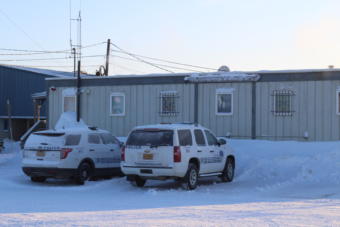
Police vehicles parked in front of the Kotzebue Police Department building. (Wesley Early/ KOTZ )

Prosecuting crimes in Western Alaska can be tough, with just a few lawyers assigned to thousands of cases annually. Local prosecutors often have to prioritize the most serious cases, while dismissing lesser crimes that might be prosecuted in other parts of the state.

Kotzebue’s district attorney position is currently vacant. The office is being temporarily overseen by Nome District Attorney John Earthman. Earthman says, in addition to numerous ongoing investigations, Nome sees about 1,000 new cases a year. The numbers in Kotzebue are similar.

“Roughly 1,000 new cases per year,” Earthman said. “That includes Kotzebue, the villages of the NANA region plus Point Hope. That’s a lot of cases for what is a two-attorney office.”

And that two-attorney Kotzebue office was vacant for about nine months. That was after Gov. Dunleavy appointed both assistant district attorneys in the Kotzebue DA office to fill judicial seats in Valdez and Homer. From December 2019 to September 2020, Earthman says some cases were picked up by the Nome DA office, but most of them were handled out of Anchorage.

Nome also lost an assistant district attorney last year, when Dunleavy appointed him to the Palmer District Court.

Earthman says getting qualified prosecutors to come out to rural Alaska has been a chronic problem.

“I think it’s a shame because living in Kotzebue or Nome or whatever … I think people are lucky to be able to do that,” Earthman said. “But it’s not for everyone. And it’s getting harder and harder to get people to even want to do these jobs out here.”

Kotzebue now has two prosecutors. Nome should be getting a new prosecutor in the summer. Averaging more than one new case a day each, Earthman says that prosecutors often have to focus on higher level crimes.

“They have very limited resources and their focus is going to be on the most serious offenses,” Earthman said. “Murders, sexual assaults, domestic violence and DUIs … that type of thing.”

Earthman says his office is working to help shoulder some of those cases by hiring a new prosecutor whose caseload will be more focused.

“To handle sex cases, investigations and prosecuted cases, in both Nome and Kotzebue,” Earthman said.

Earthman is hopeful that the new position will ease the workload of prosecutors in both Nome and Kotzebue to work on other crimes in the area. In the long term, he wants them to stick around, stating that the longer a prosecutor works in rural Alaska, the better informed they’ll be on crimes facing this part of the state.

Site notifications
Update notification options
Subscribe to notifications