KOTZ - Kotzebue

KOTZ is our partner station in Kotzebue. KTOO collaborates with partners across the state to cover important news and to share stories with our audiences.

As COVID-19 restrictions lift, Northwest Arctic Borough renews push to get VPSOs in every village

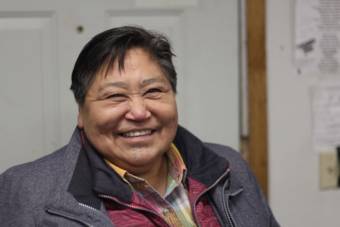
Aucha Kameroff, Director of Public Safety for the Northwest Arctic Borough. (Wesley Early, KOTZ)

As COVID-19 restrictions are lifting in the Northwest Arctic Borough, local public safety officials are continuing their push to get Village Public Safety Officers in more communities.

When Aucha Kameroff took over as head of public safety for the Northwest Arctic Borough at the start of last year, there were no Village Public Safety Officers in any of the borough’s 10 village communities. Kameroff says a lack of public safety is a problem in many rural Alaska communities, and getting VPSOs in the Northwest Arctic was her first priority.

“I want our communities to be with law enforcement in all communities,” Kameroff said. “I don’t care if you’re in Emmonak, or if you’re in Allakaket, or in Anaktuvuk Pass, and in our region, Kivalina, Buckland — all those villages, we need law enforcement.”

Though the pandemic slowed down how quickly she could fill the VPSO jobs, she and the borough have still made major progress in hiring.

“We have a VPSO coordinator and five VPSOs,” Kameroff said.

Kameroff would have to hire five more VPSOs to meet her goal of having one in each village. Once those officers are hired, another priority is getting them up to speed on Inupiaq culture. Most of the officers are from the Lower 48, so they first come to Kotzebue to meet the borough officials before heading to villages for field training.

“When we had them in Anchorage for a long time, I had them study the Northwest Arctic Borough website,” Kameroff said. “I had them study all the villages, their history and the type of people that live up here and the different cultures of the state of Alaska. Because they’re coming from New York or Arkansas or Arizona, and they have no idea.”

Kameroff says getting officers through the application process can be lengthy. It normally takes about three months to make a hire. Kameroff says she understands village leaders’ continued push for public safety.

“You know, people want something, like all of us, they want something right now,” Kameroff said. “But it takes a while to get to the right now. The process to get to the hiring is one process. The training is another process.”

The officers train through the VPSO academy in Sitka. The next 16-week academy starts at the end of July. This week, Kameroff says a VPSO for the region is graduating from the academy.

“We placed him for the village of Shungnak,” Kameroff said. “He’d done some work there last year and was there some last summer.”

Currently VPSOs work in two-week shifts, rotating between their homes and the villages they serve. It’s a similar model to how the Kotzebue Police Department operates. Kameroff says it isn’t ideal. She’d prefer having officers live in the region. However, she says, that hasn’t been practical.

“When we first started, or I started, in this position it was very hard to hire folks,” Kameroff said. “So we had to find a way to entice people to come onboard, and two weeks on, two weeks off schedule was the way to do it.”

Kameroff says the next step in expanding VPSO coverage in the region is making sure that the village communities have the infrastructure to support an officer.

“Meaning an office location, a holding cell,” Kameroff said. “You also have to have a living unit. You know, we’re not going to be working 24 hours a day, 365, you know.”

She says the borough is working with communities to provide grants and other means for getting public safety buildings in all of the villages. Now that COVID-19 is becoming less of an issue, she is planning more meetings in-person with village leaders to gauge their public safety needs moving forward.

GCI plans wireless upgrades across Alaska, including faster speeds for rural communities

A GCI van parked in Kotzebue. (Wesley Early/KOTZ)

The state’s largest wireless internet provider plans for a major boost in service for both urban and rural Alaskans.

Currently, the fastest internet speeds in Alaska are in the more urban parts of the state, like Anchorage, Fairbanks, Juneau, and the Mat-Su Borough. In those areas, GCI offers 1-gigabit speeds. At that speed, a customer can download a two-hour, high definition movie in less than 30 seconds.

The next major upgrade to Alaska communities will be bringing that 1-gig speed to Nome and Kotzebue later this year. GCI spokeswoman Heather Handyside says the upgrade will bring that part of the state more in line with Anchorage internet speeds.

“And not just comparable to what people in Anchorage have,” Handyside said. “People in Los Angeles, Chicago, there are places outside of Washington D.C., outside of Atlanta, that do not have to 1-gig speeds right now.”

Handyside says once the upgrade is complete, Nome and Kotzebue residents can expect prices to lower and be closer to what people in Anchorage pay for their 1-gig service.

“I don’t know if it will drop exactly, but it will be close, and they will also get the same speeds and data,” Handyside said. “So yes, customers will see a significant increase in data and speeds, and depending on the plan they choose and the plan they’re on right now, many will see a decrease, maybe a dramatic decrease in what they pay.”

Nome and Kotzebue aren’t the only rural areas that can expect a boost in internet service over the next few years. GCI is also moving forward on their AU-Aleutians Fiber Project. Handyside says this project will bring 1-gig internet speeds to Southwest Alaska communities like Unalaska, King Cove, Sand Point and Chignik Bay.

“It’s an 860-mile subsea fiber,” Handyside said. “And that’s part of the project, but then there’s also building out the fiber in the communities to be able to accommodate those kind of speeds that you’re going to get from the new fiber.”

Part of the project is funded through a $25 million grant from the U.S. Department of Agriculture, with another $33 million coming from GCI. Handyside anticipates the construction to wrap up by early 2023.

As rural Alaska communities begin to see improved service, the current fastest speeds in Alaska will double to 2-gig speed starting in 2022. Handyside says the upgrade will help keep up with increasing household wireless demands in places like Anchorage and Fairbanks, as well as Southeast Alaska communities connected to fiber optic internet like Sitka, Petersburg and Ketchikan.
“The customers who are on GCI’s fiber with 1-gig service will see some of the fastest speeds in the nation,” Handyside said. “Much faster than in the Lower 48.”

Handyside says the upgrades are part of a continuing push to get 10-gig internet speeds in Alaska within the next five years. She says customers who are currently on 1-gig speed plans should not see an increase in the cost of their service with the 2-gig upgrade.

Kotzebue elementary school works to better incorporate Iñupiaq culture in classrooms

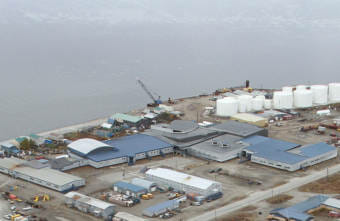
June Nelson Elementary and Kotzebue Middle-High School (Photo courtesy of Northwest Arctic Borough School District)

June Nelson Elementary School is working to help their students connect more with Iñupiaq language and culture. In previous years, the curriculum included two, 20-minute sessions of Iñupiaq each week. According to school principal Faith Jurs, there have been increases across all grades.

The teaching staff at the pre-K through 5th grade school of about 340 students felt Iñupiaq content was lacking across the board, Jurs said.

“We did a survey of all of our staff, and we identified that one of our weaknesses was that we weren’t incorporating enough Iñupiaq language and culture into our classrooms,” Jurs said. “It was a bigger problem than we realized, and a really fun project to work on.”

Jurs says all grade levels will see a boost in Iñupiaq content under the new curriculum.
“Increases were made all across the school but the pre-K program especially infused a lot of language and culture,” Jurs said.

One of the educators leading the charge is preschool teacher Cassia Teuscher. With help from her fellow preschool teacher Briahna Griffths and their Iñupiaq instructional aid Becca Wesley, Teuscher adapted the existing teaching material into a bilingual program.

“Learning two different languages is always good for any kid,” Teuscher said. “Especially brain development and stuff like that, and especially learning about their culture. They also seem to take a lot more interest in what we teach if I gear it towards what they know.”

Teuscher says the team created their own books and worksheets and also adapted Iñuit books to the Iñupiaq alphabet.

“By taking the curriculum that we had and changing it to where it is geared towards them and then giving it that spin towards their culture and also developing words that they would hopefully take and use, day to day now, in their own language, is pretty cool,” Teuscher said.

Jurs said there have been a variety of activities to suit all age groups.

“We’re doing different things at different grade levels,” Jurs said. “At the lower elementary, K-2, our Iñupiaq teacher has taught Eskimo dancing and Native Youth Olympics. Our kids in K-4 went ice fishing with Raymond Woods, the district coordinator of Iñupiaq programs.”

Jurs said the program uses many teaching tools, including cultural stories, dance, art projects and learning about local plants and animals.

“Kind of a culminating thing that we did school-wide was a big project with the migratory birds that come here,” Jurs said. “Park Service helped us. We learned information about the different birds and then we learned the Iñupiaq names for those birds. And then each grade did a different art project and those were all displayed in our display cases in the front of the building. Really, really cool. Hazel Woods coordinated that for us. It turned out great.”

Teuscher says that under the new curriculum, every day feels like Iñupiaq day for the students at June Nelson Elementary School.

Jurs also discussed literacy and science-based summer programs that are available to students in Kotzebue.

“One of the programs is going to study different countries around the world. Another one is doing STEAM projects – science, technology, [engineering], art, and math. And the other is working on getting kids caught up on some basic skills. If they’re interested in having their child go to summer school, it’s not too late to sign up,” Jurs said.

For students in need of additional flexibility in their learning style and schedule, Jurs said there are further options.

“Parents can sign up for ‘21st Century.’ We have kind of a limited enrollment because we don’t have that many teachers here right now,” Jurs said. “If a student is in ‘Migrant Education,’ that means they go hunting or berry picking, they need to register to be a migrant student and then they can go to the migrant summer school. Then the other one is called ‘Extended School Year.’ That program is for students that have an individual education program.”

These summer programs are available for all age groups and they run through the end of May.

Northwest Alaska village of Buckland assessing flood damage as water levels drop

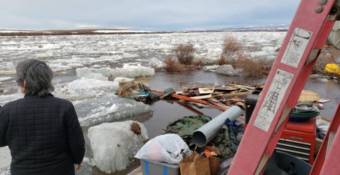
Flooding outside Buckland resident Timothy Gavin’s house on May 13, 2021 (Photo courtesy of Timothy Gavin)

Water levels in the Northwest Alaska village of Buckland have declined after a river ice jam led to major flooding last week.

The National Weather Service says the ice jam had cleared by Monday, and water levels had dropped roughly 15 feet. That’s about a three-quarters decrease from the highest flood levels, said local incident commander Raymond Lee Jr.

So far, there have been no reports of injuries due to the flood.

But the rapidly rising waters did damage homes and others structures. Responders are still assessing the extent of the damage, Lee said.

“I believe there’s like 20 homes that might be affected by the flood damage due to the insulation to the homes under the house and on the floors,” he said.

Buckland is home to about 400 people, and sits on the bank of the Buckland River, about 75 miles southeast of Kotzebue.

On Monday morning, Gov. Mike Dunleavy issued a disaster declaration for Buckland, opening up state public assistance resources to the community.

“The flooding caused significant damage to homes, roads and utility infrastructure so a declaration is warranted to get the community back on its feet as soon as possible,” Dunleavy said in a statement.

The flooding started last Wednesday, and the City of Buckland and the Northwest Arctic Borough have also both declared disasters.

Lee said the city has recently lifted the local boil water notice after water treatment plant officials ensured that sewer systems were back to normal. The village hopes to use the disaster relief to begin to address infrastructure, he said.

“There’s a lot of big rocks exposed on main roads that we use, and also the foundation of the padding on the homes,” he said. “There’s a lot of shifting due to the in and out of the backwash of the floodwaters.

The relief funds will also likely be used help residents who lost propane and stove oil during the flooding.

“Stove oil tank holders that hold the stove oil tanks were ripped off and propane tanks were ripped off,” Lee said. “I think they’re going to use those, the ones that gave the money, so they can start cooking and doing things at home normally.”

As Buckland continues to get back to normal, Lee thanked all of the local and state organizations for coming together to help the community. He singled out praise for Maniilaq Association, the regional health care provider, and Red Dog Mine for donating water to the village’s elders.

Editor’s note: The headline of this article has been updated and more information has been added about the damage in Buckland.

Northwest Alaska village of Buckland floods due to ice jam

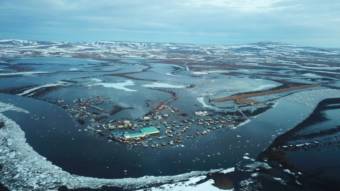
The Northwest Arctic village of Buckland has seen flooding since Wednesday night. Aerial footage taken on May 13, 2021 shows ice break-up east of town on the Buckland River. (Photo courtesy of John Jones)

An ice jam caused by warming spring temperatures near the Northwest Alaska community of Buckland has left most of the village underwater on Thursday and prompted residents to prepare to evacuate.

Buckland is home to roughly 400 people. It’s located on the bank of the Buckland River, about 75 miles southeast of Kotzebue.

Nathan Hadley Jr., Buckland’s vice mayor, said he noticed water starting to rise in the village Wednesday night.

“Around maybe 7:30, 8 at night, I was cooking a late dinner and I could see the ice moving through the river really fast,” Hadley said.

Minutes later, he said, the water started gushing from the Buckland River onto the land.

“I got my hip waders and started moving my children’s motorcycles, snowmachines, my truck, the side-by-side, and bringing them to higher ground,” he said. “And I came back to deal with the things in my house that I needed to save.”

The community has seen flooding in the past, but it hasn’t been this bad in years, said Hadley.

“We never had a flood like this in over 20 years,” he said. “The water has gotten high in the past, but not this bad. We were basically not ready for it.”

By Thursday, the flooding had cut off access to the airport road as people prepared to leave by boat if water levels kept rising.

Hadley said the city of Buckland and the local tribal council have been coordinating with volunteers to assist community members by boat.

He hadn’t heard any reports of injuries, and volunteer responders were working to secure homes so they don’t float away, he said.

Flooding outside Buckland resident Timothy Gavin’s house on May 13, 2021 (Timothy Gavin photo)

Incident commander Raymond Lee Jr. said they have seven boats on hand for rescue efforts.

“Two houses evacuated, and there are three of them, they were ready to evacuate but they put everything up, but the water didn’t go in their house so they were okay,” he said.

There are two different evacuation locations for residents, and one of them is for people in quarantine due to COVID-19 safety mandates, he said.

“The old blue building is for people that are in quarantine, house quarantine, and the ones that are not in quarantine, they are all going to head to the gym at the school,” Lee said. “There are seven homes that are in quarantine.”

Right now, ice is jammed on the river below Buckland, and Hadley said that will need to clear up for the flooding to slow down.

“If that part of the ice breaks up, then the water will have a place to go, flowing down,” he said.

The water levels were steady through Thursday morning, but Hadley anticipates they’ll rise once the temperatures get warmer later in the day.

The National Weather Service has issued a flood warning for the community through Saturday morning.

KOTZ’s Nicole Edmison contributed to this report.

This is a developing story. Check back for updates.

Spring is in the air in Kotzebue, and so are the birds

Ruby-crowned kinglet (Photo by Donna Dewhurst/USFWS)

After taking 2020 off, the Bird Sighting Contest and other bird watching festivities are back. This will be the 23rd year of the collaborative effort between the U.S. Fish and Wildlife Service and the National Park Service.

Brittany Sweeney, outreach specialist at Selawik National Wildlife Refuge, says that the community-based effort has resulted in a long-term database that can help scientists pick up changes in bird migration patterns and timing.

“That term ‘citizen science’ is thrown around, but it means, in general, when members of the community or members of the public are engaged as observers and reporters to help us track something that’s happening in the natural world,” Sweeney said.

Activities surrounding the arrival of migratory birds started in April and will run through the end of May. Coinciding with the Bird Sighting Competition, the agencies will be setting up drop-in birding spots with spotting scopes, binoculars and bird guides. Staff will be on hand to answer questions and keep equipment sanitized to maintain health and safety.

For the younger crowd, there will be a combination of bird watching, crafts and other fun activities.

“Birds are something that we can all enjoy and celebrate,” Sweeney said.

Deanna Depue, a National Park Service interpretive ranger, says the contest coincides with World Migratory Bird Day on Saturday, May 8.

“About 12 birds have been called in so far this year, ” Depue said. “All of us can start to be thinking about the birds and make a celebration for the birds, start to get excited, and be thinking about our activities for the future.”

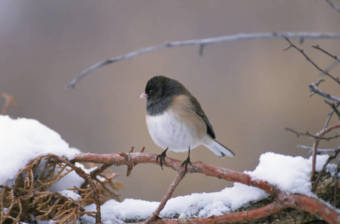
Locals spotted a ruby-crowned kinglet and a dark-eyed junco last week in Kotzebue as a storm rolled in.

Dark-eyed junco (Photo by Dave Menke/USFWS)

“The day that the ruby-crowned kinglet was sighted was one of the snowy days last week when it was hunkering down next to a tree trunk in somebody’s backyard, just trying to find a sheltered spot,” Sweeney said.

The return of the birds each spring is a sign of many things, one being the arrival of fresh meat after winter food stores have been depleted. In the past, Sweeney says the contest has also served as a useful language exchange when people call in with Inupiaq names for birds.

“So [one woman] came back and said, ‘I’m pretty sure they’re talking about a turraaturaq,’ which is a type of shorebird,” Sweeney said. “So it was an interesting exchange of trying to piece together the clues — the scientific name, or what we would biologically know it as, of the bird that this person saw that they were reporting with their name.”

The theme this year is “Sing, Fly, Soar – Like a Bird!,” which Sweeney thinks is an apt sentiment after a long year of being cooped up.

People can find updates on the Selawik National Wildlife Refuge Facebook page.

Turraaturaq or bar-tailed godwit (Photo by Steve Maslowski/USFWS)
Site notifications
Update notification options
Subscribe to notifications