KOTZ is our partner station in Kotzebue. KTOO collaborates with partners across the state to cover important news and to share stories with our audiences.
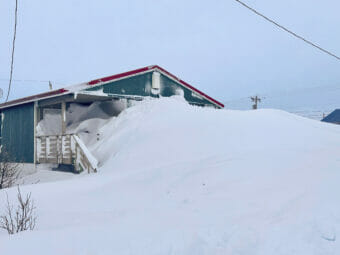
Drifting snow covers a house in Kotzebue on March 7, a day after the region’s most recent storm. (Desiree Hagen/KOTZ)
Kotzebue and the Northwest Arctic Borough have declared a disaster after a series of massive snow storms battered western Alaska. Kotzebue City Manager Tessa Baldwin said the city has a three-person crew working “around the clock,” but snow and high winds are disrupting some of the city’s key infrastructure, causing power outages and a city-wide boil water notice.
“We had a power outage which has caused a boil water notice and an extreme amount of snow,” Baldwin said. “It’s been extremely hard for our emergency responders to get to all places in the city.”
The first storm hit the region in late February and was followed by a second storm over the weekend, with gusts as high as 55 mph. Snow is piled more than 20 feet high in some areas.
Baldwin, a lifelong resident of Kotzebue, said the storms have been a “unique situation” and doesn’t believe the city has experienced this much snow in decades.
“We had five- or six-foot drifts on our main streets and then on the back streets,” she said. “We were looking at anywhere between 15- and 20-foot snow drifts. My house personally was just completely covered in snow. You can’t even tell that there was a house under the snow.”
In a letter to Borough Mayor Dickie Moto, Baldwin said 76 of the city’s fire hydrants were completely buried under snow. On Tuesday, Moto allocated $50,000 in disaster relief funding to hire local contractors to help with snow removal.
And as of Wednesday morning, the city was warning residents to keep boiling their drinking water. It was the second boil water notice issued in the last two weeks.
Baldwin said the city’s new water system, which began operating in November, was waiting for a part for its backup generator before the storm hit. According to Baldwin, Kotzebue’s intermittent power outages mean that the city’s water supply is losing pressure, which could cause sediments and other drainage to enter the city’s drinking water.
The city’s water reserves are currently below what Baldwin calls “a comfortable level.” The city is urging residents to conserve water and reduce their consumption.
The heavy snow build-up is also a concern for the city, and Baldwin said flooding when the snow melts could also pose a public health crisis. Kotzebue does not have a drainage system, and she said the spring runoff could overwhelm the city’s sewage system.
And more snow may be on the way. Baldwin says the Northwest Arctic is preparing for another storm to hit the region Thursday.
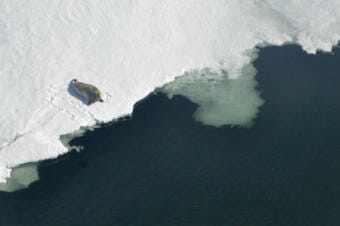
A bearded seal sits on the ice edge in Kotzebue Sound. (Photo by Jessie Lindsay, NMFS MMPA Permit No. 19309.)
Seal meat makes up a good portion of what’s in subsistence hunters’ freezers in Kotzebue. However, the sea ice the seals haul out on is diminishing, and new research has shown the window to hunt seals is getting shorter as a result.
Iñupiaq hunter Cyrus Harris has harvested ugruk, or bearded seal, his whole life. For many people in Kotzebue and the surrounding region, the rotund mammal is a dietary staple.
“Ugruk, once we process it into a seal oil form and using it as a preservative for the meats, the product itself is very nutritious,” Harris said. “We may be processing this stuff in the month of June, but we’re thinking ahead to fill our Siglauq, or storage, with product that’s going to run us through the winter.”
Harris says the hunting season starts in the spring, as the sea ice breaks up in the Kotzebue Sound. But he’s noticed a change in the season length.
“Once the ice flows break loose and are drifting north, we’d have about a two-week timeframe to do that on a regular hunting season,” Harris said. “But the shortest I’d seen it happen was about three days.”
The sharp decline in the season length can be directly linked to the decline in sea ice due to a warming climate. That’s the finding of a new collaborative study conducted by the Native Village of Kotzebue and the International Arctic Research Center at the University of Alaska Fairbanks.
Alex Whiting is the environmental program director for the Native Village of Kotzebue. He’s a co-lead author on the study and has been documenting the change in the ugruk hunting season for almost 20 years. He says it’s become more relevant as the tribe has studied the change in sea ice extent.
“Notes that I had been taking since 2002 did show a pattern of shorter ugruk hunting seasons because the ice would disappear a little bit earlier and earlier over time,” Whiting said.
That change has translated to an average loss of a day per year for the hunting season since 2002. The study found that the season is ending an average of 26 days earlier than normal. Whiting says the sea ice extent fluctuates.
“Some years it resembles a little bit like it used to in the 20th century,” Whiting said. “But other years, like 2018 and 2019 in particular, by the time the ugruk hunting season began, the ice in the Kotzebue Sound, which was 70 to 80 percent gone already, looked like it would at the end of June or the beginning of July.”
Roswell Schaffer, an Iñupiaq elder and hunter from Kotzebue, Alaska, who helped co-author the study. (Photo from Sarah Betcher, Farthest North Films)
With these changes, Whiting says hunters are having to plan their hunts earlier in the year.
“If they wait, all you need is a week of strong west winds, and you could lose out on your opportunity for that year,” Whiting said. “Because the ugruk hunting season only occurs during that short window of May, June.”
To date, researchers haven’t seen any drastic decline in hunters’ ability to land ugruk, but it’s largely due to hunters adapting to the shifting ice.
Donna Hauser is a marine ecology researcher with the International Arctic Research Center and the other co-lead author on the study. She says normally hunters would have a lot more sea ice to travel out on to harvest ugruk, often meaning packing more gear and gas for their boats. That is changing as the sea ice extent becomes smaller.
“Some sea ice had grounded close to Kotzebue, within 10 miles,” Hauser said. “And so people could make more frequent, shorter trips, use more gear, less gas, and actually be really successful still. So hunters have had to adapt to these changing conditions. That has allowed them to still be successful, despite the sea ice loss.”
In researching the impacts of sea ice extent on ugruk hunting, Hauser says the process was collaborative from the start. That meant input from more Western academics at the university level, but also the inclusion of village officials as well as an Indigenous Elder Advisory Council, something Whiting from the tribal office says is a first. Hunters like Harris were added as co-authors of the study.
Hauser says the co-production of knowledge was valuable, and the research wouldn’t have been as robust without the inclusion of Indigenous knowledge from the study’s inception.
“This is really responding to Indigenous sovereignty over the entire research process,” Hauser said. “It creates a more inclusive and sustainable research process, which hopefully will lead to more equitable outcomes in terms of incorporating those Indigenous perspectives in climate change planning and adaption.”
As Hauser and others look forward to further collaboration, hunters like Harris say they’re looking ahead to this upcoming winter, to see what sea ice it’ll bring for spring.
Alaska Federation of Natives President Julie Kitka on Aug. 26, 2020. Kitka said in a statement Tuesday, “the high-risk factors of holding a 5,000-person indoor meeting, with delegates coming in from across Alaska, make an in-person October gathering out of the question.” (Jeff Chen/Alaska Public Media)
The Alaska Federation of Natives, the state’s largest organization of Alaska Native people, has postponed their annual convention to December, citing concerns over the high rates of COVID-19 cases and hospitalizations.
The three-day event had been scheduled for Oct. 21-23 in Anchorage. However, AFN President Julie Kitka said in a statement Tuesday, “the high-risk factors of holding a 5,000-person indoor meeting, with delegates coming in from across Alaska, make an in-person October gathering out of the question.”
Cases of COVID-19 have risen steadily over the past month in Anchorage, with the convention’s host city reporting its highest number of hospitalizations from the virus since December.
The pandemic already pushed the annual Elder’s and Youth Conference to be held virtually this year. That conference is an Alaska Native gathering that typically occurs the same week as AFN.
AFN officials continue to opt for an in-person convention with a virtual option.
They say the exact dates, times and agenda for the AFN convention will be announced in the coming weeks. After reviewing data and guidance from federal, state and tribal health leaders, the AFN board will also make a final decision in October on whether the convention will be in-person or not.
The theme of this year’s convention is “ANCSA at 50: Empowering Our Future”, commemorating the Alaska Native Claims Settlement Act, a landmark land claims law that established the 12 regional Alaska Native Corporations and more than 200 village corporations. AFN co-chair Joe Nelson said in a statement that postponing the convention will allow the attendees to properly celebrate ANCSA, but “it all hinges on everyone’s willingness to get vaccinated.”
AFN represents members from 11 of the 12 regional Native corporations and more than 191 federally recognized tribes.
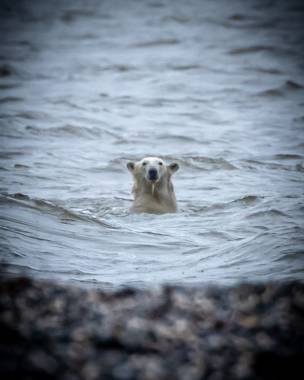
A polar bear rests at a fish camp south of Kotzebue on Aug. 14, 2021. (Photo courtesy of Lt. Scott Kellerman, U.S. Coast Guard)
Locals in Kotzebue showed a healthy mix of excitement and concern over the weekend in response to reports that a rare polar bear was spotted in the area.
Polar bear sightings in Kotzebue aren’t without precedent. In fact, the world’s largest documented polar bear was found in Kotzebue in the 60s, weighing more than 2,200 pounds and standing more than 11 feet high.
However, polar bears tend to gather on sea ice. Catching a glimpse of one on land, in August, is pretty rare.
Lindsey Mangipane is a polar bear biologist with the U.S. Fish and Wildlife Service in Anchorage.
“It has happened before but it’s not very typical,” Mangipane said. “It’s kind of speculation as to why the bear is there now, but in most situations when this happens it’s due to sea ice retreating and the bear essentially gets stuck there.”
A polar bear was spotted at a fish camp south of Kotzebue on Aug. 14, 2021. (Photo courtesy of Lt. Scott Kellerman, U.S. Coast Guard)
News of the bear sighting spread throughout town, with many curious about where exactly it was, and others hoping to get a look themselves. Lt. Scott Kellerman, a Coast Guard pilot stationed in Kotzebue, snapped some photos of the bear on Saturday evening.
“It was down by the fish camp just south of the airport, along the beach line. The bear was out in the area, just kind of sitting there.”
Kellerman says by the time the Coast Guard was made aware of the bear, local state troopers were on the scene, patrolling around the bear and advising people to stay indoors. Kellerman says he kept a healthy distance between himself and the bear as he took pictures.
“People had commented on my photo, ‘It looks like everything is kinda blurry in the background,’” Kellerman said. “And that’s because I was shooting with a super telephoto, like a 400mm lens. It allows me to stay about 200 meters back, which is pretty far. For anybody with an iPhone camera, it would look like a little blur.”
Kellerman says common bear safety includes not making any sudden movements if you’re near a bear and to stay in your vehicle. He says polar bears can be more social than other types of Alaska bears.
A polar bear walks at a fish camp south of Kotzebue on Aug. 14, 2021. (Photo courtesy of Lt. Scott Kellerman, U.S. Coast Guard)
“They don’t have the same sort of behavior like normal bears,” Kellerman said. “They’re very interested in you, so safety is number one, especially in a town setting like this.”
Kellerman says the polar bear hung around the area south of the airport for around 15 minutes before hopping in the Kotzebue Sound and swimming north. He says he hasn’t heard of it being in the city limits since Saturday night.
Mangipane, with Fish and Wildlife, says even though it’s out of the city limits, locals should still be cautious near Kotzebue’s coastline or the surrounding outskirts.
A polar bear takes a dip in the Kotzebue Sound. (Courtesy of Lt. Scott Kellerman, U.S. Coast Guard)
“Carry a deterrent with you. Bear spray has been shown to be incredibly effective on polar bears, up to 95% effectiveness even in high wind scenarios,” Mangipane said. “So carrying bear spray or a firearm or some other non-lethal deterrent could be a good idea right now. Also we recommend traveling in groups. Most attacks of polar bears on people have happened with groups of two or less people, so if you are traveling, groups are a good idea.”
As the alabaster-furred visitor ventures out of town, Lt. Kellerman described the opportunity to photograph the bear as a bucket list moment for sure.
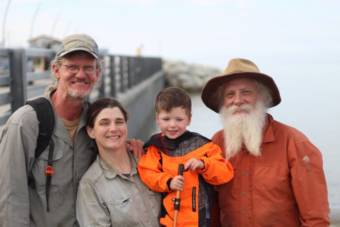
Bear Paulsen, Claire Porter, Dashwa Paulsen and Dan Cooke moments after returning to Kotzebue from more than three weeks on the Noatak River. (Wesley Early/KOTZ)
Last month, Kotzebue had its wettest month on record, with more than 5 inches of total precipitation. As rain drenched Northwest Alaska, a small group from Minnesota floated the Noatak River in a canoe, with a toddler in tow.
The Noatak River runs for about 425 miles, winding from Gates of the Arctic National Park through the Noatak National Preserve before flowing into Kotzebue Sound.
Bear Paulsen of Minnesota heard from friends it’d be a beautiful canoe trip, filled with gorgeous scenery and some nice hiking.
“There’s a lot of canoeists in Minnesota because of the Boundary Waters and what have you,” Paulsen said. “And really, what we’ve got is a network of people that’ve paddled various rivers all throughout Canada and Alaska. And so we talked to friends of ours, and they said the Noatak’s a great river. We have other friends that actually took a two-year-old down it.”
With no portages and some nice whitewater, Paulsen felt comfortable bringing along his son Dashwa, who’s just under three. Dashwa’s mother Claire Porter and friend Dan Cooke rounded out the group, who arrived in Kotzebue on July 11.
“We had 12 days of sun — felt like the desert, absolutely gorgeous,” Paulsen said. “We put in up as high as we could; Lucky Six is the name of the area.”
Lucky Six Creek is near the mouth of the Noatak, up by Ambler and Kobuk. Paulsen and company spent most of the time taking in hikes as they slowly moved along the river.
As they decided to pick up their pace along the Noatak, rain clouds above started to have the same idea.
“A few days after we started to move along was when the rain started. We heard 250 percent of average of rainfall, somewhere in that neighborhood,” Paulsen said. “We were deluged.”
Paulsen said adjusting to the rainfall meant monitoring to make sure the water level didn’t reach the group or their gear as they camped.
“We were putting marks and cairns, sticks in the shore, cairns on the shore to measure how far up the river was coming each night,” Paulsen said. “Making sure we didn’t get sunk. And we were continuously wet.”
Claire Porter and her son Dashwa Paulsen stand in a canoe after floating down the Noatak River. (Wesley Early/KOTZ)
Paulsen said while he didn’t expect the level of rainfall his group encountered, they had prepared for less than dry conditions.
“It’s something that you always are aware of that might happen,” Paulsen said. “We didn’t expect … it was pretty surprising to get ten straight days of rain. But we have nice tents, we have a nice bug shelter that keeps us out of the rain when we need to.”
Paulsen said they adjusted their approach slightly, considering they had Dashwa with them. Paulsen said he felt the Noatak was a mellow, more predictable river than others he’d paddled.
“Beyond that, we don’t paddle long days, because otherwise he goes nuts,” Paulsen said. “He starts hitting his mother because he shares the bow with her. He lasts about three hours at a stretch.”
The rainfall made one last strong push at the end of July, before the skies started to part and sunshine fell on the Northwest Arctic. For Paulsen, it was the optimal time to power back to town.
“We were about 20 miles up the Noatak and saying, ‘OK. Do we think we can cross today or tomorrow morning?’ We kept looking at the forecast saying, ‘I’m pretty sure we can do it,’” Paulsen said. “So, total reprieve, I mean, to be able to paddle up to the hotel.”
The expedition concluded last Thursday as Paulsen and company pulled up to shore from the Kotzebue Sound, right in front of the Nullaġvik Hotel. Looking back, Paulsen said his trip up the Noatak — his first in Alaska — was a little too wet, but the bugs weren’t that bad and he loved it.
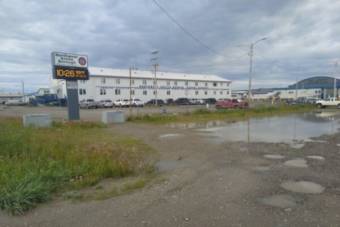
Puddles near the Northwest Arctic Borough School District building in Kotzebue after rainfall on July 30, 2021. (courtesy of Jimmy Evak)
Kotzebue’s July was one for the record books, with the highest monthly precipitation on record. The previous rainfall record for the midsummer month was set more than two decades ago.
To understand what led to Kotzebue’s heavy rainfall in July, it helps to look at weather systems in the Northern hemisphere.
This summer saw two instances of high pressure systems near Alaska. One was in eastern Siberia and the other was in Western Canada and Eastern Alaska. Both led to dry weather and numerous wildfires in the area.
“Western Alaska has just been stuck between those two high pressure systems,” said Rick Thoman, a climatologist with the International Arctic Research Center in Fairbanks. “In the atmosphere between two high pressure systems, you have low pressure. That’s how the atmosphere works. And so we’ve had multiple storms moving through the area, bringing not just one round of rain, but repeated rounds of rain.”
A chart showing the ten wettest months on record in Kotzebue. (Rick Thoman)
In total, Kotzebue saw 5.31 inches of total precipitation in July. That beat out the previous record of 5.26 inches set in August 1998. And when meteorologists measure precipitation, that includes snowfall in the winter months.
“You take the snow, and melt that down to get how much water’s in it,” Thoman explained. “So when we talk about precipitation, it is a fair comparison between what falls in January and what falls in July.”
Looking at the rainfall trend in Kotzebue, July was bookended with two heavy rain events. The first came on July 6 and 7, when Kotzebue saw the highest single-day rainfall amount on record.
“(We) had the all-time 24-hour record and then the repeated rain the last week of the month,” Thoman said. “Yet in between, from the 11th until the 23rd, there was some rain but not a lot of rain.”
Thoman says it’s not unusual for Kotzebue to see a lot of rain in the summer, but it normally comes towards the end of the season.
“Lots of folks have been remarking how July seemed like a fall month with all the rain,” Thoman said. “And certainly when we get these heavy type rain events like this, they are much more likely to occur in August than in July.”
Kotzebue wasn’t the only community in Western Alaska that saw heavy rainfall in July. Red Dog Mine saw over 7 inches of rain. Nome saw its second wettest July on record and Bethel saw the wettest July in more than 90 years.
Thoman said as the Arctic gets warmer, more extreme weather patterns will become more likely.
“With earlier ice loss, with warmer ocean temperatures, we can anticipate that when Northwest Alaska gets in between these high pressure systems at the hemispheric level — so we’re in the low pressure point — the threat of heavy rain will be higher than it was in decades past,” Thoman said.
Thoman said these days in the Arctic, weather is always extreme somewhere. It’s just a matter of where.
Close
Update notification options
Subscribe to notifications
Subscribe
Get notifications about news related to the topics you care about. You can unsubscribe anytime.