KOTZ - Kotzebue

KOTZ is our partner station in Kotzebue. KTOO collaborates with partners across the state to cover important news and to share stories with our audiences.
EPA says Red Dog Mine failed to identify hazardous waste for over 4 years

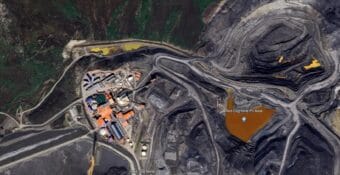
A highlighted satellite view of the Red Dog Mine (Courtesy Google, Airbus, Maxar Technologies)

The Environmental Protection Agency announced a settlement this week with the operators of the Red Dog Mine for nearly two dozen hazardous waste violations. Records show that Red Dog Mine failed to identify hazardous waste in its laboratory for over four years.

Teck Alaska, Inc. operates the mine, one of the world’s largest producers of lead and zinc located about 80 miles north of Kotzebue.

In June, Teck agreed to pay the EPA over $429,794 for hazardous waste violations spanning from October 2019 until January 2024. EPA representatives said those last four years amount to the largest hazardous waste violation in the mine’s more than 30 years of operating.

An inspection in 1995 revealed violations of a lesser nature. In that case, the two parties reached an informal resolution without any penalties for Teck. According to the EPA, it is the fourth recent violation involving Alaska mines; the others involved gold mines.

A representative from the EPA said that those 20 counts outlined in a consent agreement between the EPA and Teck include Teck’s failure to identify, store, and treat hazardous waste, as well as a failure to properly notify and report hazardous material to the EPA. The agency said that these are “serious violations.”

Kevin Schanilec, a hazardous waste compliance officer for the EPA, said while there have been no identified effects on humans or the environment from the violations, there could have been.

“Acids were stored in containers and a tank; they weren’t labeled,” Schanilec said. “If someone didn’t know what was in that container, they might have done something with it, or if it got spilled, people wouldn’t have known what was in the container.”

The EPA has what’s informally referred to as a “cradle to grave” policy for handling hazardous waste through the Resource Conservation and Recovery Act. According to Schanilec, a mine’s laboratory – which was where the violations occurred – represents the cradle side of a mine’s waste stream. These areas are used primarily to assess core samples to determine their concentrations of particular metals.

A representative from the mining company wrote in an emailed statement that the violations were due to a “different interpretation of EPA requirements for identifying, storing and disposing” of the lab’s sample residuals. “These residuals went through a treatment process in accordance with our permit and regulations and had no negative environmental impact. Teck is updating its operational procedures to align with EPA’s guidance. For context, less than 200 grams of solid residuals per month are generated which is about the weight of 80 pennies,” the representative wrote.

But Schanilec said that isn’t entirely accurate.

“The amount of waste in question was such that, had Teck notified us as is required under the regulations, they would have been a category in a higher category of waste generation that exceeds 1,000 kilograms (2,204 pounds) per month,” Schanilec said. “So the amount of wastes in question were much greater in weight than a stack of pennies.”

The EPA verified that Teck had paid the nearly $430,000 penalty for the violations. The agency said the company has until June 2025 to ensure that their laboratory’s tank and associated piping where hazardous waste is stored is clean and does not have the potential to contaminate the environment.

6 dead in fire at Noorvik home

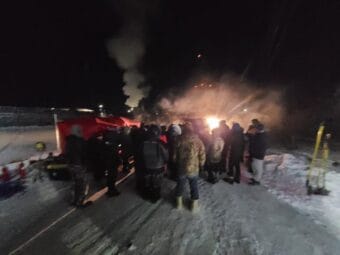
Noorvik residents respond Wednesday, Jan. 24, 2023 to a residential fire that left six people dead according to Alaska State Troopers. (Courtesy Lloyd Morris)

A residential fire Wednesday in the Northwest Arctic community of Noorvik claimed the lives of six people, Alaska State Troopers said.

According to an online dispatch troopers, deputy state fire marshals and village public safety officers responded Wednesday to reports of a fire in Noorvik, a community of about 650 people roughly 45 miles east of Kotzebue. The remains of six individuals were found at the scene.

“It is believed that one adult female and five children were in the residence at the time of the fire,” troopers wrote.
The remains have been sent to the state medical examiner’s office for identification.

The home was a total loss in the fire, troopers said. Officials say the fire apparently started near a Toyostove that was allegedly in poor condition, although the cause of the fire is still undetermined.

This is a developing story. Check back for updates.

Yamaha will stop selling snowmachines in North America

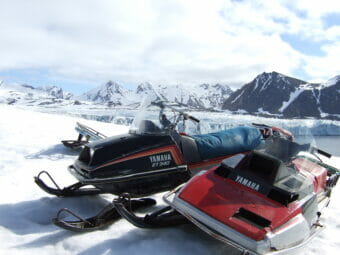
A pair of Yamaha snowmachines on Svalbard. (Graham Racher/Creative Commons photo)

Yamaha Motor Company — the Japanese manufacturer of motorcycles, boats, and other recreational vehicles — announced Wednesday that they were phasing out their snowmachines. After over five decades since the first Yamaha snowmachine model was released, the company said they plan to end sales of the machines in North America after the 2025 model year.

In a statement, the Japanese company said it aimed to grow its business through more environmentally friendly motors, and it would “be difficult to continue a sustainable business in the snowmobile market.”

For many Alaskans, especially those living in Northern Alaska, snowmachines are an essential part of winter travel. That’s especially true for rural communities not connected by roads.

For some, snowmachines serve a recreational purpose. Mike Vasser is the executive director for  Iron Dog — billed as “the world’s longest and toughest snowmobile race.” The 2,500 mile course begins in Big Lake and travels north to the Seward Peninsula and Northwest Arctic before circling back. Vasser says the Yamaha phase out would have little effect on the Iron Dog Race.

“It shouldn’t have any impact on us,” he said. “We haven’t had the Yamaha sled entered in the race for at least seven years, I think. Nor have they been a sponsor.”

While Vasser called the move a “sad day for the snowmobile industry,” he’s not really losing sleep over it.

“I’m personally a Yamaha vintage collector and have been for a long, long time,” he said. “So in my opinion, the value of my sled just went through the roof because they’re not gonna be available anymore.”

Yamaha thanked their dealers and customers for years of loyalty. They said parts, availability and maintenance service will be available after the final production run in 2025.

Yamaha’s new 2024 snowmachine models are in production and scheduled for fall delivery.

Ongoing internet outage hamstrings 911, other vital services in Northwest Alaska

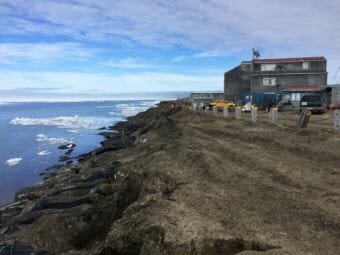
The Utqiagvik coastline, in a residential area near downtown. (Ravenna Koenig/ Alaska’s Energy Desk)

It’s been a week since ice severed a fiber optic cable in the Arctic Ocean, cutting communications to at least half a dozen communities in Northern Alaska. Many are still without internet or cellular service, and the company that owns the cable says it will be two months until the line is repaired. 

The break is disrupting normal life for many communities above the Arctic circle — including vital emergency services.

The cable connected most of Northwest Alaska. Quintillion, the Alaska-based company that owns the line, says the break primarily affected Nome, Kotzebue, Point Hope, Wainwright and Utqiagvik, as well as the villages of Atqasuk and Nuiqsut. 

Last Wednesday, the North Slope Borough issued an emergency declaration stating that the fiber break would “severely impact” the ability to provide essential services such as search and rescue, police, fire and utilities.

Atqasuk is feeling the break’s repercussions. Doug Whiteman is mayor of the community of about 300 people, which is 60 miles southwest of Utqiagvik. He says emergency communications aren’t working like they should between communities.

“We had a circumstance with 911 calls. The village police officer could call Barrow and they could hear, but their replies didn’t come back,” he said. “It’s a one way conversation.”

Whiteman says the borough is advising the community to stay off what limited internet is available. He says right now, public safety, the health clinic and fire are all sharing one satellite phone.

Further south, Wainwright — a community of nearly 700 people — is encountering similar challenges.

Mayor Chester Ekak says Wainwright is having problems with their 911 services, too. They also experienced one way communication with emergency services in Utqiagvik, which forced them to find a work-around.

“We had to set up a temporary dispatch facility and utilize VHF for police, fire and ambulance call out,” he said.

He says it’s not just emergency response that’s ground to a halt. It’s also daily life.

“It’s affecting businesses. Day-to-day operations. Stores turned into cash-only stores — they all were affected by the cable break,” he said.

Ekak says the ATMs require an internet connection, so now customers can’t withdraw money for the cash-only businesses. And Ekak says it’s also affecting people who receive assistance like EBT because they can’t use their cards.

Businesses in Kotzebue are also feeling the effects. Lewis Pagel is the owner and lead physician at Arctic Chiropractic. He says his office is without internet, which means he can’t process insurance billing, and his patients can’t schedule appointments.

“Also, my credit card machine won’t work either. So I can’t collect payments at the office. So from a financial standpoint, it’s pretty detrimental,” he said.

Pagel’s office isn’t alone. Kotzebue City Manager Tessa Baldwin says the fiber break is disrupting government operations — and that the city is unable to connect to their server, internet and phone.

The city is without internet, and  I went over there yesterday morning to pay my business taxes. But they can’t process anything,” she said. “We’re very lucky that our emergency services are still in operational mode.”

This week, Baldwin says the city was scrambling with payroll. They were able to resolve the issue, and now over 100 people employed by the city will be receiving their checks — a few days late.

“It’s been extremely difficult to manage a city with no internet or phone service,” she said.

Baldwin says there have been other issues including meeting the city’s grant deadlines and communicating with city partners outside of Kotzebue.

Internet outage closes government offices, businesses and university campus in Kotzebue

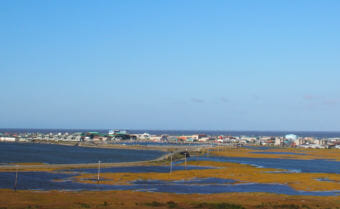
Kotzebue as seen from the road east of town (Photo by Zachariah Hughes/Alaska Public Media)

On Sunday morning, many Kotzebue residents woke to find their internet down and cell phones without service. Several days later, there’s little-to-no communications in or out, and it might be two months until services are restored to normal.
That’s according to a press release from telecommunications company Quintillion. On Monday, Quintillion reported a fiber optic cable in the Arctic Ocean had been cut, essentially severing the main artery of communications for most of rural Alaska west of Prudhoe Bay.

According to the press release, ice was the culprit. The severed cable is about 30 miles from Oliktok Point in Prudhoe Bay — and 90 feet beneath the ice.

In Kotzebue, the outage is affecting the local government operations. The City of Kotzebue is experiencing a “complete outage” to all departments. And the Northwest Arctic Borough says their telephone and internet services are down.

Kelly Williams is the CEO of OTZ telephone, a Kotzebue-based communications cooperative that provides internet, phone and cellular service to the region.

“A lot of people don’t know, this fiber optic cable is made of glass — it’s a tiny little glass tube,” he said. “Impact that ice can have, which we’ve all seen when you live in our area, especially sea ice, that there’s an inherent risk there,” he said.

The cable break is primarily affecting the hub cities of Bethel, Nome, Kotzebue and Utqiagvik. Williams says many remote communities in the Northwest Arctic are unaffected by the break. Villages in the region are mostly serviced by satellite.

“All the 10 village communities we serve are still up and running fine. We have them connected through a mixture of technologies of low, Earth-orbiting satellites and geosynchronous satellites,” he said.

For OTZ customers in Kotzebue, Williams says the communications outage only knocked out broadband.

“We had a backup system in place by which all of our emergency services, calling, texting, immediately switched when that cable was severed over and kept all of our, what we would call our vital services, up and working,” he said.

Heather Handyside is the Chief Communications officer for GCI. She says you can imagine that the fiber optic cable is a highway. But the highway’s been blocked. Now, GCI customers have to take a detour — they can get back online with satellite and microwave technology.

“It’s critical, especially in places like rural Alaska with unpredictable conditions, unpredictable weather, typhoons, earthquakes, wildfires, that there are backup systems,” sh said. “We will at least be able to deliver a basic level for phone calls, emails, text messages.”

But the backup internet service is still spotty and slow. As of Tuesday afternoon, many businesses in Kotzebue were unable to process credit card payments. Some even closed. The University of Fairbanks Chukchi Campus and library remain closed until further notice following the outage.

A large fish that fills freezers in Northwest Alaska could be in danger

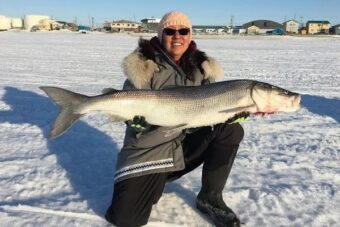
Siikauraq Martha Whiting ice fishing for sheefish. (Katrina Liebich/U.S. Fish and Wildlife Service)

Lance Kramer describes himself as an avid outdoorsman. The 52-year old loves traditional methods of hunting, fishing and trapping. His home is right next to the ice where many Kotzebue residents fish for sheefish. It gives him a bird’s-eye view to gauge when the fish are coming in.

“I get to watch every day, you know, out my window,” Kramer said. “My barometer is binoculars. If they’re pulling them up, then it’s time to go. If they’re not, stay in and drink coffee.”

Kramer is among many people living in Alaska’s Northwest Arctic who depend on sheefish as a staple in their diets. The fish, right now, are abundant. Residents’ freezers are filled with them after another successful season. But scientists warn that it may not always be this way. They say warming waters and permafrost thaw could lead to population declines. It’d be a double-whammy for a region already dealing with recent population declines in another key food source: caribou.

“When you don’t have any caribou in your freezer all year long, you know, sheefish is a huge reprieve,” said Kramer.

‘Sheefishing is a science’

Sheefish, or simply sii, are a whitefish found only in certain waterways in the Northern Hemisphere. In Alaska, they’re found in the Yukon and Kuskokwim drainage areas. In the Northwest Arctic, their spawning grounds are along the upper Kobuk and Selawik rivers. Here, individual sheefish are significantly larger than their counterparts elsewhere in the state. A single fish can measure 3.5 feet and weigh 60 pounds.

One fish is enough to provide several meals to a large family. They’re valued for their taste. The flakey white meat is oily and slightly sweet which makes it versatile in many dishes.

“There’s so many ways to eat them,” Kramer said. “It’s like Forrest Gump. Remember how he talked about the shrimp?”

Kramer, like many people in the region, fishes using a combination of traditional methods with modern equipment. He travels by snowmachine to the ice and, using an auger, drills a 10-inch hole. He looks for a “wedge” in the brackish water, where the fresh and salt waters meet. During winter, the sheefish tend to stay in the relatively warmer freshwater, occasionally venturing into the colder marine water to hunt for their next meal.

“Sheefishing is a science,” he said.

To catch the fish, Kramer uses a jig — a bent handle about a foot long with a line and hook attached. Sheefishing is typically done with a jig or net, not the rod and reel commonly used by many sports fishermen. Kramer uses the Iñupiaq words for his jig. His aulasuan, or handle, is made from wood or walrus ivory. For the ipiataq or fishing line, he uses a more heavy-duty 80-pound test line which attaches to the niksik, or hook. Kramer said he’s addicted to what he calls “the tug” — that initial feeling of hooking a sheefish on the line.

“It’s a direct connection between the energy of that huge incredible sheefish and your hand,” he said. “It’s the energy.”

A threat from thawing permafrost

Although sheefish are abundant now, they could be threatened by warming Arctic temperatures, according to Bill Carter, a fish biologist for the Selawik National Wildlife Refuge, based in Kotzebue. His focus is on the refuge’s aquatic habitat. For eight years, he and a group of Fish and Wildlife colleagues studied a potential threat to sheefish: the permafrost thaw slump.

“It’s basically a big mudslide where a south-facing slope has started to thaw into water, turning what used to be firm ground into mud and concrete — basically wet concrete,” Carter said.

Following a slump, the water becomes cloudy and full of sediment potentially suffocating the eggs of spawning sheefish. Sheefish are long-lived fish. It takes 10 years for the sheefish in the Northwest Arctic to reach sexual maturity which means that the threats to spawning could have longer lasting repercussions.

According to Carter, there have been several slumps in the region. One of the most concerning on Selawik River — about 10 miles upriver from sheefish spawning grounds — was massive.

“[It was] over 500,000 cubic meters, which is basically a 25-story building with a footprint the size of a football field,” said Carter. “That’s what’s come out of it. So it’s really big, over a half a mile across.”

He said there are several more permafrost thaw slumps in the region.

Kramer said he has the same concerns as Carter. He believes that along with warming waters and harmful algal blooms, the permafrost thaw slump will pose a threat to sheefish in the future. Carter and a group of scientists are planning a two-year project this summer to study how the thaw slump has affected sheefish populations.

Site notifications
Update notification options
Subscribe to notifications