Arctic

A dark view of geopolitics in the Arctic

Irvin Studin. (Photo by Liz Ruskin/APRN)

World leaders, including Russia’s Vladimir Putin, have talked of the Arctic as a zone of peace and co-operation. But continued tranquility is just one forecast for the region. A much darker scenario came Monday from a Canadian policy scholar who is also a professor at the University of Toronto and Russia’s Academy of National Economy and Public Administration.

Irvin Studin says competing claims for Arctic resources are inevitable but those conflicts are unlikely to erupt any time soon. In a discussion at the Wilson Center, a Washington, D.C. think tank, Studin said he sees a much closer path to conflict in the Arctic, and it starts with Russia, in Europe.

“Near term, and this is my primary message today: Escalation of fighting in Ukraine, or the collapse of Ukraine, or an accident or misread by the West, or the East, or between Russia and Ukraine, might have consequences through the Arctic as a thoroughfare,” he said.

These “consequences” he speaks of are dire.

“The Russians would bomb through the Arctic,” he said. “The rockets would go through the Arctic. I don’t think we’re talking infantry in the first instance. I think these are highly reachable targets for Russian interests.”

Studin says Russians are well aware of the prospect while the U.S., in his view, is oblivious. He says the Ukraine problem can be solved, with neutral peacekeepers and a commitment that Ukraine must never join NATO. But, he warns, the solution has to come in the next six months.

On the Arctic Council, international co-operation remains the operating principal, and Russia is still, by most accounts, working well with the U.S. Coast Guard. Studin says Moscow can strictly adhere to agreements, to what he calls “transactional” co-operation in the Arctic. The professor, though, says that’s just a veneer on Russia’s solid wall of strategic distrust.

“So this can only last so long if the underlying game is incredible,” he said.

Looking ahead, Studin says the government in Russia will change one day, and he cautions the U.S. to stay out of it.

“It is in everybody’s interest that Russia remain stable and that there is a happy succession,” he said. “And let me repeat to my American friends: there is no necessary condition for this succession, in being happy, to be democratic and in our image, as it were. It just needs to be a stable, happy transition.”

A troubled transition could create a power vacuum, he says, which would be bad for the Arctic and the rest of the world.

“Any collapse of Russia, which is not unthinkable this century, is a hellish proposition,” he said. “It is a century long problem.”

Retired diplomat Kenneth Yalowitz, another participant at the forum, doesn’t see the same conflict points that Studin does. But after hearing the analysis, Yalowitz sounded a bit tenuous in his optimism.

“You’ve given a lot of reasons why this may not be the case, but my hope is that the very obvious and self-evident reasons for cooperation in the Arctic can have a spillover effect into other areas,” he said.

In the back of the auditorium sat two top-ranking Arctic officials in the State Department: Admiral Robert Papp, the special Arctic representative, and Deputy Assistant Secretary David Balton. Papp called Studin’s perspective a “fascinating alternate view.”

“To get someone who has an inside view of what the Russians are thinking is very helpful to us, and that’s why we attended today,” Papp said.

Papp says for him, it reinforces the need for open communications with the Russians.

Shell’s Arctic drilling rig arrives to Dutch Harbor

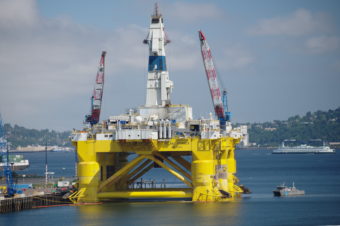
The Polar Pioneer drill rig arrives in Dutch Harbor. (Photo by Emily Schwing, KUCB/Unalaska)

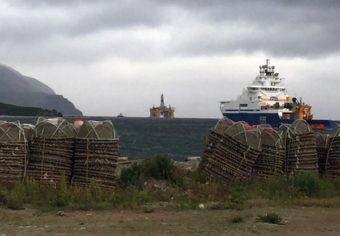
The Transocean Polar Pioneer, a drill rig contracted by Royal Dutch Shell, has arrived in Dutch Harbor.  The oil company plans to use the port as a hub this summer as part of their exploratory Arctic drilling effort.

There’s very little opposition in the tiny Alaskan town in comparison to that in Seattle, where some environmental activists went so far as to chain themselves to one of Shell’s Arctic drilling support vessels last month.

When the Polar Pioneer left Seattle, hundreds of protestors turned out in kayaks. They waved signs and tried to keep the drill rig from departing.  But when it arrived nearly two weeks later in Dutch Harbor, a tiny fishing outpost in the middle of Alaska’s Aleutian Chain, it was greeted only by a brisk, nighttime wind.

There are no anti-Arctic drilling signs, no banners, and no protestors in kayaks.  Mayor Shirley Marquardt says that’s for good reason.

“You know down in Seattle, there’s harbor boats and rescue boats and people to pull you out of the water all over the place,” Marquardt said. “You don’t have that here. And the water is tremendously brutally cold even in the summer and it doesn’t take much.”

The real reason no one is out protesting is because most people here are working either on fishing boats, or at one of the local fish processors. More fish come through Dutch Harbor than any other port in the nation.

People also work a myriad of other jobs outside of fishing from construction to security.

“We’ve always had a healthy, wealthy place to live because we depend on the sea,”  Susie Golodoff said. She has lived here for 40 years.  She teaches at the school and fishes with a gillnet right out her front door. The resident naturalist in town, she’s the person everyone asks when they want to identify a bird or a plant. She’s not quite sure why her neighbors aren’t more concerned about the oil rig or Shell’s summer plans.

“I’m kind of baffled to tell you the truth. I think part of it is that we’re kind of short term community with people from other places and people just think as far up as their as their next catch delivery, so there’s just a little bit of a disconnect maybe,” Golodoff said.

Currently, giant boats are at sea harvesting pollock, the kind of fish that’s eventually processed into things like fish sticks. Smaller vessels are out targeting species like halibut, and Dungeness crab for fine dining. Trucks are driving to and fro, filled with gravel and construction crews are furiously working on countless projects.

The sight of a giant yellow and blue drill rig towering over emerald green islands and squat gray buildings isn’t new in Dutch Harbor. In 2012, the company brought a different rig here and then sailed it nearly 1,000 miles north to the Chukchi Sea. That mission ended in near disaster when it ran aground.

But no one is talking about that accident or the possibility of something worse. James Buskirk is the captain of the fishing vessel Destination.  He was among a number of people running quick errands at the local grocery and supply store.

“Well, geographically the Chukchi Sea is a long way from the eastern Bering sea where we do all of our fishing,” Buskirk said. “So no, I don’t have any direct concerns. The possibility of an accident is always there whether they’re drilling on land or under water.”

Mayor Shirley Marquardt understands the worst-case scenario, and she and other local officials have met with Shell a handful of times to discuss safety and logistics.

“So, we’ve been able to kind of talk to Shell and their folks and say, ‘You know, we’ve seen this happen before and it didn’t work out so well,’” Marquardt said.

Shell is still awaiting federal approval before it can send the Polar Pioneer and its support vessels nearly 1,000 miles north through the Bering Strait. Until then, the rig is moored just outside the local port as fishing boats chug past to offload their catch and head back to sea for another round.


$1B icebreaker isn’t in the Coast Guard’s stars, yet

Congress does not appear close to finding $1 billion to fund a new Coast Guard icebreaker, but Thursday, the Senate Commerce Committee approved a bill authorizing $14 million to plan for one. The money could be used to develop specs, conduct a feasibility study and other “pre-acquisition” work. The amendment was offered by Sen. Maria Cantwell, a Washington state Democrat, with the support of Sen. Dan Sullivan, Republican of Alaska. Cantwell spoke to the need in the committee session.

“There’s no question the Coast Guard deserves the tools it needs to operate in the Arctic, and we need to make sure we’re moving forward on building an Arctic fleet.”

The Coast Guard has received some $10 million for pre-acquisition work in prior years. The bill now moves to the full Senate.

Enviros: Shell’s Arctic plan violates walrus rule

Pacific walrus. (Photo by National Oceanic and Atmospheric Association)

Environmental groups say they’ve found a fundamental flaw in Shell’s plan to drill in the Chukchi Sea this summer and they’re asking the government to rescind its approval.

In a letter to Interior Secretary Sally Jewell, the groups say Shell’s plan to use two drill rigs at once violates a 2013 Fish and Wildlife regulation aimed at protecting walruses. The regulation says rigs have to be 15 miles away from each other during exploration work. The sites Shell plans to drill are just nine miles apart.

“Shell and the government may have backed themselves into a corner that neither can get out of compliant with the existing rules,” says Michael LeVine, a Juneau-based senior attorney with Oceana.

The government insisted on Shell using two rigs per season as a safety measure. That’s so one rig could drill a relief well in case of a blowout, and also to shorten the number of seasons needed for exploration. LeVine says requiring Shell to just keep one rig idle isn’t a solution.

“The plan that Shell submitted contemplates two rigs drilling simultaneously,” he said. “It’s not clear whether the government has or could approve a different plan.”

An Interior Department official said today the Fish and Wildlife Service is reviewing Shell’s program to ensure it complies will all laws and minimizes any disturbance to walruses.

Shell spokeswoman Megan Baldino says the company is still working with the government on the terms of the letter of authorization it requires to begin operations.

“All of our permit applications are based on sound science,” she said in an email.

Shell has received most of the approvals it needs. It has leased two drilling rigs for its Chukchi Sea work. The Polar Pioneer is already en route from Seattle to Dutch Harbor.

Environmental groups have repeatedly challenged the Chukchi Sea leases in court. The letter sent today suggests they haven’t given up.


U.S. Arctic Research Commission will visit Nome this summer

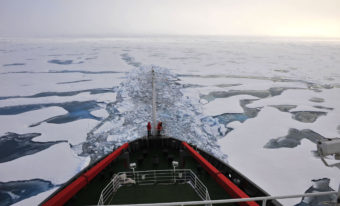
Arctic waters seen from the U.S. Coast Guard Cutter Healy. (Photo courtesy NASA Goddard Center)

The U.S. Arctic Research Commission will be visiting Nome in August looking for feedback on local Arctic research—what’s needed, what’s funded, and what needs more support.

While the commission itself does not fund research, it makes recommendations to Congress and the Office of the President on where funding goes and what research gaps in the Arctic need to be filled. They’re holding their 104th meeting in Nome to solicit ideas about what research people in our region want to see, and to increase awareness of current research that could impact the Bering Strait.

“A good example of that would be the renewable energy session,” said Dr. Cheryl Rosa, deputy director of the commission.

She says they’re looking for Bering Strait region speakers to discuss renewable energy planning, and coordinating brainstorming sessions with the Alaska Energy Authority and the Alaska Center for Energy and Power through UAF.

“The Arctic Research Commission—we don’t fund research, but we support and do coordination efforts, and one of the things we’re moving towards is trying to figure out how we fit in to the renewable energy approach in Alaska and the Arctic in general,” said Rosa.

The U.S. Arctic Research Commission is looking for feedback on any type of research being done in the Arctic—from behavioral health or indigenous languages, to climate change and marine mammals—so they can make funding recommendations to the federal government.

Already signed up to present in August are organizations including Kawerak and Alaska Climate Science Center, and Lisa Wexler, a behavioral health researcher at the University of Massachusetts who lives in Kotzebue.

“The most important part of these presentations is telling us, how are things going with research—are you happy with what’s being done? What do you see as gaps or needs? That’s really where we have the opportunity to assist in a really strong way, because that obviously goes into our reports and then we’re able to follow up from there,” said Rosa.

The commission’s visit to Alaska kicks off in Anchorage on August 24 with a day of presentations on behavioral and mental health. Meetings continue in Nome on the 25, when commission will also tour the Sikuliaq research vessel, which will be docked in our port.

Site notifications
Update notification options
Subscribe to notifications