Arctic

Shell rigs leave Dutch Harbor for Chukchi, to wait

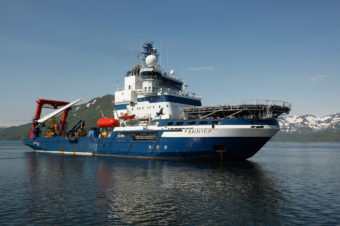
MV Fennica. (Photo courtesy of Shell)

Shell is still moving its ships and equipment into the Arctic, even as one of its icebreakers prepares to head back south for repairs. The unexpected crack in the hull of the ship called the Fennica has added a measure of uncertainty to the start of the short Arctic drilling season.
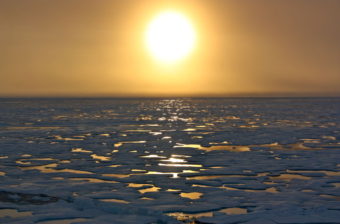
This week both of Shell’s Arctic drill rigs, the Noble Discoverer and the Polar Pioneer, left Dutch Harbor to begin the thousand-mile trip to the Chukchi Sea. Shell Spokeswoman Megan Baldino says the plan, for now, is to get there and wait.

“The rigs, with their associated support vessels, will connect to several anchors that were recently staged over Shell’s Chukchi prospect,” she said.

Shell is waiting for the Bureau of Safety and Environmental Enforcement to decide on the last permits the company needs, the applications to drill. Now that the Fennica is out of the picture for an unknown period, the wait is a bit more fraught. The ship is one of Shell’s ice handlers. It also carries the capping stack, a key piece of response equipment if there’s a blowout. Baldino says federal regulators will decide how much work Shell can do in the absence of the icebreaker.

“It’s our view that drilling can proceed, so in other words we would begin a top hole,” she said, referring to a partial well that stops above the petroleum layer.” But of course we’re going to comply with our permits, and work within the framework of our permits.”

Ten environmental groups have written a joint letter to the Interior Department, saying Shell shouldn’t be allowed to conduct any exploration in the Chukchi without the Fennica.

“All of the plans that Shell submitted and the government approved are premised on the availability of two primary icebreakers to protect the fleet,” said Michael LeVine, Juneau-based Pacific senior counsel for Oceana. “The Fennica is one of them, and the government can’t grant approval to Shell to operate without both icebreakers in the Chukchi Sea.”

LeVine also says the accident that damaged the Fennica shows Shell is taking unnecessary risks. But as Shell describes it, the short trip on July 3 from Dutch Harbor to the location where the damage occurred does not sound inherently risky. The company says the Fennica was in charted waters with a marine pilot on board when the hull struck something that just wasn’t on the chart.

LeVine, though, claims the leased ship was traveling in shallower waters than it had to.

“The choice may have been made by a contractor or a pilot but ultimately those contractors are working for Shell, and it’s Shell that bears responsibility for making sure that all of its operations are safe and responsible,” he said.

The last time Shell drilled off Alaska’s shores, in 2012, one of its rigs ran aground, capping a series of other mishaps. LeVine notes that federal investigators faulted Shell then for failing to see and mitigate risk, and for not properly overseeing the actions of its contractors.

Greg Julian, press secretary for the Bureau of Safety and Environmental Enforcement, says it’s not clear yet when the agency will decide on the applications to drill or how the missing icebreaker affects the plan.

“We’re still evaluating what might be possible for Shell to do until the Fennica can return and at this point it’s not yet determined,” he said.

He said BSEE Alaska Region Director Mark Fesmire flew to Dutch Harbor last week to inspect the capping stack aboard the Fennica and found it is undamaged.

Advocates propose leasing, sharing icebreaker to advance US Arctic interests

Arctic waters seen from the U.S. Coast Guard Cutter Healy. (Photo courtesy NASA Goddard Center)

Nothing highlights American indifference toward the Arctic as much as the tiny inventory of U.S. icebreakers: One heavy-duty ship, one medium and one down for repair. Alaska leaders and some federal officials say the country can’t assert its national interests, or see the benefits of increased shipping and resource development in the Arctic, without more icebreakers. But some advocates now say, why buy when you can lease?

Coast Guard Commandant Paul Zukunft sounds a little embarrassed by the state of the icebreaking fleet.

“We have eight times the gross domestic product — probably about eight and a half right now — of Russia,” he said. “Russia has a fleet of over 25 oceangoing icebreakers. They’re building six new nuclear icebreakers. And here we are trying to cobble together and maybe reactivate a 37-year-old icebreaker. Because that’s the best we can do.”


Rep. Don Young speaks at an Arctic symposium in Washington, D.C. (Photo by Liz Ruskin/APRN)

For years, Alaska’s delegation to Congress has pleaded for money to build a new icebreaker, and they’ve won appropriations of a few million dollars for pre-construction work. But the Coast Guard says it needs six icebreakers, and a single new ship is projected to cost a billion dollars or more, roughly equal to the Coast Guard’s entire capital budget. Alaska congressman Don Young says next week he’ll offer a bill to promote alternative funding.

“This is a problem,” he said at an Arctic symposium in Washington Wednesday. “I’ve been trying to get an icebreaker. Lisa Murkowski’s been trying to get an icebreaker. But Congress is not about to appropriate $14 billion for an icebreaker. So we have to figure out to get the money either from the Army, the Navy and the Coast Guard … a collective organization together to build us icebreakers.”

Young says the government should seek bids from the private sector to build an icebreaker and lease it to the government, with the expense divvied among several agencies. Young says he knows leasing is not the Coast Guard’s top choice.

“Everyone wants to own their own ship. That’s, by the way, one of the worst things we could do. You own a boat, you find out how much money you lose on it,” he said. “So if you’ve got somebody that’s going to lease it to you, and maintains it for you to standard, that’s the way I’d go.”

Some Coast Guard leaders, over the years, have questioned whether a leased ship is appropriate for front-line government missions, where the Coast Guard is asserting U.S. sovereignty. Admiral Zukunft, the current Coast Guard boss, says the service can’t do as much with a leased ship.

“First and foremost, you need to have some degree of agility,” he said.

You may need to operate that platform beyond what it was designed to operate in a given year, based on the mission demands that are being placed upon it.”

For any lease-or-buy decision — whether it’s a house, a car or a ship — a key factor is how long you intend to keep the asset. After a certain point, buying has the advantage. Also, Zukunft says, Congressional budget rules essentially charge an agency the whole cost of the lease in the first year.

“So from a business case, a lease option right now, does not provide us an optimal return on investment for a platform that quite honestly we’ve proven that we can maintain these for 35 or 40-plus years,” he said.

But, as with houses and cars, if you don’t have the money, buying isn’t really an option. Sen. Lisa Murkowski this week plugged an idea of former lieutenant governor Mead Treadwell. He says the United States could join other countries to provide an icebreaker escort service. As he sees it, with Canada, Finland, China, maybe Korea and maybe Russia, the U.S. could set up regular transpolar convoys. Treadwell says it requires thinking of the Arctic as a shared business asset, like a jointly owned canal.

“Suppose we told the ships of the world, ‘Meet us at a Port Clarence every Wednesday at noon and there’s an icebreaker heading out to a port in Iceland or a port in Norway,’” Treadwell said. “And you might pay a fee like you pay a fee for a canal.”

Treadwell’s concept couldn’t stand in for some of the Coast Guard’s government missions, but Murkowski says maybe it makes sense to focus on the commercial service first.


Coast Guard prepares for Shell’s Chukchi season

As Shell gears up to drill in the Chukchi Sea this summer, the Coast Guard is getting ready, too. At an Arctic symposium in Washington D.C. this morning, the head of the U.S. Coast Guard outlined the difficulties the service will face in the Chukchi Sea this summer and in the Arctic generally.

Coast Guard Commandant Paul Zukunft at an Arctic symposium in Washington D.C. (Photo by Liz Ruskin, APRN-Washington)

Coast Guard Commandant Paul Zukunft says if Shell is allowed to drill in the Chukchi Sea this summer, the Coast Guard will be there with five ships and two aircraft. But, the admiral says, nothing about the Arctic is easy.

“We are a service that prides itself on being semper paratus – ‘always ready’– but this area really does present a challenge for us,” he said.

Policing Shell is a big part of the job. Zukunft says the Coast Guard will be there to “provide that check and balance for (the) private sector. As they exploit these riches, there is zero room for failure,” he said. “And by that I mean an oil spill in the Arctic.”

Zukunft says environmental activists may be one complication.

“We may have a run-in with NGOs if Shell gets its final permit,” he said. “Greenpeace did protest when Russia was drilling in their Arctic domain. They were in prison for about 16 months. I don’t think we’ll take as harsh measures in the United States, but we need to be there as an enforcement arm.”

The worse-case scenario is a well blowout, which he says could send 25,000 barrels a day into the ocean. Zukunft says the lack of on-shore facilities would complicate a response. Zukunft was the federal on-scene coordinator for the Deepwater Horizon five years ago.

“We had 47,000 responders that we’re marshaled to the Gulf of Mexico, and you can’t do that anywhere but the Gulf of Mexico,” he said. “Try to put 100 people in Barrow, Alaska, and after the first 50 show up, the other 50 will be fending off polar bears. We do not have the (on-shore) infrastructure.”

Arctic operations have to be sea-based, he says, and that’s why Shell is moving nearly 30 ships to the Arctic for the short drilling season. It’s also why the company is required to have a relief rig and a well-capping stack on hand.

The ship carrying the capping stack got a lesson in the hazards of the Arctic just outside Dutch Harbor July 3, when its hull was cracked. Presumably, the Finnish-owned icebreaker Fennica hit an uncharted object. The National Oceanic and Atmospheric Administration was surveying nearby and was able to check out the Fennica’s route.  NOAA found areas that were shallower than charted, but senior Arctic advisor Dave Kennedy says it’s still not clear what the Fennica hit.

“They’re still analyzing the data but the preliminary report is there is nothing obvious that they could find that would indicate something that should have been an obstacle there,” Kennedy said.

A Shell spokesman says the Fennica will be repaired temporarily in Dutch Harbor then set out for Oregon for permanent repair. Shell says the mishap won’t delay the Chukchi Sea operation because the capping stack isn’t needed until August.

Admiral Robert Papp, a former head of the Coast Guard, says the Fennica might have hit something like an underwater spire, a natural structure he says would be hard for surveyors to spot. Papp is now the State Department’s special Arctic representative, and at the Arctic Symposium he hinted at a big, high-level meeting in Alaska next month.

“I can’t talk a lot about that today, but it will draw the attention of the world to Alaska and the Arctic, and I’m very excited about it. “

Months ago, Sen. Lisa Murkowski let slip that President Obama and Secretary of State John Kerry plan to visit Alaska in August. The exact date, and which communities they’ll visit, isn’t publicly known. Papp says he expects an announcement shortly.

Slow or no Internet access hinders remote Arctic communities

Arctic Fibre plans to route its 10,000-mile-long cable linking Great Britain to Japan along the coast of northern Canada and Alaska. (Image courtesy of Arctic Fibre)

This story is the first of a two-part series from KUAC.

Dial-up Internet access is a distant memory for most of us. But slow connections to the web are still a fact of life in much of the far north, says Madaleine d’Argencourt, who heads up a municipal-government organization in the Canadian territory of Nunavut.

“It’s a serious issue, all across the board here in Nunavut,” d’Argencourt said.

Most of northern Canada lacks access to broadband Internet connections. D’Argencourt says that limits residents’ ability to conduct business online. She cites studies that show broadband in the three northern territories would create jobs and dramatically boost the economy.

“This has huge economic impact,” she said.

The lack of broadband also contributes to a fragmentation of the communities, because residents must go elsewhere for training and education.

“Most people in Nunavut have to leave their own community to get the training they need because online training is impossible to do in the north, without the right broadband. And they’re paying $8,000 to $10,000, to go south.”

An ambitious project proposed by a Toronto-based company could change all that. Arctic Fibre proposes to lay a 10,000-mile-long cable on the ocean floor from the United Kingdom to Japan.

“It’s an immense undertaking — 17,000 kilometers from Asia through to Europe,” d’Argencourt said.

Company spokeswoman Madeleine Redfern says it also would enable much faster and reliable connections than the satellite-based systems now in use.

“We’re the only region in Canada that does not have fiber-optic connections to the outside world,” Redfern said. “And so we’re completely dependent on satellite. It’s very slow, and it’s extremely expensive.”

Arctic Fibre proposed the $700 million backbone as a faster link for financial institutions, and a backup for other cables. Redfern says Arctic Fibre has offered to link up with local Internet service providers in several communities along its route, which would provide broadband to about half of Nunavut’s 30,000 residents.

Next week: Alaska fiber-optic cable project would bring broadband to villages.

Polar Pioneer: An economic boon for Dutch Harbor

The Polar Pioneer drill rig arrives in Dutch Harbor. (Photo by Emily Schwing, KUCB/Unalaska)

Billions of dollars worth of drilling equipment and support vessels operated by Royal Dutch Shell are sitting out in the Bay in front of Dutch Harbor this week. The company has plans to take most of that equipment north for exploratory drilling operations later this summer. Many of the local businesses are benefiting from the oil giant’s presence.

Dutch Harbor is a busy place this time of year.

“The flights are all full, the hotel is full, vehicles – trucks for rent – companies that rent vehicles – they’re all rented,” says City Mayor Shirley Marquardt.

Marquardt says the bustle isn’t unusual. She compares it to the uptick in business the community last saw when the pollock fishery took off in the 1980s and 90s.

“… And you had the big at-sea processor fleet show up, these big boats participating in this massive fishery and they’re all coming into town and said ‘we need everything,’” Marquardt says.

But this year, much of that business can be attributed to oil giant, Shell. Over the next two years, Dutch Harbor will serve as a logistics hub as the company carries out its exploratory drilling plans further north in the Chukchi and Beaufort Seas.

Spokeswoman Megan Baldino says 15 company personnel have been in Dutch Harbor for at least the last two weeks. Now that one of the company’s drill rigs is moored in the bay just out front of town, Baldino says up to 35 people will arrive daily.

“On any given day the numbers could be lower or higher,” Baldino says.

Because flights to and from the island are limited, the company has chartered flights with Anchorage-based Ravn Alaska. Charlotte Siegreen is Ravn’s spokeswoman.

“It’s usually around one or two a day for the next couple of weeks,” Siegreen says.

Currently, only one commercial carrier provides regular service into Dutch Harbor. Siegreen says it’s not yet clear if Ravn will also consider regularly scheduled flights after its contract with Shell ends.

“We don’t have an immediate plans to make any scheduled service changes, but we’re always looking. I can say that,” Siegreen says.

With the influx of so many people, Shell has booked a block of rooms at the Grand Aleutian Hotel.

Lori Smith is the General Manger of Hospitality for Unisea, the seafood producer that owns two hotels in town. She says the oil company has been careful to relinquish rooms it is not using to free up space in a community where temporary housing is extremely limited. Marquardt says her administration has worked closely with Shell on that issue.

“We’ve been very up front and very honest with Shell from day one,” Marquardt says. “If people are going to live here full time, if (they’re) not going to hire people who live here to do the work, do not come into town and jack up prices and kick people out of their homes.”

Marquardt says so far, housing prices have remained stable. She says it’s she doesn’t know how the job market might change.

“It’s too early to tell,” She says. “When they were here the last time they did hire a lot of local folks for security and logistics and running around.”

Baldino says Shell hasn’t yet made any direct local hires, but they have contracted with a number of local businesses.

“Thee are some areas where we bring in people who we have trained to really specific competency requirements, but in the future there are plans to train and utilize local staffing so we can meet those needs locally,” she says.

The city doesn’t have a system to attribute tax revenue directly to the oil company’s presence, but city officials say they expect an uptick in revenue collected from both bed and fuel taxes.


Federal authorization could force Shell to change Chukchi exploration plans

Royal Dutch Shell Polar Pioneer semi-submersible offshore drillship at the Port of Seattle Terminal 5. (Creative Commons photo by Dennis Bratland)

The U.S. Fish and Wildlife Service issued a Letter of Authorization to Shell Tuesday. The authorization allows the oil company to “take small numbers of Polar bears and Pacific walrus incidental to activities occurring during its ‘Outer Continental Shelf 2015’ exploration drilling program in the Chukchi Sea” this summer.

In an accompanying email, Department of Interior Press Secretary Jessica Kershaw writes that “It is important to note that (the Letter of Authorization) does not green-light Shell’s activity this summer, nor does it preclude Shell’s proposed activity.” According to Kershaw, in order to proceed with exploratory drilling, Shell will have to comply with the “Letter (of Authorization) and strong federal oversight.”

According to the letter, Shell must maintain a 15-mile buffer between its two rigs while drilling takes place. That was the subject of a letter environmental groups sent to Department of Interior Secretary Sally Jewel last week. The groups argue Shell’s plan to use two rigs simultaneously violates a 2013 regulation.

Chris Krenz is the Arctic Campaign Manager and Senior Scientist at Oceana.

“We are disappointed in the issuing of this authorization we believe the correct course of action for the administration would be to rescind the approval of Shell’s exploration plan and the reason why is we have conflicting information of the impact of Shell’s activities on the marine life in the Chukchi Sea.”

According to Jessica Kershaw, “The 15-mile buffer distance is identified in the Service’s final Incidental Take Regulations issued June 2013 that were subject to public comment and designed to ameliorate potential impacts from oil and gas drilling on walrus and polar bears.”

But the well sites where Shell proposes simultaneous drilling may be too close together to be in compliance with the Letter of Authorization.

Spokesman Luke Miller says the oil company is still evaluating the document.

“It’s quite a document as most of these permits and authorizations are, so we are just reviewing it at this point and hopefully we’ll have more in the days to come.”

There are other requirements laid out in the Letter of Authorization: Shell must also keep the Fish and Wildlife Service informed on the progress of their exploration efforts. The company also has to provide detailed marine mammal observation reports.

The letter also outlines the requirements for seismic testing. The company will not be allowed to conduct offshore exploration activities within a 40-mile radius of communities that hunt marine mammals on a subsistence basis including Barrow, Wainwright, Point Lay and Point Hope without specific Fish and wildlife Service approval.

Meanwhile, a second drill rig contracted by Shell is on the way to Alaska. According to Luke Miller, the Noble Discoverer departed Everett Washington [Tuesday] morning. Miller says it’s the last of Shell’s assets to leave the Pacific Northwest.

“We’re not working under any predetermined timelines. Our focus is getting there safely.  In 2012, the journey from Dutch Harbor from the pacific northwest was about two to three weeks, so that’s what we expect.”

The Fish and Wildlife Service prohibits operational and support vessels from entering the Bering Strait until July first, in order to minimize encounters with both walrus and subsistence hunters. Miller says the company is still waiting for sea ice to clear before proceeding north.

“It’s hard for me to say with certainty when things will be going. Safety is paramount.  Our plan is to go to the Chukchi once open water permits, but at this point when Mother Nature is going to go and what your schedule is going to be.”

Shell proposes to drill up to six wells between July and late October in the Chukchi’s Burger prospect. According to the Fish and Wildlife Service, without an exemption waiver, exploration activities are only authorized between July first and November 30.

The Interior Department’s Bureau of Safety and Environment Enforcement is still reviewing Shell’s Applications for Permits to Drill.

Site notifications
Update notification options
Subscribe to notifications