Arctic

Indigenous council focused on the Arctic prepares for the future

Okalik Eegeesiak of Nunavut is chair of the Inuit Circumpolar Council. (Photo by Ben Matheson / KYUK)

Alaska and the future of Arctic policy are seeing increased international attention as the U.S. holds the chairmanship for the Arctic Council and foreign ministers prepare to meet in Anchorage later this month — joined by President Obama, who’s planning a visit to Kotzebue and Dillingham.
Bethel had international leaders on hand last week as the Inuit Circumpolar Council Executive Council met to plan their next few years of work. Jim Stotts of Barrow is President of ICC-Alaska. He says the indigenous perspective needs to be heard at the high level meetings.

“I don’t think anything can really happen in the Arctic without the involvement of the Inuit, the people who are living particularly along the coast, on the Arctic coast of North America,” said Stotts. “We’re the ones who have lived here the longest, who know the most about it. If we’re not included in discussions about the Arctic, they’re incomplete discussions as far as I’m concerned.”

The ICC represents indigenous people from Arctic nations. They consult with the United Nations and are a permanent participant on the Arctic Council.

ICC’s goals aim well beyond the president’s visit, with summits on economic development, wildlife management and education planned over the next few years. Officials say they want to strengthen the ICC’s role within the international sphere.

Chair Okalik Eegeesiak from Nunavut, Canada says another priority that doesn’t see as much publicity is mental health in the Arctic. While there are many efforts going to suicide prevention, she says it’s not enough.

“There is no work about post-suicide, and the families that are left behind … so we want to build those resources up at the community level,” said Eegeesiak.

Vice Chair Hjalmar Dahl is ICC president for Greenland. He emphasized that indigenous leaders need to reach out to all generations across the north and connect them with those that have common goals and interests.

“We are not isolated. We are part of the global community,” Dahl said. “It’s important for us also to get the youth to gain the knowledge of our work in that area.”


Shell gets final approval to drill into oil-bearing rock in the Chukchi

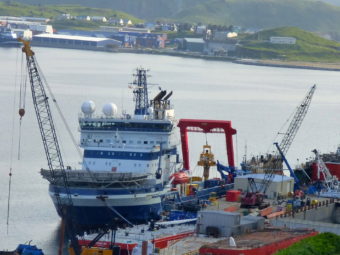
The Fennica and its yellow capping stack in Alaska's Dutch Harbor on July 18. (Photo by John Ryan/KUCB)
The Fennica and its yellow capping stack in Alaska’s Dutch Harbor on July 18. (Photo by John Ryan/KUCB)

The Obama administration approved Arctic oil drilling Monday.

The Interior Department gave final approval to Shell Oil to drill into oil-bearing rocks at the company’s “Burger J” drilling site. The company has until late September to complete this summer’s exploratory drilling. Megan Baldino is a Shell spokesperson:

“Our plan is to make the most of the time that we have in theater, and whatever we don’t accomplish this summer, we can potentially … do in 2016.”

Shell’s Polar Pioneer rig began drilling on July 30.  But Shell couldn’t get permission to drill into oil-bearing layers until its missing icebreaker and the well-capping stack on its stern returned from the Lower 48. Greg Julian is a spokesperson for the federal Bureau of Safety and Environmental Enforcement

“Now that the capping stack is on hand, Shell is allowed to drill into potential oil-bearing zones, [at the Burger J site.]” BSEE spokesman Greg Julian said.

Federal inspectors have been living on board both of Shell’s Arctic drill rigs for the past two weeks of shallow drilling.

“Nothing noteworthy to report,” Julian said. “Things are going smoothly.”

The Fennica hit a rock on its way out of Dutch Harbor on July 3. It then sailed to Oregon for repairs. Greenpeace protesters swinging beneath a Portland bridge further delayed the Fennica. Environmentalists reacted with dismay to the Obama administration’s announcement. [Today’s/Monday’s] Approval of Arctic oil drilling comes a few days after the president announced that his upcoming visit to Alaska would focus on his push to fight climate change.

Annie Leonard is the head of Greenpeace USA.

“Obama’s relation with climate is a little schizophrenic … doesn’t make sense to recognize what a serious problem climate change is and then … [have] drilling in the Arctic. You’re either on one side or the other.”

The President will visit Alaska at the end of this month. The White House video promoting Obama’s trip as part of his legacy of leadership on protecting the climate did not mention his Administration’s support for Arctic drilling.

Climate change, not Arctic drilling, drives Obama trip to Alaska

Whitehouse.gov video screenshot

The White House released a video Thursday morning to explain why he will be the first sitting president to visit Alaska’s Arctic.

The folksy video (it starts with the President of the United States saying, “Hi, everyone”) features dripping glaciers, raging wildfires and Alaska Natives hanging salmon to dry.

“As Alaskan permafrost melts, some homes are even sinking into the ground,” Obama says in the video. “The state’s God-given natural treasures are all at risk.”

In the video, the president says he’s coming to Alaska because it’s on the front lines of climate change, with lives and communities already being disrupted.

“What’s happening in Alaska isn’t just a preview of what will happen to the rest of us if we don’t take action. It’s our wake-up call,” Obama says. “The alarm bells are ringing. And as long as I’m president, America will lead the world to meet this threat — before it’s too late.”

In Anchorage, Alaska Senator Lisa Murkowski said she hopes President Obama will keep his eyes open during his visit rather than come to Alaska with a predetermined agenda.

“I think we’re all looking forward to welcoming the President of the United States to Alaska, his first official trip to see our state,” Murkowski said. “It is somewhat disappointing, though, that he apparently intends to use this as nothing more than a backdrop for climate change.”

Murkowski’s fellow Republican, Rep. Don Young, used less diplomatic language in his press release.

“It is my hope that the president will use his visit as an opportunity to learn about the many challenges we face and not as a platform to pander to extreme interest groups using Alaska as a poster child for their reckless agenda,” Young’s statement said.

Young’s statement described that agenda as locking up critical resources like oil, gas and minerals.

The White House video does not mention the administration’s Alaska- and climate-related policy that has been making national headlines this summer: its approval of exploratory drilling in the Arctic Ocean.

With the Obama administration’s blessing, Shell Oil began drilling last month in the Chukchi Sea. The company is hoping the Interior Department will approve deeper drilling into oil-bearing rocks any day now.

Environmental groups say the administration’s green lighting of Arctic drilling just doesn’t square with Obama’s stated aim of leading the world in fighting climate change.

“It’s a pretty evident contradiction,” Margaret Williams with the World Wildlife Fund in Anchorage said. “It is absolutely clear that greenhouse gases are driving change in the Arctic, and to solve the climate problem, we have to be stemming the source of greenhouse gases.”

Greenhouse gas emissions come primarily from burning fuels like coal, oil and natural gas.

International climate negotiators will meet in Paris in December. They’ll try to agree on how fast to reduce those emissions. Their aim: keeping the earth’s climate from warming more than 2 degrees Celsius.

A study this year by British energy researchers in the journal Nature found that climate change can only be kept under 2 degrees Celsius by leaving Arctic oil in the ground.

Sarah Erkmann with the Alaska Oil and Gas Association said the group has no reaction to Obama’s trip yet, with the details of his agenda still being worked out.

“We’ll have a reaction if he has any announcements that would impact the industry in Alaska specifically,” she said.

Erkmann said AOGA has no position on climate change, though individual oil companies that make up its membership do.

Last week, Shell announced it was ending its membership in the American Legislative Exchange Council. A Shell spokesman said the energy giant would be leaving the anti-regulatory group because ALEC’s opposition to action on climate change was inconsistent with Shell’s approach to the issue.


Shell ready to drill for Arctic oil as delayed icebreaker arrives

The Fennica and its yellow capping stack in Alaska’s Dutch Harbor on July 18. (Photo by John Ryan/KUCB)

Shell’s wayward icebreaker made it to the company’s Arctic Ocean drilling site Tuesday. The arrival of the Fennica after a month’s delay means the company could get to drill for oil beneath the Chukchi Sea this summer.

Currently, Shell only has permission to do shallower drilling into non-oil-bearing rocks off Alaska’s northwest coast.

With the Fennica steaming toward the Arctic, Shell submitted an application to the Interior Department Thursday for permission to drill into deeper, oil-bearing rocks.

Climate-change activists are pressuring the Obama administration to reject Shell’s application to modify its drilling permit.

The Fennica icebreaker hit a rock and tore a three-foot hole in its hull when leaving southwest Alaska’s Dutch Harbor for the Arctic July 3.

The icebreaker then sailed to Oregon for repairs, where protesters blocked its path for about a day and a half.

Shell has to stop drilling by late September.

Federal inspectors are on board both of Shell’s Arctic rigs.

Only the Polar Pioneer rig is actually drilling. It finished digging a 40-foot-deep cellar in the sea floor over the weekend for holding a blowout preventer.

Another key piece of oil-spill equipment, the capping stack, is on board the Fennica.

Shell had planned to have both its rigs drilling at the same time, 9 miles away from each other.

Federal officials rejected that plan in order to protect walruses from widespread drilling noise.

Even as Shell pursues oil in the Arctic, with climate activists nipping at its heels, Shell officials acknowledge that climate change is a problem.

Last week, Shell became the latest oil company to announce it would sever ties with the American Legislative Exchange Council. The conservative group tries to block government action on climate change and other issues.

“ALEC advocates for specific economic growth initiatives, but its stance on climate change is clearly inconsistent with our own,” Shell spokesman Curtis Smith said in an emailed statement.

study this year by energy researchers at University College London found that global climate change can only be kept to less than 2 degrees Celsius, as international negotiators have been aiming for, by leaving Arctic oil in the ground.


Head of Coast Guard says people are ‘waking up’ to the need for more Arctic icebreakers

Vice Adm. Paul Zukunft, Pacific Area Commander, traveled to Kodiak in 2013 to speak at the change of command ceremony for the Coast Guard cutter Alex Haley. (Creative Commons photo by Nicole Klauss)

The head of the U.S. Coast Guard says lawmakers and national security staff are waking up to the need for more icebreakers as the Arctic opens to increased ship traffic.

“This is really generating a lot of interest and I am optimistic that on my watch we will see, no fooling, forward progress as we look at building a national fleet of icebreakers,” said Adm. Paul Zukunft in a speech at the National Press Club in Washington, D.C. Wednesday.

The commandant says he’s had a peek at bills pending in Congress that detail how his service will fare in its campaign to modernize.

“I can’t share those with you, but it may very well bring the largest acquisition budget to the Coast Guard in Coast Guard history,” he said.

That optimism stands in contrast to an assessment a few months ago by the Government Accountability Office. The office says the list of ships and airplanes the Coast Guard says it needs is unaffordable. The report also says one upcoming project – the construction of 25 offshore patrol cutters – is expected to consume two-thirds of the Coast Guard acquisition budget until 2032.

Zukunft, in his speech to the Press Club, also discussed the lack of modern charting in the Arctic, and said the Coast Guard is considering a traffic separation plan for the Bering Strait to prevent collisions.

Shell’s Arctic icebreaker returns to Alaska

The Fennica approaches the Delta Western Fuel dock in Alaska's Dutch Harbor on Tuesday. (Photo by John Ryan/KUCB)
The Fennica approaches the Delta Western Fuel dock in Alaska’s Dutch Harbor on Tuesday. (Photo by John Ryan/KUCB)

Shell’s Fennica icebreaker has returned to Alaska.

It docked at Dutch Harbor Tuesday evening after enduring repairs and protests in Portland, Oregon.

Shell began drilling the top of a well in the Chukchi Sea last week, but it does not have federal permission from the U.S. Interior Department to drill into oil-bearing rocks unless the Fennica is on site.

Shell’s bright yellow well-capping stack sits on the stern of the Fennica. It’s to be used in case a well blows out and other spill-prevention methods fail.

“Once the Fennica is in theater [in the vicinity of the Chukchi Sea drill sites], then we’ll engage in discussions with the regulator about that permit,” Shell spokeswoman Megan Baldino said.

The drill sites are more than 1,000 miles north of Dutch Harbor, the nearest deepwater port.

The Fennica went to Portland’s Vigor shipyard after tearing a three-foot gash in its hull on an uncharted rock in Alaska’s Dutch Harbor on July 3. The U.S. Coast Guard is investigating the incident.

Greenpeace activists suspended from a bridge across Portland’s Willamette River and climate-change activists paddling kayaks in the river managed to delay the Fennica’s departure from the shipyard by about 36 hours.

Shell has until the last week of September to finish its drilling for this year.

Site notifications
Update notification options
Subscribe to notifications