Arctic

Industry and interest groups both displeased with Obama’s words on climate

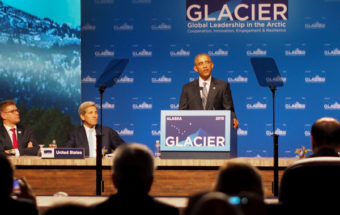
Obama delivers closing remarks at the GLACIER conference, focusing on the ways climate change is already taking a dramatic toll on Alaska. (Photo by Zachariah Hughes/KSKA)

As President Barack Obama continues to visit sites in Alaska during a trip focused on climate change and Arctic policy, reactions are to his speech at the close of the GLACIER conference Monday are still forming. However, a consistent opinion from energy and environmental advocates alike is dissatisfaction.

Nobody seems totally happy with the president’s speech on climate change: too vague, too bleak, goes too far, doesn’t go far enough. Advocates and adversaries of the administration say they just wanted something else.

“Alaska was the backdrop,” said Sen. Lisa Murkowski during a phone interview Tuesday. “His comments were directed to a national, and truly an international, audience.”

Murkowski is critical of the president’s agenda in Alaska for focusing so heavily on climate change, instead of what she believes are more salient local concerns over economic and energy issues.

Regarding the president’s remarks on climate change, Murkowski thinks it isn’t fair to clamor for a green energy future without offering a roadmap to get there.

“How do we get there Mr. President? How do we make this transition?” Murkowski asked. “There has to be a transition plan, and the transition plan cannot be that we price Alaskans out of our economic lifestyle and opportunity here.”

Unsurprisingly, that emphasis on not sacrificing development opportunities is echoed by the energy industry.

Kara Moriarty is president of the Alaska Oil and Gas Association and cites figures from the government’s Energy Information Administration that 80 percent of the nation’s energy will come from fossil fuels for the foreseeable future.

“We are going to continue to rely on oil and gas for the next several decades,” said Moriarty, “and that oil and gas should come from Alaska.”

Like Murkowski, Moriarty thinks Alaska and the nation need to change their relationship with fossil fuels but doesn’t see an immediately viable alternative solution. “Renewables are important,” Moriarty said, “but solar panels and wind turbines–they require a lot of minerals to make those materials.”

For others, though, a lack of particulars in the president’s speech was frustrating for different reasons.

Speaking from Washington, D.C., Cassady Sharp of Greenpeace said environmental advocates are used accustomed to Obama’s convincing words on climate change, matched with frustratingly little follow-through.

“When you match that rhetoric up with the actual actions he’s taking, one: they’re not enough. And then,” Sharp added, “they’re completely undermined when he approves something like Shell’s Arctic drilling plan.”

During the GLACIER conference, members of the administration offered an explanation that Royal Dutch Shell’s Arctic offshore drilling in the Chukchi was approved under President Bush, and this administration has raised standards for permitting and preparedness on it.

But Sharp doesn’t buy it: Obama hasn’t been shy about scrapping programs he disagrees with from past administrations, and yet this one made it all the way to approval.

Even self-professed Obama fans say that when it comes to climate, they haven’t seen the president deliver yet.

“President Obama has done more than any other president before to address the issue of climate change,” said Rick Steiner, a marine conservation biologist based in Anchorage. “The only problem is: it isn’t enough.”

Steiner concedes that the president admitted basically the same thing in his speech, repeating refrains about officials not acting fast or comprehensively enough.

Steiner believes that the Paris climate talks in December need to be where the administration lays out a credible, legally binding plan for curbing emissions by 75 percent in the decades ahead.

But it is a tall order coming to Alaska to pitch measures aimed at slowing climate change. Steiner sees a paradox in how the state has hitched its economic wagon to the same hydrocarbons nibbling away at the shorelines and glaciers. That’s the very reason he sees Alaska as a good place for the administration and state to start scrapping the status quo.

Melanie Bahnke’s opinion of the speech and presidential visit are a bit different. Bahnke is president of the regional non-profit Kawerak in the Bering Strait Region. She was part of the president’s hour-long roundtable with Alaska Native leaders and explained the administration’s work with Alaska Natives and tribal partners has been unprecedented measured against past American presidents. While Obama’s climate speech might not have suited every party’s agenda, Bahnke said, the fact that it’s bringing in actual voices from the communities so often invoked in Alaska’s climate debates means it’s a more holistic approach than what is typically offered.

“He understands that there’s a need to do both: we need to curb and mitigate climate change, but, on the other hand, there are these small coastal villages that are in imminent danger and require urgency and response,” Bahnke said.

Bahnke was part of a small group that met with members of the president’s staff a day after the GLACIER conference to discuss concrete actions that the executive branch can take in the next 15 months before a new administration comes into office.

Even with another icebreaker, US fleet pales against its Arctic neighbors

President Obama wants to beef up America’s fleet of icebreaking ships.

He made the announcement Tuesday before stepping on a non-icebreaking tour boat to see the glaciers of Kenai Fjords National Park.

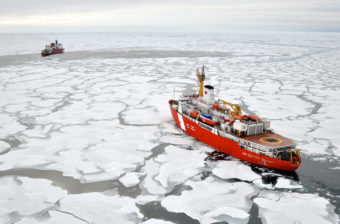
The Coast Guard vessel Healy is considered a medium icebreaker. President Obama has promised to speed up the acquisition of a heavy icebreaker for the Coast Guard’s fleet. (Photo courtesy of the United States Coast Guard)

Obama proposed to speed up construction of a heavy icebreaker by two years. He wants the new ship to be polar-ready by the year 2020, rather than 2022.
Obama also said he plans on working with Congress to expand the nation’s fleet of icebreakers.

The U.S. Coast Guard has two icebreakers in working condition, and just one of those two vessels is a heavy icebreaker — the Polar Star. By comparison, Russia has a fleet of about 40. Canada, Finland and Sweden each have six icebreakers or more.

The Congressional delegations of Alaska and Washington state have long called for more ice breakers. In an email, Sen. Lisa Murkowski’s office said Obama’s announcement is less a plan than an acknowledgment that the needs must be addressed. In an email, Murkowski spokesperson Matthew Felling said the senator “awaits seeing the priorities espoused today reflected in dollars in the President’s budget next year.”

One of the Coast Guard’s two working icebreakers is currently at 87.5 degrees north latitude. It’s a few days away from the North Pole on a science mission.

Chief scientist David Kadko with Florida International University says the polar ice has been thinner than anticipated. That’s allowed the Healy to burn less fuel breaking through the ice, and it’s made the work of the 51 scientists on board smoother. German and Canadian icebreakers are also cruising the Arctic for science this summer.

“It’s quite historic: three icebreakers from three different countries working together, and collaboratively,” Kadko said.

The three ships are working to get a baseline of conditions throughout the Arctic Ocean. They want that snapshot of the Arctic chemistry before the expected increase in shipping and resource extraction brings more pollution to the top of the world.

Climate change is the main theme of the president’s highly publicized three-day tour of Alaska. The president has not taken any questions from the media, and he is not expected to do so while he’s here.

The White House press office said Tuesday that Obama will increase ongoing efforts to chart navigation routes through the Aleutians and Bering Sea and more closely monitor sea level and sea ice in the Chukchi and Beaufort Seas.

Arctic shipping updates offered at commission meeting in Nome

The Canadian Coast Guard Ship Louis S. St-Laurent makes an approach to the Coast Guard Cutter Healy in the Arctic Ocean. (Photo by Patrick Kelley/U.S. Coast Guard)

Renewable energy and port development were the focus of the final session of the U.S. Arctic Research Commission’s two-day meeting in downtown Nome.

Lorraine Cordova, project manager for the Alaska Deep Draft Arctic Port Study, offered port updates to the crowd and research suggestions to the commission. She commended Nome’s Port Director Joy Baker and City Manager Josie Bahnke for their efforts in promoting Nome as the site of Alaska’s deep-draft port.

Although Port Clarence was in the running, its lack of infrastructure and Nome’s active sponsorship of the Alaska Deep Draft Arctic Port Study helped single out the city. The debate on whether Nome will commit to dredging as deep as the port will require is ongoing.

Kody Stitz from the U.S. Coast Guard also updated the commission on matters relating to Arctic shipping. Since 2010, the Coast Guard has conducted a Port Access Route Study in the Bering Sea. The study will determine the need for routing measures through the region. Currently, there are no speed restrictions, north and southbound lanes, or areas to be avoided from Unimak Pass in the Aleutians up through the Bering Strait.

Aside from a lack of routing measures, the Bering Sea’s nautical charts are outdated, presenting serious safety risks to vessels of all kinds.

“A really good example is the Fennica,” Stitz said. “The Fennica, just a couple of months ago coming out of Dutch Harbor, struck something and in the aftermath of that NOAA went out, did a survey, and we ended up finding an uncharted rock.”

The Coast Guard is working alongside NOAA to chart the Bering Sea and expects to have that work completed by the end of the year. Stitz said along with implementing routing measures, up-to-date nautical charts will encourage safe shipping through the route.

“One of the goals with putting down a route,” Stitz explained, “is that NOAA can now look at a couple thousand square miles of the route area and really give us a really accurate assessment.” Knowing just what lies on the seafloor will incentivize staying within the route’s boundaries.

“The shippers have a really strong incentive and the insurance carriers have a really strong incentive to say, ‘You know what if you’re going from A to B you’re going to follow this route to the maximum extent possible.’”

Stitz expects it will take at least year for the study’s findings to go through the Coast Guard, the State Department, and additional military branches for approval before finally approaching the International Maritime Organization. The complete process will take at least two to three years, Stitz said.

Obama to announce icebreaker program in Seward

The Polar Star completes ice drills in the Arctic in July 2013. Built in the 1970s and only meant to last 30 years, the vessel is the U.S. Coast Guard's only heavy icebreaker. U.S. Coast Guard/Reuters
The Polar Star completes ice drills in the Arctic in July 2013. Built in the 1970s and only meant to last 30 years, the vessel is the U.S. Coast Guard’s only heavy icebreaker.
U.S. Coast Guard/Reuters

The United States is accelerating its icebreaker program as part of a newly announced initiative to build capacity in the Arctic.

The White House said in a news release early Tuesday morning that during his visit to Seward and the Exit Glacier Tuesday, President Barack Obama will propose speeding up acquisition of a “replacement heavy icebreaker” by two years, from 2022 to 2020.

Obama also wants to work with Congress to plan for an expanded icebreaker fleet, “To ensure the United States can operate year-round in the Arctic Ocean,” he said.

Typically, it is Alaska’s congressional delegation that calls for more vessels able to operate in the icy waters of the Arctic, and rarely is there much traction.

In the same release, the White House sketched a new observer program in Alaska’s marine waters, partnering federal agencies with Alaska Native communities to gather data on changing ecological conditions, and expanded scientific scientific research projects on Arctic biodiversity.

GLACIER conference ends with vague, dire tones

President Barack Obama addressed the GLACIER conference in Anchorage Monday. (Screenshot)

As President Obama continues touring Alaska, the aims and outcomes of Monday’s GLACIER Conference are still being sorted out.

Independent of the president’s visit, the State Department organized for 20 diplomats with ties to the Arctic to gather in Anchorage’s Dena’ina Center. The aim, according to Secretary of State John Kerry, was figuring out next steps for international efforts on climate change ahead of talks in Paris later this year.

“We very much look forward to building a record, an agenda, a roadmap, if you will, to lead us into Paris, where we have a critical negotiation this year,” Kerry said during opening remarks.

Throughout the day, diplomats convened for closed-door meetings. Meanwhile, breakaway sessions elsewhere focused topics of particular interest to Alaska and the high North, like Arctic home-design, coastal erosion, and mitigation, as well as how to manage Arctic fisheries.

The common thread was in offering evidence that a changing Arctic environment is impacting economies, nations, and communities faster than anyone can adapt. Northwest Arctic Borough Mayor Reggie Joule told delegates that Native people in Alaska are seeing some of the resources closest to home threatened.

“Subsistence is our means for providing for our families,” said Joule, who spoke throughout the day on different topics, but stressed that hunting, fishing, and foraging remains fundamental to the economies and cultural identity of many Alaska Natives. “For many, more than half of our daily take of nutrition is from our traditional foods.”

By the end of the day’s sessions, Kerry said productive discussions would be reflected in a document set to be put out soon.

“We confirmed today that we cannot afford to wait until someone else moves to implement solutions to the challenges that confront us in the Arctic,” Kerry said. “I’m very pleased that through today’s GLACIER meeting we made progress in a host of areas, and our communiqué will summarize that.”

But particulars — both about the conference’s deliverables and about what steps the administration will announce — remain vague.

During closing remarks, the president cast a serious tone about the stakes of inaction on dire climatological changes. He alluded to details to come during his two remaining days visiting different parts of Alaska. But at the close of Monday’s Glacier conference, the one certainty is widespread agreement that manmade climate change is exacting a real toll on Alaska.

In fact, there was one other universal point of agreement within the conference’s crowded closing session.

“I think we could say that Denali has never looked better than it did today,” Secretary Kerry said to a battery of applause.

After an executive action Sunday, the name of North America’s highest mountain was officially restored to Denali. The weather in Anchorage was clear and the mountain’s summit was visible.

200 gather to protest Arctic drilling during GLACIER conference

Carl Wassilie, left, stands with protestors against Arctic drilling. The protest took place during the GLACIER conference in Anchorage where President Obama began his Alaska trip. (Photo by Anne Hillman/APRN)

About 200 people gathered on the Park Strip in downtown Anchorage Monday afternoon to protest offshore drilling in the Arctic and to call for stronger measures to fight climate change.

Danielle Redmond with Alaska Climate Action Network helped arrange the protest, which featured a model of Shell’s drilling rig with the moniker “Polar Profiteer” instead of “Polar Pioneer.” She says they’re glad Obama is in Alaska and has spoken about climate change, but he hasn’t done enough.

“The message that has become clear to us is it’s absolutely up to us, to ordinary people, to create the political space that is needed for real change,” Redmond said.

Redmond says it’s hard for Alaskans to speak against the human causes of climate change.

“People are terrified and they feel like they’re the only ones and are alone because we’re an oil state,” Redmond said. “Our economy depends on it and so it is a challenging thing to confront that and face that reality and to find solutions on how to move forward in a better way.”

Anchorage resident Terri Pauls was in the crowd waving a dark blue flag with an image of the planet earth.

“I feel pretty strongly that the way to look at this topic is through science, and I just find it super disappointing that so many people chose to ignore or dismiss solid science,” Pauls said.

Carl Wassilie from Western Alaska joined the event. He also attended protests against Shell in Seattle. He says he objects to offshore drilling because he says the oil industry has not helped Alaska Natives and infringes upon their rights.

“We’re still in the same situation we were 40 years ago, getting Third World diseases in the villages and that’s with 40 years of drilling onshore, primarily onshore in the Arctic,” Wassilie said. “We don’t need to go offshore. It’s not going to help the planet and it’s not going to help the people.”

Others spoke about the impacts of drilling on wildlife and subsistence hunting.

Americans for Prosperity had also planned a rally, but it was canceled for logistical reasons.

Site notifications
Update notification options
Subscribe to notifications