Arctic

Obama’s Alaska visit yields little regarding Arctic Ocean drilling

President Barack Obama meets with Kotzebue residents during his three-day tour of Alaska. (Photo by Eric Keto/Alaska Public Media)

Throughout President Obama’s tour of Alaska last week, he spoke at length about efforts to reduce the nation’s greenhouse gas emissions. He spoke very little about his support for Arctic Ocean drilling.

The drilling policy could affect the global climate much more than any of Obama’s climate-friendly initiatives.

The president wrapped up his climate-change tour of Alaska in Kotzebue, just above the Arctic Circle.

“One of the reasons I came up here is to really focus on what is probably the biggest challenge our planet faces,” President Obama said. “If there’s one thing that threatens opportunity and prosperity for everybody, wherever we live, it’s the threat of a changing climate.”

In Kotzebue, Obama spoke of climate-friendly initiatives big and small around the state.

“And I know you guys have started putting up solar panels and wind turbines around Kotzebue,” President Obama said.

And he highlighted his government’s biggest initiative of all aimed at helping the climate: the national Clean Power Plan.

“Last month, I announced the first set of nationwide standards to end the limitless carbon emissions from our power plants, and that’s the most important step we’ve ever taken on climate change,” President Obama said.

Alaska is exempt from that plan. The president did not mention one of his policies that has direct relevance in Kotzebue and the rest of Alaska.

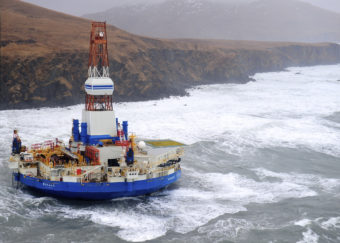
Kotzebue is one of the Western Alaska port towns getting business from the quest for oil in the Chukchi Sea. Shell’s Arctic Challenger oil-spill barge and other support vessels are based in Kotzebue Sound.

The Obama administration gave Shell the green light in August to drill into oil-bearing rocks beneath the Chukchi Sea.

The U.S. Geological Survey says more than 20 billion barrels of oil can be recovered from beneath the Chukchi and Beaufort seas. If that oil is burned in engines and homes and businesses, it would pump many times more carbon dioxide into the sky than the president’s big clean power plan would keep out of the sky.

“Approximately 15-times greater,” says Lois Epstein, an engineer with The Wilderness Society in Anchorage. Her group has been opposed to drilling in the Arctic Ocean mainly for non-climate reasons.

She says Obama’s approval of Arctic drilling is inconsistent with his big push to fight climate change.

“The administration should be at least trying to be consistent in their decision making,” Epstein said. “They have chosen not to be consistent, and that will have climate consequences.”

Other environmentalists have been less diplomatic, calling Obama hypocritical or even schizophrenic when it comes to climate change.

Shell Alaska spokesperson Meg Baldino declined to comment on the climate impacts of Arctic Ocean oil.

But earlier this year, the head of Royal Dutch Shell, Ben Van Beurden, said he agrees the world can’t burn all of its fossil fuels and avoid dangerous climate change.

“I accept the fact that having the climate change beyond 2 degrees C is probably highly undesirable, and we should do everything to prevent that from happening,” he said.

Van Beurden spoke with the left-leaning Guardian newspaper in England.

Even though this year’s plummeting oil prices reflect a world awash in oil, the Shell CEO said his company can’t stop looking for new sources, in the Arctic or elsewhere.

“I think to just say we can do without hydrocarbons, and we don’t need them anymore, stop exploring for them because they are coming out of our ears already—that is not quite an accurate reflection for a company like us,” Van Beurden said.

Van Beurden put responsibility for opening the Arctic Ocean to drilling on the U.S. government.

“The opening up of the Arctic is not our decision. It’s the decision of an Arctic nation, in this case, the United States,” he said. “And it’s our task to figure out: Can we do this responsibly? Can we do this profitably? Can it be done at all? If the answer to all that is yes, then we should consider it as an investment opportunity.”

Shell officials say it could be 10 to 20 years before any oil from the Chukchi Sea would be available as fuel. That would mean Arctic drilling could remain controversial for a long time.

During the president’s three-day tour, White House handlers didn’t let journalists ask him any questions, with the exception of an exclusive interview and photo shoot with Rolling Stone magazine.

Obama unveils plan for community ‘climate resilience’ in Kotzebue

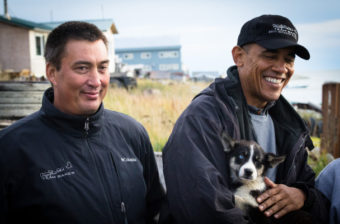
Iditarod musher John Baker meets President Barack Obama in Kotzebue, while Obama holds sled dog puppy Feather. (Photo by Matthew Smith/KNOM)

An Arctic conference in Anchorage, hiking glaciers in Seward, and getting hands-on with salmon in Bristol Bay — all a prelude to President Barack Obama’s final stops on his tour of Alaska. The president ended his three-day tour of Alaska on Wednesday with visits along the western coast — first in Dillingham and then Kotzebue, where he officially unveiled new initiatives aimed at helping Alaska’s rural villages cope with climate change in the fast-thawing Arctic.

As a regional hub for 10 remote villages about 30 miles above the Arctic Circle, Kotzebue is where Obama came closest to actually seeing the communities he’s touted throughout his trip as being imperiled by climate change. Millie Hawley is native village president of Kivalina and says her community is seeing those impacts first-hand to both the environment and their food supply.
“We barely got any seal,” she said. “The bearded seal is what we rely on year-round.”

Usually, Kivalina gets 80 seals each year, but this year the community got only eight. Changing migration patterns of belugas and caribou have also affected Kivalina’s food supply.

“Even though we try to protect our children from worry or fear, they sense that things are happening to their home,” Hawley said.

How to address a complex issue in a meaningful way? The president took to the podium at the Kotzebue junior and senior high school to outline plans for a joint tribal, state, and federal effort to help plan — and pay for — more than 30 communities in rural Alaska looking to relocate or rebuild. Obama called it “climate resilience.” The effort will be led by the Denali Commission, an independent federal agency that’s worked on Alaska infrastructure projects for nearly 20 years.

“This is going to cut through bureaucracy and red tape — free up communities like yours to develop and implement solutions for events like coastal erosion, flooding, and permafrost degradation,” Obama said.

The Denali Commission is also bringing $2 million to the table for relocation efforts. And while relocation is the goal for communities like Kivalina, clean water and functional sewer systems remain elusive for many rural communities. In his Kotzebue speech, the president announced a revision on eligibility with the U.S. Department of Agriculture’s Rural Alaska Village Program, opening the doors to more than 30 communities for water and sewer grants.

“You shouldn’t wait until disaster strikes,” the president said. “We should see if we can invest in communities before disaster strikes to prevent. So today we’re announcing $17 million in USDA rural water grants for infrastructure projects in remote Alaska communities.”

But is it enough? Northwest Arctic Borough Mayor Reggie Joule lives in Kotzebue. The borough has fewer than 8,000 people spread out over an area larger than the state of Kentucky. Estimates put the cost of relocating just one village at more than $100 million, with emergency evacuation roads costing as much as $2 million a mile.

“None of what we have on the plate — none of what many parts of rural Alaska are asking for — are things on a wish list. They’re things that people need,” Joule said.

The president ended his trip with a tour of Kotzebue’s Shore Avenue, a reinforced roadway along the coast that local leaders held up as an example of engineering that overcomes climate challenges — something they said Alaska desperately needs more of. In his speech, Obama said fast action is essential, and he pledged the federal government’s support.

“There is such a thing as being too late,” Obama said. “The effects can be irreversible if we don’t act, and that moment is almost here. You know this better than anybody. I want you to know, as your president, I’m here to make sure you get the support that you need.”

But before flying out, Obama made a final detour — a brief moment with Iditarod musher John Baker. The president donned a “Team Baker” jacket for a picture with Baker’s prize-winning pups. The Commander in Chief even cradled a blue-eyed puppy named Feather. A quick photo behind Baker’s dogsled, and then a quick hop from motorcade to the airplane and the president was gone.

Like many Alaskans, most in Kotzebue saw Obama only at arm’s length — a handshake or a glimpse as he walked amid a throng of secret service, staff, and reporters. But many said they’re happy he made Kotzebue his final stop and hope it will cause the conversation about the American Arctic to finally start.

Alaska Rep. Don Young skips president’s visit

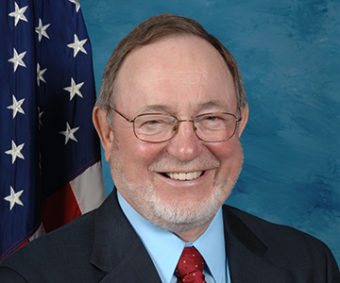
Don Young. (Official photo)

Alaskans of all stripes came out this week for a chance to shake hands with President Barack Obama, or at least glimpse his motorcade, but one person not on hand for the big visit was Don Young, Alaska’s only member of the U.S. House of representatives.

“Congressman Young traditionally spends the end of August in his hometown of Fort Yukon, and that’s what he did this year,” said Young spokesman Matt Shuckerow.

Young is still in Fort Yukon and, according to his spokesman, not easily reached by phone. But Young did follow what the president said while he was here, and Shuckerow says he wasn’t entirely disappointed.

“There were some things that Congressman Young was encouraged to see, that was focused on a wider range of Arctic issues. Arctic infrastructure, icebreakers, deepwater ports — these are things that Congressman Young and others in the delegation have been fighting for for years. It certainly is important to bring attention to them.”

Many Alaskans seemed charmed that the president embraced Alaskan symbols — from sled dog puppies to salmon to Native dancing. Young, a Republican in office since Obama was in elementary school, retains his pre-trip skepticism. Shuckerow says his boss was dismayed the president used the state as the backdrop for his climate agenda.

“The big thing that Congressman Young said was that the president just fundamentally doesn’t understand one of Alaska’s major, most basic barriers, and that is the federal government and some of its out-of-touch federal policies coming from our agencies,” Shuckerow said.

Alaska’s two U.S. senators are taking family time and were not available for interviews today. Sen. Dan Sullivan was the first person to greet Obama when he first arrived at Joint Base Elmendorf-Richardson. It was a prolonged handshake. Sullivan’s spokesman says he was urging Obama to review the Army’s plan to cut troops from the base. Sullivan was also spotted at the GLACIER conference when Obama spoke.

Sen. Lisa Murkowski participated in an hour-long meeting with the president, a roundtable with Native leaders, but she said Monday she was worried he wasn’t hearing enough from Alaskans.

Both senators issued statements thanking Obama for the Denali name change.

Village relocation efforts given ‘significant’ boost by president

Kotzebue. (Photo courtesy U.S. Army Corps of Engineers)

The White House announced Wednesday it will add funding and capacity for a wide array of programs in Alaska that address global warming. The federal government is tapping the Denali Commission as the lead agency to address the relocation of coastal communities across the state.
But the particulars of that announcement were still being sorted out ahead of the president’s appearance in Kotzebue, where he was expected to make a formal announcement.

At a tribal roundtable in the hub community of about 3,200, Percy Ballot of Buckland noted that the $2 million set aside for voluntary relocation is welcomed but falls far short of the costs.

“We appreciate that, we really do,” Ballot said in response to a question. “It’s going to help us a little bit, but we need more than that. To move (the) Native Village of Kivalina is going to cost a lot more money than that.”

That $2 million, though, is not for physical relocation, but instead for launching a coordinated review of how many among the roughly 30 communities identified in a 2009 report will either move, or fortify existing town sites.

Up until now, the state has overseen community relocation projects, but with no one agency fully in charge of the intricate logistical challenges.

“Funding has certainly been a limiting factor,” said Sally Cox, a planner with the state’s Department of Commerce, Community, and Economic Development, who has been intimately involved in developing relocation strategies since she began working with the Native Village of Newtok almost a decade ago.

So far, six communities identified as imperiled; Newtok, Shishmaref, Unalakleet, Shaktoolik, Kivalina and Koyukuk have received grant funds to develop plans for relocating or protecting in place. But the grant process is complicated, and technical guidance from regional nonprofits and state agencies has been essential for tribes deciding how to proceed.

Cox expects that in adapting and consolidating procedures that are presently spread across multiple entities the Denali Commission will improve upon existing abilities to respond.

“It could potentially make the process go much more smoothly, and streamline funding rules and regulations,” said Cox.

For those inside the Denali Commission, the White House’s announcement is significant news.

“I think it’s a huge step forward for the administration to identify a federal agency as lead to take on this huge undertaking,” said Joel Neimeyer, co-chair of the commission, which was set up almost two decades ago to better funnel federal resources into Alaska programs.

The commission does not have the staff to begin systematically working with the dozens of communities recognized as imperiled, but that is part of what the $2 million announced by the president is set aside for — staff and a review process.

“What we’re looking at are vulnerable communities that face environmental threats from flooding, erosion and permafrost degradation,” said Neimeyer.

It’s a welcome development for those who say the status quo has not been working. Selecting an entity to take charge of such multifaceted relocation reviews has been a repeated recommendation to the state and federal governments by groups like Kawerak, which represents several Bering Strait communities actively facing threats from climate change.

“We need to coordinate on a state, federal and local level,” said Kawerak President Melanie Bahnke. “There is no one lead agency that is tasked with identifying protective measures that need to be put in place.”

The Denali Commission has been an excellent partner in the past, Bahnke said, having financed projects within all 15 communities in the region. Part of the commission’s design for evaluating mitigation and relocation needs is the template established by the Health Facilities Program, which dramatically expanded clinic facilities across rural Alaska over the course of the last 15 years.

While there has been high-level attention cast towards the climate threats to coastal communities in the past, the acknowledgments brought this week are new.

“I do think the focus, the level at which the attention is now being commanded from the president of the United State, that is what’s new,” Bahnke said.

At the heart of the president’s announcement is recognition from the administration that Alaska’s coastal communities are in immediate danger. The Denali Commission news comes along with a catalog of funding resources for relocation projects, developing a set of principals for relocation and streamlining the process for tribes making official disaster declarations through FEMA.

Taken all together, many see the president’s visit as launching an organized federal response to years of scattered reports of environmental change in Alaska.

“Communities all over Alaska have been sending out a signal that they are experiencing really extreme and profound change,” said Mike Brubaker with the Alaska Native Tribal Health Consortium’s Center for Climate and Health. Brubaker’s Local Environmental Observer Network, which has produced an app for residents to self-report environmental irregularities, is included in the White House’s list of supported Alaska projects.

Although there is not yet a funding source for actual relocation or mitigation measures, Neimeyer with the Denali Commission said that involvement from the president’s recently created Arctic Executive Steering Committee could bring cabinet-level involvement into planning efforts. And with it, cabinet-level funds.

Arctic leaders outline local priorities in letter to President Obama

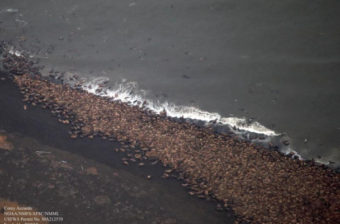
Arctic waters seen from the U.S. Coast Guard Cutter Healy. (Photo courtesy of the NASA Goddard Center)

A celebration took place in Kotzebue as final preparations are made for President Obama’s visit Wednessday. And with the spotlight on the Northwest Arctic hub — for the first visit by an American president above the Arctic Circle — local leaders have drafted a letter outlining their vision for the Arctic’s future.

Putting to rest clean-up efforts and last-minute preparations, Kotzebue residents gathered at the community school for a potluck Tuesday night — sharing food, song, and culture with the dozens of visitors from the president’s advance team and relatives who came to see the historic visit firsthand.

A round of Native Youth Olympics games and music from the Midnight Sun Drummers and Dancers were the backdrop as locals gathered to talk about what they hope the president takes away from his trip. For elder Enoch “Attamuk” Shiedt, it’s changes in the land he’s seen first hand.

Shiedt has worked for years as a subsistence coordinator. He recalls his grandpa telling him when he was just nine years old that the warming trend will eventually hurt his people.

“And now it’s here,” Shiedt said. “It’s not only global warming — it’s the erosion that’s the worst thing up this way. We’re losing some of our villages.”

Linda Hadley — originally from Deering but now teaching kindergarten in Kotzebue — sees it more as a historical moment.

“I believe it’s a momentous occasion,” she said. “It allows the president to see what a community the size of ours in the Arctic is about.” She said that having someone of his caliber come and visit “provides our community a voice in the national conversation.”

But outside the school halls and across town, the region’s part of that conversation was taking shape in the form of a letter to the president, outlining local priorities from climate change to energy.

Northwest Arctic Borough Mayor Reggie Joule was the first signature on the letter that includes tribes, Alaska Native corporations, local governments, health care providers, and more. On climate change, the letter points squarely to Kivalina — the community of about 400 on a barrier island along the Chukchi Sea coast.

“There are immediate needs for sure,” said Joule about the situation in Kivalina. “The community does need to get to safety. But more than that, the community needs to relocate.” Joule says this is not a time to be shy. “It’s a time for education — for Alaskans and for the people of the United States.”

Bearing the brunt of a changing climate, the shorefast ice that once protected the community from turbulent weather now forms later in the year, leaving the area open to storms, flooding, and erosion. In just ten years, the U.S. Army Corps of Engineers says the village will be uninhabitable.

While details are still few, the White House has announced a plan to put the Denali Commission — an independent federal agency working in Alaska since 1998 — in charge of a new mitigation and relocation effort for communities across Alaska. It’s a partnership Tim Schuerch with Manilaq said is a good fit.

Schuerch said the Denali Commission has been a great partner in developing most of the village clinics in the region.

“We do have a lot of confidence in the efficiency and effectiveness what it comes to the Denali Commission, in terms of assisting us with our infrastructure needs, including those that are needed to respond to climate change,” he said.

The letter covers a lot of ground — outlining the need to develop a deep-draft port above the Arctic Circle and advocating sharing federal revenue from offshore oil drilling with local residents. In many ways, it’s an academic breakdown of what northwest Alaska leaders say they’ll need for the future.

But Wayne Westlake, the president and CEO of NANA Regional Corporation, said it’ll take more than just a letter for Kotzebue’s voice to be heard. Westlake said he hopes the president gets the “feeling” of the region.

“There’s something here that is important not only to our country but to the health of the people of the region,” he said. “And that’s what I’m hoping for — that he’ll get that feeling that you can’t describe. He’ll tell his grandkids about it.”

President Obama begins his last day in Alaska with a morning in Dillingham. He’ll land in Kotzebue around 5 p.m. and should be flying back to Anchorage — and eventually Washington, D.C. — by 9 p.m.

Kotzebue prepares for a presidential visit

As president Barack Obama plans to shift his focus to Western Alaska by midweek, residents of Kotzebue — the northwest Arctic hub of about 4,000 people — are making final preparations for the president’s historic visit above the Arctic Circle.

Everyone from fishermen to local leaders are getting ready for the president’s visit — and have their own hopes for what he takes away.

On Monday, all of Kotzebue was put the finishing touches on cleanup efforts and last-minute planning for President Obama’s visit. More than 10 derelict houses had been knocked down as part of a community-wide cleanup that saw rusty cars, broken-down snowmachines, and more hauled away. But on Monday afternoon, Nelson Griest Junior was untangling his salmon net.

Marine One waits in a hangar in Kotzebue. (Photo by Matthew Smith/KNOM)

“From the last storm, it was pretty high — the water came up and washed my net out, and that’s where I’m at,” he said.

Nelson said he had a good summer netting chum salmon in Kotzebue’s small commercial fishery. He was working out of Kotzebue’s North Tent City — a city-built campground along a sliver of beach, offering fish racks and campsites for rent from May through September. It’s how Nelson’s spent his springs and summers since he can remember.

“It’s where I was born,” he said. “Lived down here over 15 years. My parents used to come here ever since the 70’s. Every summer, they pretty much came down here. Springtime, they’d go out hunting ugurk and seal.”

This summer, his camp in the tent city fell into the water — and it wasn’t the first time.

“It’s eroding,” he said. “It got my fish rack down here — dropped it down, fell one time. We put it back up. It’s really eroding down the coast, and every time the sand or rocks go down, there’s always ice in the bottom, on the tundra. So there is lots that’s melting, and I’m happy the president is coming. I’m excited.”

Nelson isn’t the only one talking about climate change in the lead-up to Obama’s visit.

“It’s such an honor for him to come to our village — to see first-hand our concerns as a native community here,” said Nicole Stoops, the executive director of the Kotzebue IRA. She said the concerns go beyond impacts to seal hunting and salmon fishing — it’s a connection to the land that goes back generations.

“It’s not such a simple thing to move a community as there are a lot of cultural ties to where they are now,” she said. “Just to understand the cultural ties the people have to the land, as well as finding something that would be logical and reasonable for the community members to feel comfortable on a move to relocate somewhere.”

Some of Kotzebue’s erosion issues — mainly along Shore Avenue, also known as Front Street — have been dealt with, at least for now, according to city manager Derek Martin. After 50 years of half-measures, Martin said it was a tremendous effort to finally get it right.

“The permanent fix to this erosion problem along Shore Avenue [was] to install a series of sheet pile bulkheads along 75 percent of Shore Avenue there,” he said. “That provided the necessary infrastructure to prevent further erosion and to protect the roadway. But this was a fix that worked for this community as part of our erosion problem, as part of our climate change problem here in Kotzebue.”

It’s a solution Martin said he hopes to showcase during the president’s visit — one that demonstrates the resilience of rural communities. It’s the kind of resilience Kotzebue Mayor Maija Lukin had to call on when her appendix burst this weekend.

What started off with nausea on Saturday turned into an emergency medevac to Anchorage and the quick removal of a dangerously inflamed appendix. Mayor Lukin was out of the hospital by Sunday, but she was only able to book a flight back home Monday night. It’s just one of the challenges about living in rural Alaska she puts up with to continue with her family’s traditions.

“I know the time that he’s here is very short, and we’re showing him the best of everything we have. But it’s a very hard life that people don’t quite understand,” she said. “We choose to live in Kotzebue because it’s a beautiful place — it’s above the Arctic Circle. It’s a place where you can raise your children to hunt, fish, live off the land, and do what we were taught from our parents and grandparents.”

But while many prepare to press the president on climate change, many in Kotzebue just as quickly bring up the elephant in the room — or, in this case, the oil rig in the sea. Shell Oil is pursuing exploratory drilling in the Chukchi Sea this summer and staging ships, tugs, crews, and more in Kotzebue.

Some residents say they’re opposed to the drilling outright. Others say they’re more open to the idea. But on the eve of Obama’s visit focused on climate change, many in Kotzebue are quick to point out the incongruity: The president they’re eager to welcome and talk openly with about their needs when it comes to climate change … is the same president who authorized Shell’s Arctic drilling.

For Nelson — still tending his fishnets — it’s straightforward.

“It’s not a good place to drill, I guess,” he said. “Because in fall time, when the ice is coming and the waves are getting bigger — I’m not sure about the cleanup. I think it’s going to be pretty hard in the Arctic.”

Oil and erosion, subsistence and climate change solutions — all topics on the minds of Kotzebue residents on the eve of the president’s visit to the Alaska Arctic.

Site notifications
Update notification options
Subscribe to notifications