Arctic

Arctic no rival to Suez, not this century, says shipping expert

University of Alaska Fairbanks professor Lawson Brigham says as the ice retreats, Arctic shipping is expected to increase, but not in the way we might expect. (Photo courtesy of University of Alaska )

As the ice retreats, Arctic shipping is expected to increase. But if your idea of “Arctic shipping” is cargo carriers navigating a shortcut between Europe and Asia, you may want to choose a different image.

It’s not so much the thinning ice that will drive up ship traffic in the north. It’s the price of oil, says UAF professor Lawson Brigham.
“Profound changes in sea ice are not retooling global trade routes. Why? Because the place is ice covered, through the century, for seven and a half months. Partially or fully ice covered,” says Brigham, who chaired the Arctic Council’s Marine Shipping Assesment. He spoke today at a forum sponsored by Resources for the Future, a Washington, D.C. think tank.

Brigham, once the captain of a Coast Guard icebreaker, says, despite all the breathless accounts, whatever traffic the Arctic Ocean sees will be seasonal.

“That’s not what I read in the global media wherever I go,” he said. “I read, of course, that Mr. Putin is going to replace the Suez Canal with the Northern Sea Route. Well, I would say, good luck.”

It might be possible, depending on how many centuries Putin expects to remain president of Russia, Brigham quipped.

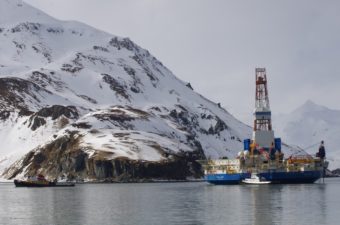
Rather than picturing container ships crossing the Arctic, think of all the vessels Shell sent north for its drilling season this summer. Brigham says global demand for Arctic resources is what will drive up ship traffic.

“Shell’s armada, I mean that’s marine shipping at the highest order: Twenty, 30 ships, all having very specialized operations to support one drilling site,” he said.

That kind of shipping, in support of Arctic industries, are a big deal, too, Brigham says. He mentioned the zinc exported from the Red Dog Mine.

“Some of the world’s largest, physically large bulk carriers, go from Kivalina to Southeast Asia or to smelters at B.C., so that’s a global connection, global commodity.”

Of course, there’s no Arctic port deep enough for those giant ships, so the zinc is lightered to them, on smaller vessels.

Nome Mayor Denise Michels said at the forum the easier access to the Arctic has brought changes to her community.

“We do see an increase in Arctic shipping,” said Michels, who lost her re-election bid yesterday. “We also see adventure tourism. We have kite-boarders. Jet skiers. We have people trying to cross the Bering Strait, which is 50 miles from the U.S. side to the Russian side if they don’t get arrested by the border guards.”

Nome will also host the Crystal Serenity next year, a 1000-passenger cruise ship expected to be the first of its class to travel the Northwest passage. Michels says making a deeper port at Nome isn’t just a local need. She called it an international priority.

Alaska port town reacts to Shell’s Arctic exit

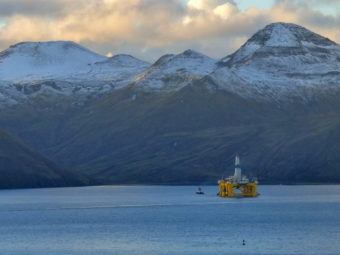
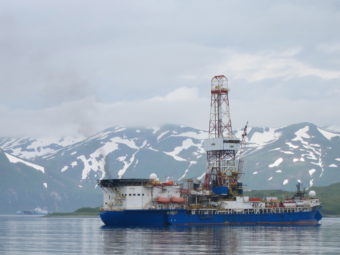
Shell Oil's Kulluk drill rig in Dutch Harbor. (Photo courtesy Shell Oil)
Shell Oil’s Kulluk drill rig in Dutch Harbor. (Photo courtesy Shell Oil)

The news that Shell Oil was abandoning its quest for oil in the Arctic Ocean came as a shock in Unalaska and around the state. Unalaska officials said the move won’t hit the city’s budget too hard. But local companies doing business with Shell are scrambling to figure out what it will mean for them.
Unalaska Mayor Shirley Marquardt said it will hurt the companies providing support to Shell’s Arctic effort in the short run.

“Our community will notice it; our business community will notice it because they utilized a lot of local businesses and hired a lot of folks. So, that’s too bad. I mean it was a real boon,” said Marquardt.

But she said the decision is a temporary setback.

“It’s not going to be too huge, I mean, we’re already…we’re an extremely busy port, we’ve been expanding for years, and that’s not…that’s not going to end,” said Marquardt.

Dutch Harbor port director Peggy McLaughlin says Shell wasn’t a frequent customer of the city’s facilities.

“In terms of, you know, the bottom line, I don’t see that it’s going to have a huge impact on us. We didn’t budget for it either operationally or in terms of revenue, so yes; we’ll probably see fewer port calls. But the city of Unalaska’s port facilities were not the primary place where they called,” said McLaughlin.

But Offshore Systems, Inc. is one of the primary facilities used by Shell. For OSI, the announcement was a disappointment. Spokesman Jim Butler says OSI officials are “in the dark” and “scratching their heads” right now about how much business they will lose. He also says the company will continue to provide support to Shell as it heads south from the Chukchi Sea.

Diane Shaishnikoff of Bering Shai Rock & Gravel says she and her husband don’t have “any idea at the moment” how it will affect their company.

Grand Aleutian general manager Laurie Smith said there’s no doubt the hotel’s occupancy rates will fall in the short term. She also said she was a little sad to hear the news; she and the staff had developed relationships with the many Shell personnel that used the hotel as a base. But Smith said the hotel will continue to have business without Shell. And that she’ll be able to get some long-deferred maintenance projects done now.

Not everyone in Unalaska was dismayed that Shell is abandoning the Arctic.

This summer, when Shell’s rigs stopped in Unalaska, Suzi Golodoff flew an anti-drilling banner. She said she got calls from far-flung relatives Monday morning celebrating the news.

“On a local level I’m really ecstatic that Shell has decided not to come here because as a community it’s just going to maybe spur us a little bit to say, boy you know, maybe there’s something wrong with this oil thing,” said Golodoff.

Golodoff said she hopes the community will look at developing other energy sources.

“Maybe we could do geothermal, maybe we could do hydro, we could do wind, we got, you know, these ocean passes right outside our door. We could be doing all kind of things. The technology is there,” she said.


Reactions to Shell’s decision range from remorse to relief

The Noble Discoverer in Unalaska in 2012. (KUCB file photo)

Governor Bill Walker is calling Shell’s announcement a “huge disappointment.” He says the end of Shell’s offshore dreams means the state must push harder for the federal government to allow drilling in another controversial region — the Arctic National Wildlife Refuge.

“We need to get some oil in the pipeline, and we need to do it as quickly as possible…if it’s not going to come from offshore, let’s safely develop it from onshore,” Walker says.

With a majority of state revenue coming from oil, Alaska has been hit hard not only by plummeting oil prices but by declining production, which has meant less oil flowing through the trans-Alaska Pipeline.

The Arctic Slope Regional Corporation is also expressing frustration. In a written statement, President Rex Rock says that without more oil and gas development, communities in the region face “a fiscal crisis beyond measure” and blames federal regulators for Shell’s decision. ASRC and six Native village corporations on the North Slope had entered into a partnership with Shell in the Chukchi Sea.

“With this type of uncertainty, we will continue to see good opportunities slip away because no one wants to do business in Alaska,” he says.

But for others, “people were relieved – there was jubilation.”

Rosemary Ahtuangaruak lives in Barrow. The city is in the middle of its fall whale hunt. Shell’s exploration was just 150 miles away.

Speaking with her grandchildren playing in the background, Ahtuangaruak says it’s crucial to protect the environment — and the community’s subsistence lifestyle – for the next generation.

“We’re not prepared; we didn’t have enough infrastructure and resources to be able to respond to an adverse event.”
She says on paper, there’s a plan to deal with any spill.

“But the reality of working in our harsh environment, there is no proven method to respond to an adverse event of a spill.”

Shell’s project would have opened up an entirely new area to drilling. Lois Epstein of The Wilderness Society says that would have had long-term repercussions well outside the region.
“Once you invest in the infrastructure to do that, we are going to be relying on fossil fuels for that much longer.”

Meanwhile, Shell still needs to seal the exploratory well and move its two drilling rigs and dozens of support vessels out of the Arctic before the arrival of winter sea ice.

Arctic Energy Summit focuses on both fossil fuels and renewables

Representatives from countries throughout the region gathered at this week’s Arctic Energy Summit in Fairbanks. (Photo by Rachel Waldholz/APRN)

Representatives from across the circumpolar North are meeting this week in Fairbanks for the Arctic Energy Summit. The meeting, which last happened in 2013 in Iceland, has drawn representatives from countries including Canada, Russia, Iceland, Finland, and Norway.

This week’s announcement from Shell that it would abandon Arctic offshore drilling has hovered at the edge of the proceedings – organizer Nils Andreassen of the Institute of the North asked for a moment of silence Monday morning to “recognize the complexities” of operating in the region.

But, he said, it doesn’t change a basic reality.

“This is still the decade of the Arctic,” Andreassen said. “Whether Shell is here or not. I think you had President Obama in the state for a reason, and an attention to the Arctic by the U.S. that we’ve never seen before. And I don’t think that’s going away.”

The conference has brought together representatives from major oil and gas producers like Shell and ExxonMobil along with those exploring wind, solar, hydro and geothermal energy.

Andreassen said in the Arctic, fossil fuels and renewables aren’t in competition.  Instead they’re often interdependent, as states, countries and companies use revenue from oil and gas to invest in alternative energy.

“That’s the model in the Arctic, is taking a non-renewable resource and turning it into renewable,” Andreassen said.

One place many at the conference would like to see that kind of investment is in remote communities that currently rely almost exclusively on diesel.

Fuel prices haven’t dropped in many villages. And climate change is exacerbating that old problem in news ways, said Sonny Adams, the Director of Alternative Energy for NANA, the regional Native corporation based in Kotzebue.

“Because of climate change, we’re not getting the kind of snowfall we used to get in the past, so we’re getting more and more shallow rivers [and] the fuel barges can’t make it up there,” Adams said. “So we’re having to fly in fuel – and wherever you fly in fuel, you’re adding $2 to the price.”

Adams said NANA is exploring the potential of everything from hydropower to biodiesel to wind farms to better efficiency to bring down the cost of energy in the region.

The Arctic Energy Summit runs through Wednesday in Fairbanks.

Murkowski: Shell decision shows how feds ‘chase business away’

Paula the Polar Bear in front of Helsinki encouraging president Obama to stop Shell's Arctic drilling.
Paula the Polar Bear in Helsinki encouraging President Obama to stop Shell’s Arctic drilling. (Photo courtesy Greenpeace Flickr)

Sen. Lisa Murkowski says news that Shell is pulling out of the Alaskan Arctic hit her hard.

“Heartsick. Kick in the gut. Just really devastated,” she said, speaking as she walked through the Capitol on her way to a Senate vote Monday.

Murkowski says dry holes are a fact of oil exploration, but she blames the federal government for curtailing Shell, and for frustrating Alaskan efforts to portray itself as “open for business.”

“You’ve got a very, very difficult federal regulatory environment that can chase that business away,” she said. “And we saw that over the course of seven years and $7 billion of commitment from Shell.”

Murkowski, who as chairman of the Senate Energy Committee, helps shape the nation’s energy policy, named one government decision as a particularly troubling impediment. The company intended to run two drilling rigs at the same time, 9 miles apart.

The U.S. Fish and Wildlife Service said no, citing a pre-existing rule requiring a 15-mile buffer between rigs to protect walrus. Murkowski says forcing the company to use just one rig at a time was a big blow to Shell.

“That wasn’t part of what they had anticipated. That was a huge financial setback for them — having that rig on standby,” she said.

Officials at the Interior Department said repeatedly they were holding Shell to rigorous standards to protect the environment.

Shell’s global priorities may have played a role in its decision, too. In April, Shell’s CEO said the company aimed to pare down to three types of businesses, which did not seem to include the Chukchi project. Company executives labeled the Arctic a “longer term option,” a category they slated for review and reduction.

Sen. McGuire won’t seek re-election in 2016

Sen. Lesil McGuire addresses the Alaska Senate, April 19, 2014. (Photo by Skip Gray/Gavel Alaska)

Sen. Lesil McGuire, a Republican from Anchorage, likely surprised attendees at the Arctic Energy Summit in Fairbanks Monday when she announced she would not seek re-election next year.

McGuire said she chose the summit as the place to make her announcement because Arctic and energy issues are two of the great passions of her life. She said although being a senator for the past 15 years has been an honor, she will not seek re-election when her term ends in 2016.

“But I’ll remain the next year and a half to work on more issues in the Arctic and energy over the next year and a half but I decided to announce it today because there has been speculation about me running again and others jumping into the race and I just wanted to make that announcement,” she said.

McGuire has served as the co-chair of the Alaska Arctic Policy Commission. She also chairs the Senate Rules Committee and is a member of the Senate Resources and Judiciary Committees.

Site notifications
Update notification options
Subscribe to notifications