Arctic

Shell to abandon Arctic offshore drilling ‘for the foreseeable future’

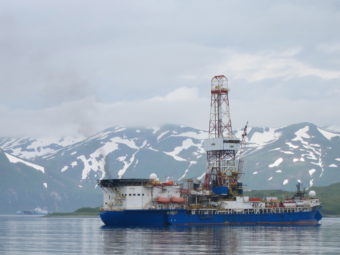
The Noble Discoverer in Unalaska in 2012. (KUCB file photo)

Shell Oil announced late Sunday night that it is abandoning offshore drilling in Alaska “for the foreseeable future.”

The announcement came as the company reported disappointing results at its exploratory well in the Chukchi Sea. The well, called the Burger J site, is about 150 miles from Barrow, in about 150 feet of water. In a statement posted online and emailed to reporters Sunday night, Shell reported that its team had drilled to about 6,800 feet and “found indications of oil and gas,” but not enough to continue exploration at the site.

The company said the decision to end offshore exploration in Alaska reflected those results and the project’s high costs, but also what it called a “challenging and unpredictable federal regulatory environment.”

Shell has spent more than $7 billion on its offshore program in the Arctic.

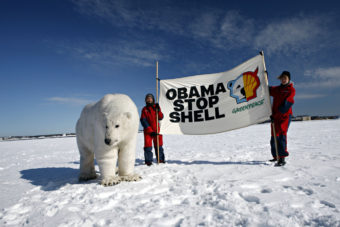
Environmental groups celebrated Shell’s pullout and gave credit to their supporters and activists.

“Whether they took to kayaks or canoes, rappelled from bridges or spread the news in their own communities, millions of people around the world have taken action against Arctic drilling,” Greenpeace USA Executive Director Annie Leonard said in an email sent to reporters. “Today they have made history.”

The announcement comes the day before a key deadline. Shell has to be out of oil-bearing rocks by today. The company must now move its two rigs and a flotilla of support vessels out of the Arctic. The company says the well itself will be sealed and abandoned in accordance with industry regulations.

Women’s traditional chin tattoos are making a comeback in Alaska


More and more Inuit women are getting face tattoos.

The traditional practice dates back centuries but was banned by 19th and 20th-century missionaries. Now it’s coming back. Though the techniques and customs were nearly lost, a new generation is using tattoos to reclaim what it means to be a Native woman in the 21st century.

In the backroom of a small Anchorage tattoo parlor, Maya Sialuk Jacobsen uses a thin needle to pull an inky thread through the skin on her friend’s wrist.

“I use the exit hole as the entrance for the next stitch,” Jacobsen explained, bent over her work as a small crowd observed.

The friend is Holly Mititquq Nordlum, organizer of a weeklong series of tattoo-related events called Tupik-Mi. Compared to the sting of a tattoo gun, the stitches hardly register, and Norldum looks unfazed, greeting and bantering with observers cycling in and out of the cramped room.

“It’s loose,” Nordlum said, nodding at the flesh on her arm. “I put on a few pounds so she’d have something to work with.”

“Her skin is so much better than my husband’s skin,” Jacobsen laughed. “She has really lovely skin to tattoo.”

Maya Sialuk Jacobsen of Greenland gives a henna tattoo to a friend’s chin during an event at the Anchorage Museum, part of the Polar Lab’s Tupik-Mi series on traditional tattoos. (Photo by Zachariah Hughes/KSKA)

Jacobsen is one of the few Inuit women who knows how to give tattoos through traditional methods like sewing and poking in dabs of dye. She’s candid about the fact that the equipment has changed. Instead of whale sinew, she uses cotton thread; rather than coloring with soot, she uses tattoo ink. But much like rifle hunting compared to harpooning, she sees her modern tools simply as superior means towards traditional ends: inscribing the skin with meaningful marks.

Jacobsen has spent years cobbling together a body of knowledge about what the practice meant before Danish colonization in her native Greenland almost three centuries ago.

“There is no short answer,” Jacobsen says, adding, “it’s also a very Western, academic way of thinking.”

Jacobsen’s son Benjamin came with her from Greenland, and shows off self-administered henna designs made of different traditional patterns, but reconfigured. (Photo by Zachariah Hughes/ KSKA)

Outsiders have looked at Inuit tattoos as having legible meanings embedded within stable rituals, like clear markers signifying marriage or adulthood. But not only did those cultural foreigners import concepts of their own–like marriage–but also a sense of fixity to a practice Jacobsen says was much more fluid and interpretive. “I can’t tell you a triangle means an iceberg,” she explained dryly. That’s partly because the historical record is unreliable, but also because symbols were not nearly so firm.”

You can’t understand tattooing, she believes, without understanding the lives of Inuit women.

While working as a tattoo artist in Europe, Jacobsen was diagnosed with fibromyalgia, which made it difficult to wield the heavy, vibrating drill that is the trade’s standard instrument. So she started poking, and from there stitching. But as she tried learning more about how Inuit women had traditionally been marked, the few historical accounts all came from European adventurers and missionaries.

“I assure you, they did not really know what tattooing was,” Jacobsen says with a wry smile.

But then came the mummies. A group of 15th century Inuit women discovered during 1972 at the Qilakitsoq (“little sky”) grave-site in Greenland, preserved tattoos and all. Jacobsen found a book about them, studied the designs, and realized the marks on their foreheads, cheeks, and chins were similar to the tight stitches she’d learned as a girl. It was her first primary source.

“I have, like, literature, and then I have, what I call ‘from the horse’s mouth,’” Jacobsen says, “and that is the mummies.”

Tupik-Mi, Jacobson and Norldum’s project, is part of an effort within the Urban Interventions series in the Anchorage Museum’s Polar Lab.

“Tupik means tattoo,” explained Nordlum, who is Inupiaq, “and then ‘mi’ is a shortened version of muit, which means ‘people.’ In Kotzebue, we say ‘Qikiqtaġrumuit’ which means, ‘We’re the people from Kotzebue.’”

Nordlum was introduced to Jacobsen over Facebook after she couldn’t find anyone to give her a traditional tattoo in Alaska. A friendship blossomed, and they arranged the first in what they hope will be yearly Tupik-Mi events.

In addition to a lecture and live tattooing demonstration, the women also hosted a light explanation of traditional tattoos for high schoolers before letting them apply tube after tube of henna to their appendages.

Nordlum squeezed a tight formation of dots and lines onto the back of an 11th grader’s wrist.

“She’s making my initials with the Inuit designs,” says Ben Hunter-Francis.

The West High junior says he has plenty of time to decide whether or not he’ll get a tattoo. But if he does, he’d like it to be attached to his Yup’ik roots in the Lower-Yukon community of Marshall.

“Just to make my heritage proud, and make my family proud,” Hunter-Francis says, “that I’m connected with my heritage in some way.”

Traditionally, tattooing was the province of women. They were the ones who wore them, and exclusively the ones to administer them. But as Nordlum finished Hunter-Francis’s wrist, she explained that the practice isn’t bound in place by history.

“In modern culture, men getting tattoos is not a rarity. We are contemporary people working in modern times, so although it was a rarity traditionally, now it isn’t,” Nordlum says, not letting up her hold on Hunter-Francis’s arm.

“Culture is not a set thing, it is a living breathing thing that changes as time goes, and we’re just adapting … like skin.”

Holly Mititquq Nordlum shows off her partially complete tattoo during a live demonstration at Anchorage’s Above The Rest studio. Each horizontal line is 40 individual stitch marks through the first layer of skin. Before starting the stitches, Jacobsen poked the basic design of three bird feet rising from the lines. Nordlum’s Inupiaq name, Mititquq, means ‘a place where birds land,’ and she celebrates big life goals with bird feet tattoos, like the two on her opposite wrist, done with a tattoo gun. (Photo by Zachariah Hughes/ KSKA)

If plans go ahead, Tupik-Mi will expand next year to train a handful of Alaskans in traditional tattooing methods. By the third year, the hope is to hold workshops in Canada and Greenland, growing tattooing capacity across the high north.

“The idea,” Nordlum explains, “is for Iñupiaq, Inuit, Yup’ik women to feel proud of who they are. To feel strong. To create a sisterhood. To belong to something bigger than yourself, so that you’re safe and you’re supported by all these other women.”

Nordlum was a few days away from getting lines tattooed on her chin, one of the most visible and common styles across a wide array of indigenous Arctic communities. She says more women in Alaska are opting for chin tattoos, to the point where she brushed off the suggestion it was a bold decision to get one

“I don’t feel very brave here because there’s so many of us,” Nordlum says.

Permanence is part of why tattoos carry so much weight, and Nordlum sees the resurgence in women’s chin tattoos as putting forward a permanent, proud Native identity for all to see.

Jacobsen had her own chin lines laid down by her partner just two months ago. Soon after the process began, she felt a visit from her late mother.

“My mind was just wrapped around all of these thousands of fore-mothers I must have had that had tattoos,” Jacobsen says, her words growing softer. “My heart was beating so hard, and I cried, and I was shaking.”

Four thin lines that would have normally taken a few minutes took hours. “It was definitely very, very emotional,” she says.

Jacobsen is sharing that intimate experience with Nordlum, dot-by-dot, as she pokes a tattoo into her friend’s chin.

Denali Commission faces internal hurdles ahead of threatened villages effort

President Barack Obama meets with Kotzebue residents during his three-day tour of Alaska. (Photo by Eric Keto/Alaska Public Media)
Obama meets with Kotzebue residents during his three-day tour of Alaska. (Photo by Eric Keto/Alaska Public Media)

The profile of the Denali Commission was elevated earlier this month, after President Barack Obama announced during his visit to Alaska that the commission would coordinate the flow of resources to communities threatened by erosion, flooding and permafrost degradation.

The president also announced that the Denali Commission would receive $2 million to begin planning and coordination efforts.

With the money in hand and needing to be allocated by Sept. 30, the Commission is trying to figure out its next steps.

At a public meeting and teleconference on Tuesday, Bob Glascott with the U.S. Army Corps of Engineers suggested that updating existing databases would be helpful, since the most recent information about communities threatened by erosion comes from 2009, and flood maps on file are often more than 40 years old.

“Go out and talk to these communities, find out historically where the impacts have been, look at high water marks in these communities and survey them in – some sort of scope that would allow us to prioritize and figure out, if you have to make a list, and say ‘this is the number one community today with this snapshot’, and kind of go from there,” Glascott said.

Commissioner Julie Kitka, President of the Alaska Federation of Natives, said the Denali Commission needs internal reforms before it can expand to fulfill its new role as the lead agency directing responses to climate change in Alaska.

That includes reinstating a 5 percent cap on the administrative fee that the Denali Commission takes out of any incoming grant money.

“Our number one thing that we could be doing better at the Denali Commission is keeping that cap and keeping accountability on that,” Kitka said. “When that exploded and increased on that, it really weakened our argument for having resources flow through the Denali Commission.”

Kitka also argued for a greater decision-making role for commissioners. Denali Commission Federal Co-Chair Joel Neimeyer was open to the suggestion but admitted that having more meetings may not be enough to tackle the challenges ahead of the Commission.

“If that is what commissioners want, I will work with stakeholders and program partners so that we can get you the information so you can make these choices. But my challenge has been: how do I get you all together for a long period of time to truly appreciate what this issue is?” Neimeyer said. “And I can tell you, I have been looking at this issue now since June, and I’ve spent a lot of time on it, and I am at a loss at trying to figure out how to move forward with the $2 million. I am at a loss at how we engage with our friends at DC.”

The Denali Commission’s new role as a coordinating agency for projects related to coastal erosion, flooding and permafrost degradation will be overseen by the White House’s Arctic Executive Steering Committee, which President Obama created in January.

The next scheduled meeting of the Denali Commission is in November.

Jewell says ‘Keep It in the Ground’ movement simplistic, country too reliant on fossil fuels

The Kulluk is an Arctic drill rig owned by Royal Dutch Shell. In 2012, the rig ran aground off Sitkalidak Island near Kodiak Island. The highly publicized incident was used by drilling opponents as an example of Shell's lack of qualifications to drill in the Arctic. (Photo by Petty Officer 1st Class Sara Francis/U.S. Coast Guard)
The Kulluk is an Arctic drill rig owned by Royal Dutch Shell. In 2012, the rig ran aground off Sitkalidak Island near Kodiak Island. The highly publicized incident was used by drilling opponents as an example of Shell’s lack of qualifications to drill in the Arctic. (Photo by Petty Officer 1st Class Sara Francis/U.S. Coast Guard)

Hundreds of environmental groups are uniting under a new banner to curtail greenhouse gas emissions. It’s called: “Keep It in the Ground.”

They’re asking President Obama to stop new petroleum leases on public lands. Interior Secretary Sally Jewell rejected the idea in a meeting with reporters today.

For decades, Alaska’s congressional delegation has been clamoring for more oil and gas leases on federal land. Now, in a letter to Obama, more than 400 green groups are saying exactly the opposite, that the president should just stop fossil fuel lease.

Iñupiat artist and activist Allison Warden lives in Anchorage but her family hails from the North Slope village of Kaktovik. Warden participated in a rally outside the White House Tuesday morning.

“It’s really exciting,” she said. “It’s a coalition of many organizations that are coming together on one message, which is no new extractions of fossil fuels, anywhere.”

Their letter to Obama says the hydrocarbons produced from federal lands and waters are a significant contributor to the nation’s carbon emissions.

Secretary Jewell, whose first career was as a petroleum engineer, told reporters the administration is dedicated to a lower carbon future by reducing energy use and fostering alternatives. But, she says, the nation is still dependent on oil, gas and coal.

“There are millions of jobs around the country that are dependent on these industries and you can’t just cut it off overnight,” she said.

She says her job, as head of the department that controls one-fifth of the U.S. landmass, and more than half of Alaska, is to ensure thoughtful regulation and development that is safe and responsible.

“I think it over-simplifies a very complex situation to suggest that one could simply cut off leasing or drilling on public lands and solve the issues of climate change,” Jewell said, speaking at a breakfast meeting organized by the Christian Science Monitor.

The “Keep It in the Ground” movement is built on the notion that to reduce greenhouse gas emissions to acceptable limits, a great deal of the world’s known petroleum reserves can never see the inside of a pipeline.

A report published in a scientific journal recently found that burning all the world’s currently attainable fossil fuels would melt the Antarctic ice sheet, putting places such as Florida and the East Coast under water.

Obama’s decision to allow Shell to drill in the Chukchi Sea angered environmental groups. Jewell says the oversight of her department’s Bureau of Safety and Environmental Enforcement is proceeding as planned in the Arctic.

“It has been on site, 24-by-7. It is holding Shell to the highest standards that really have ever been put in place,” she said.

Jewell says Shell voluntarily shut the operation down when a massive storm approached.

“I think they lost about five days because of that, but they are taking the right kinds of precautions to make sure that things are done safely there,” she said. “And our people are up there to validate those circumstances and if need be, asking for additional actions.”

Jewell was also asked about extending Shell’s Chukchi leases, which are set to expire in five years, long before Shell predicts it could begin production from the Chukchi. The secretary said she does have the authority to extend them, but also didn’t say whether she would or not.

In unnerving trend, 35,000 walrus haul out at Point Lay

Thousands of Pacific walrus gather on shore near Point Lay in 2014. (Photo courtesy of Corey Accardo/NOAA)

In what’s becoming an increasingly common sight, tens of thousands of walrus have hauled out on the coast of the Chukchi Sea near the Native Village of Point Lay.

An estimated 35,000 Pacific walrus are currently crowding a barrier island just north of Point Lay, a phenomenon that has become more and more common.

The U.S. Geological Survey, the U.S. Fish and Wildlife Service, and the Native Village of Point Lay hosted a media teleconference last month to offer updates on the haulout and guidelines for the media. Tony Fischbach, a USGS wildlife biologist started off the call with an overview of the issue.

“So the main point here is that this is a new phenomenon of large coastal haulouts forming on the U.S. shores of the Chukchi Sea that has only been seen during years of complete loss of sea ice in the Chukchi Sea.”

The haulouts were first observed in 2007, coinciding with a record sea ice melt in the Arctic, as sea ice extent plummet to 39 percent below average. Female walruses and their young generally spend their summers on the sea ice, foraging in shallower areas for food. But as summer sea ice retreats, walrus are forced to spend summers on shore.

The haulout are concerning both to scientists and those who rely on them for food, as any disturbance can lead to deadly stampedes. Last year an estimated 60 young walruses were killed due to the concentrated haulouts.

Wildlife biologist Jonathan Snyder with Fish and Wildlife Service commended the nearby village for providing a safe place for the animals to haul out.

“I think the fact that walrus continue to haul out near the community of Point Lay year after year is testament of the fact of the great stewardship role that that community has taken. I’d imagine if that were not a safe place the walrus would not keep returning.”

Point Lay is doing its best to keep the walrus safe, but the village frustrated by the media that won’t keep their distance. In conjunction with Fish and Wildlife Service, USGS, and NOAA, the village of Point Lay issued a statement urging the media to keep their distance.

“The community does not have the capacity to house anybody visiting. This is a small community. Our population is only about 246 and it’s a subsistence community.”

Leo Ferreira the III, Tribal Council President of the Native Village of Point Lay, says the media isn’t listening. At least one person has disobeyed the villages’s multiple requests to keep their distance.

Gary Braasch, an environmental photographer, flew over the haulout on August 23rd. While he says he obeyed flight guidelines, a spokesperson for the Fish and Wildlife Service speaking to the Guardian newspaper, says his photos show walruses that appear to be agitated, fleeing the area.

Ferreira vented his frustration at the media.

“It’s very disturbing when you guys disrespect our way of living, disrespect our community and our wishes for the fact that you guys want a story and think you guys can come here and then go rent a boat, rent somebody’s boat and go across and disturb the walruses on your own,” he said. “That’s not permitted. Not even our own people are permitted to go over there and disturb the walruses with a mass haulout like this.”

The community is working with the Federal Aviation Administration to issue notices and guidelines to pilots in the region. Ferreira says resident hunters have also have been reduced or redirected away from the haulout.

With freeze-up not expected until mid-October, the walruses are hunkered down on shore and the community and scientists hope that disturbances are kept to a minimum.

What Would Happen If We Burned Up All Of Earth’s Fossil Fuels?

The Antarctic ice sheet stores more than half of Earth's fresh water. Scientists wondered how much of it would melt if people burned all the fossil fuels on the planet. UPI /Landov
The Antarctic ice sheet stores more than half of Earth’s fresh water. Scientists wondered how much of it would melt if people burned all the fossil fuels on the planet.
UPI /Landov

Scientists today laid out a truly worst-case scenario for global warming — what would happen if we burned the Earth’s entire supply of fossil fuels.

Virtually all of Antarctica’s ice would melt, leading to a 160- to 200-foot sea level rise.

“If we burn it all, we’re going to melt it all,” says Ken Caldeira, a climate scientist at the Carnegie Institution for Science.

The huge Antarctic ice sheet stores more than half of the planet’s fresh water, and Caldeira had long wanted to know how much of that ice would melt if people just kept burning fossil fuels until they’re gone.

“I’ve been wondering about this question for 35 years but was never able to address it,” he says, explaining that ice sheet science has only recently gotten sophisticated enough.

He and some colleagues used an estimate of how much fossil fuel is left in the ground to do computer simulations. They found that if current trends continue, sea level is expected to rise 2 or 3 feet this century.

Then the rate of sea-level rise will start increasing, Caldeira says. “And so we’ll have something like 100 feet of sea-level rise 1,000 years from now, which means basically abandoning most of the major cities of the world.”

He says places such as New York City, London, Paris, Rome, Tokyo and Washington, D.C., would all be under water.

The study appears in the journal Science Advances.

Caldeira believes the world has basically done nothing to address human-made climate change. “So to ask ourselves, well, what would happen if we continue to do nothing, I think, is a valuable exercise,” he says. “It would make a lot of sense for us to really think about transforming our energy system to one that does not use the sky as a waste dump.”

But others say this worst-case scenario does not seem plausible.

“I don’t think there are many people who have thought about it who think we will burn all the fossil fuels on the planet in the next few hundred years,” says Michael Levi, who studies energy policy and climate at the Council on Foreign Relations.

“If you create implausible global scenarios, you get truly horrifying outcomes,” Levi says. “If you create plausible but bad scenarios, you get bad outcomes. That’s not a surprise either.”

This study also contains less-extreme scenarios. Those are the kind that interest Levi, since he says they’re more likely to be ones we might actually face.

Scientists have said they think the West Antarctic ice sheet has already reached a tipping point and that its disintegration is likely unstoppable.

Copyright 2015 NPR. To see more, visit http://www.npr.org/.
Read Original Article – Published SEPTEMBER 11, 2015 4:37 PM ET


Site notifications
Update notification options
Subscribe to notifications