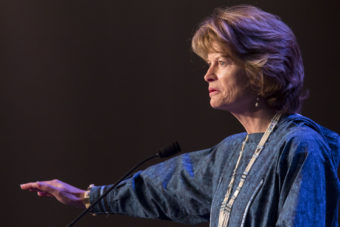
Sen. Lisa Murkowski addresses the Alaska Federation of Natives Convention, Oct. 16, 2015. (Photo by Mikko Wilson/KTOO)
At the Alaska Federation of Natives Convention on Friday, Sen. Lisa Murkowski kept her speech focused on Alaska Native heroes. While Sullivan mostly discussed military veterans, Murkowski emphasized civic and cultural leaders.
She reeled off scores of names — Sidney Huntington, John Baker, Poldine Carlo, Georgianna Lincoln, Rosita Worl, among others. Murkowski recognized leaders in community health, suicide prevention, education, engineering and business, and one pair of exemplary parents.
“These are heroes, each and every day making a difference,” the senator said. “One person, making a difference. One person saying, ‘I can do something to change the direction.’”
Murkowski also endorsed a passionate cause permeating this year’s convention: “My list of heroes includes friends in the Interior and across the state who seek justice for the Fairbanks Four. We will continue with that.”
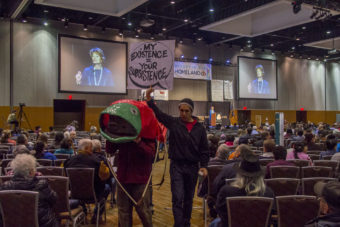
During her speech, a dozen or so demonstrators came in, some in animal costumes. They held subsistence- and climate-related signs, like “Don’t roll the dice with my ice” and “Ichthyophonus is upon us.” (That’s a fish parasite.) They told reporters they were protesting the senator’s support of Arctic drilling.
Murkowski did highlight some of her work in the Senate, including a provision in an education bill that would require school districts and the state to let Native communities weigh in on what and how their children are taught.
Murkowski also spoke of her support of a bill to restore the Voting Rights Act. Last month, she was the first Republican to co-sponsor the Senate bill. According to the congressional bill database, she’s still the only one.
KBBI reporter Daysha Eaton contributed to this story.
Protesters during Sen. Lisa Murkowski’s speech to the Alaska Federation of Natives Convention on Friday. (Photo by Mikko Wilson/KTOO)
During Sen. Lisa Murkowski’s speech at the Alaska Federation of Natives Convention in Anchorage Friday, protesters marched dressed as a salmon, a caribou and a walrus. It was part of an effort to call out Murkowski for her support of Arctic oil drilling. It was the second protest at AFN in two days.
Among the protesters in costume was George Pletnikoff Jr., originally from St. Paul Island, and who now lives in Palmer.
(Photo by Mikko Wilson/KTOO)
“We are here to make a statement that Lisa Murkowski needs to address our demands that we refuse fossil fuel use as continuing it. No drilling in the arctic, no drilling in the National Wildlife Refuge and we must switch towards renewable energies and create a sustainable future.”
Pletnikoff said the protest was organized by members of Alaska Rising Tide and REDOIL, which stands for Resisting Environmental Destruction on Indigenous Lands.
“The walrus said, ‘Eat me, Murkowski, don’t roll the dice with my ice!’”
That’s Faith Gemmill, with REDOIL. AFN officials escorted Gemmill and a protester out after a few minutes.
“We’re losing walrus habitat and their numbers are in decline because of melting ice. We wanted to send her a message that as a decision maker, she can do something to promote and protect indigenous peoples way of life here.”
The senator chairs the Senate’s Energy and Natural Resources Committee. Murkowski said she didn’t hear or see the protest, but she defended her record.
“I challenge people who suggest that my focus is all on development of fossil fuels. Look at what we have been doing to build out renewables not only in this state but from a national perspective. Look at what we’re doing here to encourage microgrids, so that our communities will be sustainable.”
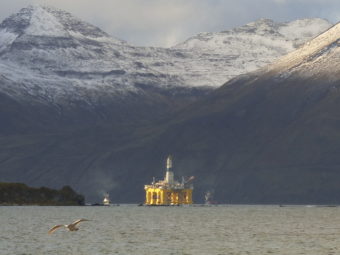
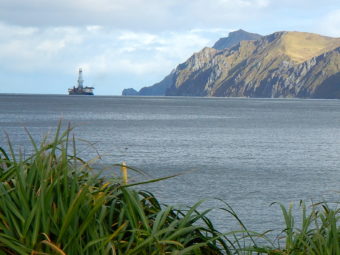
Shell spokeswoman Megan Baldino said the rigs are refueling and making crew changes during their brief stops in Dutch Harbor.
The Noble Discoverer steamed out of Dutch Harbor under its own power Monday afternoon; the Polar Pioneer remained anchored on the far side of Hog Island in Unalaska Bay.
Before this summer’s unsuccessful drilling season, Shell contracted with Seattle’s Foss Maritime to store the rigs at the Port of Seattle in the off-season.
While Baldino said the rigs’ final destinations are still being determined, they will not be returning to Seattle.
Protesters in kayaks as well as city and state officials tried to block Shell from parking at the Port. Last month, a city hearing examiner overturned the mayor of Seattle’s attempt to stop the Port from hosting Shell.
On Monday, King County Superior Court Judge Douglass North ruled against environmental groups that had sued the Port of Seattle over its plan to house the oil rigs. They opposed the project because of its twin risks of spilling oil in the remote Arctic Ocean and fueling runaway global climate change.
While Shell no longer faces legal obstacles to bringing its rigs to Seattle, the company is sending them to other ports in Washington state. The Noble Discoverer is headed to the Port of Everett to offload equipment and supplies. Baldino said the Polar Pioneer, towed by the Ocean Wind and Ocean Wave tugboats, will head to the Port of Port Angeles.
When a single tug towed Shell’s Kulluk oil rig from Dutch Harbor to Everett in 2012, the rig broke free during a winter storm in the Gulf of Alaska. The U.S. Coast Guard had to rescue the Kulluk’s crew by helicopter before the rig ran aground off Kodiak Island. The Kulluk wound up in a scrapyard in Asia.
“We’ve incorporated many, many lessons from our 2012 program,” Baldino said. “Safety is our first priority.”
Baldino said she had no new information to provide on the fate of the 400 employees who worked on the Arctic drilling project in Anchorage. As many as 3,000 Shell contractors were doing fieldwork on the project at any given time this summer.
Shell spent more than $8 billion and nearly a decade looking for oil in the Chukchi Sea, including $1.4 billion this year alone. The company is expected to provide more information on the financial implications of the failed venture when it discusses its third quarter financial results later this month.
Galena school teacher Freda Beasley and her husband Howard are fairly prolific berry pickers, sometimes gathering as much as 20 gallons of blueberries and low bush cranberries in a good year. But to Freda, it seems like the good years are getting fewer and farther between.
“This year and last year, there were no blueberries,” Beasley said.
It turns out that Freda’s not alone when it came to fruitless blueberry searches recently.
“Almost 50 percent of the people that responded said (blueberries) had become more variable – there were bigger swings from one year to the next,” said research wildlife biologist Jerry Hupp with the U.S. Geologic Survey in Anchorage.
“That’s a fairly strong response. The number of people that responded that berries had become more variable was almost twice as high as any other response. So it suggests that, yeah, something may be going on there,” Hupp said.
Along with researchers from the Alaska Native Tribal Health Consortium and the University of Alaska Anchorage, Hupp put out a survey to environmental program managers at tribal groups, asking respondents to identify the berries that are commonly harvested in their area, and indicate whether berry harvests seem to be getting larger, smaller, more unpredictable, or staying the same.
Hupp cautions that the survey does not try to shed light on why berry populations might be rising or falling, but only to document the perceptions of experienced berry pickers.
“Our goal was not so much to understand how climate may be influencing berries–how changes in snow cover or changes in precipitation may be changing berry abundance,” said Hupp. “It was more to simply ask people, ‘Are you seeing changes? Are there things happening on the ground that might indicate that things are different now than they were in previous decades?’”
Ninety-six people from 73 Alaska communities responded. They were specifically asked to compare the berry picking experience of the past 10 years with berry picking before that.
Data from the wild berry survey in the September 2015 edition of the International Journal of Circumpolar Health.
Two berries stand out as both commonly harvested and increasingly variable: low bush blueberries and cloudberries.
The perceived decline of blueberries is most pronounced along the western and northern coasts of Alaska, where 76 percent of respondents experienced lower blueberry harvests or more variability in harvests from year to year. That view was shared by around 50 percent of blueberry pickers in the maritime region of Alaska–ranging from the Aleutians to Southeast–and 40 percent in the Interior.
High bush cranberries and crowberries, on the other hand, stand out as more consistent in their availability.
For each of the 12 berry species included in the survey, only a handful of respondents perceived an increase in berry numbers.
Hupp says that other researchers could build on the survey to learn more about the science behind berry productivity, and get a better sense of how changes in climate might affect berry populations into the future.
“Monitoring studies that would examine relationships between environmental variables and berry productions, or experimental studies that might alter things like snow cover, precipitation, and measure the response of berry species to that,” Hupp said.
Shell’s Polar Pioneer leaving Dutch Harbor on Oct. 12, heading for Washington state. (Photo by John Ryan/KUCB)
When Shell announced it was pulling out of the Arctic “for the foreseeable future,” it surprised just about everyone. Many in Alaska had high hopes for offshore drilling — from an Arctic economic boom to more oil for the trans-Alaska pipeline. Shell’s announcement left the state wondering what to blame—low oil prices? Tough regulations? Better prospects elsewhere?
In other words, is it us? Or is it Shell?
Kara Moriarty heads the Alaska Oil and Gas Association. And she said maybe it’s us.
“I think we have to ask ourselves, why did it take so long?” Moriarty said.
In other words, why did it take seven years from when Shell bid for leases in the Chukchi Sea in 2008, to when it finally drilled its Burger J well this summer?
Moriarty blamed the slow pace of federal permitting and a thicket of regulations.
“We can’t control geology, and we can’t control the company’s decisions,” Moriarty said. “But what we can control, as Alaskans and Americans, is to make sure that we have the right policies in place.”
And, she thinks we don’t. That is also the view of many of Alaska’s elected officials. Sen. Lisa Murkowski called the federal regulatory environment “uncertain, everchanging and continuing to deteriorate,” while Congressman Don Young complained of “insurmountable” hurdles.
But the full story is more complex. Shell declined a request for an interview, but in a statement, the company pointed to three things: first and foremost, the Burger J well itself.
“The killer was the results from the well,” said oil and gas consultant Brad Keithley. If Shell had found the elephant field it was hoping for, red tape probably wouldn’t have been an issue.
But, “with declining cash, with increasing costs, you’ve got to have real blockbuster results to keep yourself in a position to go forward–and they didn’t have that.”
In its statement, Shell said it “found indications of oil and gas” but not enough to justify further exploration. We’ll never know exactly what they found, Keithley said. They’ll keep that information close, and perhaps dust it off five, 10 or 15 years from now, if they ever decide to return.
Another issue Shell cited was what it called a “challenging and unpredictable” regulatory environment.
“I would agree that there was a challenging regulatory environment,” said Lois Epstein, of the Wilderness Society. “But that was absolutely essential.”
She pointed out that many of the regulations Shell faced were put in place after BP’s oil spill in the Gulf of Mexico. After that disaster, she said, it was clear there needed to be more stringent rules for the Arctic, where a clean-up would be much more difficult. But on one point, she agreed.
“The regulations that are in place are appropriate, but they do make things a lot more expensive,” she said.
And that’s the third issue Shell cites – the sheer cost of the project. Over the years, costs and delays added up. The BP oil spill prompted a wholesale reorganization of the federal agencies that oversee offshore drilling. There was litigation challenging the Chukchi Sea leases. Shell finally reached the Arctic in 2012, but wasn’t allowed to drill into oil-bearing rocks because its oil spill containment dome failed during tests in Puget Sound. Then, after the 2012 season, Shell wrecked its drill rig, the Kulluk, off Kodiak while trying to drag it across the Gulf of Alaska in the dead of winter. That put off drilling for another year.
“Shell was down to one hole,” Keithley said. “If there hadn’t been the delays, if things had gone better–frankly if Shell had done some things better—if they had been able to get out there before oil prices collapsed and cash flow fell away, they might have been able to drill more wells, and they might have found that their second or third location was the one with the oil.”
As it was, Shell ended up drilling its first well in 2015, with oil prices hovering around $50 a barrel.
And during the years that Shell spent navigating the challenges of the Arctic, other opportunities had opened up, opportunities that weren’t even on the horizon when the company first bid for the leases. New technology unlocked new, cheaper resources.
“Additional opportunities, like shale, like offshore Brazil, offshore Africa, the Gulf of Mexico, have opened up in a way that have made the Arctic less important in terms of that new frontier,” Keithley said.
Shell’s decision is part of a broader trend. In just the last two years, Chevron and ExxonMobil shelved projects in Canada’s Beaufort Sea. Exploration off Greenland ended in 2012 after disappointing results.
And Shell itself has other balls in the air. It is in the midst of a $70 billion deal to acquire the British company BG Group, which comes with offshore assets in Brazil and a focus on natural gas.
So, is this the end of offshore drilling in Alaska? Keithley said yes, for now.
“Shell put its best foot forward,” he said. “I think the industry is probably uncertain about where to try next.”
Caribou graze on the coastal plain of the Arctic National Wildlife Refuge with the Brooks Range as a backdrop. (Creative Commons photo by USFWS)
Alaska gets close to 2 million visitors a year,and more and more of them are visiting the Arctic Circle and beyond. That’s what a large audience at this week’s Alaska Travel Industry Association convention in Juneau heard during a “Tourism in the Arctic” panel discussion.
Richard Beneville is Nome’s new mayor. He also owns his own tour company, Nome Discovery Tours.
“I’m going into my 24th season,” Beneville said.
He said Nome attracts tourists for many reasons – its sport fishing, hunting, “and birding. Oy gevalt! Birds! A hundred-and-seventy migratory species that come through May 15 to June 15. We just had the cranes go out. You could look out and see 100,000 cranes in different formations. Very exciting.”
Nome usually gets between 8,000 and 9,000 tourists a year, said Beneville. Tourism has remained steady, but there has been a change.
Richard Beneville stands in front of the Nome table at the Alaska Travel Industry Association’s convention at Juneau’s Centennial Hall. (Photo by Lisa Phu/KTOO)
“The first questions used to be about gold and dogs. Now, the questions are about environment, what’s happening with the Bering Strait, how does it look for Nome in the future? So my clients are very aware of what’s going on,” Beneville said.
Next summer, the number of tourists to Nome will go up. The Crystal Serenity will spend 32 days traveling from Seward to New York via the Northwest Passage. The 1,000-passenger ship will make a stop in Nome. The cruise is being advertised as the first luxury ship to travel the Northwest Passage. Fares range from $22,000 to $120,000. It’s fully booked.
The Arctic is hot right now. President and CEO of Explore Fairbanks Deb Hickok said the state has become a prominent player in Arctic discussions, most recently highlighted by President Obama’s visit.
“Alaska, as the only U.S. state included in the Arctic, is now in a special position to leverage opportunities in the Arctic,” Hickok said.
Tandy Wallack, owner of Circumpolar Expeditions, says Arctic communities need more infrastructure to increase tourism and economic development. She cited the relocation of Kaktovic’s runway as an example.
“The present runway is built on the beach so this one is in higher ground, hopefully will help with the fog and more flights will be able to get in and out. Obviously that will allow more visitors to come into the village. But more importantly, additional air service is going to benefit the village,” Wallack said.
Brett Carlson, co-founder of Northern Alaska Tour Company doesn’t necessarily think more infrastructure is needed, especially anything that could turn the Arctic into a Disneyland.
“That’s just not the vision I see for Alaska’s Arctic. I think, generally, the infrastructure is there. The reason you’re going to come to Alaska’s Arctic and the reason Alaska’s Arctic is a continually rare travel experience in the world is it’s so unlike the rest of the world,” Carlson said. “If you wanted all those modern amenities, you could go to thousands of places in the world.”
Explore Fairbanks President and CEO Deb Hickok and Northern Alaska Tour Company’s Brett Carlson during a panel discussion “Tourism in the Arctic.” (Photo by Lisa Phu/KTOO)
Carlson said his company commits to honoring traditional culture when bringing tourists to communities like Anaktuvuk Pass, Barrow and Kotzebue.
“If you can put visitors in someone’s home or in front of somebody in an authentic way where they’re not a tour guide, they’re just a person talking about their life, (it’s) a moving experience,” Carlson said.
Although Carlson admits there’s a struggle between tourism and authenticity.
Richard Beneville isn’t worried about tourism changing Nome, a community of 3,700 residents. He says when the Crystal Serenity unloads its 1,000 passengers, likely in a rotation of smaller groups, Nome will be ready.
“Nome is famous for Iditarod and Nome is famous for throwing a big party for so many people and I want to use that community feel for this ship because without it, it’s not going to work as well as it could,” Beneville said.
As tourism and other industry in Alaska’s Arctic grows, Beneville said he expects more people and more traffic to come through Nome. But he’s confident, Nome will remain Nome.
Close
Update notification options
Subscribe to notifications
Subscribe
Get notifications about news related to the topics you care about. You can unsubscribe anytime.