Arctic

Arctic Native leaders: Paris climate agreement didn’t address indigenous rights

Reggie Joule says the plan to reduce global greenhouse gas emissions that emerged from the Paris climate talks last week didn’t include some very important provisions.

“We were definitely trying to get in the binding part of the agreement the recognition of the rights of indigenous people,” said Joule, mayor of Alaska’s Northwest Arctic Borough. He said it was disappointing that it didn’t make it in.

Joule sat in on the climate talks as an observer with the Inuit Circumpolar Conference, or ICC, which represents Native peoples of northern Alaska, Canada, Greenland and northeast Russia.

The ICC and Saami Council, which represents indigenous peoples of northern Scandinavia and Russia, were among many indigenous rights groups and thousands of other delegates whose main objective was a broad agreement to slow global climate change.

“The rights of indigenous peoples wasn’t one of the major issues of a lot of the countries,” he said.

That’s unfair because the Arctic is suffering rising temperatures and other climate change impacts much faster than the rest of the planet, says Jim Gamble, executive director of the Aleut International Association. The organization represents Natives in the Aleutian Islands and far eastern Russia.

“Any agreement that doesn’t take into account that people live in the Arctic and indigenous people are really on the front lines of this change — that’s a missed opportunity,” Gamble said.

Indigenous people didn’t cause climate change, says Evon Peter, a Gwich’in Athabaskan and University of Alaska-Fairbanks vice chancellor.

“Other observers say it’s ironic that the climate agreement gives indigenous peoples such a small voice,” Peter said, “and yet it assigns a huge role to the mainly wilderness areas in which they live, which would serve as ‘carbon sinks’ to absorb and offset emissions from developed and developing countries.”

Joule says he hopes indigenous peoples will be given greater accord in the next global climate change conference to be held three years from now.

Models show permafrost melting faster than thought

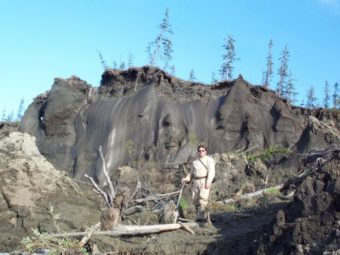
Vladimir Romanovsky
Vladimir Romanovsky in front of huge ice wedges in permafrost on an Arctic riverbank. (Photo courtesy Sergey Davydov)

For years researchers studying permafrost in the Arctic have seen a warming trend. Now scientists at the University of Alaska Fairbanks say it is happening even faster than expected.

Vladimir Romanovsky heads up the Permafrost Laboratory at the University of Alaska Fairbanks’ Geophysical Institute. Based on three decades of study he says the trend is more dramatic than previously thought.

“Even on the North Slope the summer thaw is increasing. We’re getting pretty close to that threshold of beginning of thawed permafrost.”

Romanovsky and his team, drew data from several models, as well as their own on-the-ground observations. They entered them into a special permafrost model. From that they developed two scenarios. One projects the consequences of modest reductions in global CO2 emissions. In that scenario, the resulting thaw is largely confined to the North Slope’s Brook’s Range.

The second scenario assumes today’s CO2 emission rates continue. In that case, more than half of the permafrost on the North Slope and Coastal Plain would be thawed by next century. Romanovsky says as ice-rich soils melt, the thawing will be dramatic to ecosystems and infrastructure.

“At one place you can have, like, half-meter settlement and another, just a few meters from that, almost none. And that’s the most dangerous for infrastructure because the surfaces become very uneven.”

Romanovsky’s findings were reported last week at the fall meeting of the American Geophysical Union.

Shell seeks to extend drilling rights off Alaska

A Shell station in Anchorage after a fall snow storm. (Photo by John Ryan/KUCB)

Despite its decision to abandon offshore drilling in Alaska this fall, Shell still has its eye on the Arctic.

The company filed an appeal on Tuesday, asking the federal government to reconsider extending its drilling rights in the Chukchi and Beaufort Seas, which are set to expire by 2020.

In October, the Interior Department’s Bureau of Safety and Environmental Enforcement turned down Shell’s request to extend its leases in the region (the Department also turned down a request from the Norwegian oil company Statoil). The Bureau said Shell had not laid out specific plans for further exploration, a requirement for extensions.

Shell bought its leases starting nearly a decade ago, but only managed to drill one full exploratory well this past summer, which came up dry. The company argued its efforts were delayed by forces outside its control, including regulatory restrictions and court challenges.

In a statement issued today, Shell said those arguments stand.

But that doesn’t mean Alaskans should expect the company to return any time soon. In that same statement, the company wrote, “The appeal does not change our recent decision to stop exploration offshore Alaska for the foreseeable future.”

NOAA report outlines impacts of warming Arctic

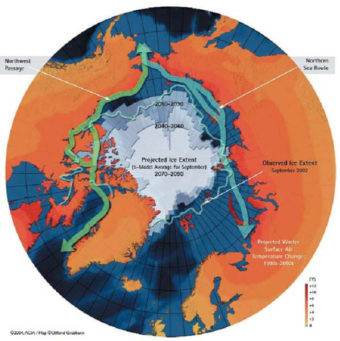
The National Oceanic and Atmospheric Administration on Tuesday released its annual Arctic Report Card, covering everything from rising temperatures on land and sea to sea ice declines and its impact on Arctic ecosystems and the rest of the world.

Since the beginning of the 20th century, the report finds surface air temperatures in the Arctic have increased by 5.2 degrees Fahrenheit.

Jackie Richter-Menge is with the Army Corps of Engineer’s Cold Regions Research and Engineering lab. She says half of that warming has happened in the last three decades.

“Between October 2014 and September 2015, the Arctic-wide annual average surface air temperature over the region was 1.3 degrees centigrade – or 2.3 degrees Fahrenheit – above the 1981-2010 baseline average,” Richter-Menge said.

That’s the highest annual average temperature in the observational record since it began in 1900.

Generally, Richter-Menge says air temperatures in all seasons were above average in the Arctic this year, with some reaching 5.4 degrees Fahrenheit above the baseline.

She says it was also an interesting year for sea ice, and the changes correlate strongly to the increasing air temperatures.

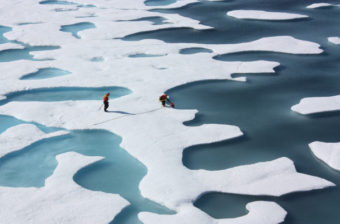
“In February 2015, the lowest-ever maximum ice extent in the satellite record – which begins in 1979 – occurred on the 25th of February,” Richter-Menge said. “This was 15 days earlier than average.”

And that record-low maximum was capped off with the 4th-lowest sea ice minimum on record in September 2015.

Along with declining sea ice, Richter-Menge says the composition of the sea ice has changed dramatically over the last few decades.

“In February and March, the oldest ice – defined as being greater than 4-years-old – made up 3 percent of the ice cover, while new first-year ice made up 70 percent of the ice pack,” Richter-Menge said. “Thirty years ago, in 1985, the composition of the ice cover was much different. Twenty percent of the ice pack was over 4-years-old and only 35 percent was classified as first-year ice.”

She says these observations confirm a trend toward a thinner, more vulnerable ice pack.

The ice pack isn’t the only thing made vulnerable by a warming climate. According to Kit Kovacs, with the Norwegian Polar Institute, marine mammals are greatly impacted – particularly walrus populations, which are hauling out on land rather than sea ice as they follow the retreating sea ice edge.

“This new haulout behavior is raising concerns about the well-being of females and their young that must now make a 180 km — that is 110 miles — feeding trips each direction from coastal haul-outs to areas of high prey abundance, rather than simply utilizing nearby ice edges as they did in the past,” she said.

Kovacs says fish populations are also changing in places like the Barents Sea – north of Scandinavia – where rising ocean temperatures are attracting fish species normally found in warmer waters, displacing cold-water, Arctic species.

Impacts are not limited to marine habitats. Martin Jeffries, an adviser for the U.S. Office of Naval Research, says the warming Arctic is resulting in lower snow pack coverage in May and June, and increasing water discharges from Arctic rivers.

“In 2014, the year for which we have the most-recent complete record, the combined discharge of the eight largest Arctic rivers was 10 percent greater than the average of 1980-1989,” Jeffries said.

The report says the changes recorded over the last few decades are clearly evident. And combined with projections of continued warming temperatures, we can expect to see further change throughout the Arctic in the future.

Murkowski declares ANWR wilderness bill ‘dead on arrival’

Pond on ANWR coastal plain. (Photo courtesy of U.S. Fish and Wildlife Service)

Two Democratic U.S. senators have introduced a bill to designate parts of the Arctic National Wildlife Refuge as a permanent wilderness area.

The bill prompted immediate outrage from Alaska Senators Dan Sullivan and Lisa Murkowski, both Republicans, who want parts of the refuge opened up to oil and gas drilling. In a statement, Murkowski declared the bill “dead on arrival.”

The legislation, from Senators Edward Markey of Massachusetts and Michael Bennett of Colorado, would protect the refuge’s coastal plain, along the Arctic Ocean. It has the support of 33 Democrats, along with Independent Bernie Sanders.

But that is nowhere near enough to pass the Republican-controlled Senate.

Similar bills to turn the coastal plain into wilderness have been introduced in every Congress for decades. And earlier this year, the Obama Administration formally recommended wilderness designation for an even larger swath of the refuge. But that proposal requires congressional action to take effect.

Alaska holding out against emission-cutting policies

The Arctic is on the front lines of climate change. Alaska is warming at twice as fast as the rest of the planet. Some of the most visible impacts are in Native communities located on barrier islands in Northwest Alaska. These communities are facing a future without the ice that used to protect them from storms that threatened to wipe them away. A group called Alaska Common Ground hosted an all-day forum in Anchorage over the weekend to answer the question, “What are we doing about it?”

The answer: not much, yet.

The community of Kivalina, Alaska. (Photo by Coast Guard Lt. Cdr. Micheal McNeil)

Studies recommended relocating villages like Newtok, Kivalina and Shishmaref. But more than 10 years later they are still there, with waves getting higher and storms getting stronger. Part of the reason is that emergency programs don’t finance this kind of ongoing situation and erosion.

That’s left people like Mike Black with the Alaska Native Tribal Health Consortium trying to engineer patches to keep communities functioning as the ground turns to jelly or melts out from under them.

One of the solutions is to cool the foundations. That used to be done with passive systems developed for the pipeline, which enables cold air from the surface to sink down into the ground to keep the permafrost frozen. Now that air is too warm to do the job and engineers are forced to use energy to refrigerate the foundations.

“Refrigeration can work in the summertime extremely well when you’re using solar panels because we have constant sun. So in that way it’s kind of an elegant solution. But the reality is you can only protect some relatively limited spots the rest of the community often times will have to suffer from the melting of that permafrost,” Black said.

To cope with heaving ground, engineers are also abandoning metal pipes for flexible plastic ones to take water and sewage away from village homes. Black sees this as a stopgap measure. He and others want to design more mobile structures and systems that will allow small Alaska communities to move as the water rises and ground sinks in the warming Arctic.

One solution to slow the warming is to reduce methane and carbon dioxide emissions. That’s where taxing carbon comes in making oil and other fossil fuels more expensive to use. Many west coast governments are working to reduce emissions and have imposed various kinds of carbon taxes. Alaska remains a holdout.

Former Department of Environmental Conservation commissioner Bill Ross says Alaska needs to adopt some type of emissions tax because it will be good for the economy as well as the planet. He points to the economic impact of the places that have adopted carbon taxes.

“The number of green jobs is growing twice as fast as regular jobs in those economies. So even though they are moving aggressively to reduce carbon emission their economies are thriving compared to anyone else that is their peers,” Ross said.

He suggests using the Permanent Fund to pave the transition away from oil. A lot would need to change in the state to make that happen… including Alaskans’ attitudes toward taxes. But even simple things remain undone… like removing regulations that make it hard for state departments to borrow money to make buildings tighter and more energy efficient.

Larry Merculieff with the Alaska Native Science Commission says there is no time to waste. Native elders he works with say there’s no climate change, but instead a climate crisis. They say everything will warm up much faster than anyone predicts and that people need to act now.

“The elders certainly are unanimous about this in all the regions and I’m talking about not just older people. I’m talking about elders who are tradition bearers and have wisdom recognized by the community,” Merculieff said.

To underscore the magnitude of change that needs to be made, Merculieff quoted Albert Einstein, who said you can’t solve the problems that face humanity with the same consciousness that created those problems.

Site notifications
Update notification options
Subscribe to notifications