Arctic

In The Arctic Circle, The Sun Will Come Up After 58 Tomorrows

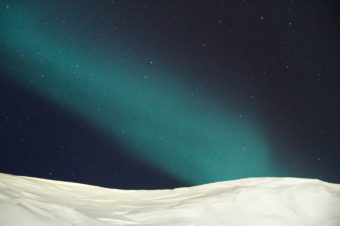
The Northern Lights over the town of Ittoqqortoormiit, Greenland — about 400 miles north of the Arctic Circle. Rebecca Hersher/NPR
The Northern Lights over the town of Ittoqqortoormiit, Greenland — about 400 miles north of the Arctic Circle.
Rebecca Hersher/NPR

On Nov. 24, the sun set in the tiny Greenlandic town of Ittoqqortoormiit. When I arrived in mid-January, it had yet to rise again.

Even for Greenland, Ittoqqortoormiit is isolated. It’s considerably colder and darker than the capital, Nuuk.

“I remember my first Christmas on the west coast [of Greenland],” says Mette Barselajsen, who was born here and is raising her four kids in town. “I remember I was surprised we had the sun at Christmas. Like, too light!”

But Barselajsen insists there are no particular tricks for dealing with the dark. It’s just a normal part of life.

There must be something, though, to keep a person happy without the sun. Right?

Barselajsen smiles. “I haven’t seen them,” she begins. “But I heard you can buy a lamp.” She’s talking about lamps that are supposed to provide something close to natural daylight, and she’s making fun of them.

“We will not have it,” she says, laughing. “It will be like, why should we stare at it? We don’t need that.”

That’s pretty much the local mindset: How do we deal with it? We just do! Polar people don’t mind!

Barselajsen acknowledges it can be depressing, especially for people who weren’t born here. “I think it is very hard for them,” she says. Especially in December.

“You will bring your children to school in the dark, work in the dark, pick them up in the dark,” she says.

Being outside is a big part of life here, and an important part of the normal rhythms of the town. Even in the darkest, coldest part of December, the town gathers outside to celebrate the Advent and light a Christmas tree flown in from Iceland or Denmark.

A few days before the sun is due to rise, the moon is pink at noon. It’s reflecting the red light of the sun, now just a few degrees below the horizon. I go to the only store, looking for something to eat. Bananas are $9 each. The milk is past its sell-by date. I buy some peanuts for $2.50 and leave. Resupply ships can make it into the fiord only twice a year, between July and September. Most food spends the long winter in deep freeze. Inevitably, June finds the shelves mostly bare.

But the meat is fresh all year round. The snowy expanses around Ittoqqortoormiit are home to musk ox, polar bears, narwhals, walruses, sea birds and seals. Even before the sun returns, 60-year-old Isak Pike takes his dog team out.

In the dark months, some hunters leave the dogs and walk out onto the frozen ocean, lone figures against an endless white backdrop, looking for the breathing holes of seals. I see them in the early morning, standing motionless with their rifles, staring down through the ice.

As the sun prepares to rise again in late January, the hunters and the polar bears both move out toward the open ocean. The day before the sun is supposed to rise in Ittoqqortoormiit, the town is full of barking as hunters load up their sleds and head out onto the ice.

And then, it’s Jan. 20: the first sunrise in 58 days.

Just before noon, all the kids in town put on their snowsuits and mittens, and climb up a nearby hill. The younger ones are carrying cardboard cutouts of the sun, decorated with marker and construction paper.

At the top of the hill, they gather in a circle and sing a song for the sun. The lyrics go, “Welcome back, my dear friend. Welcome back the sun.”

From this day on, each day will have 15 minutes more sunlight than the last. In two short months, the days will be 12 hours long. Ittoqqortoormiit and the rest of the Arctic are speeding away from complete darkness toward endless daylight.

Rebecca Hersher is reporting from Greenland as NPR’s Above the Fray Fellow, which is sponsored by the John Alexander Project.

Copyright 2016 NPR. To see more, visit http://www.npr.org/.
Read original article – January 25, 2016 4:31 PM ET


Prosperity, mitigating climate change effects covered in Arctic conference

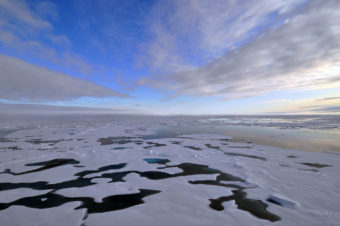
The clouds begin to thin over the Arctic Ocean Aug. 19, 2009.
The clouds begin to thin over the Arctic Ocean Aug. 19, 2009. (Public Domain photo by USGS)

Alaskans participated in a Seattle conference over the weekend that focused on Arctic development and climate change.

The Arctic Encounter Symposium also touched on such issues as Arctic security and politics, transportation and shipping, and environmental protections.

Lt. Gov. Byron Mallott said discussions focused on weather and climate issues, moving villages, building ports, and improving water and sewer infrastructure.

Mallott said the concept of building Arctic prosperity really resonated with him during one of the presentations.

“We need to have the opportunity for prosperity wherever Alaskans live,” Mallott said. “Because as Alaska faces a fiscal reality that it does and the Legislature having to act in the 2016 session to close out an almost $4 billion budget gap, it just reminds us again that the opportunity for prosperity in Alaska is at an absolutely critical juncture. The actions that the Alaska Legislature takes during this session will, in many ways I believe, determine Alaska’s opportunity for prosperity at least for the next quarter century.”

Lt. Governor Byron Mallott talks about his participation at the Arctic Encounter Symposium.


Mallott said his own presentation would focus on what could be done once the State of Alaska achieves financial stability.

Also scheduled to attend the third annual Arctic Encounter Symposium were Bethel Rep. Bob Herron, Anchorage Sen. Lesil McGuire, Craig Fleener, the Walker Administration’s Arctic policy advisr, and U.S. Sen. Lisa Murkowski.

Alaskans fly south for Arctic symposium

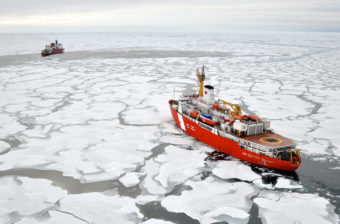
The Canadian Coast Guard Ship Louis S. St-Laurent makes an approach to the Coast Guard Cutter Healy in the Arctic Ocean. (Photo by Patrick Kelley/U.S. Coast Guard)

The University of Washington School of Law is hosting policymakers from Alaska and around the country for discussions on Arctic security and politics, development, transportation and shipping, environmental protection, and climate change.

The third annual Arctic Encounter Symposium runs Friday through Saturday in Seattle.

Elected Alaska officials, academics, municipal and Native corporation representatives, and some of the Coast Guard’s top officers are expected to attend.

Bethel Rep. Bob Herron is part of a panel that will discuss development of a port system, and improving communications and mapping of the Arctic. He said they’ll also talk about reducing heating costs, developing adequate water and sewer systems for Arctic communities, and responding to the effects of climate change.

“I think that we have to remind them that maybe we are the best to be deeply involved, and not to take us for granted,” Herron said.

Lt. Gov. Byron Mallott, Anchorage Sen. Lesil McGuire and Craig Fleener, the Walker administration’s Arctic policy adviser, are some of the other Alaskans participating in panel discussions or addressing the conference.

Herron is attending again this year in his role as chair of the House Economic Development, Tourism & Arctic Policy Committee. He admits to being annoyed whenever he hears comments from nonresidents that imply that Alaska needs saving from Alaskans.

“We’re not someone’s convenient snow globe so they can look inside the snow globe and see all these little fur-clothed, subsistence people living in a zoo, in a museum, in an environment where they must protect it,” Herron said. “There’s a couple times where I’ve felt that I’ve been patted on the head and they’ve said, ‘Don’t worry. We’ll take care of you.'”

Alaska Sen. Lisa Murkowski and Washington Sen. Maria Cantwell, co-chair and ranking member of the Senate Energy and Natural Resources Committee respectively, will also attend the symposium.

Herron said it’s good that the symposium is being held in Seattle this year.

“We’ve got to bridge this Pacific Northwest, western Canada future,” Herron said. “You can’t separate Alaska from the Arctic. You can’t separate Alaska from our Canadian neighbors. And, even though we’re not directly connected to the Pacific Northwest, we still have all that history.”

Temperatures up by 50 Degrees at North Pole

On July 12, 2011, crew from the U.S. Coast Guard Cutter Healy retrieved a canister dropped by parachute from a C-130, which brought supplies for some mid-mission fixes. The ICESCAPE mission, or "Impacts of Climate on Ecosystems and Chemistry of the Arctic Pacific Environment," is a NASA shipborne investigation to study how changing conditions in the Arctic affect the ocean's chemistry and ecosystems. The bulk of the research took place in the Beaufort and Chukchi seas in summer 2010 and 2011. (photo by Kathryn Hansen/NASA)
Crew from the U.S. Coast Guard Cutter Healy retrieve a canister dropped by parachute, which brought supplies for some mid-mission fixes. (Photo by Kathryn Hansen/NASA)

The North Pole is melting. Or so say many news outlets. But Walt Meier, a research scientist for NASA and a co-author of the National Oceanic and Atmospheric Administration’s 2015 Arctic Report Card on Sea Ice, says that’s not quite accurate.

“I’ve seen stories on that, and they’re kind of misleading,” Meier said.

Meier explains that what’s actually happening is a strong low pressure over Iceland is funneling warm air up into the Arctic and toward the North Pole, resulting in air temperatures slightly above freezing.

While Meier does say that much of the media’s coverage about the melting at the North Pole is overblown, temperatures are generally much lower this time of year.

“You’re normally at -20, -30 degrees Celsius up at the North Pole at this time of year,” Meier explains, “so that’s a really anomalously warm weather system that’s moving through there.”

Although there aren’t records that show how often something like this has happened in the past, there are records that indicate a warming climate.

According to both NASA and NOAA scientists, 2014 was the warmest year since 1880, and 2015 is on track to be even warmer. While the rest of the world has warmed by an average of 1.4 degrees Fahrenheit, the Arctic has warmed by twice as much.

Despite a history of rising temperatures and an anomaly of warm air funneling up from Iceland, Meier clarifies that the North Pole hasn’t turned to slush quite yet.

“When you have temperatures like that, you would have some surface melt, but you know it’s still ice covered,” he said.

Meier says there’s probably still 6 to 8 feet of ice at the pole.

The low pressure causing the spike in temperatures at the North Pole is the same weather system that recently led to blizzards in the southwest, tornadoes in Texas and flooding in the Midwest.

The system is expected to move off the pole by next week, bringing temperatures back down to the normal -25 degrees Celsius.

Russian icebreaker makes record-setting Arctic voyage

This projection shows Arctic sea ice coverage will substantially decrease by 2070. (Image courtesy of the University of Arctic Council)
This projection shows Arctic sea ice coverage will substantially decrease by 2070. (Image courtesy of Arctic Council)

According to the Russian media outlet Port News, a Russian icebreaker has just completed the fastest transit of the Northern Sea Route. Along with setting the speed record, the icebreaker also completed the trip over a month after the shipping season usually ends in the Arctic. But it’s still a long way off from becoming the next great trade route.

The Northern Sea Route runs along Russia’s Arctic coast from the Barents Sea in the west to the Bering Strait in the east.

The Vaygach, a nuclear-powered icebreaker, took just seven and a half days, or one hundred and 85 hours to be exact, to complete the trip. It left from the Siberian side of the Bering Strait Dec. 17, covering over 2,200 nautical miles before reaching its destination in the White Sea on the 25th.

Statistics do show a handful of other trips taking fewer than eight days, so it’s not the speed that’s most impressive, but the time of year it took place. According to statistics from the Northern Sea Route Information Office, the last three shipping seasons wrapped up in mid-November. The Vaygach started its trip in mid-December, completing the record-breaking journey on Christmas Day.

Walt Meier, a research scientist for NASA and co-author of NOAA’s 2015 Arctic Report Card on Sea Ice says the successful transit is a sign of changing ice conditions in the Arctic.

“You know, doing it this late in the year, is pretty unusual and is an indication that the ice is pretty thin, you know they have confidence that they can get through without too much trouble,” Meier says.

That confidence was showcased at an international Arctic forum in St. Petersburg in early December, where Russia’s deputy Prime Minister Dmitry Rogozin said the Northern Sea Route could soon be operational year-round. But despite the record transit and the proclaimed potential of the route, Andreas Østhagen a senior fellow at the Arctic Institute’s, doesn’t think this is this start of an Arctic boom.

“When I read this story, though initially, I’m assuming that what they’re doing, and by ‘they’ I mean the Russian authorities, is just highlighting the capabilities they have,” Østhagen says.

Those capabilities include the largest fleet of icebreakers in the world, with more than Norway, Canada, Demark and the U.S. combined. While Russia’s unmatched fleet allows them to offer more escorts and assistance along their Arctic coastline, it hasn’t exactly attracted to more international traffic.

The number of vessels that traveled the full-length of the route dropped from more than 70 in 2013 to less than 20 in 2015. The amount cargo transported dropped even more dramatically by about 97 percent in just two years.

So what can explain all this? Østhagen says, among other factors, the recent plunge in oil prices means the shorter route is just less attractive to international traffic.

“And then you have the incidents in Ukraine in 2014 naturally hampering the operational environment, maybe not directly, but at least indirectly. The business climate for Russian collaboration in the Northern Sea Route was damaged to some extent,” Østhagen says.

Despite persisting political tensions, there is one type of traffic that has been on the rise: Destinational traffic, or intra-transits as Østhagen describes them.

“When you look at the numbers for this year, I think it’s quite obvious that what is taking place in the northern sea route is intra-transits, so transits with a destination in the Northern Sea Route itself,” Østhagen says.

Russia granted over 700 permits for vessels traveling along the route, a number that has steadily risen over the past few years. The amount of cargo is also up, nearly doubling between 2013 and 2015.

So what’s next for the Northern Sea Route? While it’s hard to predict how the political climate may shift, NASA’s Meier says the changing climate in the Arctic is leading to thinner ice.

“And as the ice is thinner, it’s more easily blown by the winds as well, so it can more easily move away from the coast,” Meier says.

With any luck the right winds, the Northern Sea Route will be back open for business in June of next year.

Conoco withdraws from Russian Arctic

American oil titan ConocoPhillips has sold its 50 percent stake in the Polar Lights drilling project in the Russian Arctic, according to Russian news media. The sale marks Conoco’s complete exit from Russia.

The Polar Lights project is located on tundra adjacent to the Barents Sea in Northwest Russia. When the project first came on line in 1992, production was around 14 million barrels a year. But similar to Alaska’s North Slope, production has declined substantially since then.

According to analysts cited by the Financial Times, Conoco’s withdrawal was the result of falling oil prices, a string of poor investments, and the opportunity for development closer to home in the North American shale boom.

Site notifications
Update notification options
Subscribe to notifications