Arctic

Lawmakers eye earnings of rural energy endowment to fund state budget

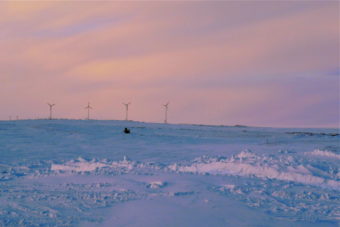
Wind turbines in Chevak
These four wind turbines in Chevak, pictured in March 2012, provide some renewable electricity to the village, but residents still pay high rates. (Creative Commons photo by Joseph)

Rural Alaskans can pay three to five times more for electricity than those in urban areas. That’s why the state launched the Power Cost Equalization Endowment Fund in 2000. It’s paid roughly $40 million annually to subsidize rural energy bills.

But some are questioning if the fund, now worth $900 million, should be committed to benefit only about one in nine Alaskans.
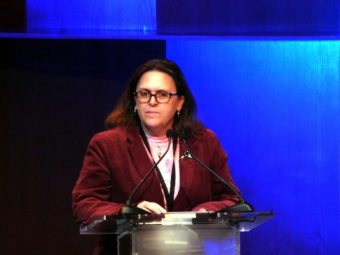
Senate Finance Committee Co-Chairpeople Anna MacKinnon and Pete Kelly discuss the budget. (Photo by Andrew Kitchenman)
Senate Finance Committee Co-Chairwoman Anna MacKinnon alongside Sen. Pete Kelly. (Photo by Andrew Kitchenman/KTOO)

Senate Finance Committee Co-Chairwoman Anna MacKinnon, an Eagle River Republican, said the state government could consider tapping the fund.

“You’ll see Power Cost Equalization come before us. There’s a billion dollars in that fund,” she said. “That billion dollars has been benefiting a selected group of Alaskans with Power Cost Equalization. But is that the highest and best use of those dollars now?”

MacKinnon is a sponsor of Senate Bill 196, which would rebudget fund earnings for other purposes. In years where fund earnings are greater than what’s needed for the Power Cost Equalization program, 60 percent of the excess earnings would go to the state government, 30 percent would go to renewable energy projects, and 10 percent would build up the endowment.

The fund lost money this year, so no excess money is available. It’s not clear whether MacKinnon and other lawmakers are looking beyond Senate Bill 196, to use the fund itself to help close the state’s budget shortfall.

Bethel Democratic Sen. Lyman Hoffman – another sponsor of the bill – sees Senate Bill 196 as a way to protect the fund’s principal while helping the state.

“So what we’re trying to do with this bill is to assure that during those high years, the fund only pay for its intended purpose – and if there are excess earnings, that those earnings be sent back to two different programs,” Hoffman said.

Rep. Bob Herron, another Bethel Democrat, said power cost equalization is fair to rural residents. He notes the endowment was started after the government paid for dams that provide power to cities.

Gov. Bill Walker wants to make sure that if changes are made to the fund, they’re considered along with his plan to close the budget shortfall. He wants to ensure everyone in the state shares the burden.

Walker expressed concern that the combined impact of Power Cost Equalization changes with Permanent Fund dividend changes would put too much of the burden on rural Alaskans.

“That’s why we have focused on a sustainable plan that is a broad-based plan, so that we take into consideration rural Alaska’s situation, which is unique versus urban Alaska,” Walker said. “We’ve tried to take all of that into consideration. That’s why one piece at a time doesn’t really work.”

The Senate Finance Committee heard testimony supporting Senate Bill 196 on Wednesday, but didn’t vote on the bill.

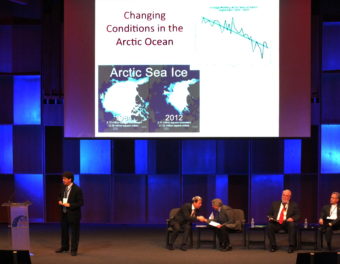
Scientists, policymakers converge in Fairbanks for Arctic Science Summit Week

Julia Gourley
Julia Gourley is the United States’ senior Arctic official on the Arctic Council. (Photo by Matt Miller/KTOO)

Hotels are booked up solid in Fairbanks this week, and rental cars are hard to find. Over a thousand people from 30 countries are in the Golden Heart City for a meeting of Arctic scientists and policymakers called Arctic Science Summit Week.

One highlight is a meeting of the Arctic Council, a multinational governmental forum created to address the Arctic’s pressing issues.

“Good public policy, including good foreign policy, which is the main work of the Arctic Council, must be based on facts on the ground, which is to say it must be based in reality,” said Julia Gourley, the United States’ senior Arctic official on the Arctic Council.
Gourley said they rely on good, solid science to tell them what is really happening in the Arctic. That science helps shape their recommendations that go to key policymakers in various Arctic nations.

It’s not just environmental science. Gourley said the Arctic Council recently heard about the latest in social science on the economy of the north, living conditions and human development.

“These kinds of social science studies, which have shaped the Arctic Council agenda over the years, really have contributed much to how we decide what we’re going to work on in the council,” she said. “And the social science work in particular has contributed to very real topics in the council such as mental wellness and suicide prevention, reindeer husbandry, the role of salmon as a key food source for the Arctic people, and other sociological aspects of living in the Arctic.”

The Arctic Council includes representatives from eight Arctic member nations and six permanent participant delegations from various indigenous groups. The permanent participants can provide input and advise the council on policy issues. But they do not have a vote.

The Arctic Council’s recommendations aren’t binding on participating governments.

There are nearly two dozen observers from other European and Asian countries, and intergovernmental and nongovernmental organizations who are also allowed to sit in on council meetings.

“I would argue that with the Arctic Council there’s a lot more dialogue going on with the nations that are engaged in Arctic dialogue than perhaps anywhere else,” said University of Alaska Fairbanks Vice Chancellor Mike Sfraga.

He’s leading the creation of a new Center for Arctic Policy Studies. Sfraga said the Arctic Council’s work does not seem to be colored by other worldwide conflicts and disputes like Crimea and Syria.

“There are personal relationships, there are nation relationships that still have yet to be damaged by other international issues going on,” he said. “The tensions are there. But in the north there seems to just be a very different dynamic, and it is driven — of course — by resource development. But it is also driven by the fact that we have people reliant on the land, it’s a place where we have traditionally cooperated before, and there just seems to be a willingness in the Arctic Council, a consensus-building body, that we will leave the Arctic alone, as much as you can, from other international dynamics.”

The Arctic Council started its three-day meeting behind closed doors Tuesday at UAF.

Also Tuesday, the Model Arctic Council wrapped up a seven-day meeting. Over 60 students from 13 countries crafted position papers and drafted policy recommendations on cruise ship tourism, managing maritime traffic in the Arctic, improving access to running water and sewer, and reducing suicide among various indigenous groups. Model Arctic Council members were surprised when they learned that their final paper, called the Fairbanks Declaration, will become the starting point for discussions among Arctic Council members next year.

The Arctic Science Summit Week also includes hundreds of scientists from around the world who are coordinating research on the effects of climate change on the rapidly changing Arctic.

BLM director visits North Slope to cap wells, transfer lands

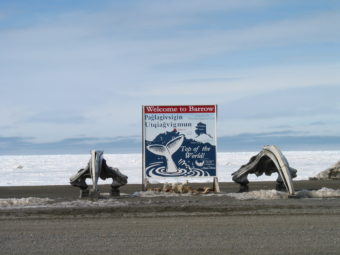
The welcome sign in Barrow, Alaska. (Creative Commons photo by Bob Johnston)

The director of the Bureau of Land Management is visiting the North Slope this week. Over the next two days, Director Neil Kornze will meet with Native corporations, local government officials, and community leaders in the region.

On Tuesday, Kornze helped cap two cores south of Barrow. The Simpson Core and Iko Bay were both drilled by the U.S. Navy in the 1950s. They’re among 18 legacy wells the BLM plans to clean up this year.

The director will travel to Wainwright to finalize the transfer of 1,500 acres of federal land to the Olgoonik Corporation. According to the BLM, the land was used by the Department of Defense for national defense purposes. The land is being sold to Olgoonik to support future economic development.

The trip is part of the BLM’s effort to focus on Arctic issues. This is Director Kornze’s fifth visit to Alaska’s North Slope.

Senate cuts $63 million more from budget than House

The Senate voted 16-4 Monday on a state government budget that goes $63 million deeper in cuts than the House budget.

That’s mainly because the Senate voted for $100 million in executive branch cuts that aren’t allocated.

Sen. Pete Kelly, R-Fairbanks, wraps up the discussion on the state operating budget shortly before it was passed out of the Senate, March 14, 2016. (Photo by Skip Gray/360 North)
Sen. Pete Kelly, R-Fairbanks, wraps up the discussion on the state operating budget shortly before it was passed out of the Senate. (Photo by Skip Gray/360 North)

Fairbanks Republican Sen. Pete Kelly said the Legislature can work out the specifics before the end of the session.

“This $100 million was mostly recognition of those kinds of structural changes — Medicaid reform is a pretty good example,” Kelly said. “Somewhere in the neighborhood of $31 million this year and … over $100 million each year after that.”

Before the vote, minority caucus Democrats proposed an amendment to eliminate the unallocated cut.

They also proposed restoring money for several different programs, including Permanent Fund inflation proofing, senior benefits and prekindergarten. They wanted to pay for some of these programs by reducing spending through cuts to oil and gas tax credits, and reducing spending on several stalled infrastructure projects.

All of the amendments failed.

Anchorage Democratic Sen. Berta Gardner said the state can afford to fund the education measures she included in one amendment.

“This amendment chooses education and Alaska’s children over projects that may once have been a great idea but that we simply can’t afford anymore,” Gardner. “The amendment restores pre-K education, Online With Libraries, the teacher mentor program, and the unallocated $10-million university cut.”

The cost of Gardner’s amendment would be offset by cuts to the Knik Arm Crossing, the Susitna-Watana hydroelectric dam, and the Ambler mining district road.

Eagle River Republican Sen. Anna MacKinnon said it would be wrong to use cuts in spending on construction projects to pay for budget items that will pop up every year.

“We have tough decisions to make, and I appreciate scrubbing the budget and looking at one-time funding to fulfill re-occurring costs, but it’s just not the way to do business,” MacKinnon said. “You do not take one-time money, and invest it in re-occurring costs. It just means we’re going to face the same battle next year.”

The two houses will resolve the differences between their versions of the budget through a conference committee. The Senate bill includes $25 million more for the University of Alaska. But it would cost less than the House in other areas, including $8 million less for Health and Social Services and $7 million less for transportation.

Before the conference committee is assigned, both Houses will consider major changes to oil and gas tax credits and the Permanent Fund, as well as the Medicaid and criminal justice overhauls.


Alaska senators unhappy with Arctic agreement after Canadian PM visits Washington

President Obama talks with Canada Prime Minister Justin Trudeau and Mexico President Enrique Peña Nieto in the leaders lounge before an APEC meeting, Nov. 19, 2015. (Official White House Photo by Pete Souza)

After Canadian Prime Minister Justin Trudeau’s first official visit to Washington D.C. Thursday, he and President Barack Obama released an agreement on the Arctic, energy and climate. Alaska’s senators aren’t happy with it.

The Arctic portion of the agreement calls for a “new partnership” to build an economy that protects the environment. In a White House news conference, Trudeau said the partnership foresees science-based standards for various Arctic activities.

“From fishing in the high seas of the Arctic, as well as set new standards to ensure maritime transport with less emissions, the partnership will also support sustainable development in the region,” Trudeau said.

The Arctic statement says both countries “reaffirm” their national goals of protecting at least 17 percent of the land and 10 percent of marine areas by 2020. It also says they will also lead an effort to persuade other northern nations to develop a pan-Arctic network of marine protected areas.

Heather Conley, an Arctic expert at the Center for Strategic and International Studies, says it’s important the Arctic was featured at the conference but she said it didn’t take top billing.

“It’s obviously a great day to celebrate a very close relationship. (It’s) phenomenal that (the) Arctic was so prominently featured, but understanding that this is primarily a climate change perspective,” Conley said.

The two leaders are also pledging to work together to establish low-impact shipping corridors. In the energy and climate portions of the agreement, they agreed to reduce methane emissions from their oil and gas industries by at least 40 percent by 2025 and end routine gas flaring. Environmental groups promptly lauded the agreement. Gov. Bill Walker said he was disappointed Alaskans weren’t consulted in crafting it.

“The Arctic presents great opportunity for our state and our nation to prosper in a global economy,” Walker said in a written statement. “However, the way to achieve that is by greater federal investment in our state’s Arctic development efforts, and not the restrictive policies that were presented today.”

Sen. Dan Sullivan says he and Sen. Lisa Murkowski couldn’t get information about the agreement until a briefing two days prior to the announcement. Sullivan says they even tried contacting the Canadian Embassy because no one from the U.S. government was returning their emails.

“The president and the Secretary of State are making commitments on the Arctic. What are they doing? They’re making commitments about Alaska,” Sullivan said before he and other senators met with Trudeau at the Capitol. “That’s the Arctic. We’re an Arctic nation only because of Alaska and they’re making these big commitments. Not one of them reached out to us. Not one of them asked us what we thought. Not one of them was seeking input from us.”

Sullivan says promises in the agreement are “legally suspect” oil and gas regulations and are often vague.

Murkowski said in a statement that the agreement seems to give Canada a partial veto of development decisions in Alaska. Her spokesman pointed to a sentence that says if Arctic oil and gas activity proceeds, it must align with “science-based standards between the two nations” that ensure operators are prepared for Arctic conditions.

Neither Alaskan was among the border-state senators invited to the state dinner at the White House. The guest list included prominent Canadians in entertainment, such as “Saturday Night Live” producer Lorne Michaels, and actors Sandra Oh, Mike Myers and Michael J. Fox, as well as Trudeau’s mother, Margaret Trudeau, and his in-laws. Alaska was represented on the menu, with halibut “casseroles” as the first course.

Recent international sea ice report ‘difficult’ to correlate

Arctic waters seen from the U.S. Coast Guard Cutter Healy. (Photo courtesy NASA Goddard Center)

The National Snow and Ice Data Center reported the lowest January Arctic sea ice extent in the satellite record. The center also says Arctic sea ice growth has stalled.

Alaska’s coastal sea ice is thin this year, but it’s too soon to connect large-scale regional data with this year’s local conditions. That’s according to Becki Heim who leads the sea ice program for the National Weather Service in Alaska. She said it’s difficult to directly correlate data from the National Snow and Ice Data Center with what’s happening locally this year.

“There’s so many small scale influences.,” said Heim. “One low-pressure system coming into the Bering Sea near Norton Sound can pump up warm air and liquid precipitation that can help melt ice out while a week later we could have a high-pressure system come sit over the Bering Strait and pump in cold air growing our ice again.”

Sea ice is highly variable, explained Heim.

“Just like snow pack cover like over Southcentral Alaska has gone from very maximum snow extent to like what we’re seeing this year with ‘where’s the snow, where’s winter?’ the same thing can happen with sea ice over the Bering Sea,” she said

Heim said sea ice off the coast of Western Alaska has been thin the last two years, but she credits that to wind driven mobility. She also says there’s no way to interpret a trend from only two years worth of data.

“This year and last year, we happen to be looking at years where we’re having thinner ice coverage and maximum extent in the Bering Sea might not be as south,” she said. “However within this decade we’ve had ice down to St. Paul island in January and this year, we’re just reaching St. Matthew island.”

The distance between the two islands is at 250 sea miles. Heim says really there are two ways to talk about sea ice — on a seasonal scale and on a climatic scale.

“We’re always going to have sea ice form in the Bering Sea and it’s always going to melt back in summer,” said Heim. “That’s one thing that’s never going to change. Now, how it forms, how early it forms and how early it breaks up, that’s the exciting part of the science right now and watching things on a daily basis. When does it come and when does it go?”

Heim said those are the extremes scientists are seeing more and more.

Site notifications
Update notification options
Subscribe to notifications