Arctic

Offshore drilling plan draws climate change protesters

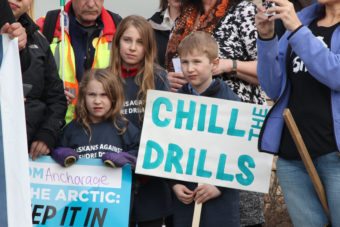
160406 Climate Protest kids
Molly, Penelope and Simon Whitlock, ages 5, 10 and 7, joined protesters opposed to offshore drilling outside the Bureau of Ocean Energy Management’s public meeting in Anchorage. (Photo by Rachel Waldholz/APRN)

About 70 people — and Frostpaw the Polar Bear — gathered in the parking lot of the Embassy Suites hotel in Midtown Anchorage on Tuesday evening, holding signs that read “Keep it in the ground” and “Chill the drills.”

160406 Climate Protest costumes
Frostpaw the Polar Bear joined protesters outside BOEM’s meeting in Anchorage. The protesters argue that BOEM has not taken climate change into account when considering offshore leases. (Photo by Rachel Waldholz/APRN)

Inside, the Bureau of Ocean Energy Management, or BOEM, was holding one of 10 public meetings around the state to get input on potential offshore lease sales. The agency wants the public to weigh in on plans for offshore drilling over the next five years. The tentative proposal would allow lease sales in the Arctic Ocean and Cook Inlet.
That plan has drawn opposition from environmentalists, who see their fight as part of a worldwide effort to halt climate change. The bureau’s plan covers the years 2017-2022, and tentatively includes three lease sales in Alaska: in Cook Inlet, and in the Beaufort and Chukchi Seas.

BOEM’s draft environmental impact statement looks at effects on local communities, infrastructure, subsistence, marine mammals and the potential for oil spills.

The one issue it doesn’t address is the one critics are most concerned about.

“We don’t say, if this much oil, for example, is taken out of the ground, it will have this much effect on climate change,” said Jennifer Bosyk a marine biologist with the Bureau. Bosyk said that kind of discussion is left to policymakers.

But Eric Grafe, a staff attorney at the environmental group Earthjustice, called that a major omission.

To reach the climate goals agreed to in Paris last year, he said, the world can’t burn much of the oil that’s already been discovered – let alone any new oil.

“If we burn all the oil we know about, the glass is already overflowing — and we’re pouring more water into the glass,” Grafe said. “That doesn’t make sense.”

There has been no offshore lease sale in Alaska since 2008. The Department of the Interior canceled sales planned for the current cycle after Shell pulled out of the Arctic last September, citing the company’s disappointing results and a lack of other industry interest.

BOEM’s new commenting process led to a somewhat surreal scene at the Embassy Suites. Instead of accepting verbal comments in a town hall-style event, the agency set up stations in a conference room, where members of the public could speak with experts and then record written comments in laptops.

160406 BOEM
The Bureau of Ocean Energy Management held 10 meetings across the state to take public input on the draft environmental impact statement for the 2017-2022 outer continental shelf drilling plan. (Photo by Rachel Waldholz/APRN)

Sergio Acuna came to support more offshore drilling. Acuna works in pipeline maintenance. Like many people in the room, he wore a bright orange sweatshirt with the logo for the Laborers’ International Union of North America, Local 341.

“We, the laborers, we’re the ones who care for our beloved trans-Alaska pipeline,” he said.

Acuna said he thought the protest was great. But at the end of the day, he said, a lot of jobs depend on how much oil is flowing through that pipeline.

“I understand their point of view,” Acuna said. But, he added with a laugh, “My only question for them will be, like, what do they do for work? Because, if there’s no more oil in Alaska, I may have to come up to them and ask them for work.”

BOEM is accepting public comment on its draft environmental impact statement through May 2.

With record low sea ice, crack forces Navy camp evacuation

ICEX 2016 - Ice Camp Sargo
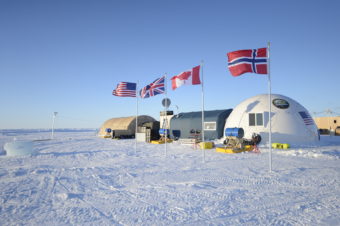
Ice Camp Sargo on March 13, 2016. The camp was located in the Arctic Circle and served as the main stage for the Navy’s Ice Exercise, also known as ICEX 2016. (Creative Commons photo by Tyler Thompson/U.S. Navy)

A camp constructed by the U.S. Navy on a sea ice floe in the Arctic was evacuated last week in an early closure that coincides with a record low sea ice extent in the Arctic.

Located about 200 miles off the coast of Prudhoe Bay, the camp was host to American sailors and scientists from the around the world.

The Navy has held its Ice Exercise, or ICEX for short, to test military readiness and conduct scientific research in the far north every few years since 1960.

Commander Tommy Crosby is the public affairs officer for the Navy’s submarine forces.

“The camp itself is a temporary camp that is built on an ice floe that is moving,” explained Crosby. “With currents and wind direction and ice rubbing up against each other and moving, cracks do form and refreeze.”

The Navy’s exercise was scheduled to wrap up at the end of this week, but Crosby said changes in sea ice caused the camp to close early.

“We had a crack that got close to camp,” Crosby said, so “for the safety of everyone … we demobilize(d) a little early.”

The crack shouldn’t come as a big surprise. Last week, the National Snow & Ice Data Center reported the lowest maximum sea ice extent in the Arctic in satellite history.

Ted Scambos is the NSIDC’s lead scientist. He says warmer than normal temperatures in the region led to the record low.

It was unusually warm near the North Pole, up to 6 degrees centigrade,” Scambos explained. “When you’re averaging, over three months, something like an 11 or 12 degree above average mean temperature, (it’s) a huge deal.”

Scambos said the warmer temperatures didn’t just affect the sea ice extent.

“Not only did the ice not spread out very far from the Arctic Ocean and out into the Bering (Sea) and North Atlantic, but it’s also probably thinner than it has been in decades past,” explained Scambos.

The U.S. Navy should expect thinner ice conditions. This year’s early closure mirrors what happened two years ago almost to the day, when rapidly changing sea ice forced them to pack up ahead of schedule.

The camp’s more than 200 participants were evacuated safely. The two submarines involved in ICEX will continue their operations under the thinning Arctic sea ice through early April.

‘Huge anomaly’: Warm winter weather limiting sea ice formation

The National Snow and Ice Data Center says Arctic sea ice extent as of March 24 averaged 5.6 million square miles, about 5,000 miles less than last year’s record-low maximum extent. (Image by NSIDC/NASA Earth Observatory)

Scientists say warm winter weather around the circumpolar north has led to another record-setting year of decreasing sea-ice coverage of the Arctic Ocean. The extent of sea ice formed over this past winter fell short of the previous record-low extent set last year.

National Snow and Ice Data Center Director Mark Serreze struggled for words a few weeks ago to describe the warmest of last winter’s weather.

“It was just crazy warm,” he said. “I’ve never really seen anything like it.”

Scientists with the center again cited the weird weather Monday, when they announced the amount of sea ice that formed over the winter in the Arctic Ocean was for a second year far below average – the average based on when the center began satellite monitoring sea ice in 1981.

“You know, if I look at December, January, February average air temperatures, over the poles they’re almost 12 degrees Celsius above normal,” says Julienne Stroeve, a senior research scientist with the center.

Twelve degrees Celsius equals about 22 degrees Fahrenheit.

“That’s a huge anomaly in the temperatures for the Arctic,” she said.

Stroeve says some of that warmth came from El Nino and “The Blob” – the mass of warm-water that parked in the North Pacific late last year.

She says those phenomena won’t be present next year, so it seems unlikely the sea-ice extent at the end of next winter will set another record. But she says the overall trend is clear.

“The long-term warming from increasing greenhouse gasses in the atmosphere – all climate models that we’re going to continue to lose the sea ice,” Stroeve said.

The Denver-based National Snow and Ice Data Center says sea-ice extended an average of 5.6 million square miles over the Arctic Ocean as of Thursday. That’s about 5,000 square miles less than last year’s maximum sea-ice extent.

Serreze says that suggests the sea-ice minimum, recorded at the end of summer, may also break that record, set in 2012.

“Where it sits in the record books depends on the summer weather pattern,” he said. “And we just can’t predict that.”

The center will issue its report on the minimum sea-ice extent in September.

Warmer winters, flooding complicate maintenance of Arctic roadways

Excavators dig trenches up to 5 feet deep to channel water from the Sagavanirktok River away from the northernmost stretch of the Dalton Highway. (Photo courtesy of Alaska Department of Transportation)

Work began early this year on protecting the highway that serves Alaska’s North Slope oilfields from a repeat of last year’s flooding.

“In December, we started to see overflow on the Dalton Highway near the same area where we had the aufeis and overflow and flooding last year,” says Meadow Bailey, a spokesperson for the Alaska Department of Transportation. Aufeis is a type of ice that forms into piles of sheets, usually caused by overflowing rivers.

Bailey says workers picked up where they left off last fall on projects to prevent floodwaters from the Sagavanirktok River from washing out the northernmost stretch of the Dalton Highway. Sag River flooding closed the highway several times last year, severing the lifeline to the giant Prudhoe Bay complex.

“We knew that similar conditions were developing,” she said, “and so we took some proactive measures.”

Bailey says workers built the roadbed up to about 10 feet above the surrounding tundra and are digging 5-foot-deep trenches in ice near the highway to divert floodwaters back into the riverbed.

“What we’re trying to do is build an infrastructure that will withstand whatever conditions are present,” she said.

Sag River floodwaters submerged many stretches of the Dalton Highway, washing out some areas south of the Prudhoe Bay oilfield complex. Repair work by midsummer totaled about $43 million. (Photo courtesy of Alaska Department of Transportation)

Observers say they’ve never seen the Sag River flood like that. Bailey says there’s only about 50 years of historical climatological data for the area, so it’s hard to determine whether the flooding is unusual and whether it’ll occur again – perhaps, like last year, during spring breakup.

“What we don’t know is what breakup will look like. Based on last year, it was really the most extreme situation that we could have imagined,” Bailey said.

Experts suspect unusually warm winter weather contributed to the flooding. Warmer weather in recent years has presented many new challenges to transportation engineers in the far north, says Billy Conner, who directs the Alaska University Transportation Center at UAF’s Institute of Northern Engineering.

“We’re seeing the possibility of rainstorms in the middle of January – (that) didn’t use to happen,” Conner said. “That throws us in the transportation world into a real tizzy, because we’re not used to dealing with that.”

Conner says climate change probably accounts for some unusual weather. And he says it probably indirectly contributes to roadway damage, for example by creating conditions that increase wildfires, which accelerate permafrost thawing and cause the subgrade of nearby roadways to settle and buckle.

But Conner says oftentimes simply building a roadway creates conditions that cause problems, for example clearing vegetation or altering drainage by building up a roadbed

U.S. and Russia sign joint wildlife management agreement

A polar bear mother watches carefully with her cubs along her side along the Beaufort Sea. (Photo courtesy USFWS)

Cooperation across the Bering Strait was strengthened this week when the United States and Russia signed a joint wildlife agreement.

Officials from the two Arctic nations met in San Diego to discuss polar bear and snow goose monitoring efforts in Alaska and Chukotka.

James Kurth, Deputy Director of the U.S. Fish and Wildlife Service, signed off on the agreement alongside his Russian counterpart Amirkhan Amirkhanov, deputy head of the Federal Service for Supervision of Natural Resources.

The two have worked together on wildlife management in the past. A similar joint management effort took place between 2013 and 2015. At this week’s meeting in San Diego, Russian and American officials also discussed results from their joint study on the dynamics of the Bering and Chukotka Seas’ ecosystems.

The U.S. Fish and Wildlife Service was unavailable for comment on the agreement.

At Arctic summit, climate change is inevitable and irreversible

Ambassador David Balton delivers the keynote address during International Assembly Day during Arctic Science Summit Week in Fairbanks. Greenland's Minister Plenipotentiary Innuteg Holm Olsen greets Alaska Lt. Gov. Byron Mallott at center. David Kennedy, retired deputy under Secretary for Operations at National Oceanic and Atmospheric Administration, and Marcus Carson, senior research fellow at the Stockholm Environment Institute, listen at right.
Ambassador David Balton delivers the keynote address during International Assembly Day during Arctic Science Summit Week in Fairbanks. At center, Greenland’s Minister Plenipotentiary Innuteg Holm Olsen greets Alaska Lt. Gov. Byron Mallott. Listening at right are David Kennedy, retired deputy under secretary for operations at the National Oceanic and Atmospheric Administration, and Marcus Carson, senior research fellow at the Stockholm Environment Institute. (Photo by Matt Miller/KTOO)

The common theme among policymakers and scientists meeting in Fairbanks this week is that the Arctic is warming at an accelerating pace, and climate change is inevitable and irreversible. What happens in the Arctic doesn’t stay in the Arctic, and what happens in the mid-latitudes also affects the Arctic.

Steve Ginnis of the Fairbanks Native Association switched back and forth between Gwich’in and English as he welcomed a thousand people from 30 countries during International Arctic Assembly Day on Tuesday. Ginnis said climate change is affecting their way of life.

Steve Ginnis
Steve Ginnis of the Fairbanks Native Association. (Photo by Matt Miller/KTOO)

“It’s not a myth like some people might claim. It’s real. It really affects us up here, big time,” he said. “Our fish, returning of our king salmon, is affected with the warming of the ocean, ocean water among other things.”

Lt. Gov. Byron Mallott said his eldest son, a lifelong commercial fisherman in Yakutat, can’t reconcile his early experiences with current weather and ocean conditions.

“It doesn’t work anymore. He said, ‘I feel disoriented in my own place.’ He said, ‘All of those sixth senses that you brought to bear from your total work experience in this field really don’t fit anymore.’”

Robert Papp 031516
Retired Coast Guard Adm. Robert Papp. (Photo by Matt Miller/KTOO)

Retired Coast Guard Adm. Robert Papp, who is the State Department’s special representative for the Arctic, quoted a naval admiral who warned there is no sharp boundary line between safety and fatal danger. There’s no such thing as a blinking red light that warns ship captains before they head into bad weather.

“So, the analogy is there’s no little red light that’s going to go on and tell us when the Arctic has gone too far and is unrecoverable,” Papp said. “It’s going to be shaded. If there was a little red light, that red light is probably going on right now. How long must we wait to take appropriate action to make sure that we preserve this environment?”

Ambassador David Balton, the State Department’s deputy assistant secretary for oceans and fisheries, said Arctic nations have informally committed to not allowing commercial fishing in the ice-free waters of the Arctic Ocean. But a donut hole exists in the center of the ocean that is outside of any country’s jurisdiction. Other non-Arctic countries may want to fish there, soon.

“At least from the point of view of the United States, what we are trying to do is get all of these players to agree to a binding regime (as) enshrined in the principles of this declaration,” Balton said. “There should be no commercial fishing in this area until there is adequate science, and until there is some framework for actually managing the fisheries in place. I don’t know where this negotiation will take us. As we stand here today, this is an unanswered question.”

Inuuteg Holm Olsen is a University of Alaska Fairbanks graduate who now serves as minister plenipotentiary for Greenland representation at the Danish Embassy in Washington, D.C.

“The policy-science interface quickly can become a sensitive one,” Olsen said. It can either become too political if you have opposing agendas, which can be a hindrance to adopt policy in combating climate change. When we talk about the Arctic, there is a multitude of layers with a sizable presence of indigenous peoples that has to be incorporated in new ways of handling issues today.”

Olsen said scientists and policymakers should not work in isolation. They need to build trust to engage each other.

Site notifications
Update notification options
Subscribe to notifications