Arctic

What’s so critical about polar bear habitat?

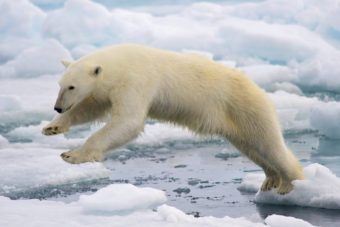
Polar bear jumping on fast ice. Creative Commons photo by Arturo de Frias Marques)

A federal appeals court last week ruled the U.S. Fish and Wildlife Service was following the law when it designated a California-sized piece of the Alaskan Arctic as critical habitat for the polar bear. The ruling dismayed the state of Alaska, the oil industry and several Native groups. They’d challenged the habitat designation, saying it was too broad and would deter activity in the region. Let’s take a look at this designation and what it could mean for the industry.
The first thing to know is that this habitat is an enormous area, but 96 percent of it is off-shore, covering sea ice or sea. The 4 percent that’s on land is a band of coast that stretches from the Canadian border in the northeast to Barrow, and all the barrier islands, down to Hooper Bay in Western Alaska.

U.S. Fish and Wildlife Biologist Ted Swem says the habitat designation won’t require anyone to get any new permits. For oil companies, he says, it just adds a question for federal permits they’d have to get anyway.

“In my experience it adds paragraphs or pages to the length of a document, and that requires the project applicant and the federal agency with which we’re working to add more text, and we have to have more thought and more discussion …. But it doesn’t add weeks or months to the process.”

That’s because, Swem says, regardless of whether the habitat is designated, the polar bear is listed as a bear2threatened species. Under the Endangered Species Act, he says, any federal permit for development in this area of the Arctic already requires consultation with his agency, to evaluate its impact on the bear. And here’s the thing: even without the habitat designation, Swem says Fish and Wildlife still has to look at the impact on the habitat, because harming the habitat could harm the bear.

“Every place there’s critical habitat, there is also polar bears,” as Swem put.

The habitat designation adds a new question– what’s the impact on the bear’s habitat? — but the answer is roughly the same.

“Not just roughly, but I would say it would be the same.
Swem says. “It has been the same. In my experience, the answer is the same.”

Swem cites Point Thomson, the Exxon project on the North Slope, as an example. Exxon got the crucial wetlands permit for that in 2012 when the polar bear habitat designation was in place before the legal challenge put it on hiatus.

“And it was right on the coast and it is in critical habitat, and I would contend that it didn’t affect that development at all, to have that project within critical habitat,” Swem says.

The Corps of Engineers’ wetlands permit required Exxon to bring two drilling pads in from the coast a bit and shrink a third, to accommodate polar bears coming ashore. The Corps also required Exxon to pay compensation for filling 267 acres of wetlands, at a 3-to-1 ratio. That meant paying a conservation fund to preserve 801 acres elsewhere. Exxon won’t say how much they had to pay, but safe to say it was several million dollars.

Joshua Kindred, an environmental attorney for the Alaska Oil and Gas Association, an industry trade group, contends the habitat designation adds exponentially to that kind of cost.

“If an area of land in which say a developer want to develop is critical, then the Corps puts sort of an automatic multiplier on the value of that land, from a wetlands mitigation standpoint,” he said.

That’s not how the Corps of Engineers sees it.

“There’s no one thing that says ‘OK this is habitat for a polar bear, therefore the wetland mitigation ratio is X,” says Sheila Newman, chief of the Special Actions Branch, in the regulatory arm of the Corps of Engineers-Alaska District.

It’s not easy to explain the Corp’s evaluation methods. Newman says they examine wetland “functions” but have no standard assessment tool. They use several. Newman says they’re trying to pare down the methodologies so companies can better predict their mitigation costs.

“But, you know, we are not there yet,” she says.

But, she says, on all the assessment tools in use, it wouldn’t make a difference whether an area is a designated critical habitat or just a place where polar bears tend to be seen.

“So the critical habitat designation, in itself, does not make a difference at all,” she said.

Kindred, from the Alaska Oil and Gas Association, says the designation, if nothing else, adds uncertainty to a project. He says AOGA and the other plaintiffs haven’t decided yet whether to pursue their legal challenge further.

Murkowski urges construction of multiple icebreakers

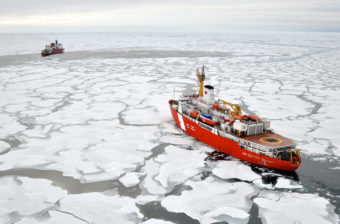
The Canadian Coast Guard Ship Louis S. St-Laurent makes an approach to the Coast Guard Cutter Healy in the Arctic Ocean. (Photo by Patrick Kelley/U.S. Coast Guard)

Sen. Lisa Murkowski drilled Department of Homeland Security Secretary Jeh Johnson on Arctic security Wednesday. At an Appropriations Committee hearing on the Coast Guard’s Arctic assets, Murkowski urged Johnson to look beyond the nation’s plan to build just one new icebreaker.

“We recognize that it is expensive, but we also recognize that — (per) the Coast Guard’s study — that it be not just one icebreaker, but there actually be three polar icebreakers and three smaller icebreakers,” Murkowski said.

Right now, the nation has two polar-class icebreakers. The Polar Star splits time between the Arctic and Antarctic, and its sister ship, the Polar Sea, has been out of commission since 2010.

Johnson was receptive to Murkowski’s call for increased presence in the Arctic. But, he said, members of the House Appropriations Committee think they may be moving too quickly in the region.

In another effort to increase presence in the Arctic, Murkowski encouraged Johnson to homeport a National Security Cutter in Alaska. The closest cutter right now is near San Francisco.
“Right now the closest is Alameda, California,” Murkowski explained. “It’s a long haul to get from Alameda, California to get up into the Arctic—into the Beaufort, into the Chukchi, into the areas in the Gulf and the Bering Sea.”

The National Security Cutter Murkowski wants to homeport in the Arctic is still under construction. For that reason, Johnson said it would be premature to comment on whether or not there is a chance the cutter will be homeported in Alaska.

As first legislative budget cuts emerge, some question rural impact

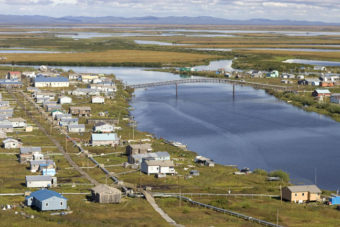
The community of Selawik, near the mouth of the Selawik River, is home to over 800 people. The site of the village, spread between riverbanks and an island, is also called Akuligaq, meaning "a river fork." (Photo by Steve Hillebrand/USFWS)
The community of Selawik, near the mouth of the Selawik River, is home to over 800 people. The site of the village, spread between riverbanks and an island, is also called Akuligaq, meaning “a river fork.”
(Photo by Steve Hillebrand/USFWS)

Legislators are looking to cut the state budget deeper than Gov. Bill Walker’s proposal to reduce spending by $100 million.

But some lawmakers – especially those from rural areas — are raising concerns about where these cuts will fall.

More than five weeks into the legislative session, House finance subcommittees recommended the first cuts to the budget for the fiscal year that starts July 1.

They include $9.8 million in cuts to education programs, as well as cutting all $2.7 million in state funding for public broadcasting.

Rep. Daniel Ortiz, a Ketchikan independent, says eliminating the $2 million for a prekindergarten program is a mistake.

“It’s about investing now so that you don’t have higher costs later,” Ortiz said. “And it just makes good economic sense to do this. Yeah, we get the $2 million reduction but, you know, it’s going to be hard for anybody to chart the costs to the state later on down the road.”

Other proposed cuts include eliminating state funding for rural schools and libraries to increase broadband internet access. As well as a state program to fund mentors for teachers, which is aimed at retaining new teachers in rural Alaska.

Wasilla Republican Rep. Lynn Gattis says none of the cuts are easy, but they’re necessary. That’s because the state has a $3.5 billion budget shortfall.

“There’s nobody sitting here, and I suspect nobody in the audience, that’s very comfortable with any of these cuts,” Gattis said at an education subcommittee hearing. “Somebody said to me, ‘You’re making me make a choice: the right arm or the left arm. And the unfortunate part is — which arm do you write with — is where we’re at in making these cuts.”

Juneau Democratic Rep. Sam Kito says the state should be looking for new revenue, like Walker has proposed, before cutting programs that disproportionately benefit rural areas.

“The libraries in many of these communities become the focal point in trying to maintain connections with the outside world to try and engage students with technology,” Kito said.

For Anchorage Republican Rep. Mike Hawker, the debated education cuts are a small fraction of the overall cuts that are needed to close the state’s budget gap. He contends that the state expanded programs during oil boom years that it can no longer afford.

“The decisions that I want to see coming out of this Legislature are the difficult decisions to reduce our spending to a level that is sustainable,” Hawker said. “To do that, there is no question that we are going to have to be reducing programs in areas across the state that are good, that are desirable that people want but that respectfully we just can’t afford these days.”

Nome Democratic Representative Neal Foster says he hopes, before the budget is completed, the effects of the cuts are geographically balanced.

“I agree that cuts have to be made,” Foster said. “I’m sad to see that so many of these cuts are being made out of rural Alaskan programs. And so, I know it’s the beginning of the process, so I’m hopeful.”

Subcommittees are completing their work on the budget over the next week.

Scientists find PSP, other toxins in most marine mammal species

Whales, otters and other marine mammals were found with two algae-carrying toxins along most of the Alaska coastline. (Map courtesy Northwest Fisheries Science Center)
Whale, otter and other marine mammal carcasses were found with evidence of two algae-carrying toxins along most of the Alaska coastline in a study released Thursday. (Map courtesy Northwest Fisheries Science Center)

For the first time, scientists have documented the prevalence of two biotoxins in Alaska’s marine mammal population above the Arctic Circle.

That’s according to a new study out Thursday in the Journal Harmful Algae. But it’s not clear if algal toxins have always existed in the Arctic, because scientist never looked before now.

Scientists did not expect to find algal toxins in ocean water or marine mammals that range north of the Gulf of Alaska and the state’s Southeast region.

“This is really important, because these are animals that are integral to the culture and the community and food security here in Alaska,” said Frances Gulland, a commissioner with the federal Marine Mammal Commission. She co-authored the new study.

“There are detectable levels that have actually been measured of two different biotoxins: domoic acid and saxitoxin and both these toxins are produced by harmful algal blooms,” Gulland said.

The two are known to cause amnesic shellfish disorder and paralytic shellfish disorder in people.

“Now that we see that algae is there,” said Gay Sheffield, a biologist with the Alaska SeaGrant Marine Advisory Program and a study co-author.

“What would be the best coarse of action to make it comprehensive knowledge is to find out how our Russian neighbors have seen any of these unusual algaes or if they have any unusual concerns and more importantly is there traditional knowledge on shellfish poisoning or algal blooms or is there strange behavioral events with marine mammals,” she said.

After algae dies in the ocean, what’s left gets consumed – or filtered – by shellfish like clams and mussels, staple foods for many marine mammals. So, if there are algal toxins present they could end up in the gut contents of an unsuspecting Pacific Walrus, for example. Sheffield said of the 13 marine mammal species sampled over the course of nearly a decade, walrus had the highest levels of algal toxins.

“Because its such an important subsistence food item for the Bering Strait, there’s of course interest both from an animal health perspective, but a public health, human health, food security as well, but right now, there’s no problem,” said Sheffield.

According to the study, levels of algal toxins measured do not exceed regulatory limits for seafood safety in Alaska, or at the federal level. It’s also not clear if the toxins have always been present in the Far North, because scientists never tested for them before now.

Frances Gulland added that the study is not only limited in size, but the data itself can’t provide information about the magnitude of exposure, because toxins like domoic acid are cleared from an animals bloodstream and the gastrointestinal system so quickly.

“If the animal ate some food 10 minutes ago that was full of domoic acid, it would have a high level, but if its 12 hours since the animal ate, the levels will be lower,” she said.

“If it’s two days since the animal ate, the levels will be really low,” said Gulland. “So, really the data are limited because they’re only telling you what’s in that snapshot in time.”

Research does indicate an increase in the occurrence of algal blooms in the Arctic. Gulland believes that’s due to warming ocean temperatures and changes in sea ice.

“They’re plants, they grow, they are temperature dependent,” she said, “so clearly, with warmer waters, they’re going to replicate quicker, so its sensible to assume that temperature is important, but there also changes in micro-nutrients – things like iron and different components of water – that will affect how they bloom as well.”

Funding for study sampling came from the U.S. Fish and Wildlife Service, the National Marine Fisheries Service and the Alaska Department of Fish and Game. Additional money came from the National Institute of Health and the National Science Foundation.

Another Democrat joins Republican-led Senate majority

Sen. Donny Olson joined the the Alaska Senate’s Republican-led majority caucus on Wednesday. The move by the Golovin Democrat means that 16 of the 20 senators now caucus together.

Sen. Donny Olson, D-Nome, at a Senate minority press availability, March 4, 2015. (Photo by Skip Gray/360 North)
Sen. Donny Olson, D-Golovin, at a Senate Democrats press availability in March 2015. (Photo by Skip Gray/360 North)

Olson said he’s honored to join the majority and will lend a strong voice for rural Alaskans.

He joins Sen. Lyman Hoffman of Bethel, another Democrat, in the Republican-led majority.

Senate Minority Leader Berta Gardner, an Anchorage Democrat, said her caucus members were disappointed.

But she said they’re pleased the majority will benefit from a member with progressive values, who supports public education and Medicaid expansion.

Olson represents District T, which covers much of the state. It stretches from Fort Yukon to Nome, and includes the North Slope and Northwest Arctic boroughs.

Rural Democrats have joined Republican-led majorities for many years. All six Democratic legislators who represent areas outside of Anchorage, Fairbanks and Southeast Alaska caucus with the majority.

New arrivals in Kotzebue Sound preying on belugas

Orcas. (Creative Commons photo by Chis Michel)

Kotzebue Sound is changing and beluga hunters are facing new competition. Researcher Manuel Castellote at the Alaska Fisheries Center placed underwater microphones in the Sound. Instead of belugas, he found the source of the problem — killer whales.

“It turns out when we look at our data what we found was mainly killer whales. So that’s why the project quickly became a killer whale project.”

Things have gotten so bad in Kotzebue Sound that belugas there don’t sing out as much as they do elsewhere. Researchers suspect the belugas are afraid killer whales will find them and eat them.

“… because they know that if they are happy they will hear them and they might be predated. So they try to be silent.”

As in so many areas in the Arctic, changes are happening more quickly than further south. In Kotzebue Sound, the seabirds that used to eat fish have declined while those eating plankton have increased.

Site notifications
Update notification options
Subscribe to notifications